Pentagon to Send Military Battalions to Contain Iran’s Threats to US Allies

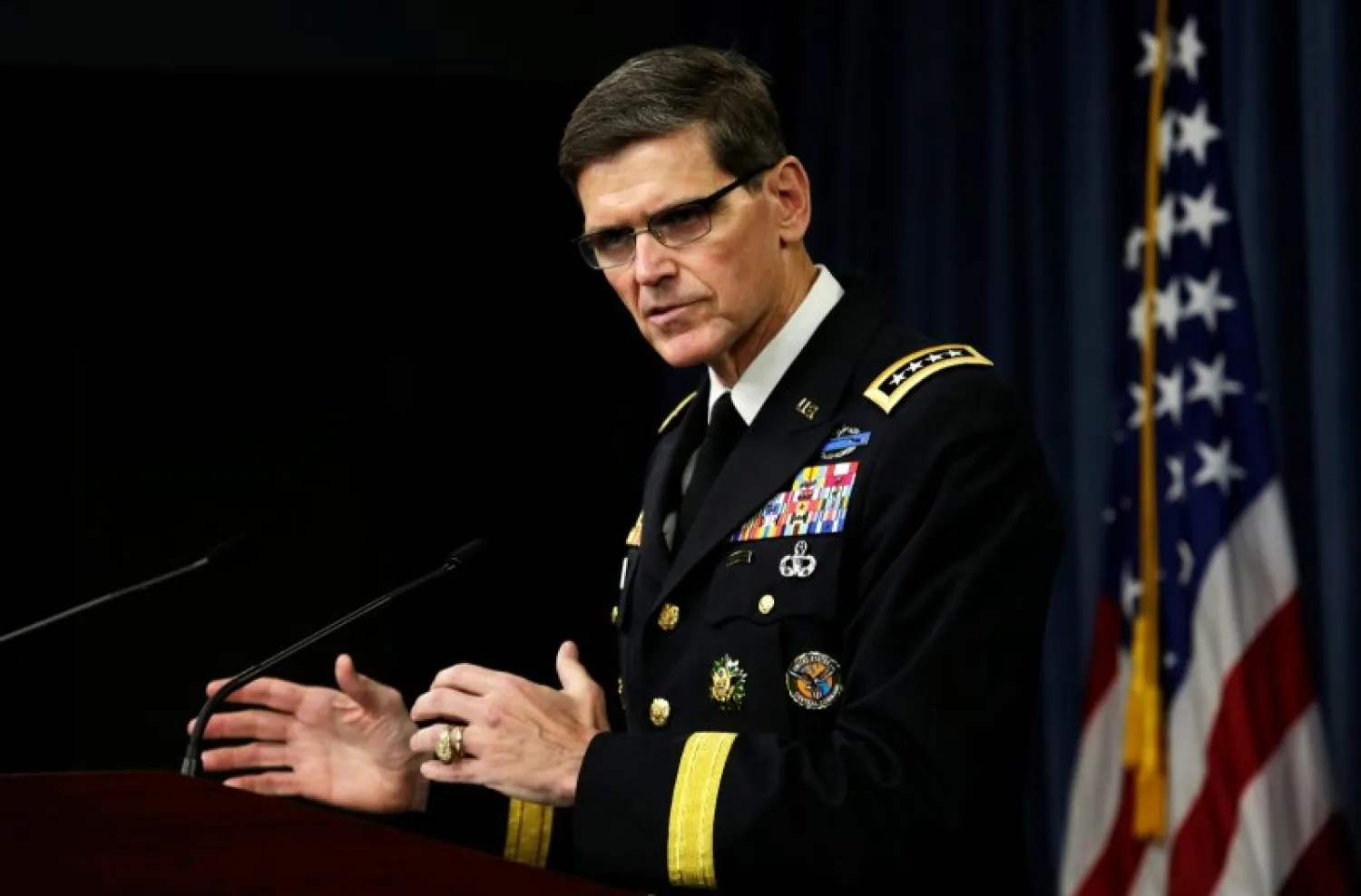
US Army General Joseph Votel (Reuters)
TT

Pentagon to Send Military Battalions to Contain Iran’s Threats to US Allies

US Army General Joseph Votel (Reuters)

A US military official has revealed his country’s intention to form forces to send them to the Arab region to help counter Iranian threats.
 
“The United States wants to help the Arab countries deal with Iranian threats,” said General Joseph Votel, commander of the US Central Command at the 26th annual Arab-American Policymakers Conference in Washington.
 
“The Pentagon is working to achieve that desire and ensure its effective implementation. That includes the establishment of US military battalions sent as missions to the region and be designed specifically to provide advice and assistance,” he noted, stressing that such cooperation was an example of “partnership” between Washington and its allies in the region.
 
Votel underlined his country’s keenness to preserve relations with Arab states, adding that the Middle East would remain of exceptional importance to the United States, “considering that opportunities in the region are greater than obstacles and that regional countries want strong relations with the United States.”
 
The US General went on to say that security relations were the factor that maintains political relations, stating that bilateral military cooperation was still strong among the countries of the region, especially in Syria and Iraq and in the war against ISIS and other terrorist groups.
 
Stressing the importance of the US focus on security partnerships in the Middle East and encouraging local solutions in those countries, Votel said that America’s allies were leading their military wars in the region, while the role of the United States was limited to support and assistance.
 
“The United States will help its partners wherever and whenever it is necessary, because this benefits American interests,” he told the conference, which is organized by the National Council on US-Arab Relations.
 
Founded in 1983, the council is an American non-profit, non-governmental, educational organization dedicated to improving American knowledge and understanding of the Arab world.
 
The organization is based in Washington and works on strengthening and expanding strategic, economic, political, commercial, and defense cooperation ties between the United States and Arab countries.



Army Chief Says Switzerland Can’t Defend Itself from Full-Scale Attack

Lieutenant General Thomas Suessli, Chief of the Armed Forces of the Swiss Army, attends a news conference on the outbreak of the coronavirus disease (COVID-19) in Bern, Switzerland, March 16, 2020. Picture taken March 16, 2020. (Reuters)
TT

Army Chief Says Switzerland Can’t Defend Itself from Full-Scale Attack

Lieutenant General Thomas Suessli, Chief of the Armed Forces of the Swiss Army, attends a news conference on the outbreak of the coronavirus disease (COVID-19) in Bern, Switzerland, March 16, 2020. Picture taken March 16, 2020. (Reuters)

Switzerland cannot defend itself against a full-scale attack and must boost military spending given rising risks from Russia, the head of its armed forces said.

The country is prepared for attacks by "non-state actors" on critical infrastructure and for cyber attacks, but its military still faces major equipment gaps, Thomas Suessli told the NZZ newspaper.

"What we cannot do is defend against threats from a distance or even a full-scale ‌attack on ‌our country," said Suessli, who is ‌stepping ⁠down at ‌the end of the year.

"It's burdensome to know that in a real emergency, only a third of all soldiers would be fully equipped," he said in an interview published on Saturday.

Switzerland is increasing defense spending, modernizing artillery and ground systems ⁠and replacing ageing fighter jets with Lockheed Martin F-35As.

But the ‌plan faces cost overruns, while ‍critics question spending on artillery ‍and munitions amid tight federal finances.

Suessli said ‍attitudes towards the military had not shifted despite the war in Ukraine and Russian efforts to destabilize Europe.

He blamed Switzerland's distance from the conflict, its lack of recent war experience and the false belief that neutrality offered protection.

"But that's historically ⁠inaccurate. There are several neutral countries that were unarmed and were drawn into war. Neutrality only has value if it can be defended with weapons," he said.

Switzerland has pledged to gradually raise defense spending to about 1% of GDP by around 2032, up from roughly 0.7% now – far below the 5% level agreed by NATO countries.

At that pace, the Swiss military would only be ‌fully ready by around 2050.

"That is too long given the threat," Suessli said.


Another 131 Migrants Rescued off Southern Crete

A dinghy transporting dozens of refugees and migrants is pulled towards Greece's Lesbos island after being rescued by a war ship during their sea crossing between Türkiye and Greece on February 29, 2020. Aris Messinis, AFP/File picture
TT

Another 131 Migrants Rescued off Southern Crete

A dinghy transporting dozens of refugees and migrants is pulled towards Greece's Lesbos island after being rescued by a war ship during their sea crossing between Türkiye and Greece on February 29, 2020. Aris Messinis, AFP/File picture

The Greek coast guard Saturday rescued 131 would-be migrants off Crete, bringing the number of people brought out of the sea in the area over the past five days to 840, a police spokesperson said.

The migrants rescued Saturday morning were aboard a fishing boat some 14 nautical miles south of Gavdos, a small island south of Crete.

The passengers, whose nationality was not revealed, were all taken to Gavdos.

Many people attempting to reach Crete from Libya drown during the risky crossing.

In early December, 17 people -- mostly Sudanese or Egyptian -- were found dead after their boat sank off the coast of Crete, and 15 others were reported missing. Only two people survived.

According to the UN High Commissioner for Refugees, more than 16,770 people trying to get to Europe have arrived in Crete since the beginning of the year, more than on any other Greek island.

In July, the conservative government suspended the processing of asylum applications for three months, particularly those of people arriving from Libya, saying the measure as "absolutely necessary" in the face of the increasing flow of migrants.


Thailand and Cambodia Sign New Ceasefire Agreement to End Border Fighting

A handout photo made available by the Defense Ministry of Thailand shows Cambodian Defense Minister Tea Seiha (L) and Thai Defense Minister Natthaphon Narkphanit attending a General Border Committee Meeting in Ban Pak Kard, Chanthaburi Province, Thailand, 27 December 2025. (EPA/Defense Ministry of Thailand/Handout)
TT

Thailand and Cambodia Sign New Ceasefire Agreement to End Border Fighting

A handout photo made available by the Defense Ministry of Thailand shows Cambodian Defense Minister Tea Seiha (L) and Thai Defense Minister Natthaphon Narkphanit attending a General Border Committee Meeting in Ban Pak Kard, Chanthaburi Province, Thailand, 27 December 2025. (EPA/Defense Ministry of Thailand/Handout)

Thailand and Cambodia on Saturday signed a ceasefire agreement to end weeks of armed combat along their border over competing claims to territory. It took effect at noon local time.

In addition to ending fighting, the agreement calls for no further military movements by either side and no violations of either side’s airspace for military purposes.

Only Thailand employed airstrikes in the fighting, hitting sites in Cambodia as recently as Saturday morning, according to the Cambodian defense ministry.

The deal also calls for Thailand, after the ceasefire has held for 72 hours, to repatriate 18 Cambodian soldiers it has held as prisoners since earlier fighting in July. Their release has been a major demand of the Cambodian side.

The agreement was signed by the two countries’ defense ministers, Cambodia’s Tea Seiha and Thailand’s Nattaphon Narkphanit, at a checkpoint on their border after lower-level talks by military officials met for three days as part of the already-established General Border Committee.

The agreement declares that the two sides are committed to an earlier ceasefire that ended five days of fighting in July and follow-up agreements and includes commitments to 16 de-escalation measures.

The original July ceasefire was brokered by Malaysia and pushed through by pressure from US President Donald Trump, who threatened to withhold trade privileges unless Thailand and Cambodia agreed. It was formalized in more detail in October at a regional meeting in Malaysia that Trump attended.

Despite those deals, the two countries carried on a bitter propaganda war and minor cross-border violence continued, escalating in early December to widespread heavy fighting.

Thailand has lost 26 soldiers and one civilian as a direct result of the combat since Dec. 7, according to officials. Thailand has also reported 44 civilian deaths from collateral effects of the situation.

Cambodia hasn’t issued an official figure on military casualties, but says that 30 civilians have been killed and 90 injured. Hundreds of thousands of people have been evacuated from affected areas on both sides of the border.

Each side blamed the other for initiating the fighting and claimed to be acting in self-defense.

The agreement also calls on both sides to adhere to international agreements against deploying land mines, a major concern of Thailand. Thai soldiers along the border have been wounded in at least nine incidents this year by what they said were newly planted Cambodian mines. Cambodia says the mines were left over from decades of civil war that ended in the late 1990s.

Another clause says the two sides “agree to refrain from disseminating false information or fake news.”

The agreement also says previously established measures to demarcate the border will be resumed and the two sides also agree to cooperate on an effort to suppress transnational crimes.

That is primarily a reference to online scams perpetrated by organized crime that have bilked victims around the world of billions of dollars each year. Cambodia is a center for such criminal enterprises.