

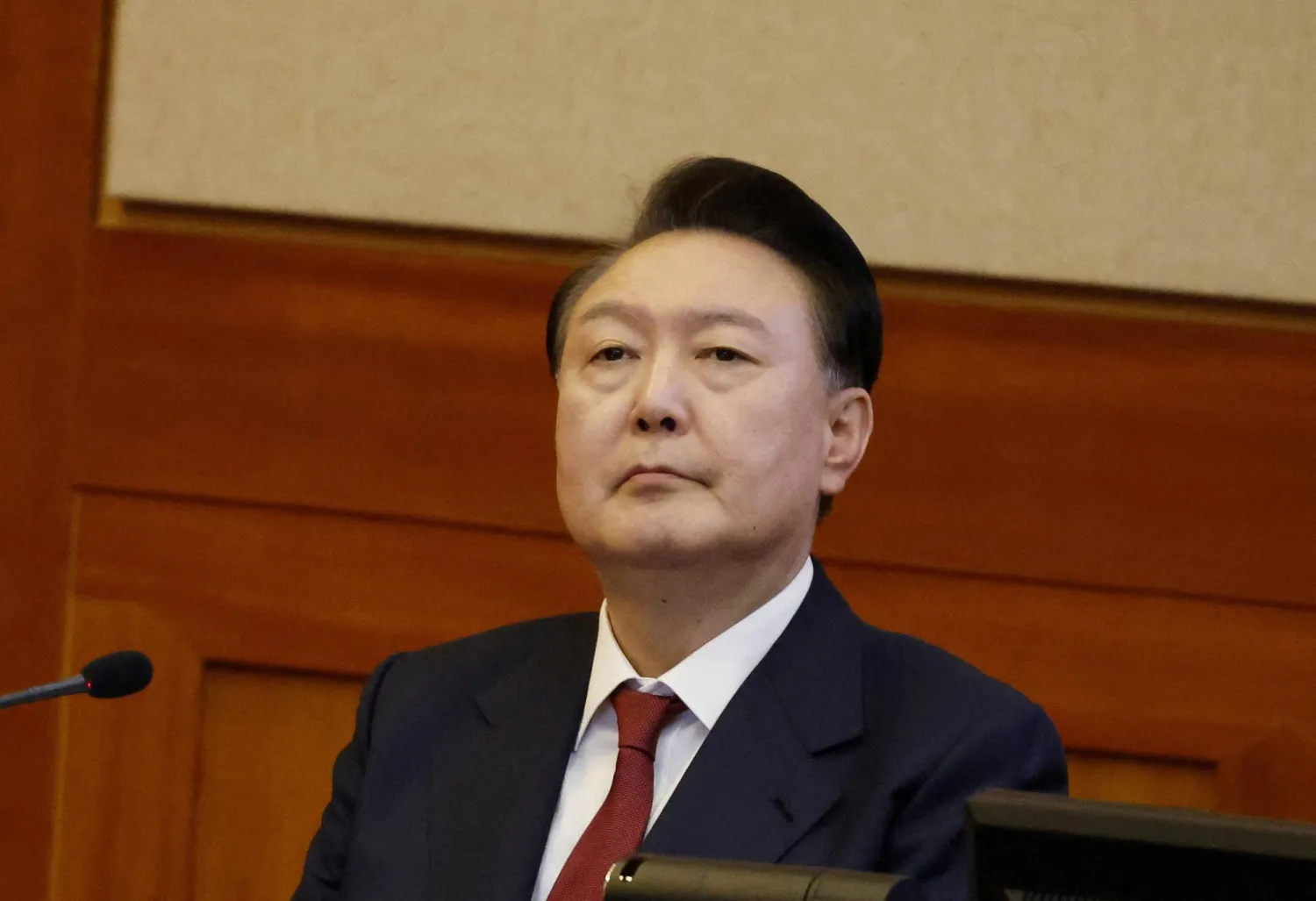

Former South Korean President Yoon Receives Life Sentence for Imposing Martial Law

FILE PHOTO: South Korea’s impeached President Yoon Suk Yeol attends the fourth hearing of his impeachment trial over his short-lived imposition of martial law at the Constitutional Court in Seoul, South Korea, 23 January 2025. JEON HEON-KYUN/Pool via REUTERS/File Photo
TT

Former South Korean President Yoon Receives Life Sentence for Imposing Martial Law

FILE PHOTO: South Korea’s impeached President Yoon Suk Yeol attends the fourth hearing of his impeachment trial over his short-lived imposition of martial law at the Constitutional Court in Seoul, South Korea, 23 January 2025. JEON HEON-KYUN/Pool via REUTERS/File Photo

Former South Korean President Yoon Suk Yeol was sentenced to life in prison for his brief imposition of martial law in a dramatic culmination to the country’s biggest political crisis in decades.

Yoon was ousted from office after a baffling attempt to overcome an opposition-controlled legislature by declaring martial law and sending troops to surround the National Assembly on Dec. 3, 2024, The Associated Press said.

Judge Jee Kui-youn of the Seoul Central District Court said he found Yoon guilty of rebellion for mobilizing military and police forces in an illegal attempt to seize the liberal-led Assembly, arrest politicians and establish unchecked power for a “considerable” time.

Martial law crisis recalled dictatorial past Yoon’s martial law imposition, the first of its kind in more than four decades, harkened back to South Korea’s past military-backed governments when authorities occasionally proclaimed emergency decrees that allowed them to station soldiers, tanks and armored vehicles on streets or at public places such as schools to prevent anti-government demonstrations.

As lawmakers rushed to the National Assembly, Yoon’s martial law command issued a proclamation declaring sweeping powers, including suspending political activities, controlling the media and publications, and allowing arrests without warrants.

The decree lasted about six hours before being lifted after a quorum of lawmakers managed to break through a military blockade and unanimously voted to lift the measure.

Yoon was suspended from office on Dec. 14, 2024, after being impeached by lawmakers and was formally removed by the Constitutional Court in April 2025. He has been under arrest since last July while facing multiple criminal trials, with the rebellion charge carrying the most severe punishment.

Yoon's lawyers reject conviction Yoon Kap-keun, one of the former president’s lawyers, accused Jee of issuing a “predetermined verdict” based solely on prosecutors’ arguments and said the “rule of law” had collapsed. He said he would discuss whether to appeal with his client and the rest of the legal team.

Yoon Suk Yeol told the court the martial law decree was only meant to raise public awareness of how the liberals were paralyzing state affairs, and that he was prepared to respect lawmakers if they voted against the measure.

Prosecutors said it was clear Yoon was attempting to disable the legislature and prevent lawmakers from lifting the measure through voting, actions that exceeded his constitutional authority even under martial law.

In announcing Yoon and Kim’s verdicts, Jee said the decision to send troops to the National Assembly was key to his determination that the imposition of martial law amounted to rebellion.

“This court finds that the purpose of (Yoon’s) actions was to send troops to the National Assembly, block the Assembly building and arrest key figures, including the National Assembly speaker and the leaders of both the ruling and opposition parties, in order to prevent lawmakers from gathering to deliberate or vote,” Jee said. “It’s sufficiently established that he intended to obstruct or paralyze the Assembly’s activities so that it would be unable to properly perform its functions for a considerable period of time.”

Protesters rally outside court

As Yoon arrived in court, hundreds of police officers watched closely as Yoon supporters rallied outside a judicial complex, their cries rising as the prison bus transporting him drove past. Yoon’s critics gathered nearby, demanding the death penalty.

There were no immediate reports of major clashes following the verdict.

A special prosecutor had demanded the death penalty for Yoon Suk Yeol, saying his actions posed a threat to the country’s democracy and deserved the most serious punishment available, but most analysts expected a life sentence since the poorly-planned power grab did not result in casualties.

South Korea has not executed a death row inmate since 1997, in what is widely seen as a de facto moratorium on capital punishment amid calls for its abolition.

Other officials sentenced for enforcing martial law

The court also convicted and sentenced several former military and police officials involved in enforcing Yoon’s martial law decree, including ex-Defense Minister Kim Yong Hyun, who received a 30-year jail term for his central role in planning the measure and mobilizing the military.

Last month, Yoon was sentenced to five years in prison for resisting arrest, fabricating the martial law proclamation and sidestepping a legally mandated full Cabinet meeting before declaring the measure.

The Seoul Central Court has also convicted two members of Yoon’s Cabinet in other cases. That includes Prime Minister Han Duck-soo, who received a 23-year prison sentence for attempting to legitimize the decree by forcing it through a Cabinet Council meeting, falsifying records and lying under oath. Han has appealed the verdict.

Yoon is the first former South Korean president to receive a life sentence since former military dictator Chun Doo-hwan, who was sentenced to death in 1996 for his 1979 coup, a bloody 1980 crackdown on pro-democracy protesters in Gwangju that left more than 200 people dead or missing, and corruption.

The Supreme Court later reduced his sentence to life imprisonment, and he was released in late 1997 under a special presidential pardon. He died in 2021.



Türkiye Says US Patriot System Deployed to Boost Air Defense amid Iran War

A Turkish soldier stands guard as army and security personnel search a field after a piece of ammunition fell following the interception of a missile launched from Iran by a NATO air defense system, in Diyarbakir, Türkiye, March 9, 2026. REUTERS/Sertac Kayar
TT

Türkiye Says US Patriot System Deployed to Boost Air Defense amid Iran War

A Turkish soldier stands guard as army and security personnel search a field after a piece of ammunition fell following the interception of a missile launched from Iran by a NATO air defense system, in Diyarbakir, Türkiye, March 9, 2026. REUTERS/Sertac Kayar

Türkiye said on Tuesday that a US Patriot air defense system was deployed to its southeast, near a NATO radar base, as part of steps by the alliance to boost air defenses in the face of missile threats from the Iran war.

It is being deployed to Malatya province, the location of the Kurecik NATO radar base, which provides vital data for the alliance ‌and helped ‌identify two Iranian ballistic missiles heading toward ‌ Türkiye ⁠over the last ⁠week, said Reuters.

Iran has said it is not at war with regional countries and denies explicitly targeting its neighbor Türkiye. Ankara has warned Tehran against firing any more missiles towards it and the two countries' presidents discussed the issue on Monday.

"In addition to ⁠the measures we take on a ‌national level, air and missile ‌defense measures by NATO have been increased. In that ‌framework, one Patriot System is being deployed to ‌Malatya to contribute to defending our air space," the defense ministry said.

It added that Türkiye would continue to evaluate regional developments and cooperate with NATO allies.

The deployment comes ‌amid reports that Washington is looking into redeploying its military assets, including Patriot ⁠systems, currently stationed ⁠in South Korea.

It was not immediately clear where the Patriot system or its batteries were being redeployed from.

Türkiye, an emerging leader in the global defense industry that has the alliance's second-largest army, lacks its own fully fledged air defenses despite development efforts, and has relied on NATO air defenses stationed in the eastern Mediterranean Sea in both missile incidents in the last week.

There is currently one Patriot system, from Spain, deployed in Türkiye as part of NATO defens es.


Israel’s Netanyahu Warns ‘We Are Not Done Yet’ in Iran

A person holds a sign supporting Israeli Prime Minister Benjamin Netanyahu and US President Donald Trump during a gathering of Iranian community members showing support for Israel and the United States, outside the Consulate General of Israel in Los Angeles, on March 5, 2026. (AFP)
TT

Israel’s Netanyahu Warns ‘We Are Not Done Yet’ in Iran

A person holds a sign supporting Israeli Prime Minister Benjamin Netanyahu and US President Donald Trump during a gathering of Iranian community members showing support for Israel and the United States, outside the Consulate General of Israel in Los Angeles, on March 5, 2026. (AFP)

Prime Minister Benjamin Netanyahu warned that Israel's military offensive against Iran was "not done yet", saying the operation was degrading Iran's clerical leadership.

"Our aspiration is to bring the Iranian people to cast off the yoke of tyranny; ultimately, it depends on them. But there is no doubt that with the actions taken so far, we are breaking their bones -- and we are not done yet," Netanyahu said during a visit to the National Health Command Center on Monday night, according to a statement published Tuesday.

Israel ‌is ahead of schedule in achieving its war goals in Iran, its ambassador to France said on Tuesday, adding that the operation aims to weaken Iran’s authorities to curb attacks beyond its borders and allow its people to shape their own future. 

"When we were asked at the start of this war about its duration, we said ‌it would ‌last a few weeks. ‌That ⁠hasn’t changed," Joshua Zarka told ⁠BFM TV. "We are ahead of schedule to achieve our war objectives." 

Zarka, formerly Israel’s lead diplomat on Iran, said the goals extend beyond ending Iran’s nuclear program. They include weakening the government to the point ⁠that its population can "take its fate ‌into its own ‌hands," and ensuring Tehran can no longer mount ‌attacks beyond its borders. 

Asked about the ‌appointment of Mojtaba Khamenei as the new Supreme Leader, Zarka said that if he follows his father Ali Khamenei's positions, he "would also be on ‌a list of those who should be eliminated." 

Israel has simultaneously launched ⁠major ⁠operations against Iran-backed Hezbollah after it struck Israeli territory. The Lebanese government has said it wants direct talks with Israel to halt the fighting, but Zarka argued that Beirut is not disarming Hezbollah. 

"At this stage, I’m not aware of any decision to enter negotiations to end this war," he said. "What would end it is the disarmament of Hezbollah — and that is a choice for the Lebanese government." 


Attacks against Israel Intensify as New Supreme Leader Takes over in Iran

 08 March 2026, Israel, Tel Aviv: Israelis inspect the damage of a site hit by an Iranian ballistic missile in central Israel. (dpa)
08 March 2026, Israel, Tel Aviv: Israelis inspect the damage of a site hit by an Iranian ballistic missile in central Israel. (dpa)
TT

Attacks against Israel Intensify as New Supreme Leader Takes over in Iran

 08 March 2026, Israel, Tel Aviv: Israelis inspect the damage of a site hit by an Iranian ballistic missile in central Israel. (dpa)
08 March 2026, Israel, Tel Aviv: Israelis inspect the damage of a site hit by an Iranian ballistic missile in central Israel. (dpa)

Iran and Hezbollah intensified their attacks against Israel after Tehran appointed Mojtaba Khamenei to replace his slain father as Iran's supreme leader.

On Monday, reports said Iran launched seven missile barrages at Israel while Lebanon’s Hezbollah conducted seven waves of rocket, mortar, and drone attacks targeting Israeli forces at the border and inside Israel.

In Tel Aviv, analysts said the escalation came as a message from the new supreme leader that he was avenging his father's murder.

The attacks sent five million residents running to bomb shelters throughout Sunday evening and Monday afternoon, reported Israeli media.

Emergency responders and news outlets have repeatedly documented injuries sustained while civilians ran for cover, including the death of a 102-year-old man who fell on his way to a protected space in Ramat Gan and later died of his wounds.

Two workers at a construction site were killed and tens of accidents were reported due to the fall of rocket debris in two separate locations following several rocket barrages launched by Iran.

The Israeli army, which has maintained strict secrecy regarding the outcome of Iran and Hezbollah bombings against its sensitive military positions, affirms that along its US partners, is engaged in an intensive operation aimed at degrading Iranian missile capabilities and targeting Hezbollah infrastructure in Lebanon.

The army even boasted that its forces have launched more strikes than the US against Iran, despite being occupied in a second front against Hezbollah at the Lebanese borders.

More Israeli strikes

The Tel Aviv-based Institute for National Security Studies (INSS) said that early in the war, US forces carried out over three times as many strikes in Iran, but since the shift to the "next phase," Israel has dramatically increased its attacks, potentially reflecting strategy, munitions limits and political calculations.

During the first five days of the war, US forces struck about 2,000 targets in Iran, compared with roughly 600 Israeli strikes.

Over the weekend, however, after both Israel and the United States announced a transition to the “next phase” of Operation Roaring Lion, the trend shifted. Since then, the Israeli army has carried out nearly three times as many strikes as the US military, hitting about 2,800 targets compared with roughly 1,000 US strikes.

Overall, according to INSS figures, the United States has attacked about 3,000 targets in Iran since the start of the operation. Israel has struck around 3,400 targets in Iran, in addition to about 600 more in Lebanon.

According to the Yedioth Ahronoth daily, the data suggest that after the transition to the new phase of the campaign, Israel sharply accelerated its strikes in Iran, while the US has largely maintained the operational tempo it set earlier in the war.

Behind the numbers may lie a broader story reflecting different approaches by Israel and the US to managing the conflict.

It said that one possible reason Washington has not significantly increased its strike rate may involve munitions supplies and interceptor inventories.

Also, the US has moved additional military assets toward the Middle East, some of which are still en route.

These include the aircraft carrier USS George Bush and its strike group, which includes three destroyers. In recent days, four US B-1 bombers have also arrived in Britain.

From Israel’s perspective, the shift in strike tempo as the campaign enters its next phase may reflect progress in the fighting. It may also indicate concern that Trump could halt the operation due to public opinion in the United States.

Israeli officials reportedly understood early in the war that it would be important to maximize operational gains quickly.

At the same time, Trump has said several times that the war could last a month or even longer, and there are signs the campaign is far from over.

Trump also said the final decision on when the war ends will ultimately rest with him, although Israeli Prime Minister Benjamin Netanyahu will have influence over the timing.

Meanwhile, reports said Trump and his administration have so far offered mixed messages and contradictory explanations on the joint US-Israeli military campaign against Iran.

According to polls, most Americans still ignore why they are at war that has immediately impacted the US economy and energy prices.

According to the right-wing Israel Hayom newspaper, Israelis estimate that despite the wave of large-scale Iranian attacks against Israel, Tehran has not altered its tactics, continuing to bet on the US to intervene and stop the war.