


The Decline of Holland's Football Team: Doomed by Total Obsession with Past

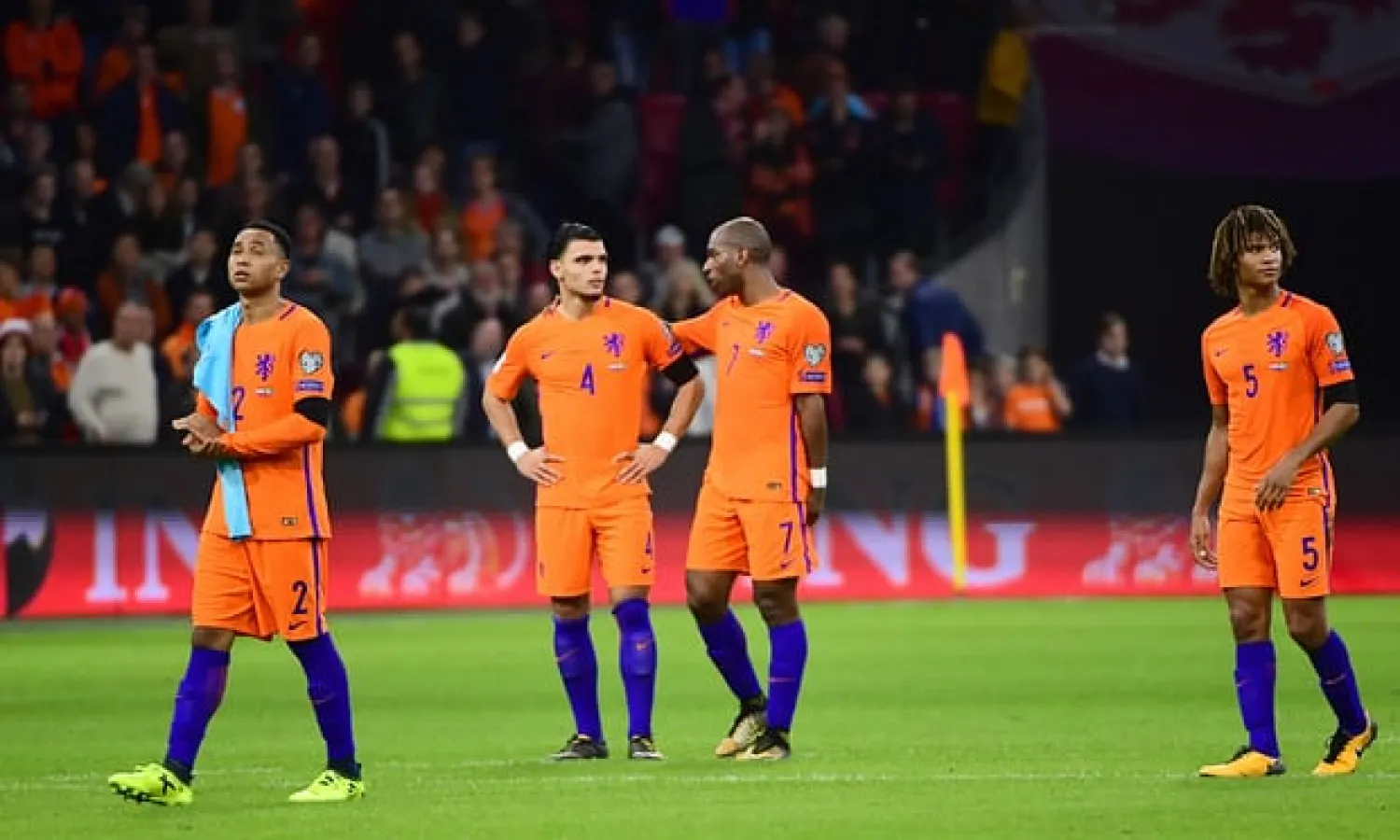
 The Holland players react to the disappointment of failing to qualify for their second major football tournament in a row. Photograph: Emmanuel Dunand/AFP/Getty Images
The Holland players react to the disappointment of failing to qualify for their second major football tournament in a row. Photograph: Emmanuel Dunand/AFP/Getty Images
TT

The Decline of Holland's Football Team: Doomed by Total Obsession with Past

 The Holland players react to the disappointment of failing to qualify for their second major football tournament in a row. Photograph: Emmanuel Dunand/AFP/Getty Images
The Holland players react to the disappointment of failing to qualify for their second major football tournament in a row. Photograph: Emmanuel Dunand/AFP/Getty Images

In Graham Swift’s novel Waterland his narrator, a history teacher going through a mid-life crisis, says: “And where history does not undermine and set traps for itself in such an openly perverse way, it creates this insidious longing to revert. It begets this bastard but pampered child, Nostalgia. How we yearn to return to that time before history claimed us, before things went wrong.”

At some point analysis of decline becomes an ordeal, particularly when the causative factors seem numerous and varied and not independent of one another. Nostalgia lends itself to convenient explanations of why things are not as good as they were, which may overshadow the fact it is perhaps more important that one looks back to move forward and not vice versa. Dutch football has seen four talented generations of players, right from Cruyff and Van Hanegem’s cohort in the 70s, Gullit, Rijkaard, Van Basten and Koeman in the 80s, Bergkamp’s batch in the 90s and the 1983-84-born class of the 00s led by Arjen Robben and Wesley Sneijder.

In the wake of failing to qualify for next year’s World Cup finals in Russia Dutch footballers are now criticised for a lack of “winning mentality”. Marcel Brands of PSV, in a discussion in 2014 with his fellow technical directors of the so-called big three, Marc Overmars of Ajax and Feyenoord’s Martin van Geel, remarked: “We develop many intelligent, tactically strong players. We just need to improve substantially in the winning factor. I went to Portugal recently: Sporting, Benfica and Porto. There it is completely different. There it is all about winning. With us, it’s the exact opposite: ‘80% possession, played well, yes but we lose 1-0.’

“That’s not how it should be. If you look at Germany, they have taken a step. There was always physical football, a lot of running. Now, there is a lot more [technical] football than 10 years ago. They also observed us [the Dutch] a lot.”

Tellingly, nearly all of the successful recent exports from the Eredivisie have been players who were scouted between the ages of 16 and 19 – Uruguay’s Luis Suárez, Denmark’s Christian Eriksen and Belgium’s Toby Alderweireld found the Netherlands a prime location to hone their talent, having developed initially elsewhere. But even if the current Holland side lacked extraordinary talents, there was sufficient quality for them at least to make the qualification play-offs. That suggests there are deeper structural problems with the national team. It is clearly more complicated than just Memphis Depay’s preference for wearing hats.

In 2014 all the big three’s technical directors agreed that the KNVB, the Dutch FA, needed a strong technical director. Jelle Goes had functioned as “technical manager” since 2013 and played a big role in drafting the Winnaars van Morgen, “Winners of Tomorrow”, plan for reviving Dutch football; and, when Hans van Breukelen was made technical director in 2016, Goes’ focus shifted to youth.

However, this summer both Goes and Van Breukelen left their roles, with the latter resigning, having made a mess of the national coach situation after Danny Blind’s departure and saying he had not been able to make “his – and the KNVB’s — ambitions come true”.

The KNVB’s lack of a clear long-term vision seemed evident as they let Hakim Ziyech slip through their fingers. The 24-year-old, who played for Dutch youth teams up to the under-21s and was the outstanding Dutch midfielder of his generation, was injured on his first call-up in May 2015 and could not play, but then seemed to be overlooked. He then elected to represent Morocco, making his debut in October 2015.

In March 2016 Blind was asked why there had not been more of an effort to tie down Ziyech. The then Holland manager responded with the specious excuse that Ziyech was not playing as a “true No10” at Twente at the time but as more of a second striker. Immediately his then-assistant coach, Marco van Basten, sitting at the back of the room, turned to the reporter who had suggested the KNVB had failed in this regard and said: “Why? He has gone with the choice with his heart? Then, in my opinion, you should ask him.”

In May 2016 Van Basten called Ziyech and the St-Etienne winger Oussama Tannane “stupid boys” for not having the patience to wait for their chance: “How stupid can you be to choose Morocco if you are in contention for the Dutch national team?”

This, beyond the disrespect, suggests some delusions of grandeur and superiority persist despite Holland’s shortcomings on the pitch. Nearly two years later another young talent – Sofyan Amrabat –is set to follow Ziyech. He still has a chance of playing at the World Cup finals with Morocco, while the Dutch must watch a second consecutive international tournament on their TV screens, still lacking direction in their long-term planning as well as a player worthy of building a new side around.

The way in which Van Basten expressed his view is indicative of the way dynamics can shift when there are many big personalities vying for influence. For the Dutch this is not a new phenomenon. In 1981, as Ajax trailed Twente 2-3 at De Meer, Johan Cruyff, then in a vague directorial role, made his way from the stands to the bench and propped himself beside the coach, Leo Beenhakker, shouting instructions and making tactical changes. In 2004, when Ronald Koeman was manager of Ajax, Louis van Gaal, then technical director, used to sit on the sidelines and commentate on training sessions.

Recently Ruud Gullit, assistant coach to Dick Advocaat, recorded a video for his Twitter feed in the Holland dressing room. Advocaat was unaware of and unhappy with the breach of protocol, yet Gullit was excused. Less than a month later Advocaat suggested Gullit would be his ideal successor because of the way the France players seemed to approach him in reverence at full-time, after they had easily defeated Holland 4-0 in September. “The Netherlands really forgets what a great Gullit is,” said Advocaat. There is bias in choosing to remember the great player – but not the fairly mediocre manager.

Robert Maaskant, who has managed NAC Breda and Willem II, pertinently told De Volkskrant in August: “When I started as a trainer, I thought: ‘I did not have a great career as a player, so I need to get into [management] early. Because between the ages of 42 and 50, all those former internationals [Frank de Boer, Phillip Cocu, Giovanni van Bronckhorst] will start to get involved, and they will get the best jobs first.’ But the lead I had, ultimately led to nothing more. Because experience is no longer as important.

“It started with Marco van Basten’s appointment as Holland coach, without any experience. Since then you do not ‘build’ a career in Dutch football any more: it will ‘happen’ to you.”

Peter Bosz, now at Borussia Dortmund, is a Dutch rarity in breaking that ceiling in recent years but seemed to be swiftly pushed out by the powers that be at Ajax. So a picture emerges of an insular, constricted group of coaches who are granted opportunities with little or no coaching experience. Most share a common idea of possession-based 4‑3‑3 football, which makes Dutch teams predictable while other nations have either bettered 4-3-3 or moved on.

The most successful exponents of the “Dutch” style are no longer Dutch, and given there is little to lose now, perhaps a step in the right direction would be to experiment with appointing a foreign coach. The last one – the Austrian Ernst Happel – did not fare too badly.

Dutch football has always been a battleground of “philosophy” and winning football matches in the somewhat arbitrary “right” way over just winning. That there was still pride in losing the 1974 World Cup final to West Germany – when Cruyff’s talented side squandered a one-goal lead to their greatest rivals in Munich – seemed to set forth the belief that results were, to an extent, expendable in the pursuit of the ideal of total football.

Now, in the friction between the nostalgia for their great footballing innovations of the past and the reality of being surpassed in tactical relevance today, the Dutch seem to have lost their standing and ended up compromising on both the style for which they were renowned and the results they fail to achieve.

In retrospect their shock 5-1 drubbing of Spain at the 2014 World Cup finals in Brazil signified a strange fork-in-the-road of a game, in which the defending champions had fallen into a predictable rhythm and the team who had lost the 2010 final seemed to be one step ahead. But Spain have recovered while the Dutch have regressed because that is where the insidiousness of nostalgia can lead – to regression, in the assumption that to achieve glory in the future we need to “go back” and recreate a past that has long been lost. Clearly Holland and Dutch football must now look to the future instead.

The Guardian Sport


Sinner Sees off Popyrin to Reach Doha Quarters

 Italy's Jannik Sinner greets the fans after defeating Australia's Alexei Popyrin in their men's singles match at the Qatar Open tennis tournament in Doha on February 18, 2026. (AFP)
Italy's Jannik Sinner greets the fans after defeating Australia's Alexei Popyrin in their men's singles match at the Qatar Open tennis tournament in Doha on February 18, 2026. (AFP)
TT

Sinner Sees off Popyrin to Reach Doha Quarters

 Italy's Jannik Sinner greets the fans after defeating Australia's Alexei Popyrin in their men's singles match at the Qatar Open tennis tournament in Doha on February 18, 2026. (AFP)
Italy's Jannik Sinner greets the fans after defeating Australia's Alexei Popyrin in their men's singles match at the Qatar Open tennis tournament in Doha on February 18, 2026. (AFP)

Jannik Sinner powered past Alexei Popyrin in straight sets on Wednesday to reach the last eight of the Qatar Open and edge closer to a possible final meeting with Carlos Alcaraz.

The Italian, playing his first tournament since losing to Novak Djokovic in the Australian Open semi-finals last month, eased to a 6-3, 7-5 second-round win in Doha.

Sinner will play Jakub Mensik in Thursday's quarter-finals.

Australian world number 53 Popyrin battled gamely but failed to create a break-point opportunity against his clinical opponent.

Sinner dropped just three points on serve in an excellent first set which he took courtesy of a break in the sixth game.

Popyrin fought hard in the second but could not force a tie-break as Sinner broke to grab a 6-5 lead before confidently serving it out.

World number one Alcaraz takes on Frenchman Valentin Royer in his second-round match later.


Ukraine's Officials to Boycott Paralympics over Russian Flag Decision

Milano Cortina 2026 Winter Olympics - Skeleton - Interview with Ukraine Youth and Sports minister Matvii Bidnyi - N H Hotel, Milan, Italy - February 12, 2026 Ukraine Youth and Sports Minister Matvii Bidnyi speaks after the disqualification of Ukrainian skeleton racer Vladyslav Heraskevych from the Winter Games. REUTERS/Kevin Coombs
TT

Ukraine's Officials to Boycott Paralympics over Russian Flag Decision

Milano Cortina 2026 Winter Olympics - Skeleton - Interview with Ukraine Youth and Sports minister Matvii Bidnyi - N H Hotel, Milan, Italy - February 12, 2026 Ukraine Youth and Sports Minister Matvii Bidnyi speaks after the disqualification of Ukrainian skeleton racer Vladyslav Heraskevych from the Winter Games. REUTERS/Kevin Coombs

Ukrainian officials will boycott the Paralympic Winter Games, Kyiv said Wednesday, after the International Paralympic Committee allowed Russian athletes to compete under their national flag.

Ukraine also urged other countries to shun next month's Opening Ceremony in Verona on March 6, in part of a growing standoff between Kyiv and international sporting federations four years after Russia invaded.

Six Russians and four Belarusians will be allowed to take part under their own flags at the Milan-Cortina Paralympics rather than as neutral athletes, the Games' governing body confirmed to AFP on Tuesday.

Russia has been mostly banned from international sport since Moscow invaded Ukraine. The IPC's decision triggered fury in Ukraine.

Ukraine's sports minister Matviy Bidny called the decision "outrageous", and accused Russia and Belarus of turning "sport into a tool of war, lies, and contempt."

"Ukrainian public officials will not attend the Paralympic Games. We will not be present at the opening ceremony," he said on social media.

"We will not take part in any other official Paralympic events," he added.

Ukrainian Foreign Minister Andriy Sybiga said he had instructed Kyiv's ambassadors to urge other countries to also shun the opening ceremony.

"Allowing the flags of aggressor states to be raised at the Paralympic Games while Russia's war against Ukraine rages on is wrong -- morally and politically," Sybiga said on social media.

The EU's sports commissioner Glenn Micallef said he would also skip the opening ceremony.

- Kyiv demands apology -

The IPC's decision comes amid already heightened tensions between Ukraine and the International Olympic Committee, overseeing the Winter Olympics currently underway.

The IOC banned Ukrainian skeleton racer Vladyslav Heraskevych for refusing to ditch a helmet depicting victims of the war with Russia.

Ukraine was further angered that the woman chosen to carry the "Ukraine" name card and lead its team out during the Opening Ceremony of the Games was revealed to be Russian.

Media reports called the woman an anti-Kremlin Russian woman living in Milan for years.

"Picking a Russian person to carry the nameplate is despicable," Kyiv's foreign ministry spokesman Georgiy Tykhy said at a briefing in response to a question by AFP.

He called it a "severe violation of the Olympic Charter" and demanded an apology.

And Kyiv also riled earlier this month at FIFA boss Gianni Infantino saying he believed it was time to reinstate Russia in international football.

- 'War, lies and contempt' -

Valeriy Sushkevych, president of the Ukrainian Paralympic Committee told AFP on Tuesday that Kyiv's athletes would not boycott the Paralympics.

Ukraine traditionally performs strongly at the Winter Paralympics, coming second in the medals table four years ago in Beijing.

"If we do not go, it would mean allowing Putin to claim a victory over Ukrainian Paralympians and over Ukraine by excluding us from the Games," said the 71-year-old in an interview.

"That will not happen!"

Russia was awarded two slots in alpine skiing, two in cross-country skiing and two in snowboarding. The four Belarusian slots are all in cross-country skiing.

The International Paralympic Committee (IPC) said earlier those athletes would be "treated like (those from) any other country".

The IPC unexpectedly lifted its suspension on Russian and Belarusian athletes at the organisation's general assembly in September.


'Not Here for Medals', Nakai Says after Leading Japanese Charge at Olympics

Ami Nakai of Japan competes during the women's short program figure skating at the 2026 Winter Olympics, in Milan, Italy, Tuesday, Feb. 17, 2026. (AP Photo/Ashley Landis)
TT

'Not Here for Medals', Nakai Says after Leading Japanese Charge at Olympics

Ami Nakai of Japan competes during the women's short program figure skating at the 2026 Winter Olympics, in Milan, Italy, Tuesday, Feb. 17, 2026. (AP Photo/Ashley Landis)

Ami Nakai entered her first Olympics insisting she was not here for medals — but after the short program at the Milano Cortina Games, the 17-year-old figure skater found herself at the top, ahead of national icon Kaori Sakamoto and rising star Mone Chiba.

Japan finished first, second, and fourth on Tuesday, cementing a formidable presence heading into the free skate on Thursday. American Alysa Liu finished third.

Nakai's clean, confident skate was anchored by a soaring triple Axel. She approached the moment with an ease unusual for an Olympic debut.

"I'm not here at this Olympics with the goal of achieving a high result, I'm really looking forward to enjoying this Olympics as much as I can, till the very last moment," she said.

"Since this is my first Olympics, I had nothing to lose, and that mindset definitely translated into my results," she said.

Her carefree confidence has unexpectedly put her in medal contention, though she cannot imagine herself surpassing Sakamoto, the three-time world champion who is skating the final chapter of her competitive career. Nakai scored 78.71 points in the short program, ahead of Sakamoto's 77.23.

"There's no way I stand a chance against Kaori right now," Nakai said. "I'm just enjoying these Olympics and trying my best."

Sakamoto, 25, who has said she will retire after these Games, is chasing the one accolade missing from her resume: Olympic gold.

Having already secured a bronze in Beijing in 2022 and team silvers in both Beijing and Milan, she now aims to cap her career with an individual title.

She delivered a polished short program to "Time to Say Goodbye," earning a standing ovation.

Sakamoto later said she managed her nerves well and felt satisfied, adding that having three Japanese skaters in the top four spots "really proves that Japan is getting stronger". She did not feel unnerved about finishing behind Nakai, who also bested her at the Grand Prix de France in October.

"I expected to be surpassed after she landed a triple Axel ... but the most important thing is how much I can concentrate on my own performance, do my best, stay focused for the free skate," she said.

Chiba placed fourth and said she felt energised heading into the free skate, especially after choosing to perform to music from the soundtrack of "Romeo and Juliet" in Italy.

"The rankings are really decided in the free program, so I'll just try to stay calm and focused in the free program and perform my own style without any mistakes," said the 20-year-old, widely regarded as the rising all-rounder whose steady ascent has made her one of Japan's most promising skaters.

All three skaters mentioned how seeing Japanese pair Riku Miura and Ryuichi Kihara deliver a stunning comeback, storming from fifth place after a shaky short program to capture Japan's first Olympic figure skating pairs gold medal, inspired them.

"I was really moved by Riku and Ryuichi last night," Chiba said. "The three of us girls talked about trying to live up to that standard."
