

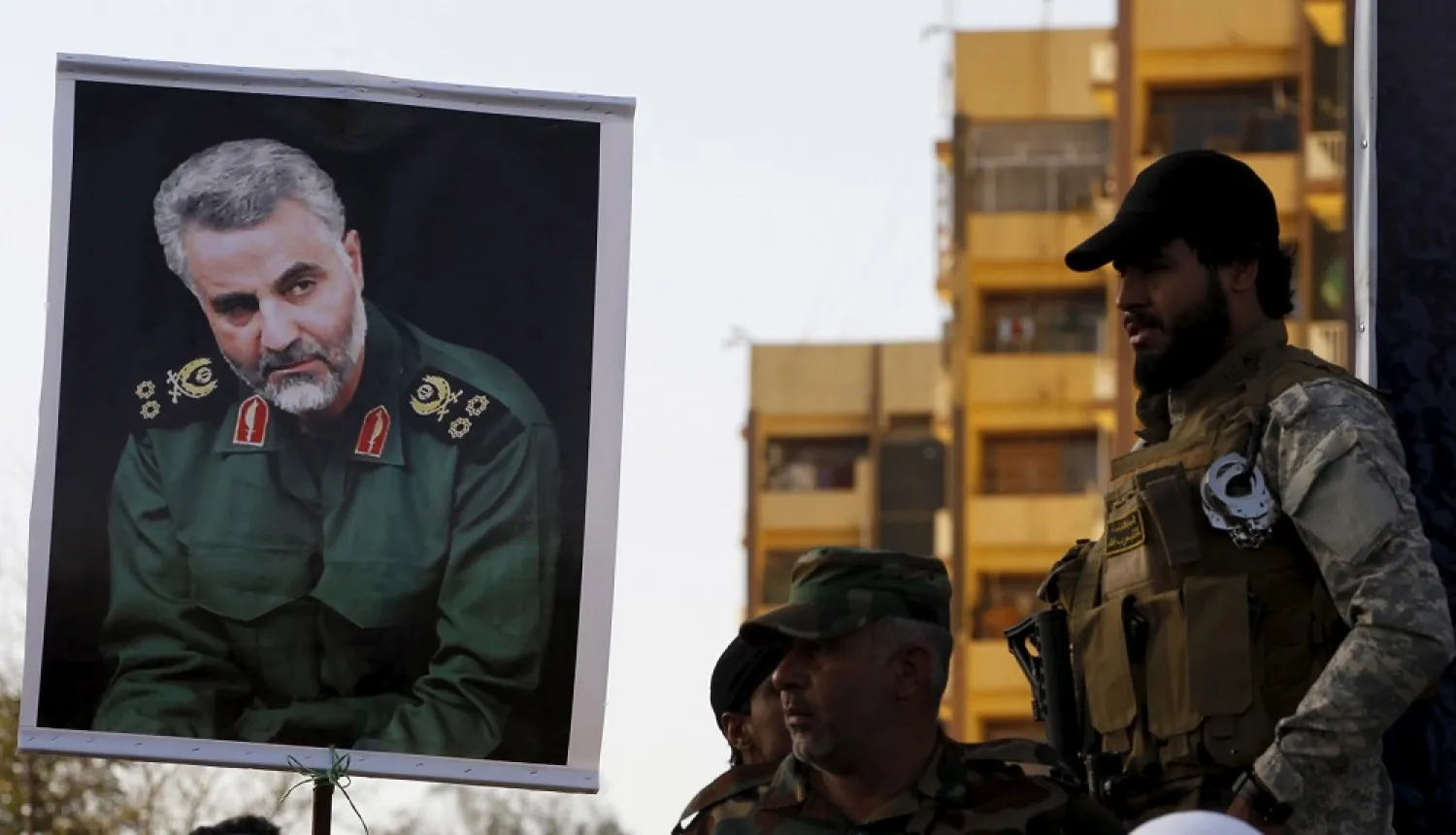

Soleimani Gave Military ‘Guidance’ from Kirkuk Prior to Iraqi Offensive

Members from Iraq’s Popular Mobilization Units hold a portrait of Iranian commander Major General Qassem Soleimani during a demonstration in Baghdad March 31, 2015. (Reuters)
TT

Soleimani Gave Military ‘Guidance’ from Kirkuk Prior to Iraqi Offensive

Members from Iraq’s Popular Mobilization Units hold a portrait of Iranian commander Major General Qassem Soleimani during a demonstration in Baghdad March 31, 2015. (Reuters)

Iranian military commander Qassem Soleimani had made repeated warnings to Kurdish leaders in northern Iraq, asking them to withdraw from oil-rich Kirkuk or face a fierce Iraqi government offensive.

Soleimani, who is commander of foreign operations for Iran’s Revolutionary Guards, had met leaders from the Patriotic Union of Kurdistan (PUK) in the city of Sulaimania the day before Iraqi Prime Minister Haidar al-Abadi ordered his forces to advance on Kirkuk, according to a PUK lawmaker briefed on the meeting.

His message was clear, either withdraw or lose Iran as a strategic ally, said the lawmaker according to Reuters.

The Iranian official had paid at least three visits to the Iraqi Kurdistan Region in October before the launch of the Iraqi government’s lightening operation in the North to regain regions that Kurds had seized during their fight against ISIS over the past three years.

“Abadi has all the regional powers and the West behind him and nothing will stop him from forcing you to return back to the mountains if he decides so,” the lawmaker quoted Soleimani as telling the PUK leadership.

The Iranian general evoked late Iraqi president Saddam Hussein’s massive attack on a Kurdish rebellion in 1991, when almost the entire Kurdish population fled northern Iraq to the mountains, the PUK lawmaker said.

“Soleimani’s visit ... was to give a last-minute chance for the decision-makers not to commit a fatal mistake,” said the lawmaker, who like others interviewed in this story declined to be identified because of the sensitivity of the issue.

Commanders of the Kurdish Peshmerga forces have accused Iran of orchestrating the Shi‘ite-led Iraqi central government’s push into areas under their control, a charge senior Iranian officials have denied.

But Iran has made no secret of its presence in Iraq.

“Tehran’s military help is not a secret anymore. You can find General Soleimani’s pictures in Iraq everywhere,” said an official close to Iranian President Hassan Rouhani.

“Now, beside political issues, Kirkuk’s oil is a very key element for Iran, which is an OPEC member. Control of those oil fields by Iran’s enemies would be disastrous for us. Why should we let them enter the oil market?”

Kirkuk fell to Iraqi government forces on Monday. Their offensive followed a referendum last month in which the semi-autonomous Kurdistan region voted to secede from Iraq against Baghdad’s wishes.

But Iraq’s two main Kurdish parties have been at odds over both the referendum and the approach to the crisis in Kirkuk, which the Kurds consider to be the heart of their homeland.

The PUK, a close ally of Iran, accused its rival, the Kurdistan Democratic Party (KDP), of putting the Kurds at risk of military intervention and isolation by pushing hard for the vote, which won wide approval for independence. The KDP is headed by President Masoud Barzani.

Soleimani has been allied to the PUK for years, but the referendum has drawn him even closer to Kurdish politics and expanded Iran’s reach in Iraq beyond the Baghdad government.

The Iranian general is no stranger to conflicts in Iraq, which fought an eight-year war with Iran in the 1980s. He has often been seen in footage from the frontlines, and Iran has long helped Baghdad to carry out its military strategy through paramilitary Shi‘ite militias which it funds and arms.

Before the referendum, Soleimani suggested to Kurdish leaders that holding a vote on secession -- which Iran feared would encourage its own Kurdish population to agitate for greater autonomy -- would be risky.

“The Iranians were very clear. They have been very clear that there will be conflict, that these territories will be lost,” said one prominent Iraqi Kurdish politician who met Soleimani ahead of the September 25 referendum.

On October 6, barely a week after the vote, Soleimani attended the funeral of PUK leader Jalal Talabani. Again, he wanted to make sure even his closest Kurdish allies understood the dangers of not withdrawing from Kirkuk, officials said.

A senior Iranian diplomat in Iraq and an official in Iran close to Supreme Leader Ali Khamenei’s office said Soleimani met with Kurdish leaders after Talibani’s funeral and urged them to withdraw from Kirkuk and in exchange Tehran would protect their interests.

Soleimani met with one of Talabani’s sons, Bafel, a few days after his father was buried, one of the PUK officials said.

“Soleimani said Abadi should be taken very seriously. You should understand this,” the official said.

An Iranian source in Iraq said Soleimani was in Kirkuk two nights before the Iraqi government offensive for “a couple of hours to give military guidance.” Iraqi intelligence sources said Tehran sent a clear signal to the PUK.

“We understand from our sources on the ground that neighboring Iran played a decisive role in making the PUK chose the right course with Baghdad,” one Iraqi intelligence official told Reuters.

Tensions over the referendum and Kirkuk have deepened divisions between the two main political parties in northern Iraq. The KDP accused the PUK of betraying the Kurdish cause by capitulating to Iran and striking a deal to withdraw.

“The Talabani clan were behind the offensive on Kirkuk. They asked Qassem (Soleimani) for help and his troops were there on the ground,” said a source close to Massoud Barzani, president of the Kurdistan Regional Government and head of the KDP.

“It is becoming clear that Iran is directing the operations to destroy the KDP.”

The PUK strongly denies this. Talabani’s son Bafel accused the KDP of missing a zero-hour chance to avoid losing Kirkuk by failing to reach a deal over a military base which Iraqi government forces had demanded to take back.

“Unfortunately we reacted too slowly. And we find ourselves where we are today,” Bafel told Reuters.

Two other Kurdish political sources gave a similar account.

Iran and Soleimani offered early assistance to northern Iraq’s Kurds in the fight against ISIS, a rallying point for the Kurdish community. But after the devastating loss of Kirkuk, Iraqi Kurds have been left disillusioned.

“They (both PUK and KDP leaders) just make decisions on their own and play with people’s lives. In the end, we pay the price,” said pensioner Abdullah Ahmed in Sulaimania. “This is a disaster for everyone. Everyone was united against Daesh (Islamic State). Now they are back just looking out for themselves.”



Türkiye Says Greece-Chevron Activity off Crete Unlawful 

A Chevron gas station sign is pictured at one of their retain gas stations in Cardiff, California October 9, 2013. REUTERS/Mike Blake/File Photo
TT

Türkiye Says Greece-Chevron Activity off Crete Unlawful 

A Chevron gas station sign is pictured at one of their retain gas stations in Cardiff, California October 9, 2013. REUTERS/Mike Blake/File Photo

Türkiye said on Thursday it opposed Greece's "unilateral activities" in energy fields south of Crete with a consortium led by US major Chevron as a violation of international law and good neighbourly relations.

Athens responded that its policies abide international law.

The Chevron-led consortium signed exclusive lease agreements on Monday to look for natural gas off southern Greece, expanding US presence in the eastern Mediterranean.

"We oppose this unlawful activity, which is being attempted in violation of the 2019 Memorandum of Understanding on Maritime Jurisdiction between Libya and our country," the Turkish Defense Ministry said at a press briefing.

It said the activity, while not directly impacting Türkiye's continental shelf, also violated Libya's maritime jurisdiction that was declared to the United Nations in May last year.

"We continue to provide the necessary support to the Libyan authorities to take action against these unilateral and unlawful activities by Greece," the ministry said.

A 2019 agreement signed by Türkiye and Libya set out maritime boundaries in the Mediterranean Sea. It was rejected by Greece as it ignored the presence of the Greek island of Crete between the coasts of Türkiye and Libya. The Chevron deal doubles the amount of Greek maritime acreage available for exploration and is the second in months involving a US energy major, as the European Union seeks to phase out supplies from Russia and the US seeks to replace them.

Asked about the Turkish objections later on Thursday, Greek government spokesman Pavlos Marinakis told a press briefing that Athens followed an "active policy" and "exercises its rights in accordance with international law and respects international law steadfastly - and I think no one questions that, period."

There was no immediate comment from Chevron.

Neighbors and NATO members Türkiye and Greece have been at odds over a range of issues for decades, primarily maritime boundaries and rights in the Aegean, an area widely believed to hold energy resources and with key implications for airspace and military activity.

A 2023 declaration on friendly relations prompted a thaw between the sides and leaders have voiced a desire to address remaining issues.


Andrew Mountbatten-Windsor Arrested on Suspicion of Misconduct in Public Office

FILE - Britain’s Andrew Mountbatten-Windsor, formerly known as Prince Andrew, looks round as he leaves after attending the Easter Matins Service at St. George's Chapel, Windsor Castle, England, April 20, 2025. (AP Photo/Kirsty Wigglesworth, File)
TT

Andrew Mountbatten-Windsor Arrested on Suspicion of Misconduct in Public Office

FILE - Britain’s Andrew Mountbatten-Windsor, formerly known as Prince Andrew, looks round as he leaves after attending the Easter Matins Service at St. George's Chapel, Windsor Castle, England, April 20, 2025. (AP Photo/Kirsty Wigglesworth, File)

UK police arrested Andrew Mountbatten-Windsor on Thursday on suspicion of misconduct in public office.

The Thames Valley Police, an agency that covers areas west of London, including Mountbatten-Windsor’s former home, said it was “assessing” reports that the former Prince Andrew sent trade reports to convicted sex offender Jeffrey Epstein in 2010. The assessment followed the release of millions of pages of documents connected to a US investigation of Epstein.

The police force did not name Mountbatten-Windsor, as is normal under UK law. But when asked if he had been arrested, the force pointed to a statement saying that they had arrested a man in his 60s. Mountbatten-Windsor is 66.

“Following a thorough assessment, we have now opened an investigation into this allegation of misconduct in public office,’’ the statement said. “It is important that we protect the integrity and objectivity of our investigation as we work with our partners to investigate this alleged offence."

“We understand the significant public interest in this case, and we will provide updates at the appropriate time,” the statement added.

Pictures circulated online appearing to show unmarked police cars at Wood Farm on the Sandringham Estate in Norfolk, with plainclothes officers appearing to gather outside the home of Mountbatten-Windsor.


Georgia Arrests Two Foreigners Trying to Purchase Uranium

FILE PHOTO: A block with the symbol, atomic number and mass number of Uranium (U) element, in this illustration taken January 21, 2026. REUTERS/Dado Ruvic/Illustration/File Photo
TT

Georgia Arrests Two Foreigners Trying to Purchase Uranium

FILE PHOTO: A block with the symbol, atomic number and mass number of Uranium (U) element, in this illustration taken January 21, 2026. REUTERS/Dado Ruvic/Illustration/File Photo

Georgia has ‌detained two people who attempted to purchase $3 million worth of uranium and a cache of a radioactive isotope found in nuclear weapons testing programs, the national security service said on Thursday.

Two foreign nationals from unspecified countries were arrested in the city of Kutaisi, the State Security Service said in a statement.

"They were planning to ‌illegally purchase ‌nuclear material uranium and radioactive ‌substance ⁠Cesium 137 for $3 ⁠million and illegally transport it to the territory of another country," Reuters quoted it as saying.

It said other foreigners had been arriving in Georgia in recent weeks with the aim of purchasing and transporting the nuclear and ⁠radioactive materials, without elaborating further.

The ‌statement did ‌not specify the quantity of materials the individuals were ‌attempting to procure. There were ‌no details on the substances' origin or potential destination.

Cesium 137 is a radioactive isotope present primarily in the aftermath of nuclear weapons testing ‌and nuclear power plant accidents such as the Chernobyl disaster in ⁠then-Soviet ⁠Ukraine in 1986.

The security of nuclear materials was one of the biggest concerns after the 1991 fall of the Soviet Union, of which Georgia was part. There have been several serious incidents involving the illicit trade in nuclear materials in Georgia over recent decades.

Most recently, three Chinese citizens were arrested in the capital Tbilisi for attempting to purchase two kilograms of "nuclear material" uranium.