


Japan’s Abe on Course for Major Elections Win

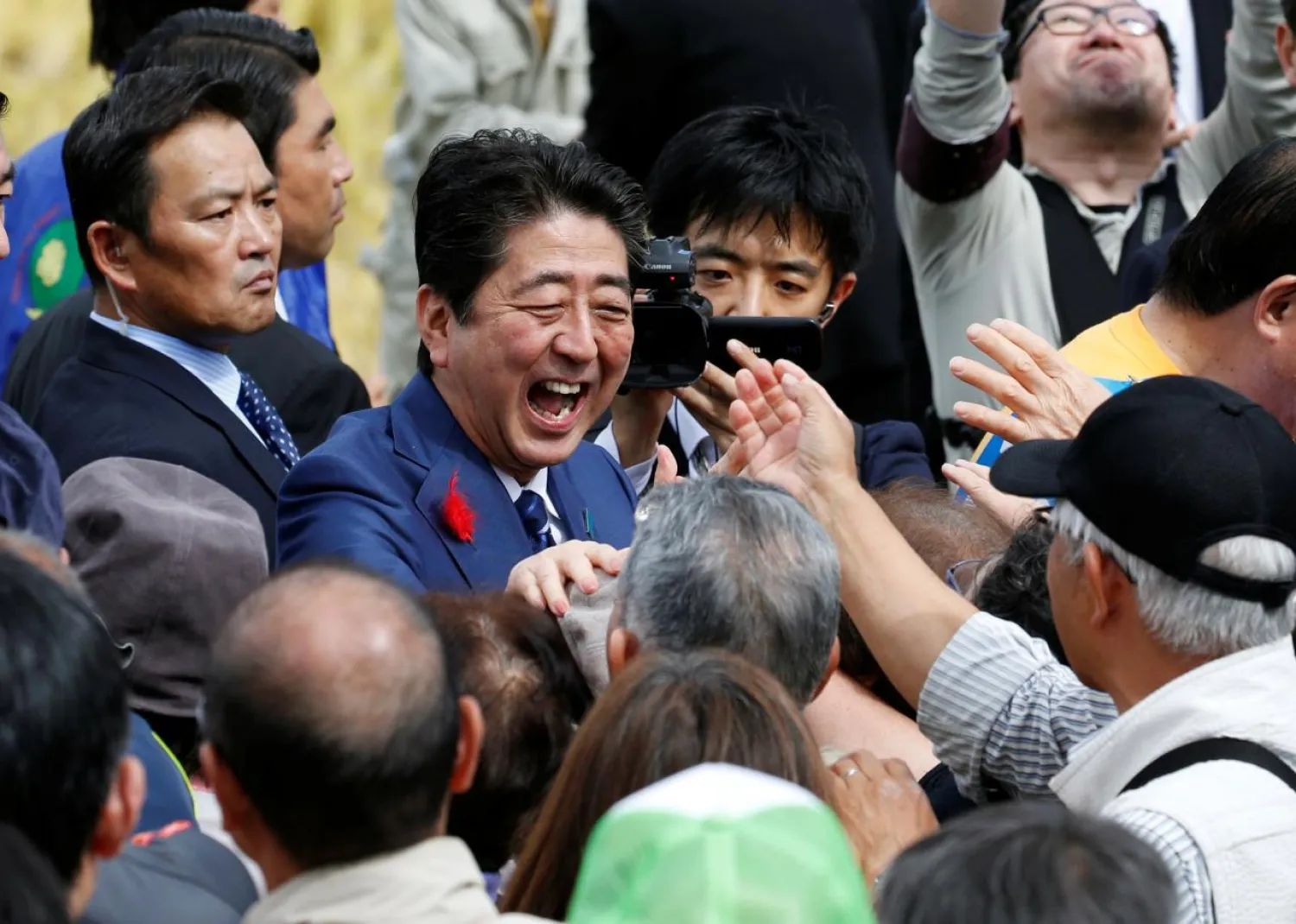
Japan's Prime Minister Shinzo Abe, who is also ruling Liberal Democratic Party leader, shakes hands with his supporters after an election campaign rally in Fukushima, Japan, October 10, 2017. (Reuters)
TT

Japan’s Abe on Course for Major Elections Win

Japan's Prime Minister Shinzo Abe, who is also ruling Liberal Democratic Party leader, shakes hands with his supporters after an election campaign rally in Fukushima, Japan, October 10, 2017. (Reuters)

Japanese Prime Minister Shinzo Abe’s ruling coalition was on course for a major victory in national elections, exit polls showed on Sunday.

His Liberal Democratic Party-led (LDP) coalition was set to win 311 seats, keeping its two-thirds "super majority" in the 465-member lower house, an exit poll by TBS television showed.

The victory would boost his chances of winning another three-year term next September. That could extend his premiership to 2021, giving him more time to pursue his goal of revising Japan's post-war constitution.

It also means his "Abenomics" growth strategy centered on the hyper-easy monetary policy will likely continue.

Final official results are expected early on Monday.

Abe dissolved the lower house less than a month ago, forcing the snap election. Up for grabs are 465 seats in the more powerful chamber, which chooses the prime minister.

Analysts initially thought that a new opposition party launched by populist Tokyo Governor Yuriko Koike could put a dent in the ruling coalition's majority.

But Japanese public broadcaster NHK projected that Koike's Party of Hope would win just 38 to 59 seats in the 465-seat lower house.

Koike called the results "very severe" in a televised interview from Paris, where she is attending a conference of mayors. She said some of her remarks might have been taken negatively by voters, and that she would take the blame.

Revising Japan's post-war pacifist constitution has been Abe’s longtime goal.

The US-drafted constitution's Article 9, if taken literally, bans the maintenance of armed forces. But Japanese governments have interpreted it to allow a military exclusively for self-defense.

Backers of Abe's proposal say it would just codify the status quo. Critics fear it would allow an expanded role overseas for the military.

The Komeito is cautious about changing the constitution, drawn up after Japan's loss in World War Two. Several opposition parties favor changes, but do not agree on details. Amendments must be approved by two-thirds of each chamber of parliament and then by a majority in a public referendum.

"Nothing about the process (of revising the constitution) will be easy," said Tobias Harris, an analyst at Washington-based consultancy Teneo Intelligence. "But we'll be hearing a lot about it."

Abe had said he needed a new mandate to tackle a "national crisis" from North Korea's missile and nuclear threats and a fast-aging population, and to approve his idea of diverting revenue from a planned sales tax hike to education and child care from public debt repayment. He called the poll amid confusion in the opposition camp and an uptick in his ratings, dented earlier in the year by suspected cronyism scandals.

Abe's move had seemed risky after Koike, often floated as a possible first Japanese female premier, launched her conservative Party of Hope.

The Party of Hope absorbed a big chunk of the failed main opposition Democratic Party. But voter enthusiasm soon waned despite its calls for popular policies such as an exit from nuclear power and a freeze on the planned sales tax rise.

Koike did not run for a lower house seat herself - she was in Paris for a climate change event on Sunday - and failed to say whom her party would back for prime minister.

A new Constitutional Democratic Party of Japan (CDPJ), formed by liberal former DP members, was vying with Koike's party for the top opposition spot - the TBS exit polls had the CDPJ beating out the Party of Hope - although both will have just a sliver of the LDP's presence if forecasts prove accurate.

"Day by day, we felt we were getting more voter support for our call to revive more decent politics, and not fret about whether it's right or left wing - and instead to push things forward," Tetsuro Fukuyama, a CDPJ member in parliament's upper house, said on NHK.



Israeli Air Force Deploys First Laser Interception System

FILED - 26 March 2024, Israel, Jerusalem: Israel Katz attends a meeting at a hotel in Jerusalem. Photo: Christoph Soeder/dpa
TT

Israeli Air Force Deploys First Laser Interception System

FILED - 26 March 2024, Israel, Jerusalem: Israel Katz attends a meeting at a hotel in Jerusalem. Photo: Christoph Soeder/dpa

Israel's defense ministry said on Sunday it had deployed a new "Iron Beam" laser system for the air force to intercept aerial threats.

The laser system's main developers, the ministry's research and development department and defense contractor Rafael, delivered it to the air force at a ceremony in northern Israel.

"For the first time globally, a high-power laser interception system has achieved full operational maturity, successfully executing multiple interceptions," Defense Minister Israel Katz said at the ceremony, according to a statement.

"This monumental achievement... delivers a critical message to our enemies, near and far alike: do not challenge us, or face severe consequences," AFP quoted him as saying.

The handover marks a major milestone in a project more than a decade old.
"Israel has become the first country in the world to field an operational laser system for the interception of aerial threats, including rockets and missiles," said Yuval Steinitz, chairman of Rafael.

The laser system seeks to enhance and slash the cost of Israel's interception of projectiles, and will supplement other aerial defense capacities such as the more well-known Iron Dome.

Iron Dome offers short-range protection against missiles and rockets. The David's Sling system and successive generations of Arrow missiles are Israeli-American technology built to bring down ballistic missiles.

The defense ministry announced in early December that the laser system was complete, and would be deployed by the end of the month.

During the 12-day war launched by Israel against Iran in June, the country's missile defense system failed to intercept all the projectiles fired by Tehran toward Israeli territory.

Israel has since acknowledged being hit by more than 50 missiles during the war with Iran, resulting in 28 deaths.


Trump Says Had 'Productive' Call with Putin Ahead of Zelensky Meeting

US President Donald Trump takes part in a Christmas Eve dinner in the ballroom of his Mar-a-Lago club in Palm Beach, Florida, US, December 24, 2025. REUTERS/Jessica Koscielniak
TT

Trump Says Had 'Productive' Call with Putin Ahead of Zelensky Meeting

US President Donald Trump takes part in a Christmas Eve dinner in the ballroom of his Mar-a-Lago club in Palm Beach, Florida, US, December 24, 2025. REUTERS/Jessica Koscielniak

US President Donald Trump said he had a productive telephone call with his Russian counterpart Vladimir Putin on Sunday ahead of a planned meeting in Florida with Ukraine's leader Volodymyr Zelensky.

"I just had a very good and productive telephone call with President Putin of Russia" before the planned talks with Zelensky at Trump's Florida estate at 1:00 pm local time (1800 GMT), the US leader said on Truth Social.

Putin said Ukraine was in no hurry for peace and if it did not want to resolve their conflict peacefully, Moscow would accomplish all its goals by force.

Putin's remarks on Saturday, carried by state news agency TASS, followed a vast Russian drone and missile attack that prompted Zelensky to say Russia was demonstrating its wish to continue the war while Kyiv wanted peace.


Russia Sends 3 Iranian Satellites into Orbit, Report Says

In this photo released by Roscosmos space corporation on Thursday, Feb. 29, 2024, the Soyuz-2.1b rocket blasts off at the Vostochny cosmodrome outside the city of Tsiolkovsky, about 200 kilometers (125 miles) from the city of Blagoveshchensk in the far eastern Amur region, Russia. A Russian Soyuz rocket successfully put an Iranian satellite into orbit along with 18 Russian satellites on Thursday. (Roscosmos space corporation via AP)
TT

Russia Sends 3 Iranian Satellites into Orbit, Report Says

In this photo released by Roscosmos space corporation on Thursday, Feb. 29, 2024, the Soyuz-2.1b rocket blasts off at the Vostochny cosmodrome outside the city of Tsiolkovsky, about 200 kilometers (125 miles) from the city of Blagoveshchensk in the far eastern Amur region, Russia. A Russian Soyuz rocket successfully put an Iranian satellite into orbit along with 18 Russian satellites on Thursday. (Roscosmos space corporation via AP)

Russia on Sunday sent three Iranian communications satellites into orbit, the second such launch since July, Iranian state television reported.

The report said that a Russian rocket sent the satellites to circle the Earth on a 500-kilometer (310-mile) orbit from the Vostochny launchpad in eastern Russia. The three satellites are dubbed Paya, Kowsar and Zafar-2.

The report said that Paya, weighing 150 kilograms (330 pounds), is the heaviest satellite that Iran has ever deployed into orbit. Kowsar weighs 35 kilograms (77 pounds), but the report didn't specify how heavy Zafar-2 is.

The satellites feature up to 3-meter resolution images, applicable in the management of water resources, agriculture and the environment. Their life span is up to five years.

Russia occasionally sends Iran's satellites into orbit, highlighting the strong ties between the two countries. In July, a Russian rocket sent Iranian communications satellite Nahid-2 into orbit.

Russia, which signed a “strategic partnership” treaty with Iran in January, strongly condemned the Israeli and US strikes on Iran that came during a 12-day air war in June and killed nearly 1,100 Iranians, including military commanders and nuclear scientists. Retaliatory missile barrages by Iran killed 28 people in Israel.

As a long-standing project, Iran from time-to-time launches satellite carriers to send its satellites into space.

The United States has said that Iran’s satellite launches defy a UN Security Council resolution and called on Tehran to undertake no activity involving ballistic missiles capable of delivering nuclear weapons. UN sanctions related to Iran’s ballistic missile program expired in 2023.