


US Plans to Deploy More Missile Launchers to the Philippines Despite China’s Alarm 

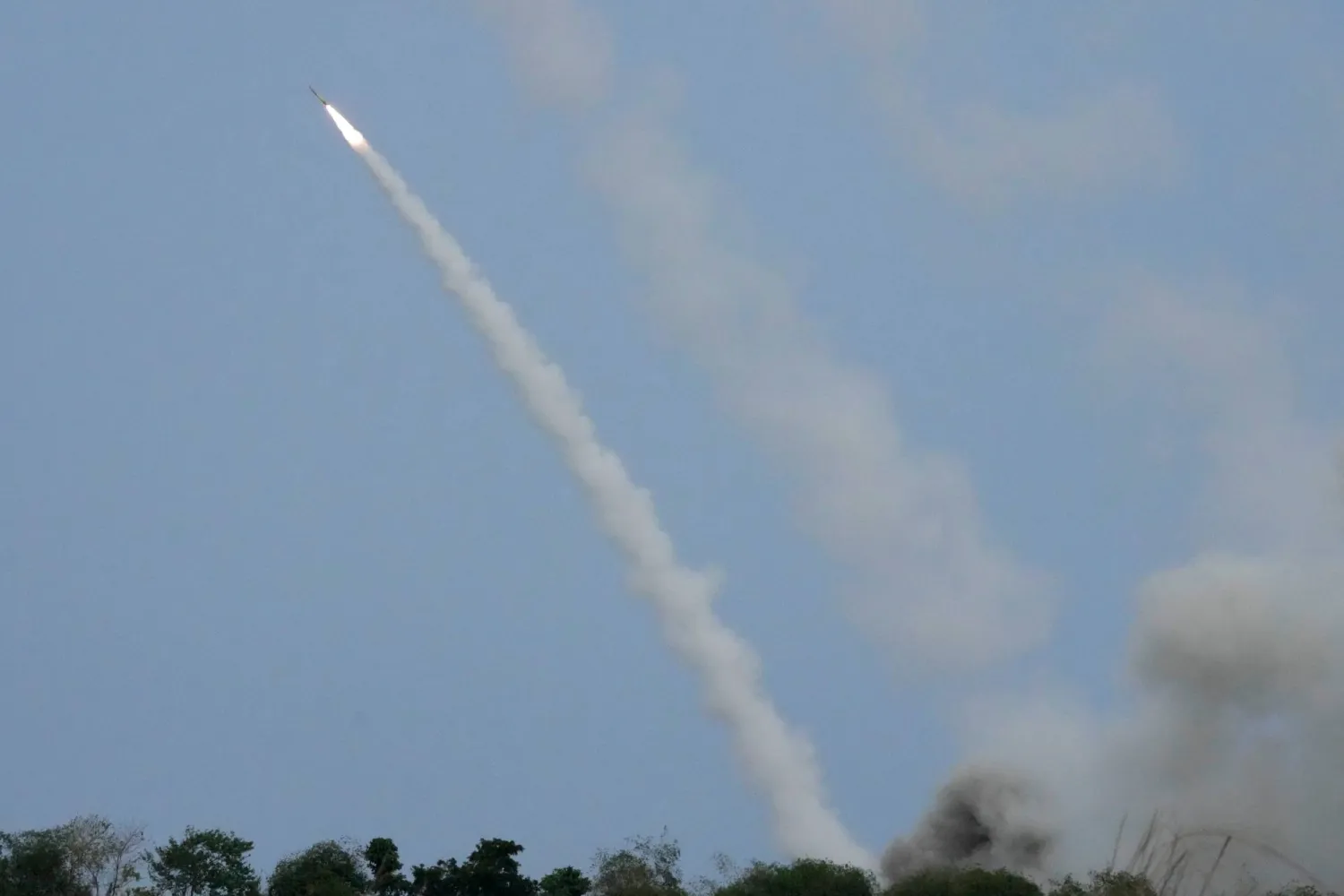
A US M142 High Mobility Artillery Rocket System (HIMARS) fires a missile during a Combined Joint Littoral Live Fire Exercise at the joint military exercise called "Balikatan", Tagalog for shoulder-to-shoulder in a Naval station in Zambales province, northern Philippines on Wednesday, April 26, 2023. (AP)
TT

US Plans to Deploy More Missile Launchers to the Philippines Despite China’s Alarm 

A US M142 High Mobility Artillery Rocket System (HIMARS) fires a missile during a Combined Joint Littoral Live Fire Exercise at the joint military exercise called "Balikatan", Tagalog for shoulder-to-shoulder in a Naval station in Zambales province, northern Philippines on Wednesday, April 26, 2023. (AP)

The United States plans to deploy more high-tech missile systems to the Philippines to help deter aggression in the South China Sea, where the treaty allies on Tuesday condemned what they called China’s "illegal, coercive, aggressive, and deceptive activities."

Beijing has repeatedly expressed alarm over the installation in the northern Philippines of a US mid-range missile system called the Typhon in 2024 and of an anti-ship missile launcher last year. It said the US weapons were aimed at containing China’s rise and warned that these were a threat to regional stability.

China has asked the Philippines to withdraw the missile launchers from its territory, but officials led by President Ferdinand Marcos Jr. have rejected the demand.

US and Philippine officials held annual talks Monday in Manila on broadening security, political and economic engagements and boosting collaboration with regional security allies.

The US and the Philippines outlined in a joint statement Tuesday specific defense and security plans for this year, including joint military exercises, Washington's support to help modernize the Philippine military and efforts "to increase deployments of US cutting-edge missile and unmanned systems to the Philippines."

The longtime allies "underscored their support for preserving freedom of navigation and overflight, unimpeded lawful commerce and other lawful uses of the sea for all nations," the statement said.

"Both sides condemned China’s illegal, coercive, aggressive and deceptive activities in the South China Sea, recognizing their adverse effects on regional peace and stability and the economies of the Indo-Pacific and beyond," it added.

Confrontations between Chinese and Philippine coast guard forces have spiked in the disputed waters in recent years. Vietnam, Malaysia, Brunei and Taiwan are also involved in the territorial standoffs.

Neither side elaborated on the planned missile deployments but Philippine ambassador to Washington, Jose Manuel Romualdez, who took part in Monday’s talks, said US and Filipino defense officials discussed the possible deployment this year of "upgraded" types of US missile launchers that the Philippines may eventually decide to purchase.

"It’s a kind of system that’s really very sophisticated and will be deployed here in the hope that, down the road, we will be able to get our own," Romualdez told The Associated Press.

The Typhon missile system that the US Army deployed to the main northern Philippine region of Luzon in April 2024 and an anti-missile launcher called the Navy Marine Expeditionary Ship Interdiction System that was deployed in April last year also to Luzon have remained in the Philippines, Romualdez said.

During joint drills, US forces have exhibited the missile systems to batches of Filipino forces to familiarize them with the weapons’ capabilities and usage, military officials said.

Romualdez said the US missile deployments to the Philippines did not aim to antagonize any country.

"It’s purely for deterrence," he said. "Every time the Chinese show any kind of aggression, it only strengthens our resolve to have these types."

The Typhon missile launchers, a land-based weapon, can fire the Standard Missile-6 and the Tomahawk Land Attack Missile. Tomahawk missiles can travel over 1,000 miles (1,600 kilometers), which places China within their target range, from the northern Philippine region of Luzon.

Last year, the US Marines deployed the anti-ship missile launcher, the Navy Marine Expeditionary Ship Interdiction System, to Batan island in the northernmost Philippine province of Batanes, which faces the Bashi Channel just south of Taiwan.

The sea passage is a critical trade and military route that the US and Chinese militaries have tried to gain strategic control of.



Putin, Erdogan Urge Immediate Middle East Ceasefire

 Russian President Vladimir Putin attends a meeting with Egyptian Foreign Minister Badr Abdelatty at the Senate Palace of the Kremlin in Moscow, Russia April 2, 2026. (Alexander Zemlianichenko/Pool via Reuters)
Russian President Vladimir Putin attends a meeting with Egyptian Foreign Minister Badr Abdelatty at the Senate Palace of the Kremlin in Moscow, Russia April 2, 2026. (Alexander Zemlianichenko/Pool via Reuters)
TT

Putin, Erdogan Urge Immediate Middle East Ceasefire

 Russian President Vladimir Putin attends a meeting with Egyptian Foreign Minister Badr Abdelatty at the Senate Palace of the Kremlin in Moscow, Russia April 2, 2026. (Alexander Zemlianichenko/Pool via Reuters)
Russian President Vladimir Putin attends a meeting with Egyptian Foreign Minister Badr Abdelatty at the Senate Palace of the Kremlin in Moscow, Russia April 2, 2026. (Alexander Zemlianichenko/Pool via Reuters)

Russian President Vladimir Putin and Turkish counterpart Recep Tayyip Erdogan called for an immediate ceasefire in the Middle East war during a phone call on Friday, the Kremlin said.

The war started over a month ago with US-Israeli strikes on Iran, triggering a conflict throughout the Middle East that has convulsed the global economy and impacted millions of people worldwide.

"The leaders noted their shared positions on the need for an immediate ceasefire and the development of compromise peace agreements that take into account the legitimate interests of all states in the region," a Kremlin statement said.

"It was noted that intense military action is leading to serious negative consequences not only regionally but also globally, including in the areas of energy, trade, and logistics," it added.

Putin and Erdogan also discussed "the importance of coordinated measures to comprehensively ensure security in the Black Sea area," Kremlin said, accusing Ukraine of "attempts to target gas transportation infrastructure linking Russia and Türkiye".

On Thursday, Russian forces repelled a drone attack on part of the TurkStream gas pipeline that connects southern Russia and Türkiye, the pipeline's operator Gazprom said.

Several European countries, including Hungary, Slovakia and Serbia, receive gas supplies via the pipeline.

Russia has accused Ukraine of attacking it multiple times, most recently in March.

Ukraine has struck Russian energy infrastructure throughout the nearly four-year war, in a bid to sap Moscow's ability to finance its offensive.

Russian strikes on Ukrainian energy facilities have cut power and heating to millions of people since the beginning of its full-scale assault in 2022.


US Fighter Shot Down Over Iran as Trump Threatens to Hit More Infrastructure

A view of the B1 bridge is pictured, a day after it was destroyed by a strike in Karaj, around 20miles (35kms) southwest of Tehran, April 3, 2026. (AFP)
TT

US Fighter Shot Down Over Iran as Trump Threatens to Hit More Infrastructure

A view of the B1 bridge is pictured, a day after it was destroyed by a strike in Karaj, around 20miles (35kms) southwest of Tehran, April 3, 2026. (AFP)

Iran shot down a US warplane on Friday, setting off a search by both sides for surviving crew as the war looked set to intensify with President Donald Trump threatening more attacks on civilian infrastructure.

Iran's Revolutionary Guard Corps said it was combing an area near where the plane came down in southwestern Iran. The regional governor promised a commendation for anyone who captured or killed the pilot.

A US military official confirmed that a fighter jet had been shot down and a search was under way.

Iranian news agencies said US helicopters were flying low on apparent search missions and carried videos of residents shooting at them.

DETAILS UNCLEAR OF US FIGHTER JET DOWNED BY IRAN

There were no confirmed details of the searches or the type of aircraft shot down, which the Iranian military said was an F-35, a single-seater. The Pentagon and US Central Command did not immediately respond to requests for comment.

The loss underlined the risk still faced by US and Israeli aircraft over Iran, despite assertions by Trump and Defense Secretary Pete Hegseth that their forces had total control of the skies.

Nearly five weeks after the US and Israel opened the campaign with a wave of strikes that killed Supreme Leader ‌Ali Khamenei, there is ‌no sign of an end to the war, which has already killed thousands and threatened lasting damage ‌to the global ⁠economy.

On Thursday, Trump ⁠posted footage on social media showing dust and smoke billowing up as US strikes hit the newly constructed B1 bridge between Tehran and nearby Karaj, which was due to open this year, and said more attacks would follow.

"Our Military, the greatest and most powerful (by far!) anywhere in the World, hasn't even started destroying what’s left in Iran. Bridges next, then Electric Power Plants!" he wrote in a subsequent post.

Despite the pressure, Iran has been able to hit back at Israel and strike Gulf countries.

On Friday, as Trump threatened to hit its bridges and power plants, Iran struck a power and water plant in Kuwait.

Trump urged Iran's leaders ⁠to seek peace, saying on social media that Iran "knows what has to be done, and has to be done, FAST!".

But ‌Tehran has shown no sign of acquiescence and Trump faces growing pressure to find a quick ‌resolution, with anger building at home and his Republican Party in danger of losing control of Congress at elections in November.

Negotiations conducted via intermediaries with new leaders in Iran have ‌shown little sign of progress, and polls indicate most Americans oppose the war.

'TAKE THE OIL AND MAKE A FORTUNE'

At the same time, the economic ‌impact has been global, with Iran's grip on the strategic shipping lane in the Strait of Hormuz giving it a choke hold on oil and gas.

Trump has expressed anger at US allies that have refused his calls to help re-open the strait, through which a fifth of global oil and liquefied gas passes in normal times. On Friday, he said reopening it would not be difficult.

"With a little more time, we can easily OPEN THE HORMUZ STRAIT, TAKE THE OIL,& MAKE A FORTUNE," he said on Truth Social.

The ‌US and Israel say they have degraded Iran's military capacity. But Iranian media have issued daily reports of attacks on civilian sites too, including schools, pharmaceutical suppliers and health facilities.

On Thursday, the century-old Pasteur Institute in the ⁠heart of Tehran was severely damaged, the ⁠Health Ministry said. On Friday, a drone hit a Red Crescent relief warehouse in the Choghadak area of the southern Bushehr province.

Over 100 American international law experts said the conduct of US forces and statements by senior US officials "raise serious concerns about violations of international human rights law and international humanitarian law, including potential war crimes".

For its part, Iran has continued to strike targets around the Gulf.

Kuwait Petroleum Corporation said its Mina al-Ahmadi refinery had been hit by drones. Other attacks were also reported to have been intercepted in Saudi Arabia and Abu Dhabi. Missile debris landed near the Israeli port of Haifa, site of a major oil refinery.

IRAN WAR CAUSES GLOBAL ECONOMIC UPHEAVAL

Global financial markets have whipsawed in response to expectations of a possible end to the war and the re-opening of the Strait, which only isolated vessels have been able to transit.

The closure has also squeezed shipments of fertilizer, threatening a humanitarian crisis in developing countries in Asia and Africa, underlined by data showing a sharp rise in global food prices in March.

On Friday, a container ship belonging to the French shipping group CMA CGM passed through, MarineTraffic vessel tracking data showed, a sign that Iran may not consider France hostile. A liquefied natural gas ship belonging to Japan's Mitsui OSK Lines also transited.

Oil markets were closed after benchmark US crude prices gained 11% on Thursday following a speech by Trump that offered no clear sign of an imminent end to the war.

The UN Security Council is set to vote on Saturday on a Bahraini resolution to protect commercial shipping in and around the strait, diplomats said, but veto-wielding China made clear its opposition to authorizing armed intervention.


White House Requests Giant $1.5 Trillion Defense Budget Amid Iran War

A media representative walks past a heavily damaged building following a strike at the Azadi Sport Complex in Tehran on April 3, 2026. (AFP)
TT

White House Requests Giant $1.5 Trillion Defense Budget Amid Iran War

A media representative walks past a heavily damaged building following a strike at the Azadi Sport Complex in Tehran on April 3, 2026. (AFP)

The White House sent a spending proposal to lawmakers Friday calling for a massive $1.5 trillion US defense budget next year as it faces increased costs due to the war in Iran.

The total year-on-year increase in Pentagon spending would be the largest since World War II, US media reported, although presidential budgets are wish lists that have to be approved by Congress, rather than binding orders.

The request would represent a 42 percent hike in the Pentagon topline for 2026.

It is part of a proposal that asks Congress to slash non-defense spending by some $73 billion, or 10 percent, by "reducing or eliminating woke, weaponized and wasteful programs, and by returning state and local responsibilities to their respective governments."

The Pentagon isn't expected to release a detailed breakdown of the budget request until later this month, but the plan could form a fiscal framework that adds trillions to the already growing federal debt over the next decade, assuming Congress adopts the president's proposals.

Trump called on lawmakers to approve the bulk of the increase through the standard annual government funding process, while passing the remaining $350 billion via the same party-line legislative maneuver that allowed Republicans to secure tax cuts without Democratic support last year.

In the lead-up to releasing the proposal, the president and his advisors have emphasized the urgency of boosting defense spending, pointing to the need to replenish weapons stockpiles and other military resources during the ongoing conflict with Iran.

At a private lunch, Trump stressed that defense funding should take precedence over other federal expenditures, even if it meant scaling back social safety-net programs and other assistance.

"It's not possible for us to take care of day care, Medicaid, Medicare, all of these individual things, they can do it on a state basis," he said, adding that the priority had to be "military protection."

The White House posted a video of Trump's remarks on its YouTube page and then deleted it.

Democrats and Republicans have recently voiced concern about increasing military spending to the levels Trump has proposed, noting that the administration has not provided sufficient updates on the five-week-long war with Iran.