Arjen Robben: How Holland will Miss the Wonderful Master of Cutting Inside

From left to right: Arjen Robben making his debut against Portugal in 2003; playing at the 2006 World Cup; and at the same tournament four years later; saying farewell to the home fans on Tuesday night. Composite: Getty Images; Allstar Picture Library; Revierfoto/Action Press/Rex/Shutterstock
TT

Arjen Robben: How Holland will Miss the Wonderful Master of Cutting Inside

From left to right: Arjen Robben making his debut against Portugal in 2003; playing at the 2006 World Cup; and at the same tournament four years later; saying farewell to the home fans on Tuesday night. Composite: Getty Images; Allstar Picture Library; Revierfoto/Action Press/Rex/Shutterstock

“Fourteen years is a long time. The Man of Glass lasted the longest” – Arjen Robben probably summed it up best himself. After an international career with 37 goals in 96 matches for Holland the 33-year-old bade farewell to the Oranje on Tuesday night. Early on in his career, he had been mocked for being injured too often but in the end there was just a sense of loss.

The Dutch had not only failed to qualify for the World Cup finals in Russia next summer, they also have to try to regroup now without the one outstanding player they have had at their disposal. Make no mistake, Robben is an extraordinary player and, as with so many others, perhaps he will only be fully appreciated now that he has left.

It was an overwhelmingly emotional evening at the Amsterdam Arena, where the former Amsterdam mayor Eberhard van der Laan, who died last week, was mourned and the Dutch knew what was coming. Realistically, there was no way they were going to beat Sweden by the seven goals required to reach Russia. As the Wilhelmus anthem reverberated around the stadium, Robben visibly welled up, aware that this was likely to be the final game for his country.

A graph of soaring highs and dispiriting lows, Robben’s Holland career had come full circle in that he made his debut in 2003 and was playing his final game in 2017 under the same coach, Dick Advocaat.

Advocaat’s association with Robben is perhaps known most for what many in the Netherlands consider to be the single worst substitution ever. At Euro 2004 Robben, then still only 20 and soon to be heading to Chelsea, started against the Czech Republic and began exerting the influence he would continue to show with the national team for 13 years. The Dutch were leading 2-0 and he had dazzled, creating both goals, the first a free-kick deliciously served up with that left foot to the back-post for Wilfried Bouma, and then a cross whipped in from the left for Ruud van Nistelrooy to tap in.

Strangely, Advocaat decided to withdraw him at 2-1 just before the hour, replacing him with Paul Bosvelt. The result? The Oranje capitulated in the most staggering of ways, going down to 10 men and losing 3-2. The assistant coach, Wim van Hanegem, asked what he would do if Advocaat made the same decision in the following game against Latvia, said: “I’ll take him down.” Perhaps the threat worked because Advocaat let Robben play the full 90 minutes – and Holland won.

In the quarter-finals against Sweden – their qualifying opponents in Amsterdam – Robben scored the final penalty in the shootout and sent the Dutch to the semi-finals, where they promptly went out 2-1 to the host country, Portugal. But the tone was set for the young forward whose slalom runs on spindly legs sent shivers down defenders’ spines.

Having played the role of protagonist and pantomime villain alike, and despite fitness doubts looming in essentially every summer before a major national tournament, Robben has been undeniably central in providing the most lasting football memories of the past decade for the Netherlands.

In 2008, he began working with the osteopath Hub Westhovens. “He gives me confidence in my body,” Robben has said. That summer the flying forward produced one of the best individual performances seen by a Holland player in one half as Holland beat France 4-1 at Euro 2008.

Introduced at half-time, Robben soon ran on to a Van Nistelrooy pass by the touchline. It was the kind of run that has come to typify Robben – where one could actually imagine the gears shifting, the motor roaring, and the engine firing his legs forward. The sheer acceleration he showed once he latched on to the pass was remarkable, and he sent in a cross in for Robin van Persie to tap in. Twelve minutes later, released on the left by Wesley Sneijder, Robben sped through, with the slightest drop of the shoulder confounding Lilian Thuram and allowing him to get ahead.

Despite us being accustomed to the winger cutting inside to score in recent years, Robben - as in this case - could equally cut outside and score. From a tight angle, he struck the ball into the top of the net, and the France goalkeeper Grégory Coupet had no chance. Robben celebrated with a nonchalant shrug, as if his ability to influence proceedings was merely second nature.

Two summers later, Holland were carried at the World Cup by two 26-year-old “veterans”: the man who had led Bayern to the Champions League final that year (Robben) and the man who actually won it with Internazionale (Sneijder). They led the team – chastised for straying away from “Dutch principles” – to within touching distance of eternal glory, of achieving what neither Johan Cruyff nor Marco van Basten nor Dennis Bergkamp could do.

That touching distance eventually turned out to be Iker Casillas’s outstretched leg as Robben found himself one on one with the Spain goalkeeper in the World Cup final but could not quite place his shot well enough. “It is a moment that will always haunt me,” he says.

Perhaps then, it is understandable to see that in his other World Cup meeting with Casillas, Robben - for the fifth goal in the 5-1 victory in 2014 - was not panicked into shooting.

Having beaten Sergio Ramos to the ball despite starting at least 10 yards behind the centre-back, Robben propelled himself into another one on one against Casillas. This time as the Spanish No1 rushed out to close the angle, Robben turned, dribbled further into the centre as if to twist the knife further, while the Spanish keeper scrambled and flapped haplessly at his feet, and then unleashed a shot that seemed to channel all the frustration from that fateful night in Johannesburg.

During their training camp in Portugal for the 2014 World Cup, Louis van Gaal opened up about some of the secrets behind Robben’s success. “I have said several times that there are few players in this world who handle their body as professionally as Robben does. If you see how Arjen does his warm-up exercises and compare it with the others, that is a different experience altogether. I find it very beautiful.”

Detractors have accused him of being a one trick pony, but even if he only has one move up his sleeve, he at least does it better than anyone else. Defenders know which run he will make, where he will likely receive the ball, and what he will do once he gets it and are still helpless against him and his magical left foot - arguably second-best only to Lionel Messi in this era.

After the 2013 Champions League final Cruyff praised him as having a “beautiful mix of intuition, technique and the desire he naturally has towards the goal”.

For an incredibly brief moment in Tuesday’s game against Sweden, as his second goal soared into the net, with an unstoppable mix of power and precision, the Dutch may have been excused for starting to believe again – because this is what Robben has meant. He has been, for years, still able to inspire a group of supporters somewhat disillusioned with the state of football in the national team and the domestic league.

As the clock ticked down and the flicker of hope was snuffed out again, the crowd at the Arena began serenading the captain, who applauded them back. “I wanted so badly to show them what I can do, just one more time.”

It was like a testimonial, and the gravity of his retirement began to overshadow the disappointment of not making the World Cup, which had been something of a foregone conclusion anyway.

“Normally you would say: ‘This is a very nice way to go out,’”, said Robben. “To win 2-0 and score twice. It was a bit like Dirk Kuyt’s farewell, with his hat-trick [for Feyenoord], apart from the fact that he won the league and we fail to reach the World Cup.”

When the Big Four of Van Persie, Sneijder, Rafael van der Vaart and Robben broke through, they were rightfully seen as the faces of a bright future for the Dutch. Sneijder and Robben remained key players at major tournaments from 2006 to 2014, which is a remarkable duration in international football. Robben was not a natural leader, with his sulky demeanour, but he grew into an unmistakable one over the course of his career. “I have learned so much from him without him even knowing about it,” Virgil van Dijk said on Tuesday.

Now, although he is officially the first to retire of the four, Robben’s decision seems to signify the end of that era. He spoke of “passing the baton” on Tuesday but the overwhelming sentiment is that there are not many – if any – candidates worthy of picking it up.

Robben has his flaws: he can be an irritating player to watch with his tendency to tumble too easily. He does not always contribute much as far as defending is concerned and can come across as a very individual player, wanting the ball for himself all the time. But he possesses and often explicitly shows a desire to change a game that very few can match.

At half-time on Tuesday, Robben told his team-mates: “Goddamit, this is the Dutch national team. That is what we have to show.” And yet they could not muster a goal in the second half. It is not inconceivable that there is a gulf in the notion of the playing “like a Dutch national team should” for Robben and the rest, and with him gone, the future seems bleak at the moment.

“Never say never,” he said when asked if he would come out of retirement if the Dutch were in crisis – but then you could argue they are in the midst of a crisis right now.

Robben remains the last truly world-class Dutch footballer (at least in men’s football) and retires from international duty as the best currently active. His farewell was precipitated by a wish to prolong his club career at Bayern Munich, where he is still influential, and he definitely has a better chance of adding to his trophy cabinet.

For many born in the 1990s who may have seen only a few years of peak Bergkamp, Robben is arguably the best player they have seen in the distinctive orange shirt and, although this takes many different factors into account, he should be considered among the top 10 Dutch footballers of all time, and perhaps even the top five.

And if it were not for Lionel Messi and Cristiano Ronaldo, Robben’s sheer consistency in achievement at the highest level of football and ability to constantly grab games by the scruff of their neck would perhaps be lauded a lot more.

Memoria praeteritorum bonorum goes a Latin expression; the phenomenon of sometimes judging the past disproportionately more positively than the present. Maybe in the future, Robben will get more credit. Even as the glass man continues to defy decline, there is not much left of him in the present. For all his flaws, one should really savour every time he bounds in from the right and skips past defenders with that smirk on his face, before it is too late.

The Guardian Sport


Ukraine's Officials to Boycott Paralympics over Russian Flag Decision

Milano Cortina 2026 Winter Olympics - Skeleton - Interview with Ukraine Youth and Sports minister Matvii Bidnyi - N H Hotel, Milan, Italy - February 12, 2026 Ukraine Youth and Sports Minister Matvii Bidnyi speaks after the disqualification of Ukrainian skeleton racer Vladyslav Heraskevych from the Winter Games. REUTERS/Kevin Coombs
TT

Ukraine's Officials to Boycott Paralympics over Russian Flag Decision

Milano Cortina 2026 Winter Olympics - Skeleton - Interview with Ukraine Youth and Sports minister Matvii Bidnyi - N H Hotel, Milan, Italy - February 12, 2026 Ukraine Youth and Sports Minister Matvii Bidnyi speaks after the disqualification of Ukrainian skeleton racer Vladyslav Heraskevych from the Winter Games. REUTERS/Kevin Coombs

Ukrainian officials will boycott the Paralympic Winter Games, Kyiv said Wednesday, after the International Paralympic Committee allowed Russian athletes to compete under their national flag.

Ukraine also urged other countries to shun next month's Opening Ceremony in Verona on March 6, in part of a growing standoff between Kyiv and international sporting federations four years after Russia invaded.

Six Russians and four Belarusians will be allowed to take part under their own flags at the Milan-Cortina Paralympics rather than as neutral athletes, the Games' governing body confirmed to AFP on Tuesday.

Russia has been mostly banned from international sport since Moscow invaded Ukraine. The IPC's decision triggered fury in Ukraine.

Ukraine's sports minister Matviy Bidny called the decision "outrageous", and accused Russia and Belarus of turning "sport into a tool of war, lies, and contempt."

"Ukrainian public officials will not attend the Paralympic Games. We will not be present at the opening ceremony," he said on social media.

"We will not take part in any other official Paralympic events," he added.

Ukrainian Foreign Minister Andriy Sybiga said he had instructed Kyiv's ambassadors to urge other countries to also shun the opening ceremony.

"Allowing the flags of aggressor states to be raised at the Paralympic Games while Russia's war against Ukraine rages on is wrong -- morally and politically," Sybiga said on social media.

The EU's sports commissioner Glenn Micallef said he would also skip the opening ceremony.

- Kyiv demands apology -

The IPC's decision comes amid already heightened tensions between Ukraine and the International Olympic Committee, overseeing the Winter Olympics currently underway.

The IOC banned Ukrainian skeleton racer Vladyslav Heraskevych for refusing to ditch a helmet depicting victims of the war with Russia.

Ukraine was further angered that the woman chosen to carry the "Ukraine" name card and lead its team out during the Opening Ceremony of the Games was revealed to be Russian.

Media reports called the woman an anti-Kremlin Russian woman living in Milan for years.

"Picking a Russian person to carry the nameplate is despicable," Kyiv's foreign ministry spokesman Georgiy Tykhy said at a briefing in response to a question by AFP.

He called it a "severe violation of the Olympic Charter" and demanded an apology.

And Kyiv also riled earlier this month at FIFA boss Gianni Infantino saying he believed it was time to reinstate Russia in international football.

- 'War, lies and contempt' -

Valeriy Sushkevych, president of the Ukrainian Paralympic Committee told AFP on Tuesday that Kyiv's athletes would not boycott the Paralympics.

Ukraine traditionally performs strongly at the Winter Paralympics, coming second in the medals table four years ago in Beijing.

"If we do not go, it would mean allowing Putin to claim a victory over Ukrainian Paralympians and over Ukraine by excluding us from the Games," said the 71-year-old in an interview.

"That will not happen!"

Russia was awarded two slots in alpine skiing, two in cross-country skiing and two in snowboarding. The four Belarusian slots are all in cross-country skiing.

The International Paralympic Committee (IPC) said earlier those athletes would be "treated like (those from) any other country".

The IPC unexpectedly lifted its suspension on Russian and Belarusian athletes at the organisation's general assembly in September.


'Not Here for Medals', Nakai Says after Leading Japanese Charge at Olympics

Ami Nakai of Japan competes during the women's short program figure skating at the 2026 Winter Olympics, in Milan, Italy, Tuesday, Feb. 17, 2026. (AP Photo/Ashley Landis)
TT

'Not Here for Medals', Nakai Says after Leading Japanese Charge at Olympics

Ami Nakai of Japan competes during the women's short program figure skating at the 2026 Winter Olympics, in Milan, Italy, Tuesday, Feb. 17, 2026. (AP Photo/Ashley Landis)

Ami Nakai entered her first Olympics insisting she was not here for medals — but after the short program at the Milano Cortina Games, the 17-year-old figure skater found herself at the top, ahead of national icon Kaori Sakamoto and rising star Mone Chiba.

Japan finished first, second, and fourth on Tuesday, cementing a formidable presence heading into the free skate on Thursday. American Alysa Liu finished third.

Nakai's clean, confident skate was anchored by a soaring triple Axel. She approached the moment with an ease unusual for an Olympic debut.

"I'm not here at this Olympics with the goal of achieving a high result, I'm really looking forward to enjoying this Olympics as much as I can, till the very last moment," she said.

"Since this is my first Olympics, I had nothing to lose, and that mindset definitely translated into my results," she said.

Her carefree confidence has unexpectedly put her in medal contention, though she cannot imagine herself surpassing Sakamoto, the three-time world champion who is skating the final chapter of her competitive career. Nakai scored 78.71 points in the short program, ahead of Sakamoto's 77.23.

"There's no way I stand a chance against Kaori right now," Nakai said. "I'm just enjoying these Olympics and trying my best."

Sakamoto, 25, who has said she will retire after these Games, is chasing the one accolade missing from her resume: Olympic gold.

Having already secured a bronze in Beijing in 2022 and team silvers in both Beijing and Milan, she now aims to cap her career with an individual title.

She delivered a polished short program to "Time to Say Goodbye," earning a standing ovation.

Sakamoto later said she managed her nerves well and felt satisfied, adding that having three Japanese skaters in the top four spots "really proves that Japan is getting stronger". She did not feel unnerved about finishing behind Nakai, who also bested her at the Grand Prix de France in October.

"I expected to be surpassed after she landed a triple Axel ... but the most important thing is how much I can concentrate on my own performance, do my best, stay focused for the free skate," she said.

Chiba placed fourth and said she felt energised heading into the free skate, especially after choosing to perform to music from the soundtrack of "Romeo and Juliet" in Italy.

"The rankings are really decided in the free program, so I'll just try to stay calm and focused in the free program and perform my own style without any mistakes," said the 20-year-old, widely regarded as the rising all-rounder whose steady ascent has made her one of Japan's most promising skaters.

All three skaters mentioned how seeing Japanese pair Riku Miura and Ryuichi Kihara deliver a stunning comeback, storming from fifth place after a shaky short program to capture Japan's first Olympic figure skating pairs gold medal, inspired them.

"I was really moved by Riku and Ryuichi last night," Chiba said. "The three of us girls talked about trying to live up to that standard."


PSG’s Mental Strength Hailed as they Come from Behind to Win at Monaco

Soccer Football - UEFA Champions League - Play Off - First Leg - AS Monaco v Paris St Germain - Stade Louis II, Monaco - February 17, 2026 Paris St Germain coach Luis Enrique reacts REUTERS/Manon Cruz
TT

PSG’s Mental Strength Hailed as they Come from Behind to Win at Monaco

Soccer Football - UEFA Champions League - Play Off - First Leg - AS Monaco v Paris St Germain - Stade Louis II, Monaco - February 17, 2026 Paris St Germain coach Luis Enrique reacts REUTERS/Manon Cruz

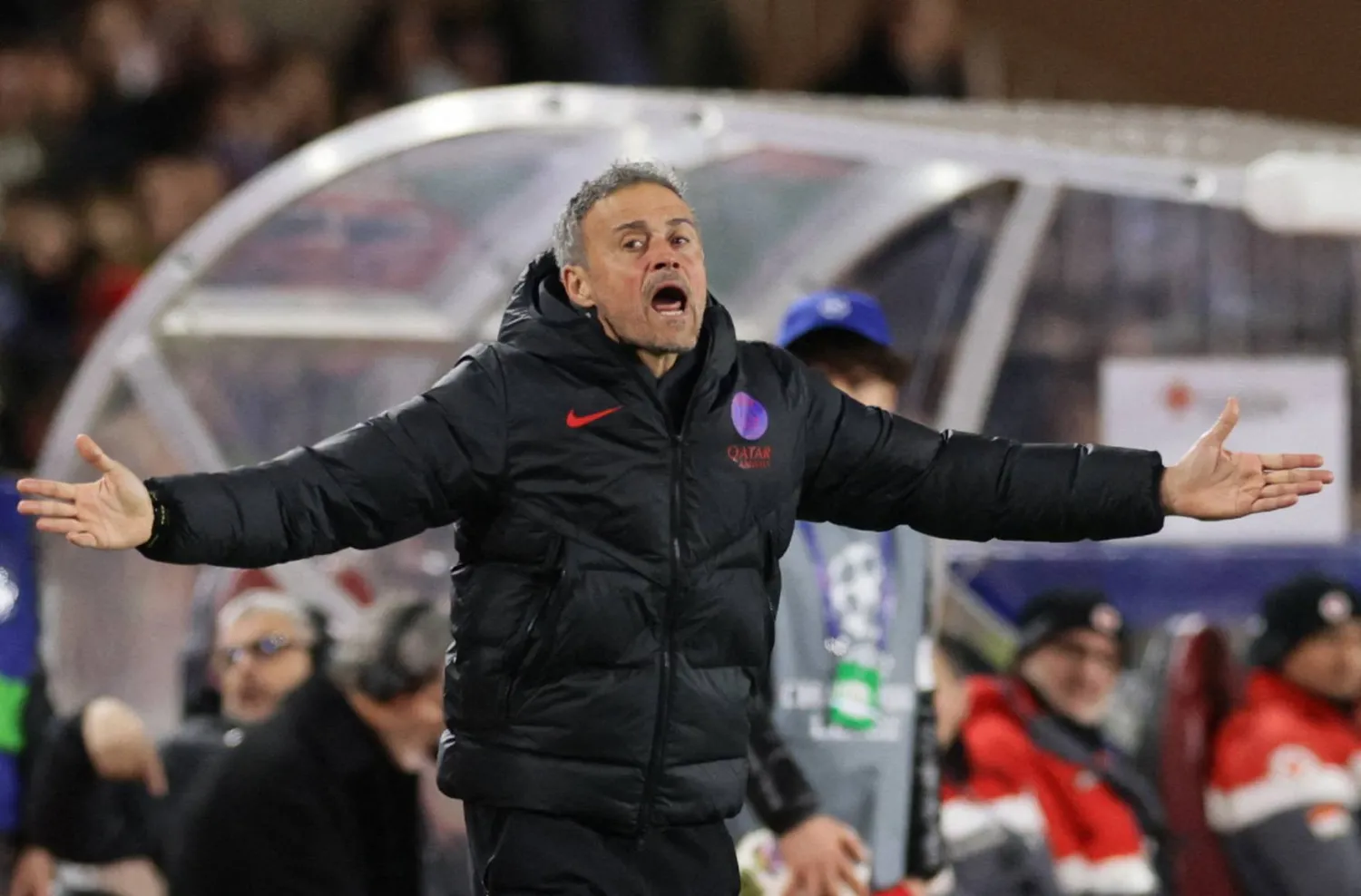
Paris Saint-Germain coach Luis ‌Enrique hailed the mental strength of his side in coming from two goals down to win 3-2 away at Monaco in the Champions League on Tuesday, but warned the knockout round tie was far from finished.

The first leg clash between the two Ligue 1 clubs saw Folarin Balogun score twice for the hosts in the opening 18 minutes before Vitinha had his penalty saved to compound matters.

But after Desire Doue came on for injured Ousmane Dembele, the ‌match turned ‌and defending champions PSG went on to ‌secure ⁠a one-goal advantage ⁠for the return leg.

"Normally, when a team starts a match like that, the most likely outcome is a loss,” Reuters quoted Luis Enrique as saying.

“It was catastrophic. It's impossible to start a match like that. The first two times they overcame our pressure and entered our half, they scored. They ⁠made some very good plays.

“After that, it's difficult ‌to have confidence, but we ‌showed our mental strength. Plus, we missed a penalty, so ‌it was a chance to regain confidence. In the ‌last six times we've played here, this is only the second time we've won, which shows how difficult it is.”

The 20-year-old Doue scored twice and provided a third for Achraf Hakimi, just ‌days after he had turned in a poor performance against Stade Rennais last Friday ⁠and was ⁠dropped for the Monaco clash.

“I'm happy for him because this past week, everyone criticized and tore Doue apart, but he was sensational, he showed his character. He helped the team at the best possible time.”

Dembele’s injury would be assessed, the coach added. “He took a knock in the first 15 minutes, then he couldn't run.”

The return leg at the Parc des Princes will be next Wednesday. “Considering how the match started, I'm happy with the result. But the match in Paris will be difficult, it will be a different story,” Luis Enrique warned.