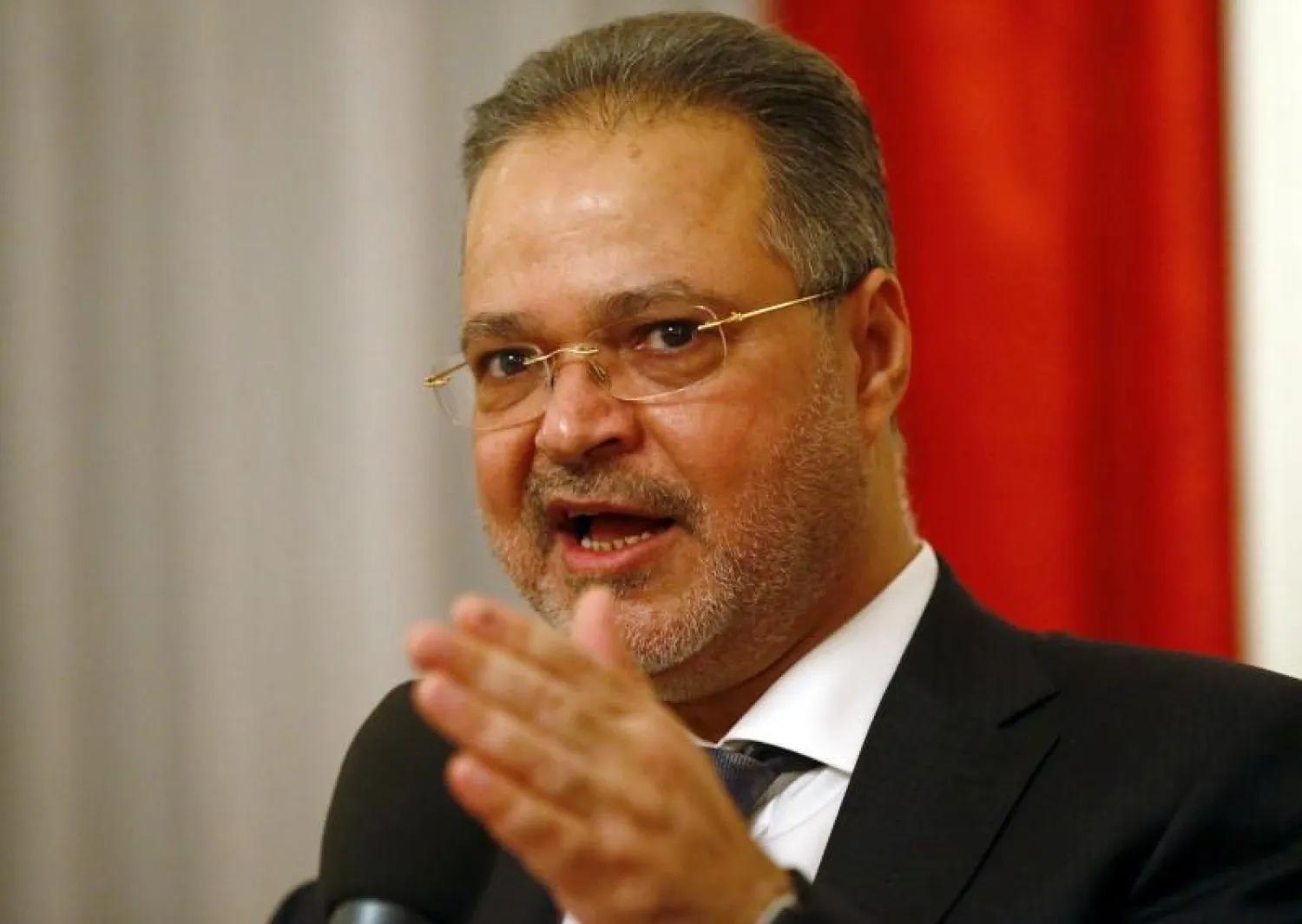
Mekhlafi: Disarming Insurgents is Essential for Peace in Yemen

Yemeni Foreign Minister Abdel-Malek al-Mekhlafi speaks to the media after the Yemen peace talks in Switzerland in Bern December 20, 2015. REUTERS/Ruben Sprich
TT

Mekhlafi: Disarming Insurgents is Essential for Peace in Yemen

Yemeni Foreign Minister Abdel-Malek al-Mekhlafi speaks to the media after the Yemen peace talks in Switzerland in Bern December 20, 2015. REUTERS/Ruben Sprich

A meeting of foreign ministers and chiefs of staff of the Arab Coalition to Support Yemen’s Legitimacy is scheduled to take place in the Saudi capital next week to discuss a number of issues, including  the situation on the ground and pushing the Yemeni peace process forward.
 
In remarks to Asharq Al-Awsat, Yemeni Deputy Prime Minister and Foreign Minister Abdel-Malek al-Mekhlafi said that his government would stress during the upcoming meeting its commitment to peace, especially in light of the latest international proposals that were approved by the Yemeni authorities.
 
He added that Yemen would provide a full explanation of the problems caused by the coup and the situation on the ground, underlining the need to force the rebels to disarm, to consolidate the legitimate authority and to curb Iran’s influence in the country.
 
While noting that his country calls for more efforts at the humanitarian and relief levels, he said that the Yemeni government would express its appreciation and thanks to brotherly countries within the coalition for all the work achieved to alleviate the suffering of the Yemeni people.
 
 “We are at a turning point, in which much has been achieved in the last period in favor of the restoration of the state, putting an end to this coup, and strengthening the presence of the Yemeni government across the Yemeni territories. We are in a new phase seeking to realize greater and wider victory, especially that the Arab coalition has achieved a lot on the ground and in the political process,” Al-Mekhlafi stated.
 
For his part, Maj. Gen. Taher al-Aqili, Yemeni Chief of Staff, said that the upcoming meeting in Riyadh would touch on all the topics related to the war in Yemen, including the situation on the ground.
 
“We will talk in the meeting about everything we know, because the main objective is to achieve security and local stability,” he told Asharq Al-Awsat.
 
The Chief of Staff confirmed that all indicators were in favor of the legitimate government and the Arab coalition forces on all fronts.
 
“There is a clear retreat by the rebels,” he said. “We are waiting for a political decision to wage military actions to liberate the remaining cities under insurgent control.”



Iran Mobilizes Remnants of Fourth Division to Stoke Syria Unrest

 Circulating images of Syria’s Fourth Division
Circulating images of Syria’s Fourth Division
TT

Iran Mobilizes Remnants of Fourth Division to Stoke Syria Unrest

 Circulating images of Syria’s Fourth Division
Circulating images of Syria’s Fourth Division

The Syria TV website said Iran has been working since early December to mobilize remnants of the Fourth Division, which was linked to Iran and previously overseen by Maher al-Assad, the brother of fugitive President Bashar al-Assad, to inflame the situation in Syria.

Citing regional security sources, the website reported that Iran is utilizing Ghiyath Dalla, the former commander of the Fourth Division, along with Maj. Gen. Kamal Hassan, a former head of military intelligence, and Maj. Gen. Ghassan Bilal, who previously served in the Fourth Division’s command.

According to the sources, Iran’s Islamic Revolutionary Guard Corps, which has over recent months kept dozens of officers from the Fourth Division and military intelligence in camps it controls along the Iraqi border, in Lebanon’s Hermel area, and in areas under the control of formations linked to the Kurdistan Workers Party in eastern Syria, is pushing for their return to Syrian territory and the mobilization of former Assad regime elements for a new wave of security operations.

The New York Times recently published a report based on interviews with participants in those moves and a review of correspondence between them, showing that the former leadership figures are determined to reassert their influence in Syria, which remains gripped by tensions more than 13 years after the outbreak of civil war.

The newspaper said it had received credible information that some former figures in the Assad regime are working to build an armed insurgent movement from exile.

One of them is backing a lobbying campaign in Washington, estimated to cost millions of dollars, in the hope of securing control over Syria’s coastal region, the stronghold of the Alawite sect to which Assad and many of his senior military and security commanders belong.

Returning to the information cited by Syria TV, Iran has several objectives in fueling tensions in Syria. Chief among them is easing US pressure on Iran in the Iraqi arena along the Iranian border, where the US envoy to Baghdad is pressing Iraqi factions to disband.

Escalation in Syria would serve as a distraction and diversion from those efforts.

The report said pressure is also expected to intensify on Lebanon’s Hezbollah to complete the process of disarming, with the possibility that it could face new military operations, alongside a potential new Israeli attack on Iran.

Mobilizing remnants of the Assad regime and extending their presence in Syria would give Tehran and Hezbollah greater room to maneuver, rather than remaining confined to a defensive posture.

They could also be used in intelligence operations to track future Israeli movements preemptively.


Somali President to Visit Türkiye After Israeli Recognition of Somaliland

 Somalia's President Hassan Sheikh Mohamud delivers a joint press conference with the German Chancellor after talks at the Chancellery in Berlin, on November 5, 2024. (AFP)
Somalia's President Hassan Sheikh Mohamud delivers a joint press conference with the German Chancellor after talks at the Chancellery in Berlin, on November 5, 2024. (AFP)
TT

Somali President to Visit Türkiye After Israeli Recognition of Somaliland

 Somalia's President Hassan Sheikh Mohamud delivers a joint press conference with the German Chancellor after talks at the Chancellery in Berlin, on November 5, 2024. (AFP)
Somalia's President Hassan Sheikh Mohamud delivers a joint press conference with the German Chancellor after talks at the Chancellery in Berlin, on November 5, 2024. (AFP)

Somalia's president is to visit Türkiye on Tuesday following Israel's recognition of the breakaway territory of Somaliland, Türkiye’s presidency said.

Somali President Hassan Sheikh Mohamud will hold talks "on the current situation in Somalia in the fight against terrorism, measures taken by the federal Somali government towards national unity and regional developments", Burhanettin Duran, head of the Turkish presidency's communications directorate, said on X.

Türkiye on Friday denounced Israel's recognition of Somaliland, a self-proclaimed republic, calling it "overt interference in Somalia's domestic affairs".

Somaliland declared independence in 1991.

The region has operated autonomously since then and possesses its own currency, army and police force.

It has generally experienced greater stability than Somalia, where Al-Shabaab militants periodically mount attacks in the capital Mogadishu.

Diplomatic isolation has been the norm -- until Israel's move to recognize it as a sovereign nation, which has been criticized by the African Union, Egypt, the six-nation Gulf Cooperation Council and the Saudi-based Organization of Islamic Cooperation.

The European Union has insisted Somalia's sovereignty should be respected.

The recognition is the latest move by Israel that has angered Türkiye, with relations souring between the two countries in recent years.

Ankara has strongly condemned Israel's offensive in the Gaza Strip, and Israel has opposed Türkiye’s participation in a future stabilization force in the Palestinian territory.


Iraq's Parliament Elects Al-Halbousi as Its New Speaker

 The new speaker of parliament Haibet Al-Halbousi, center, looks on before the start of their first legislative session in Baghdad, Iraq, Monday, Dec. 29, 2025. (AP Photo/Hadi Mizban)
The new speaker of parliament Haibet Al-Halbousi, center, looks on before the start of their first legislative session in Baghdad, Iraq, Monday, Dec. 29, 2025. (AP Photo/Hadi Mizban)
TT

Iraq's Parliament Elects Al-Halbousi as Its New Speaker

 The new speaker of parliament Haibet Al-Halbousi, center, looks on before the start of their first legislative session in Baghdad, Iraq, Monday, Dec. 29, 2025. (AP Photo/Hadi Mizban)
The new speaker of parliament Haibet Al-Halbousi, center, looks on before the start of their first legislative session in Baghdad, Iraq, Monday, Dec. 29, 2025. (AP Photo/Hadi Mizban)

Iraq's parliament on Monday elected a new speaker following overnight talks to break a political deadlock.

Haibet Al-Halbousi received 208 votes from the 309 legislators who attended, according to The AP news. He is a member of the Takadum, or Progress, party led by ousted speaker and relative Mohammed al-Halbousi. Twenty legislators did not attend the session.

Iraq held parliamentary elections in November but didn’t produce a bloc with a decisive majority. By convention, Iraq’s president is always Kurdish, while the more powerful prime minister is Shiite and the parliamentary speaker is Sunni.

The new speaker must address a much-debated bill that would have the Hashd al-Shaabi, or Popular Mobilization Units become a formal security institution under the state. Iran-backed armed groups have growing political influence.

Al-Halbousi also must tackle Iraq’s mounting public debt of tens of billions of dollars as well as widespread corruption.

Babel Governor Adnan Feyhan was elected first deputy speaker with 177 votes, a development that might concern Washington. Feyhan is a member of the Asaib Ahl al-Haq, or League of the Righteous, a US-sanctioned, Iran-backed group with an armed wing led by Qais al-Khazali, also sanctioned by Washington.