The English Managerial Success Story Shunned By The Premier League

 Graham Potter is borne aloft by his Ostersund players after reaching the group stage of the Europa League in August by beating PAOK. Photograph: Nils Petter Nilsson/Getty Images
Graham Potter is borne aloft by his Ostersund players after reaching the group stage of the Europa League in August by beating PAOK. Photograph: Nils Petter Nilsson/Getty Images
TT

The English Managerial Success Story Shunned By The Premier League

 Graham Potter is borne aloft by his Ostersund players after reaching the group stage of the Europa League in August by beating PAOK. Photograph: Nils Petter Nilsson/Getty Images
Graham Potter is borne aloft by his Ostersund players after reaching the group stage of the Europa League in August by beating PAOK. Photograph: Nils Petter Nilsson/Getty Images

Graeme Jones knew there was something atypical about the full-back who had joined him in signing on for a League Two season at Boston United. It was 2003 and winter was, for different reasons, drawing in on both men’s playing careers: Jones had been a prolific goalscorer in the lower divisions but was 33 and had half an eye on what was next; Graham Potter was five years younger and had never quite strung together a few consistent seasons in the top two tiers with Birmingham, Stoke, Southampton and West Bromwich Albion. There was a sense of disillusionment in Potter but there was more, too: a spark behind it all that, in 10 years as a professional, Jones had rarely seen in a team-mate.

“I knew he was different and that’s what attracted me to his personality,” Jones remembers. “Different as a boy, as a lad, and I enjoyed that as I was probably of a similar ilk. I liked his humour, I liked his intelligence and we really connected on that level.”

A close friendship developed and both men are a long way from York Street now. Jones will patrol touchlines in Russia next summer as assistant to Roberto Martínez with Belgium. It is Potter, though, whose star has risen to a degree that, on raw facts alone, defies comprehension. When he took over as manager of Ostersund in December 2010 he inherited a dysfunctional fourth-tier side from the north of Sweden; seven years on they are a win away from qualifying for the Europa League knockout stage and, since July, have taken the scalps of Galatasaray, PAOK and Hertha Berlin.

That is breathtaking in itself but Potter’s story is an example of what can happen when, with a happy confluence of time and place, talent is given the space to flourish. He had, in Jones’s words, “found the game, and management in particular, really, really frustrating” as a player, feeling his technical attributes were misunderstood, and retired two years after the pair met. Potter worked as football development manager at Hull and Leeds Metropolitan universities, completing a master’s in leadership and emotional intelligence at the latter. The occasional offer to play again held little appeal and had another chance friendship struck up by Jones not borne fruit, it is hard to imagine there would be a tale of this magnitude to relay.

At the heart of Ostersund is their irrepressible chairman, Daniel Kindberg, a former army battalion commander prone to seemingly fantastical statements that, unusually in a sport full of people eager to patent different shapes of wheel, keep on coming true. These days Kindberg says with a straight face that Ostersund can win this season’s Europa League and, after that, the Champions League; there were more mundane priorities when, in the summer of 2006, he asked the Premier League for three academy coaches to work with the club’s young players.

Jones, by now looking after Middlesbrough’s under-14s, was one of them and quickly became a close confidant. Players and coaches from his contacts book soon started coming over to this outpost of 50,000 inhabitants, based in an area far better known for winter sports. Kindberg trusted his judgment but hesitated in 2009 when a callow Potter was put forward for the manager’s job. “Daniel met him and wasn’t sure,” Jones says. “But they got relegated that season and he said to me: ‘What do you think now?’ I replied: ‘I told you the best person for the job was Graham Potter.’”

Jones feared Potter would need some persuading to sit down with Kindberg again; fortunately Potter did not demur and now in a better place himself having completed his studies and become a father, this time a quick agreement was reached.

With hindsight you wonder how Kindberg could ever have hesitated. Ostersund, who quickly won three promotions under Potter and are the current cup holders, play the kind of constructive, flexible football their manager had pined for while traipsing around the English leagues. Equally noteworthy are the resources Potter has used to achieve his end: his methods are centred on a willingness to revitalise players others had long since consigned to the scrapheap. That nous for emotional intelligence has come in especially handy and it does not take conversations of undue length with some of his players to discern heartfelt feeling about the turnarounds, personal and professional, Potter has wrought.

Ostersund’s captain, Brwa Nouri, had been blacklisted by Swedish clubs after a number of infractions but is now a driving force in their European campaign and has described Potter as “one of the best men I’ve ever met in my life”. Other success stories include Curtis Edwards, a wing-back who had, by his own admission, “not conducted myself right” while coming through at Middlesbrough. Edwards’s was a tale of the usual vices – nightclubs, alcohol, gaming, girls – and by the age of 20 he was working on building sites for his father while playing Northern League Division Two football with Thornaby. Potter found him trying to make some sort of living in Sweden’s fifth division with Ytterhogdals IK 18 months ago; Edwards is now 23 and scored a superb half-volley in the 2-2 Europa League draw with Athletic Bilbao last month.

The point is that, just as players aged between 18 and 21 have plenty to learn in football terms, they are also incomplete people. It seems obvious enough but Potter’s approach is far removed from the norm in England, where the cutting loose of talent in that age bracket frequently causes heads to shake on the continent. Jamie Hopcutt, a 25-year-old winger who was released by York City in 2010, was one of Ostersund’s matchwinners against Galatasaray in the second qualifying round and had last been playing for Tadcaster Albion when Potter caught what others had missed.

Having come this far, Edwards is honest enough to say Ostersund represent a shop window. “It’d be nice to go back to England, but if it didn’t happen it wouldn’t feel like I’d failed,” he says. “I’m happy where I am but obviously want to progress, whether there or somewhere else.” He is far from the only player to have attracted interest; the vultures will circle as soon as the European run ends but a more complicated question surrounds the future of Ostersund’s prize asset.

It is, depending on your perspective, either scarcely credible or grimly predictable that Potter has attracted next to no serious attention in discussions around the recent vacancies at Everton, West Ham and Sunderland. His selling points hardly need spelling out; sadly, nor does the fear of the little-known that pervades Premier League and Championship boardrooms. Kindberg has fielded interested phone calls in the past but it speaks volumes that no odds are readily available on Potter for any current roles in England.

“I know for a fact that he can go to the very top,” Jones says. “The problem is that he’s got such job security at Ostersund: he’s allowed to work, Daniel trusts him and you can’t really measure how important that is.”

The adage, per Sir Alex Ferguson, that you pick a chairman rather than a club has particular mileage here. Would Potter be able to thrive at a chaotic Stadium of Light, for example? He may feel tempted to ponder anew when Ostersund exit the Europa League; that will not be until in the new year if Zorya Luhansk are beaten at the Jämtkraft Arena on 23 November and, having narrowly missed out on guaranteed qualification for next season’s competition after a fifth-placed finish in the 2017 Allsvenskan, a new challenge could be a logical next step.

“I speak to Graham all the time: we’ve always got football issues to speak about, as well as having a giggle and a laugh as friends,” Jones says. They can reflect on the wonders that were born on a training pitch in Lincolnshire; the question now is whether anyone closer to home will trust Potter – and, if so, whether Potter should really trust them.

The Guardian Sport


IOC Boss Coventry Hails Milano Cortina Games a Success

 20 February 2026, Italy, Milan: President of the International Olympic Committee (IOC) Kirsty Coventry holds a press conference. (dpa)
20 February 2026, Italy, Milan: President of the International Olympic Committee (IOC) Kirsty Coventry holds a press conference. (dpa)
TT

IOC Boss Coventry Hails Milano Cortina Games a Success

 20 February 2026, Italy, Milan: President of the International Olympic Committee (IOC) Kirsty Coventry holds a press conference. (dpa)
20 February 2026, Italy, Milan: President of the International Olympic Committee (IOC) Kirsty Coventry holds a press conference. (dpa)

The Milano Cortina Olympics exceeded expectations despite a shaky build-up, IOC President Kirsty Coventry said on Friday, hailing the first spread-out Winter Games a success.

"These Games are truly ... successful in a new way of doing things, in a sustainable way of doing things, in a way that I think many people thought maybe we couldn't do, or couldn't be done well, and it's been done extremely well, and it's surpassed everyone's expectations," Coventry told a press conference.

It was the International Olympic Committee chief's clearest endorsement yet of a format that split events across several Alpine clusters rather than concentrating them in one host city.

Her assessment came after two weeks in which organizers sought to prove that a geographically dispersed Games could still deliver a consistent athlete experience.

The smooth delivery ‌comes after years ‌of logistical and political challenges, including construction delays at Milan’s Santagiulia Arena ‌and ⁠controversy over building ⁠a new sliding center in Cortina against IOC advice.

Organizers have also faced isolated disruptions during the Games, such as suspected sabotage on rail lines and protests in Milan over housing and environmental issues.

Transport concerns across the dispersed venues have been mitigated by limited cross-regional travel among spectators, though some competitors had to walk to the Cortina Curling Olympic Stadium in heavy snowfall that stopped traffic.

Central to the success of the Games, Coventry argued, was the effort to standardize conditions across multiple athlete villages despite the distances separating venues from Cortina d’Ampezzo to ⁠Livigno and Bormio.

Italian athletes’ performances also helped ticket sales, which amounted to ‌about 1.4 million.

"And the athletes are extremely happy. And they're happy ‌because the experiences that the MiCo (Milano Cortina) team and my team delivered to them have been the same," she ‌said.

Mixed relay silver medalist Tommaso Giacomel did, however, lament the fact there was no Olympic village near ‌the Antholz-Anterselva Biathlon Arena and that competitors were dotted around different hotels near the venue instead of in one place.

TWO OPENING CEREMONIES

Two opening ceremonies were held - the main one at Milan’s San Siro stadium and a more low-key parade on Cortina d’Ampezzo's Corso Italia, where athletes and spectators were within touching distance.

Feedback from competitors suggested the more intimate ‌settings had in some cases enhanced the Olympic atmosphere, Coventry said, taking the Cortina opening ceremony as an example.

The Zimbabwean, presiding over her first Games ⁠as IOC chief after elections in ⁠2025, framed Milano Cortina as proof of concept for future hosts grappling with rising costs and climate constraints, while acknowledging adjustments would follow.

"It allows us to really look at ourselves and look at the things that we have in place and how we're then going to make certain adjustments for the future," she said.

Beyond logistics, Coventry pointed to the broader impact of the Games, highlighting gender balance - with women making up 47% of competitors - and global engagement as marks of progress.

"But it's been an incredible experience and we're all very proud to have gender equity playing a big role in the delivery of the Games," she said, describing a "tremendous Games" in which athletes have "come together and shared in their passion".

With the closing ceremony in Verona approaching, Coventry said the focus would soon shift to a formal evaluation process, but insisted the headline conclusion was already clear.

"So we look forward to doing that and to learning from all the incredible experiences that I think all of the stakeholders have had across these Games, across these past two weeks," she said.


‘A Huge Mistake.’ Kompany Hits Out at Mourinho for Vinícius Júnior Comments

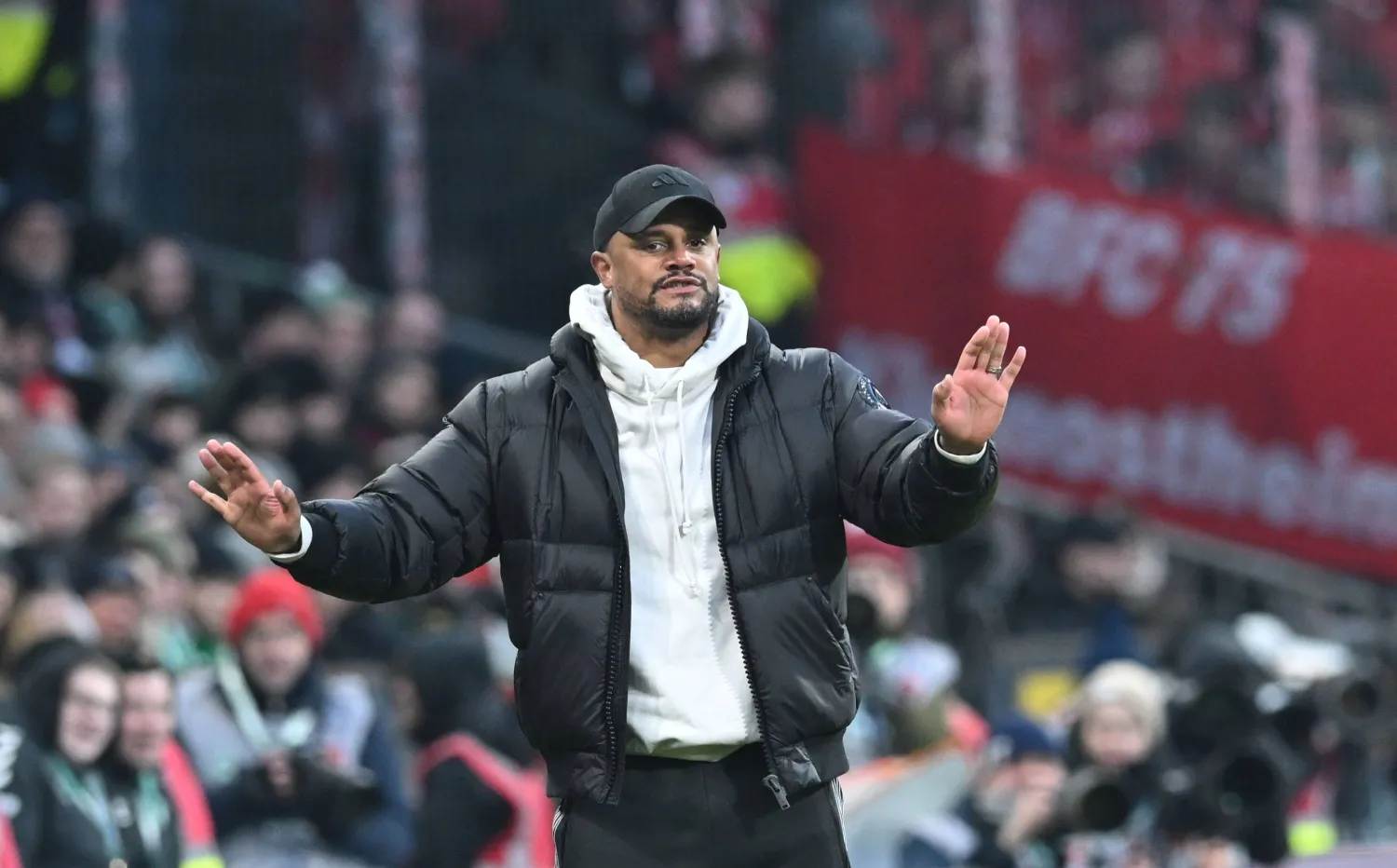
14 February 2026, Bremen: Bayern Munich coach Vincent Kompany gestures during the German Bundesliga soccer match between Werder Bremen and Bayern Munich at Weserstation. (dpa)
TT

‘A Huge Mistake.’ Kompany Hits Out at Mourinho for Vinícius Júnior Comments

14 February 2026, Bremen: Bayern Munich coach Vincent Kompany gestures during the German Bundesliga soccer match between Werder Bremen and Bayern Munich at Weserstation. (dpa)

Bayern Munich coach Vincent Kompany has criticized José Mourinho for attacking the character of Vinícius Júnior after the Real Madrid star accused an opponent of racially insulting him during a Champions League match.

Benfica coach Mourinho suggested that Brazil forward Vinícius had incited Benfica's players with his celebrations after scoring the only goal in Tuesday's playoff match.

Vinícius accused Benfica's Gianluca Prestianni of calling him "monkey" during a confrontation after his goal.

Mourinho also questioned why Vinícius, who is Black and has been subjected to repeated racist insults in Spain, was so frequently targeted.

"There is something wrong because it happens in every stadium," Mourinho said. "The stadium where Vinícius played something happened. Always."

Speaking on Friday, Kompany condemned Mourinho's comments.

"So after the game you have the leader of an organization, José Mourinho, who attacks the character of Vinícius Júnior by bringing in the type of celebration to discredit what Vinícius is doing in this moment," Kompany said. "And for me in terms of leadership, it’s a huge mistake and it’s something that we should not accept."

Mourinho’s celebrations

UEFA appointed a special investigator on Wednesday to gather evidence about what happened in Lisbon in Madrid’s 1-0 win in the first leg of the Champions League playoffs. Madrid said it had sent "all available evidence" of the alleged incident to European soccer's governing body.

Referring to Vinícius' celebrations after curling a shot into the top corner, Mourinho said he should "celebrate in a respectful way."

Kompany pointed out Mourinho's own history of exuberant celebrations — such as when he ran down the sideline to cheer when his Porto team beat Manchester United in the Champions League.

Kompany said Mourinho's former players "love him" and added "I know he’s a good person."

"I don’t need to judge him as a person, but I know what I’ve heard. I understand maybe what he’s done, but he’s made a mistake and it’s something that hopefully in the future won’t happen like this again," he said.

Prestianni denied racially insulting Vinícius. Benfica said the Argentine player was the victim of a "defamation campaign."

‘Right thing to do’

Kompany said Vinícius' reaction "cannot be faked."

"You can see it — his reaction is an emotional reaction. I don’t see any benefit for him to go to the referee and put all this misery on his shoulders," he said. "There is absolutely no reason for Vini Junior to go and do this.

"I think in his mind he’s doing it more because it’s the right thing to do in that moment."

Kompany added: "You have a player who’s complaining. You have a player who says he didn’t do it. And I think unless the player himself comes forward, it’s difficult. It’s a difficult case."


FIFA to Lead $75m Palestinian Soccer Rebuilding Fund

President of FIFA Gianni Infantino attended the inaugural meeting of US President Donald Trump's 'Board of Peace'. CHIP SOMODEVILLA / GETTY IMAGES NORTH AMERICA/AFP
TT

FIFA to Lead $75m Palestinian Soccer Rebuilding Fund

President of FIFA Gianni Infantino attended the inaugural meeting of US President Donald Trump's 'Board of Peace'. CHIP SOMODEVILLA / GETTY IMAGES NORTH AMERICA/AFP

FIFA will spearhead a $75 million fund to rebuild soccer facilities in Gaza that were destroyed by the war between Israel and Hamas, President Donald Trump and the sport's governing body said Thursday.

Trump made the announcement in Washington at the first meeting of his "Board of Peace," an amorphous institution that features two dozen of the US president's close allies and is initially focused on rebuilding the Gaza strip, said AFP.

"I'm also pleased to announce that FIFA will be helping to raise a total of $75 million for projects in Gaza," said Trump.

"And I think they're soccer related, where you're doing fields and you're getting the greatest stars in the world to go there -- people that are bigger stars than you and I, Gianni," he added, referring to FIFA president Gianni Infantino, who was present at the event.

"So it's really something. We'll soon be detailing the announcement, and if I can do I'll get over there with you," Trump said.

Later Thursday, FIFA issued a statement providing more details, including plans to construct a football academy, a new 20,000-seat national stadium and dozens of pitches.

The FIFA communique did not mention Trump's $75 million figure, and said funds would be raised "from international leaders and institutions."

Infantino has fostered close ties with Trump, awarding him an inaugural FIFA "Peace Prize" at the World Cup draw in December.

At Thursday's meeting, the FIFA president donned a red baseball cap emblazoned with "USA" and "45-47," the latter a reference to Trump's two terms in the White House.

In FIFA's statement, Infantino hailed "a landmark partnership agreement that will foster investment into football for the purpose of helping the recovery process in post conflict areas."

The "Board of Peace" came together after the Trump administration, teaming up with Qatar and Egypt, negotiated a ceasefire in October to halt two years of devastating war in Gaza.

The United States says it is now focused on disarming Hamas -- the Palestinian group whose unprecedented October 7, 2023, attack on Israel triggered the massive offensive.