Saudi Arabia Announces Contact Numbers to Report Wanted Houthis

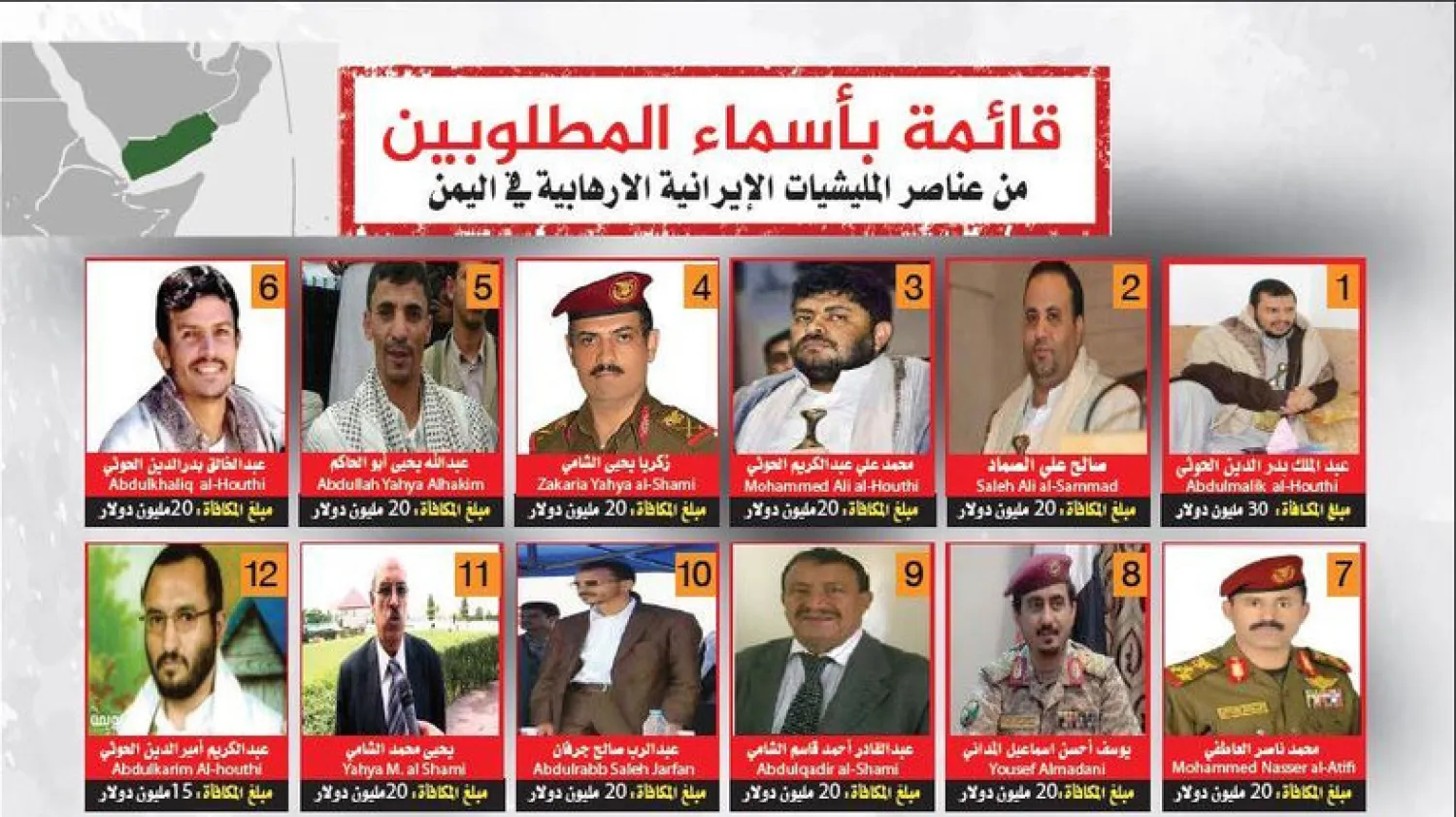
A number of wanted Houthi elements. SPA
TT

Saudi Arabia Announces Contact Numbers to Report Wanted Houthis

A number of wanted Houthi elements. SPA

Saudi Arabia announced contact numbers to report on the list of 40 wanted from the terrorist Houthi group.

It said that financial rewards will be given to anyone who provides relevant authorities with any helpful information that may lead to arresting or locating them.

Last week, Saudi Arabia announced a list of 40 wanted Houthi terrorist elements in Yemen, who are primarily responsible for planning, implementing and supporting various terrorist activities.

The Kingdom promised to pay up to $300 million for those who will provide it with information about their locations or that lead to their arrest.

The list was topped with Leader of the insurgents Abdulmalik Badreddin al-Houthi, Head of the so-called "Political Revolutionary Council" Saleh al-Sammad, Head of the so-called Revolutionary Committee of the Houthi armed militias Mohammed Ali al-Houthi, Zakariya al-Shami, Abdullah Yahya Abu al-Hakem, Abdulkhaliq al-Houthi, Mohammed al-Atifi, Yousif al-Madani, Abdulqader al-Shami, Abdulrab Jurfan and Yahya Al Shami.

Whoever provides information that leads to their arrest will be granted 20 million dollars.

The numbers for communication and receiving reports from inside and outside Yemen are: 00966555674409, 00966555674289, 00966555674293, WhatsApp: 00966555674293 and Telegram: Wanted990.


Israeli Forces Encircle Bint Jbeil in South Lebanon

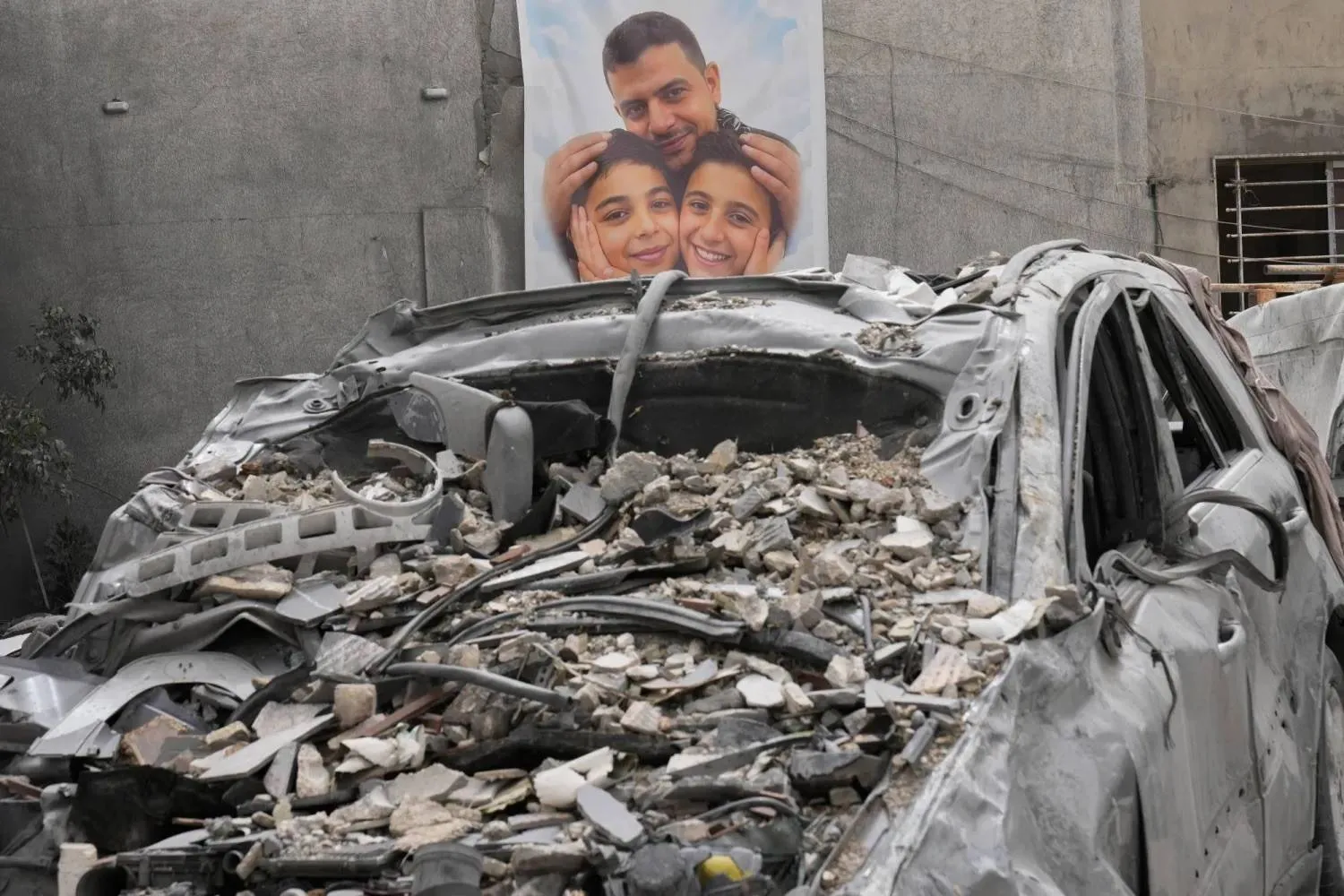
A poster of a man and two children killed in an Israeli air strike that targeted their home in south Lebanon (AP) 
TT

Israeli Forces Encircle Bint Jbeil in South Lebanon

A poster of a man and two children killed in an Israeli air strike that targeted their home in south Lebanon (AP) 

Military developments are accelerating in south Lebanon as Israel steps up pressure through a mix of strikes, evacuation warnings and what analysts describe as a strategy of isolating border towns, with Bint Jbeil emerging as a primary focus.

The Israeli army on Friday warned residents on the northern outskirts of the nearby town of Ain Ebel to move further inside, in what appeared to be an effort to regroup civilians within designated areas.

Attention has centered on Bint Jbeil, where Israel appears to be avoiding a direct ground assault.

Retired Brigadier General Said Kozah told Asharq Al-Awsat that Israeli forces were “relying on a tactic of full encirclement rather than advancing directly into the town”.

He said troops were tightening a cordon along several axes — from Aitaroun and Aainata to the east and south, from Aita al-Shaab toward the outskirts of Haddatha in the north, and potentially from Ain Ebel in the west — effectively isolating Bint Jbeil on all sides.

Kozah noted that the evacuation of Salah Ghandour Hospital in the Saf al-Hawa area, a key junction linking the town to surrounding areas, pointed to an Israeli push to control supply and movement routes.

He added that Israel typically avoids combat in densely built areas due to the high cost, suggesting it may instead rely on heavy bombardment before any ground incursion.

“Bint Jbeil, with its prepared defenses, could become a costly war of attrition,” he stated, adding that a large-scale assault appeared unlikely in the immediate term.

Instead, he said, the likely scenario was continued encirclement, disruption of supply lines and clashes on the outskirts unless battlefield conditions shift.

Alongside developments in the south, Israel expanded pressure to Beirut’s southern suburbs.

Israeli army spokesman Avichay Adraee renewed warnings Friday, urging residents of Haret Hreik, Ghobeiry, Laylaki, Hadath, Burj al-Barajneh, Tahwitat al-Ghadir and Shiyah to evacuate immediately.

In the western Bekaa, Israel struck a bridge linking Sohmor and Mashghara over the Litani River after issuing prior warnings and calling on residents to move north of the Zahrani River.

An Israeli drone later struck worshippers leaving a mosque in Sohmor, killing two people and wounding 11 others, in a sign that strikes were extending to civilian gatherings.

Air strikes resumed on Beirut’s southern suburbs after two days of relative calm, while heavy bombardment continued across the south.

A house between Kafra and Srifa near a center run by the Islamic Health Authority was hit, burning an ambulance without causing injuries.

Strikes also hit Srifa, Braachit, Jouaiya, Borj Qalaouiyeh, Debaal, Ramadiyeh, Bustan, Yohmor al-Shaqif and Shaaitiyeh, with casualties reported, including among Syrians.

Additional strikes targeted Debbine and Srifa in the Tyre district, while intermittent artillery fire hit the outskirts of Haris and Kafra.

Drones were reported flying intensively over Hermel, the northern Bekaa, Beirut, Mount Lebanon and the southern suburbs as part of broad surveillance operations.

At dawn, Apache helicopters fired on the coastline from Bayyada to Mansouri, coinciding with clashes on the ground. Hezbollah fighters were reported to have attacked Israeli forces advancing toward the coastal road near Bayyada.

Overnight strikes hit Bint Jbeil, Hanine, Kounine and Tayri, while eastern Brachit came under artillery fire. Israeli forces also blew up remaining houses in Aita al-Shaab, with explosions heard as far as Tyre.

Separately, Lebanon’s National News Agency said three Indonesian soldiers serving with a UN peacekeeping unit were wounded at their base in Adaisseh by a shell, with the source under investigation.

Hezbollah said it fired rockets toward northern Israel, targeting Kiryat Shmona, troop positions at Honin barracks and military sites in Safed, as well as Metula and Kfar Yuval.

The group also said it detonated an explosive device against Israeli forces in Bayyada, causing casualties that required helicopter evacuation before the area was later shelled.



Hamas Hopes Pressure Will Amend Gaza Disarmament Plan

Gunmen from Hamas’ Izz al-Din al-Qassam Brigades in Nuseirat refugee camp, central Gaza, February 2025 (EPA)
TT

Hamas Hopes Pressure Will Amend Gaza Disarmament Plan

Gunmen from Hamas’ Izz al-Din al-Qassam Brigades in Nuseirat refugee camp, central Gaza, February 2025 (EPA)

Hamas is pressing mediators to secure changes to a plan presented more than a week ago by Nikolay Mladenov, the High Representative of the “Board of Peace,” which calls for the full disarmament of Gaza without exception.

A Hamas delegation in Cairo is holding intensive talks with Palestinian factions and Egyptian officials, alongside meetings with representatives of the Board of Peace, including Mladenov, who has already met the group again, Asharq Al-Awsat has learned.

A senior Hamas official in Cairo said the movement has delivered a clear message to mediators: the proposal in its current form is unacceptable to Palestinians.

The official said amendments must bind Israel to complete the remaining terms of the first phase of the ceasefire agreement and commit to the second phase, particularly a full and immediate withdrawal, in line with the 20-point plan presented by US President Donald Trump during negotiations last September.

Hamas, they said, is still consulting internally and with other factions, with no final position yet on disarmament. Any response will depend on changes to the plan, especially guarantees of Israeli withdrawal and an end to what the official described as repeated ceasefire violations.

The official also accused Israel of restricting aid and goods, engineering shortages, tightening movement through the Rafah crossing, and using armed groups to search and humiliate travelers.

They said talks with mediators are focused on forcing revisions to the proposal.

A second Palestinian faction source said the plan is unjust and requires major changes, not only on weapons but also on withdrawal mechanisms, reconstruction, and governance, which he said must remain purely Palestinian without foreign oversight.

Linking disarmament to second-phase measures, including reconstruction limited to disarmed areas, amounts to blackmail, he said, adding that all Palestinian factions reject such conditions.

Reuters cited three sources, two Egyptian and one Palestinian, as saying Hamas has told mediators it will not discuss disarmament without guarantees of a full Israeli withdrawal from Gaza, as outlined in the Board of Peace proposal.

Hamas has also demanded an end to Israeli violations, full implementation of all provisions, and clarification over Israel’s expanding control in the enclave.

Two Hamas officials declined to comment, while the Israeli government and Board of Peace representatives did not respond to requests for comment, Reuters reported.

Israel insists on full disarmament of Gaza, including light and heavy weapons. The Board of Peace plan calls for dismantling tunnel networks and surrendering weapons in stages over eight months, with a full Israeli withdrawal only after Gaza is verified to be free of weapons.

Trump’s top Board of Peace envoy in the Middle East, Mladenov, said on X that all mediators had endorsed the plan and helped shape it before presenting it to Hamas.

"(The) international community has supported it, now is the time to agree to the framework for its implementation. For the sake of both Palestinians and Israelis, there is not time to lose," he said in the post.


Baghdad Says Faction Attacks are ‘Individual Attempts’

Members of the Popular Mobilization Forces stand guard during a pro-Iran rally in Tahrir Square on April 2, 2026 (AFP)
TT

Baghdad Says Faction Attacks are ‘Individual Attempts’

Members of the Popular Mobilization Forces stand guard during a pro-Iran rally in Tahrir Square on April 2, 2026 (AFP)

The Iraqi government moved on Friday to contain the fallout from an escalating regional war, after the US issued sharp warnings of possible attacks on its interests inside Iraq.

Prime Minister Mohammed Shia al-Sudani vowed to pursue those behind attacks and the kidnapping of foreigners, saying the law would be enforced “without red lines.”

The move comes as the confrontation between the US and Israel on one side, and Iran on the other, spills further into Iraq, through rocket and drone attacks and mounting humanitarian and economic strains, including an extended closure of Iraqi airspace.

Iraq’s foreign ministry, responding to a US Embassy statement urging American citizens to leave immediately, said Iraq “is not a party to the conflict and does not wish to be part of it,” reaffirming a policy of distancing itself from the crisis.

The embassy warned that “Iran-aligned militias” could carry out attacks in the near term, underscoring fears that the conflict could spread into Iraq.

The foreign ministry said such incidents were “individual attempts” that do not reflect state policy, adding that some actors may take unilateral steps “contrary to the state’s direction.”

It described the actions as “illegal” and said holding the state responsible amounted to “unjustified generalization,” as Iraq faces growing pressure given its geography and ties with both Washington and Tehran.

Security push

Sudani chaired a security meeting at the Interior Ministry’s intelligence headquarters with senior officials to address threats to diplomatic missions, vital facilities, and the kidnapping of foreigners.

He called for “maximum measures” to pursue those responsible and stressed that enforcing the law would face “no red lines,” regardless of the party involved. He also ordered stronger intelligence efforts and higher readiness as regional tensions intensified.

This comes as uncertainty persists over the fate of American journalist Shelly Kittleson kidnapped in Baghdad, with no group claiming responsibility, highlighting ongoing challenges in securing foreign interests.

Observers say Baghdad’s description of the attacks as “individual” aims to avoid direct responsibility and preserve a delicate balance in relations with Washington and Tehran.

Unclear strike

A security source said an airstrike hit a gravel plant in al-Rutba district in western Anbar province. “Unknown” warplanes carried out the strike early Friday, with no casualties or significant damage reported. Authorities have opened an investigation.

Local data showed the Kurdistan region has been hit by 614 rockets and drones since Feb. 28 through midday Friday.

The attacks killed 14 people and wounded 93, with Erbil accounting for 484 projectiles, Sulaymaniyah 103, Duhok 25, and Halabja two.

The figures underscore mounting pressure on the region as it remains within the wider theater of confrontation.

Displacement rises

A report by the International Organization for Migration said regional tensions have begun to drive internal displacement.

It recorded 90 families displaced in Sulaymaniyah province by March 24 due to fears of drone strikes.

Baghdad and Erbil also saw limited displacement, with residents leaving affected areas to stay with relatives or in rented homes in rural areas.

Iraq’s civil aviation authority extended the suspension of air traffic for seven more days, from 12 p.m. Friday to the same time on April 10, describing the move as a temporary precaution based on ongoing security assessments.

The extension reflects fears of a wider escalation or the use of Iraqi airspace in further military action, leaving Baghdad to navigate a difficult balance: preventing the country from becoming an open conflict arena while maintaining ties with regional and international powers.