


Artemis Astronauts More than Halfway to Moon, Putting Earth in Rearview

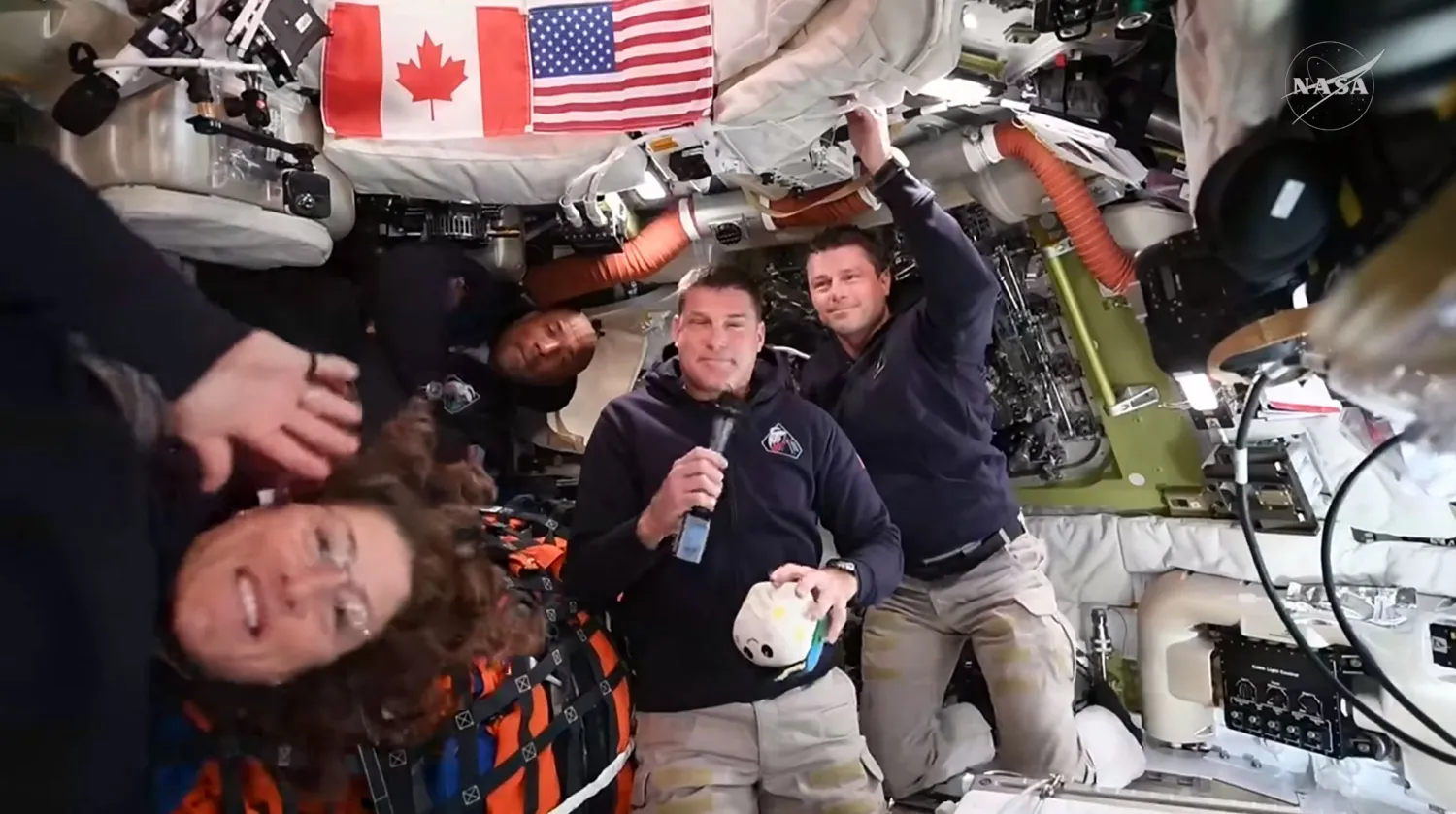
This screengrab from a NASA live broadcast video shows (L-R) NASA astronaut and Artemis II Mission Specialist Christina Koch, NASA astronaut and Artemis II pilot Victor Glover, Canadian Space Agency astronaut Artemis II Mission Specialist Jeremy Hansen and NASA astronaut and Artemis II Commander Reid Wiseman during a press call as they travel to the Moon in the Orion spacecraft, on April 3, 2026.  (Photo by NASA / AFP)
This screengrab from a NASA live broadcast video shows (L-R) NASA astronaut and Artemis II Mission Specialist Christina Koch, NASA astronaut and Artemis II pilot Victor Glover, Canadian Space Agency astronaut Artemis II Mission Specialist Jeremy Hansen and NASA astronaut and Artemis II Commander Reid Wiseman during a press call as they travel to the Moon in the Orion spacecraft, on April 3, 2026. (Photo by NASA / AFP)
TT

Artemis Astronauts More than Halfway to Moon, Putting Earth in Rearview

This screengrab from a NASA live broadcast video shows (L-R) NASA astronaut and Artemis II Mission Specialist Christina Koch, NASA astronaut and Artemis II pilot Victor Glover, Canadian Space Agency astronaut Artemis II Mission Specialist Jeremy Hansen and NASA astronaut and Artemis II Commander Reid Wiseman during a press call as they travel to the Moon in the Orion spacecraft, on April 3, 2026.  (Photo by NASA / AFP)
This screengrab from a NASA live broadcast video shows (L-R) NASA astronaut and Artemis II Mission Specialist Christina Koch, NASA astronaut and Artemis II pilot Victor Glover, Canadian Space Agency astronaut Artemis II Mission Specialist Jeremy Hansen and NASA astronaut and Artemis II Commander Reid Wiseman during a press call as they travel to the Moon in the Orion spacecraft, on April 3, 2026. (Photo by NASA / AFP)

The Artemis 2 astronauts have passed the halfway point between Earth and the Moon on Saturday as they sped toward a planned lunar flyby, with NASA releasing initial images of Earth taken from inside the Orion spacecraft.

Astronaut Christina Koch said the crew had a collective "expression of joy" upon being told of the milestone, which was hit around two days, five hours and 24 minutes after the spacecraft blasted off from the Kennedy Space Center in Florida, AFP said.

"We can see the Moon out of the docking hatch right now, it is a beautiful sight," Koch said around 11 pm (0400 GMT) Friday, according to the space agency's official live broadcast.

NASA's online dashboard showed early Saturday that the Orion spacecraft carrying the astronauts was more than 229,000 kilometers (142,000 miles) from Earth.

The space agency earlier released images from Orion that included a full portrait of Earth, featuring its deep blue oceans and billowing clouds.

After a flurry of high-stakes activity including a dramatic blast-off and an engine firing that catapulted them on their historic trajectory to circle the Moon, the four astronauts aboard were able to catch their breath, even as they continued to perform a variety of equipment checks and tests.

"There has been a tremendous amount of disbelief for me, it's just so extraordinary," said Canadian Jeremy Hansen during a Q&A session with press late Thursday.

"I really like it up here," said Hansen, on his first ever journey to space. "The views are extraordinary."

"It's really fun to be floating around" in zero gravity, he added. "It just makes me feel like a little kid."

Hansen is on the crew with Americans Koch, Victor Glover and Reid Wiseman.

They are due to loop around the Moon early next week -- a feat not accomplished in more than 50 years.

NASA official Lakiesha Hawkins praised the photographs taken by commander Wiseman, calling them "amazing" during a briefing Friday.

"We continue to learn all about our spacecraft as we operate it in deep space with crew for the first time," Hawkins said.

"It's important to remind ourselves of that as we learn a little bit more day by day."

- 'Great spirits' -

Friday's to-do list includes a CPR demonstration and medical kit checks, the US space agency said, as well as preparation for the scientific observations they'll need to document when they are closest to the Moon on day six of their journey.

NASA officials reported Friday that all systems were performing well, and that the astronauts were in "great spirits" and had spoken to their families.

The next major milestone of the approximately 10-day journey is expected overnight Sunday into Monday, at which point the astronauts will enter the "lunar sphere of influence" -- when the Moon's gravity will have stronger pull on the spacecraft than Earth's.

If all proceeds smoothly, as Orion whips around the Moon the astronauts could set a record by venturing farther from Earth than any human before.

"There is nothing normal about this," said mission commander Wiseman late Thursday.

"Sending four humans 250,000 miles away is a Herculean effort, and we are now just realizing the gravity of that."

The Artemis 2 mission is part of a longer-term plan to repeatedly return to the Moon, with the goal of establishing a permanent lunar base that will offer a platform for further exploration.



France, Germany Send Firefighters to Help Battle Dutch Blazes

A French firefighter douses burning vegetation during a bushfire in Budel, Netherlands May 1, 2026. (Reuters)
TT

France, Germany Send Firefighters to Help Battle Dutch Blazes

A French firefighter douses burning vegetation during a bushfire in Budel, Netherlands May 1, 2026. (Reuters)

France and Germany sent firefighting units to the Netherlands on Friday to help battle woodland blazes flaring in several areas.

Many of the fires, which sparked on Wednesday and Thursday, were raging in land used for military training, including an artillery range, in the south.

Stretched Dutch authorities requested help facing the emergency through the EU Civil Protection Mechanism, with France and Germany responding.

French Interior Minister Laurent Nunez said on X that Paris had dispatched 41 civil security personnel and 10 vehicles.

A total of 67 firefighters, 21 vehicles and three trailers were sent by the Bonn fire service in Germany.

A Dutch military spokesman, Major Mike Hofman, on Friday confirmed to AFP that army "training grounds were in use at the time the fires broke out".

He said an investigation was under way "examining whether there is a connection between the military operations and the origin of the fires".

The head of the Dutch armed forces said on Thursday that extra precautions were being taken on terrain used for drills because of a drought currently parching the country.

He added, however, that the military exercises being conducted would not be suspended.


Oscar Statuette for 'Mr. Nobody Against Putin' Goes Missing on Flight

FILE PHOTO: File Photo: Pavel Talankin arrives at the Vanity Fair Oscars party after the 98th Academy Awards, in Beverly Hills, California, US, March 16, 2026. REUTERS/Danny Moloshok/File Photo/File Photo
TT

Oscar Statuette for 'Mr. Nobody Against Putin' Goes Missing on Flight

FILE PHOTO: File Photo: Pavel Talankin arrives at the Vanity Fair Oscars party after the 98th Academy Awards, in Beverly Hills, California, US, March 16, 2026. REUTERS/Danny Moloshok/File Photo/File Photo

The Oscar statuette belonging to Pavel Talankin, the Russian director who won best documentary this year for "Mr. Nobody Against Putin," has gone missing after he was forced to check the award into hold luggage on a flight from New York to Germany, his co-director said.

Talankin was due to fly from John F. Kennedy International Airport to Frankfurt on German carrier Lufthansa. But Transportation Security Administration (TSA) agents told him that the 8.5 lb (3.8 kg) statuette posed a potential security threat, his co-director David Borenstein said on Thursday.

"At the airport, a ⁠TSA agent stopped ⁠him and said the Oscar could be used as a weapon," Borenstein said on Instagram.

"Pavel didn’t have a bag to check it in, so the TSA put the Oscar in a box and sent it to the bottom of the plane," he said, posting a series of pictures, ⁠including of the box.

"It never arrived in Frankfurt."

Responding to Borenstein's Instagram post, Lufthansa said it was taking the matter seriously.

"We deeply regret this situation," a company spokesperson later said in response to a Reuters request for comment.

"Our team is handling this matter with the utmost care and urgency and we are conducting a comprehensive internal search to ensure that the Oscar is found and returned as soon as possible.”

Speaking to the online magazine Deadline.com after arriving in Germany on Thursday, ⁠Talankin ⁠said it was "completely baffling how they consider an Oscar a weapon."

On previous flights on various airlines, he had flown with it "in the cabin, and there never was any kind of problem," he told the outlet.

Talankin and Borenstein's documentary used two years of footage that Talankin recorded at a school where he worked in Russia's Chelyabinsk region, to show how students were exposed to pro-war messaging.

The 35-year-old Talankin, who fled Russia in 2024, has defended the film as a record for posterity to show how "an entire generation became angry and aggressive."


Russia Successfully Test Launches New Soyuz-5 Rocket from Kazakhstan, Space Agency Says

The ⁠new rocket is ‌capable of ‌carrying payloads of up to ‌17 metric tons. (AP file)
TT

Russia Successfully Test Launches New Soyuz-5 Rocket from Kazakhstan, Space Agency Says

The ⁠new rocket is ‌capable of ‌carrying payloads of up to ‌17 metric tons. (AP file)

Russia has test launched its new Soyuz-5 rocket for the first time, the country's space agency said late on Thursday, saying it had lifted off from the Baikonur cosmodrome in Kazakhstan without any issues.

The Soyuz-5, which Roscosmos, ‌Russia's space ‌agency, describes as a ‌launch ⁠vehicle equipped with ⁠the world's most powerful liquid-fueled engine, lifted off successfully at 2100 Moscow time (1800 GMT) on April 30, it said in a statement.

The ⁠new rocket is ‌capable of ‌carrying payloads of up to ‌17 metric tons, will significantly ‌reduce launch costs, and is more effective than its predecessors at placing objects like satellites in near ‌earth orbit, the agency said.

Dmitry Bakanov, the head ⁠of ⁠Roskosmos, said the rocket - which he hailed as a "new step in space exploration" - would create new jobs in Russia and Kazakhstan.

Bakanov has previously told President Vladimir Putin that the Soyuz-5 is the first new launch vehicle that Russia has developed since 2014.