


The Gulf Between Arsenal, Tottenham Is Big, Getting Bigger

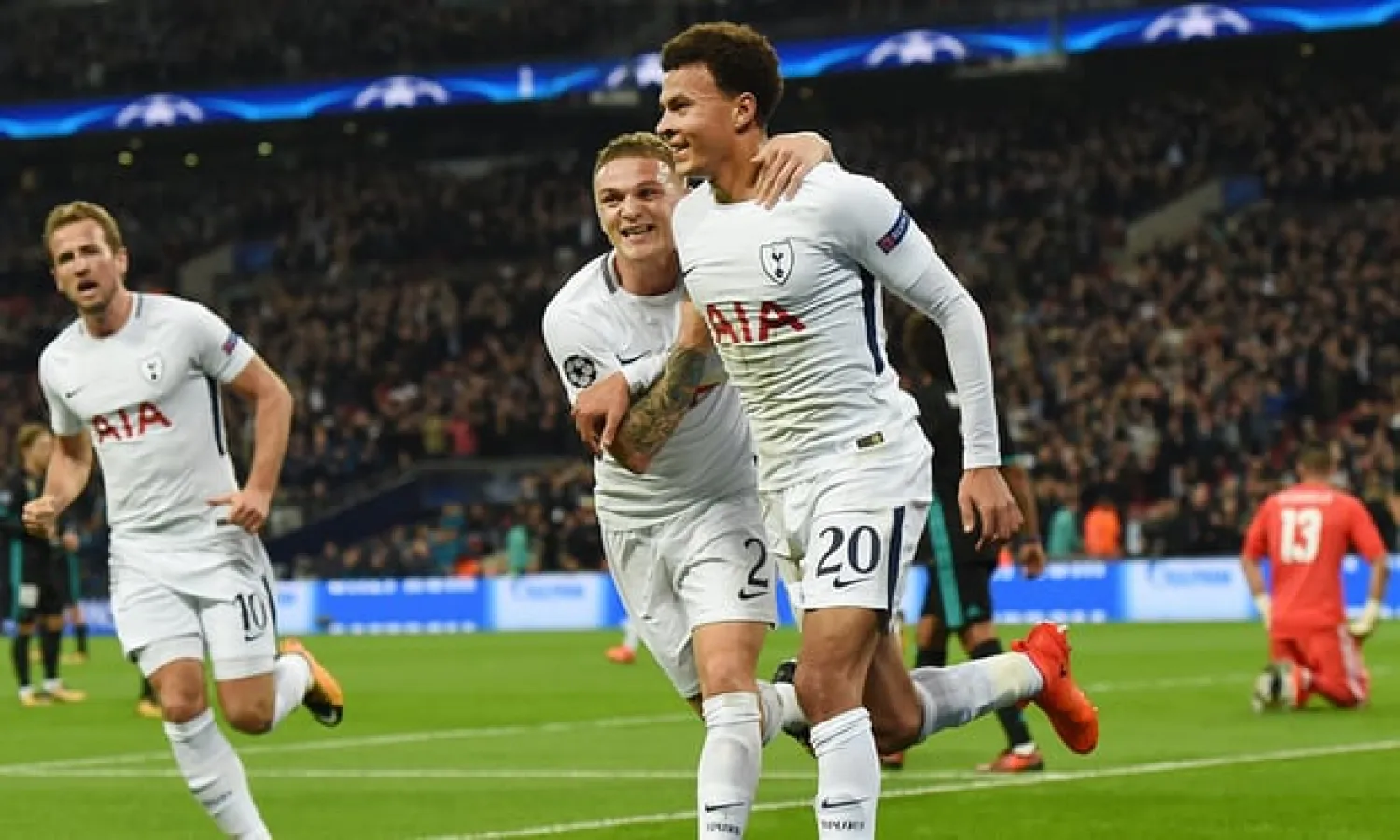
 Dele Alli, right, celebrates with Kieran Trippier as Harry Kane prepares to join in - the trio examplify what Tottenham are achieving with faith in youth and good recruitment. Photograph: Andy Rain/EPA
Dele Alli, right, celebrates with Kieran Trippier as Harry Kane prepares to join in - the trio examplify what Tottenham are achieving with faith in youth and good recruitment. Photograph: Andy Rain/EPA
TT

The Gulf Between Arsenal, Tottenham Is Big, Getting Bigger

 Dele Alli, right, celebrates with Kieran Trippier as Harry Kane prepares to join in - the trio examplify what Tottenham are achieving with faith in youth and good recruitment. Photograph: Andy Rain/EPA
Dele Alli, right, celebrates with Kieran Trippier as Harry Kane prepares to join in - the trio examplify what Tottenham are achieving with faith in youth and good recruitment. Photograph: Andy Rain/EPA

A gleaming new stadium looming over north London. A distinct style based around homegrown players paid a fraction of what other comparable clubs are paying. A foreign manager who arrived in England to widespread scepticism before being revered as a magus-like figure who has led a revolution in physical preparation. Tottenham are becoming the club Arsenal should have been.

They have even sold one of their better players to Manchester City – albeit, and this perhaps shows how they have improved on the Arsenal model – with a replacement already in place.

The difference – and Arsenal fans will rightly rush to point this out – is that Wenger actually won things, not just in his early days when he introduced sophisticated ideas such as basing nutrition around broccoli and pasta rather than beer and more beer, or buying players from France, but also more recently. Even in the three years since Mauricio Pochettino took over at Tottenham, Wenger leads the trophy count 2-0.

Finishing above Arsenal last season was a hugely significant moment for Spurs. For the first time since 1995, there was solid statistical evidence they are the best team in north London. This season, already, the gap between the sides is four points. It’s three years and six games since Arsenal last beat Tottenham in the league. As Spurs are beating Real Madrid and Borussia Dortmund in the Champions League, Arsenal are snoozing through deathly 0-0 draws against Red Star Belgrade in the Europa League. The FA Cups, the myth of St Totteringham’s Day, created a mirage: the gulf between Tottenham and Arsenal was significant even before last season and it is getting bigger.

And what perhaps makes the inversion of roles most galling for Arsenal is Tottenham have not accelerated past them with the sort of injection of cash that has elevated Chelsea and Manchester City. This is not financial doping (or at least not as Wenger used the term; others further down the pyramid, of course, may argue every Premier League club is roided to the eyeballs on television revenue). Tottenham are an example of what can be achieved through careful husbandry, a faith in youth and the establishment of a collective that works tactically and psychologically.

That in turn, casts Arsenal’s failings in a worse light. Wenger was unfortunate the economic future for the club he had mapped out, the new stadium closing the gap to the continent’s elite, was undermined by the unexpected interest in football from oil tycoons but what Tottenham have shown is subservience to oligarchs is not inevitable.

They benefit, from the fact they have their own billionaire in the background in the form of Joe Lewis but their net transfer spend since Pochettino arrived is £12m. Arsenal, in the same period, have a net spend of £199m. Net spend is not everything but it is a handy quick reference and for Arsenal it is a hugely troubling statistic.

But it’s perhaps not even the worst aspect in any comparison: that’s youth development. There could be six Tottenham players (plus Kyle Walker) in the England squad for the World Cup all of whom, bar Kieran Trippier, joined Tottenham before they were 20. Arsenal’s recent history is strewn with abandoned promise. Gareth Southgate’s most recent England squad featured not one Arsenal player. At 28, Theo Walcott is the oldest promising teenager in the world. At 25, Jack Wilshere is a riddle wrapped in a mystery shrouded by the smoke of a cheeky cigarette. At 28, Kieran Gibbs is at West Brom. At 24, Alex Oxlade-Chamberlain may just have got out in time.

The Emirates reeks of broken dreams, not just of individuals but of the club as a whole. Stagnation has become a way of life. That the futures of Alexis Sánchez and Mesut Özil linger undecided is extraordinary. What if they go in January? What if they don’t? What is the long-term plan? Is there a long-term plan? Again, for Arsenal, Tottenham offer an unwelcome contrast: Pochettino has been ruthless in his handling of Walker and, before him, Andros Townsend and Nabil Bentaleb, an attitude that presumably helped persuade Danny Rose to fall – at least partially – back into line after his act of minor rebellion in the summer.

Problems will come for Tottenham, new stadium or not. They cannot keep paying players so much less than their rivals. Walker will not be the only key player to see opportunities elsewhere. Pochettino, too, may be lured away. It’s still not entirely clear how much the move to a new stadium will restrict finances. It’s entirely possible that in a decade, football will be wondering how Tottenham spurned this immense opportunity. Existence on the mezzanine just below the elite is never easy, the transition to becoming part of the elite all but impossible.

But at least there is a plan. At least there is a possible golden future. Four and a half miles away there is merely drift. Tottenham may not yet be the club Arsenal could have been but Arsenal are the club Tottenham don’t want to become.

The Guardian Sport


Shakhtar Boss Pays Ukrainian Racer $200,000 After Games Disqualification

Ukrainian President Volodymyr Zelenskiy holds helmet as he meets with a Ukrainian skeleton racer Vladyslav Heraskevych , who was disqualified from the Olympic skeleton competition over his "helmet of remembrance" depicting athletes killed since Russia's invasion and his father and coach, Mykhailo Heraskevych, amid Russia's attack on Ukraine, in Munich, Germany February 13, 2026. (Ukrainian Presidential Press Service/Handout via Reuters)
TT

Shakhtar Boss Pays Ukrainian Racer $200,000 After Games Disqualification

Ukrainian President Volodymyr Zelenskiy holds helmet as he meets with a Ukrainian skeleton racer Vladyslav Heraskevych , who was disqualified from the Olympic skeleton competition over his "helmet of remembrance" depicting athletes killed since Russia's invasion and his father and coach, Mykhailo Heraskevych, amid Russia's attack on Ukraine, in Munich, Germany February 13, 2026. (Ukrainian Presidential Press Service/Handout via Reuters)

The owner of ‌Ukrainian football club Shakhtar Donetsk has donated more than $200,000 to skeleton racer Vladyslav Heraskevych after the athlete was disqualified from the Milano Cortina Winter Games before competing over the use of a helmet depicting Ukrainian athletes killed in the war with Russia, the club said on Tuesday.

The 27-year-old Heraskevych was disqualified last week when the International Bobsleigh and Skeleton Federation jury ruled that imagery on the helmet — depicting athletes killed since Russia invaded Ukraine in 2022 — breached rules on athletes' expression at ‌the Games.

He ‌then lost an appeal at the Court ‌of ⁠Arbitration for Sport hours ⁠before the final two runs of his competition, having missed the first two runs due to his disqualification.

Heraskevych had been allowed to train with the helmet that displayed the faces of 24 dead Ukrainian athletes for several days in Cortina d'Ampezzo where the sliding center is, but the International Olympic Committee then ⁠warned him a day before his competition ‌started that he could not wear ‌it there.

“Vlad Heraskevych was denied the opportunity to compete for victory ‌at the Olympic Games, yet he returns to Ukraine a ‌true winner," Shakhtar President Rinat Akhmetov said in a club statement.

"The respect and pride he has earned among Ukrainians through his actions are the highest reward. At the same time, I want him to ‌have enough energy and resources to continue his sporting career, as well as to fight ⁠for truth, freedom ⁠and the remembrance of those who gave their lives for Ukraine," he said.

The amount is equal to the prize money Ukraine pays athletes who win a gold medal at the Games.

The case dominated headlines early on at the Olympics, with IOC President Kirsty Coventry meeting Heraskevych on Thursday morning at the sliding venue in a failed last-minute attempt to broker a compromise.

The IOC suggested he wear a black armband and display the helmet before and after the race, but said using it in competition breached rules on keeping politics off fields of play. Heraskevych also earned praise from Ukraine President Volodymyr Zelenskiy.


Speed Skating-Italy Clinch Shock Men’s Team Pursuit Gold, Canada Successfully Defend Women’s Title

 Team Italy with Davide Ghiotto, Andrea Giovannini, Michele Malfatti, celebrate winning the gold medal on the podium of the men's team pursuit speed skating race at the 2026 Winter Olympics, in Milan, Italy, Tuesday, Feb. 17, 2026. (AP)
Team Italy with Davide Ghiotto, Andrea Giovannini, Michele Malfatti, celebrate winning the gold medal on the podium of the men's team pursuit speed skating race at the 2026 Winter Olympics, in Milan, Italy, Tuesday, Feb. 17, 2026. (AP)
TT

Speed Skating-Italy Clinch Shock Men’s Team Pursuit Gold, Canada Successfully Defend Women’s Title

 Team Italy with Davide Ghiotto, Andrea Giovannini, Michele Malfatti, celebrate winning the gold medal on the podium of the men's team pursuit speed skating race at the 2026 Winter Olympics, in Milan, Italy, Tuesday, Feb. 17, 2026. (AP)
Team Italy with Davide Ghiotto, Andrea Giovannini, Michele Malfatti, celebrate winning the gold medal on the podium of the men's team pursuit speed skating race at the 2026 Winter Olympics, in Milan, Italy, Tuesday, Feb. 17, 2026. (AP)

An inspired Italy delighted the home crowd with a stunning victory in the Olympic men's team pursuit final as

Canada's Ivanie Blondin, Valerie Maltais and Isabelle Weidemann delivered another seamless performance to beat the Netherlands in the women's event and retain their title ‌on Tuesday.

Italy's ‌men upset the US who ‌arrived ⁠at the Games ⁠as world champions and gold medal favorites.

Spurred on by double Olympic champion Francesca Lollobrigida, the Italian team of Davide Ghiotto, Andrea Giovannini and Michele Malfatti electrified a frenzied arena as they stormed ⁠to a time of three ‌minutes 39.20 seconds - ‌a commanding 4.51 seconds clear of the ‌Americans with China taking bronze.

The roar inside ‌the venue as Italy powered home was thunderous as the crowd rose to their feet, cheering the host nation to one ‌of their most special golds of a highly successful Games.

Canada's women ⁠crossed ⁠the line 0.96 seconds ahead of the Netherlands, stopping the clock at two minutes 55.81 seconds, and

Japan rounded out the women's podium by beating the US in the Final B.

It was only Canada's third gold medal of the Games, following Mikael Kingsbury's win in men's dual moguls and Megan Oldham's victory in women's freeski big air.


Lindsey Vonn Back in US Following Crash in Olympic Downhill 

Milano Cortina 2026 Olympics - Alpine Skiing - Women's Downhill 3rd Official Training - Tofane Alpine Skiing Centre, Belluno, Italy - February 07, 2026. Lindsey Vonn of United States in action during training. (Reuters)
TT

Lindsey Vonn Back in US Following Crash in Olympic Downhill 

Milano Cortina 2026 Olympics - Alpine Skiing - Women's Downhill 3rd Official Training - Tofane Alpine Skiing Centre, Belluno, Italy - February 07, 2026. Lindsey Vonn of United States in action during training. (Reuters)

Lindsey Vonn is back home in the US following a week of treatment at a hospital in Italy after breaking her left leg in the Olympic downhill at the Milan Cortina Games.

“Haven’t stood on my feet in over a week... been in a hospital bed immobile since my race. And although I’m not yet able to stand, being back on home soil feels amazing,” Vonn posted on X with an American flag emoji. “Huge thank you to everyone in Italy for taking good care of me.”

The 41-year-old Vonn suffered a complex tibia fracture that has already been operated on multiple times following her Feb. 8 crash. She has said she'll need more surgery in the US.

Nine days before her fall in Cortina d'Ampezzo, Italy, Vonn ruptured the ACL in her left knee in another crash in Switzerland.

Even before then, all eyes had been on her as the feel-good story heading into the Olympics for her comeback after nearly six years of retirement.
