

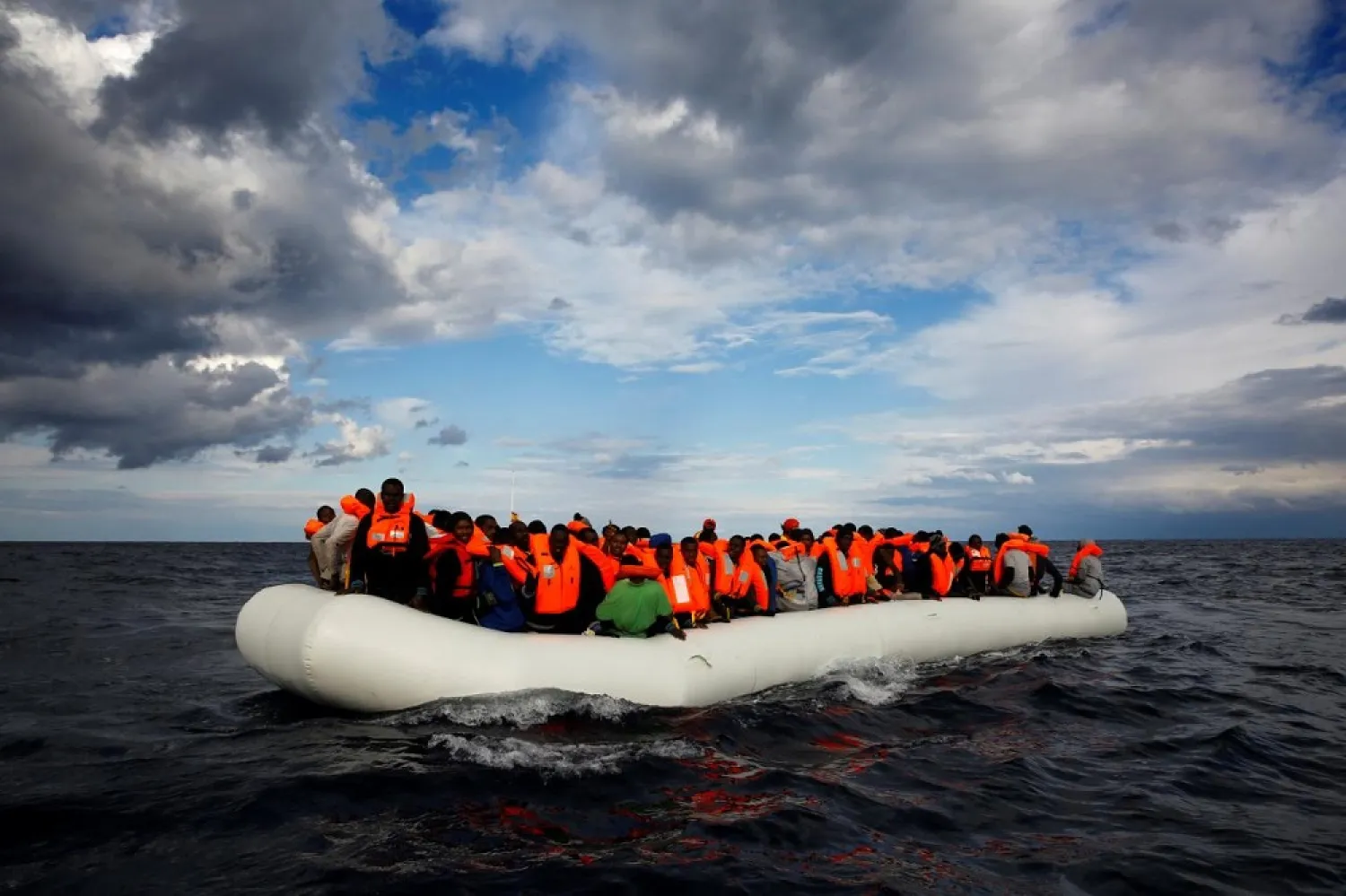

At Least 25 Migrants Killed in Boat Sinking Off Libya Coast

An overcrowded raft drifts out of control in the central Mediterranean Sea, some 36 nautical miles off the Libyan coast. (Reuters)
TT

At Least 25 Migrants Killed in Boat Sinking Off Libya Coast

An overcrowded raft drifts out of control in the central Mediterranean Sea, some 36 nautical miles off the Libyan coast. (Reuters)

At least 25 migrants died on Saturday after their boat sank off Libya’s western coast, Libyan coastguard officials announced.

Survivors were being brought back to port in Tripoli, they added.

Libya is the main departure point for mostly African migrants trying to cross to Europe. Smugglers usually pack them into flimsy inflatable boats that often break down or sink.

Most migrants are picked up by international vessels and taken to Italy, where more than 115,000 have landed so far this year, although an increasing number are intercepted by Libya’s European-backed coastguard and returned to the North African country.

Since July, there has been a sharp drop in crossings, though this week has seen a renewed surge in departures.

Nearly 3,000 migrants are known to have died or be missing after trying to cross to Europe by sea this year, the majority of them between Libya and Italy.

The International Organization for Migration said on Friday that since 2000 the Mediterranean had been “by far the world’s deadliest border”.

After record arrivals from 2014 to 2016, the European Union’s deal with Turkey to stop arrivals to Greece and blocks on migrants inside Libya and off its coast have greatly reduced the flow, the IIOM added.

Professor Philippe Fargues of the European University Institute in Florence, author of the report, said the figures probably underestimated the actual scale of the human tragedy.

“The report states that at least 33,761 migrants were reported to have died or gone missing in the Mediterranean between the year 2000 to 2017. This number is as of June 30,” IOM’s Jorge Galindo told a Geneva news briefing.

“It concludes that Europe’s Mediterranean border is by far the world’s deadliest,” he said.

So far this year some 161,000 migrants and refugees have arrived in Europe by sea, about 75 percent of them landing in Italy with the rest in Greece, Cyprus and Spain, according to IOM figures. Nearly 3,000 others are dead or missing, it said.

“Shutting the shorter and less dangerous routes can open longer and more dangerous routes, thus increasing the likelihood of dying at sea,” Fargues said.

The report said: “Cooperation with Turkey to stem irregular flows is now being replicated with Libya, the main country of departure of migrants smuggled along the central route; however, such an approach is not only morally reprehensible but likely to be unsuccessful, given the context of extremely poor governance, instability and political fragmentation in Libya.”

Though sea arrivals to Italy are down almost a third this year, this week there was a surge in rescues and attempted crossings.

On Friday, Libya’s EU-backed coastguard intercepted more than 600 mainly sub-Saharan African migrants, including many women and children, from a total of five boats that had left from the coast east of the Libyan capital, Tripoli, coast guard officials said.

On Wednesday and Thursday, Italy’s coast guard said some 1,600 migrants were rescued from nearly 20 vessels in the central Mediterranean.

Libya’s UN-backed government said on Thursday it was investigating reports of African migrants being sold as slaves and promised to bring the perpetrators to justice.

Footage broadcast by CNN appearing to show African migrants being traded in Libya sparked an international outcry and protests in Europe and Africa.



Türkiye Says SDF Has No Option but to Integrate into Syrian Army

Turkish Land Forces Commander Metin Tokel and Syrian Defense Minister Murhaf Abu Qasra meet in Damascus on December 11. (Turkish Defense Ministry)
TT

Türkiye Says SDF Has No Option but to Integrate into Syrian Army

Turkish Land Forces Commander Metin Tokel and Syrian Defense Minister Murhaf Abu Qasra meet in Damascus on December 11. (Turkish Defense Ministry)

Türkiye said on Friday that the Syrian Democratic Forces (SDF) have no alternative but to implement a March 10 agreement requiring their integration into the Syrian army, accusing Israel of encouraging the group to stall the deal through its actions in Syria.

In a statement, the Turkish Ministry of National Defense said the SDF, whose backbone is the Kurdish People’s Protection Units (YPG), is acting in violation of the agreement signed in Damascus between Syrian President Ahmad al-Sharaa and SDF commander Mazloum Abdi.

Ankara considers the YPG an extension of the Kurdistan Workers’ Party (PKK), which it designates as a terrorist organization.

Ministry spokesperson Zeki Akturk said the SDF’s continued activities, instead of integration despite the March 10 accord, undermine stability and security in Syria. He stressed that SDF members must join the Syrian army as individuals, not as an autonomous bloc.

He accused unnamed countries of encouraging the SDF through actions and rhetoric, to reject integration and disarmament, calling such efforts futile attempts to buy time.

He also said Turkish forces have destroyed 732 kilometers of SDF tunnels in areas of operations across northern and northeastern Syria, including four kilometers in Manbij.

Separately, Turkish Foreign Minister Hakan Fidan linked the SDF’s reluctance to implement the March 10 agreement to Israeli moves in Syria.

He said the SDF would reach an understanding with Damascus on integration the day Israel finds common ground with Syria, arguing that the SDF’s stance is not solely its own decision but influenced by Israel.

Fidan stressed that the agreement initially enjoyed support from Türkiye, the United States, and Syria, but that progress has stalled as the YPG/SDF refrains from taking required steps.

Expressing hope for a negotiated solution between Damascus and the SDF, Fidan said dialogue would reassure all communities, Arabs and Kurds alike. He warned that conflict would harm civilians and benefit no one, noting plans to unify armed factions under a single national army.

Meanwhile, Türkiye’s Defense Ministry announced a visit to Damascus by Land Forces Commander Metin Tokel, who met Syrian Defense Minister Murhaf Abu Qasra and Chief of Staff Ali Noureddine al-Naasan. Tokel also toured the joint Turkish-Syrian operations center.


Lebanese State Formally Launches Reconstruction Effort with Modest Public Funding

A member of the Civil Defense stands on the rubble of a house hit by an Israeli airstrike in the town of Jbaa in South Lebanon. (Reuters)
TT

Lebanese State Formally Launches Reconstruction Effort with Modest Public Funding

A member of the Civil Defense stands on the rubble of a house hit by an Israeli airstrike in the town of Jbaa in South Lebanon. (Reuters)

More than a year after the end of the war between Israel and Hezbollah, which caused widespread destruction in South Lebanon, the Lebanese state has formally launched its reconstruction effort, albeit with very limited public funding.

Within the framework of the 2026 state budget, Parliament’s Finance and Budget Committee approved allocations for the Council for Development and Reconstruction (CDR), the Council of the South, and the Higher Relief Committee.

It also endorsed the transfer of funds from the emergency reserve for shelter and repairs, a move committee chairman Ibrahim Kanaan described as “a positive signal from the Lebanese state to our people, within the limits of the budget.”

Committee sources said a total of $90 million was transferred from the reserve: $67 million to the Council of the South and $24 million to the Higher Relief Committee.

With the approval of these allocations, the state has effectively begun the reconstruction process with what lawmakers themselves describe as a very modest sum, after waiting for more than a year for foreign aid that never materialized. This marks the first direct state funding for reconstruction since the war ended in November 2024.

Foreign envoys have told Lebanese officials in recent months that international support for reconstruction is contingent on Lebanon implementing a package of financial reforms and, crucially, achieving exclusive state control over weapons. Lebanese officials believe the issue has since become even more complex, tied in particular to the trajectory of agreements with Israel.

The fate of a reconstruction conference spearheaded by France remains uncertain, especially as Paris has recently prioritized plans for a conference to support the Lebanese army, expected early next year.

Meanwhile, political divisions in parliament over expatriate voting have stalled legislative work, derailing the approval of World Bank loans linked to reconstruction that could total up to $500 million, according to Kanaan. He warned that the loans could be withdrawn if parliament fails to ratify them before the end of the year.

Parliamentary sources said lawmakers from the so-called Shiite duo — Hezbollah and the Amal Movement — insisted on reallocating part of the relatively large budget reserve toward reconstruction, arguing that the state must send a positive signal to citizens who have been neglected for over a year.

According to the sources, many lawmakers went along with the proposal under pressure, amid fears they would otherwise be held accountable by residents, especially given the risk of building collapses threatening lives.

Ali Hassan Khalil, an MP from Amal’s Liberation and Development Bloc, called on the government to issue the regulatory framework for reconstruction, saying the approved funds, while limited, would help address urgent shelter needs and serve as a starting point for a major national effort.

MP Hassan Fadlallah, of Hezbollah's Loyalty to the Resistance Bloc, said reconstruction requires large sums but stressed that the state cannot remain idle waiting for foreign funds, while welcoming any non-politicized, unconditional assistance.

Researcher Mohammad Shamseddine of Information International estimated total direct war damage at $8.5 billion, with reconstruction costs of about $2.3 billion. He told Asharq Al-Awsat the approved funding represents only a fraction of what is needed and confirms the state’s limited capacity, noting that foreign aid is unlikely before a definitive settlement and lasting peace with Israel.

The move drew objections from the Lebanese Forces party. MP Ghada Ayoub, a member of the Strong Republic Bloc and the Finance Committee, criticized what she called pressure to divert public funds to reconstruction, arguing that financing should come through a dedicated, internationally supervised fund and external assistance.

She said the priority should instead be strengthening the Lebanese army to ensure stability and enable the safe return of residents.


Britain Imposes Sanctions on RSF Leaders, Including Hemedti’s Brother

British Foreign Secretary Yvette Cooper. (AP)
TT

Britain Imposes Sanctions on RSF Leaders, Including Hemedti’s Brother

British Foreign Secretary Yvette Cooper. (AP)

Britain on Friday imposed sanctions on senior commanders of Sudan’s Rapid Support Forces (RSF), accusing them of involvement in mass killings, systematic sexual violence and deliberate attacks on civilians in Sudan.

The UK government said Abdul Rahim Hamdan Dagalo, the RSF’s deputy commander and brother of its leader Mohamed Hamdan Dagalo, known as Hemedti, along with three other commanders suspected of involvement in the crimes, are now subject to asset freezes and travel bans.

In an official statement, British Foreign Secretary Yvette Cooper said: “The atrocities taking place in Sudan are so horrific they scar the conscience of the world. The overwhelming evidence of heinous crimes - mass executions, starvation, and the systematic and calculated use of rape as a weapon of war - cannot and will not go unpunished.”

The RSF’s actions in el-Fasher are not random: they are part of a “deliberate strategy to terrorize” populations and seize control through fear and violence. The impact of their actions is visible from space. Satellite images of el-Fasher show blood-stained sand, clusters of bodies, and evidence of mass graves where victims have been burned and buried. There needs to be accountability for these actions, and urgent steps taken to avoid this happening again, it added.

Sanctioning RSF leaders suspected of mass killings and sexual violence in el-Fasher “sends a clear message that those who commit atrocities will be held accountable,” it continued, underscoring Britain’s commitment to preventing further crimes.

Those sanctioned include Abdul Rahim Hamdan Dagalo, the RSF deputy commander, whom the UK said there are reasonable grounds to suspect of involvement in mass killings, ethnically motivated executions, systematic sexual violence including gang rape, kidnapping for ransom, arbitrary detention, and attacks on health facilities and aid workers.

Also sanctioned is Gedo Hamdan Ahmed, the RSF commander in North Darfur, who is suspected of involvement in mass killings, sexual violence, kidnappings and attacks on medical teams and humanitarian staff.

The list further includes Al-Fateh Abdullah Idris, an RSF brigadier suspected of responsibility for violence against people based on ethnicity and religion and for deliberately targeting civilians, and Tijani Ibrahim Moussa Mohamed, an RSF field commander suspected of responsibility for the deliberate targeting of civilians in el-Fasher.

Britain urged all parties to the conflict to immediately end atrocities, protect civilians and remove obstacles to humanitarian access.

The government also pledged an additional £21 million to provide food, shelter, healthcare and protection for women and children in hard-to-reach areas on the brink of collapse. The funding, the statement said, will enable aid agencies to reach 150,000 people, meet basic needs, keep hospitals operating and reunite families separated by war.

The sanctions come after the United States, the United Arab Emirates, Egypt and Saudi Arabia proposed a three-month ceasefire plan in November, followed by peace talks. While the RSF initially accepted the plan, it later launched intensive drone strikes on army-held areas.

The war in Sudan, which erupted in April 2023 between the army and the RSF, has displaced millions.

Earlier this month, the UN Human Rights Council adopted a UK-led resolution condemning atrocities and mandating an urgent investigation into crimes committed in el-Fasher.

UN Secretary-General Antonio Guterres has described the war as a “scandal,” announcing plans to convene talks between the Sudanese army and the RSF in Geneva to press both sides to respect international humanitarian law, protect civilians and implement commitments made under the Jeddah Declaration.