

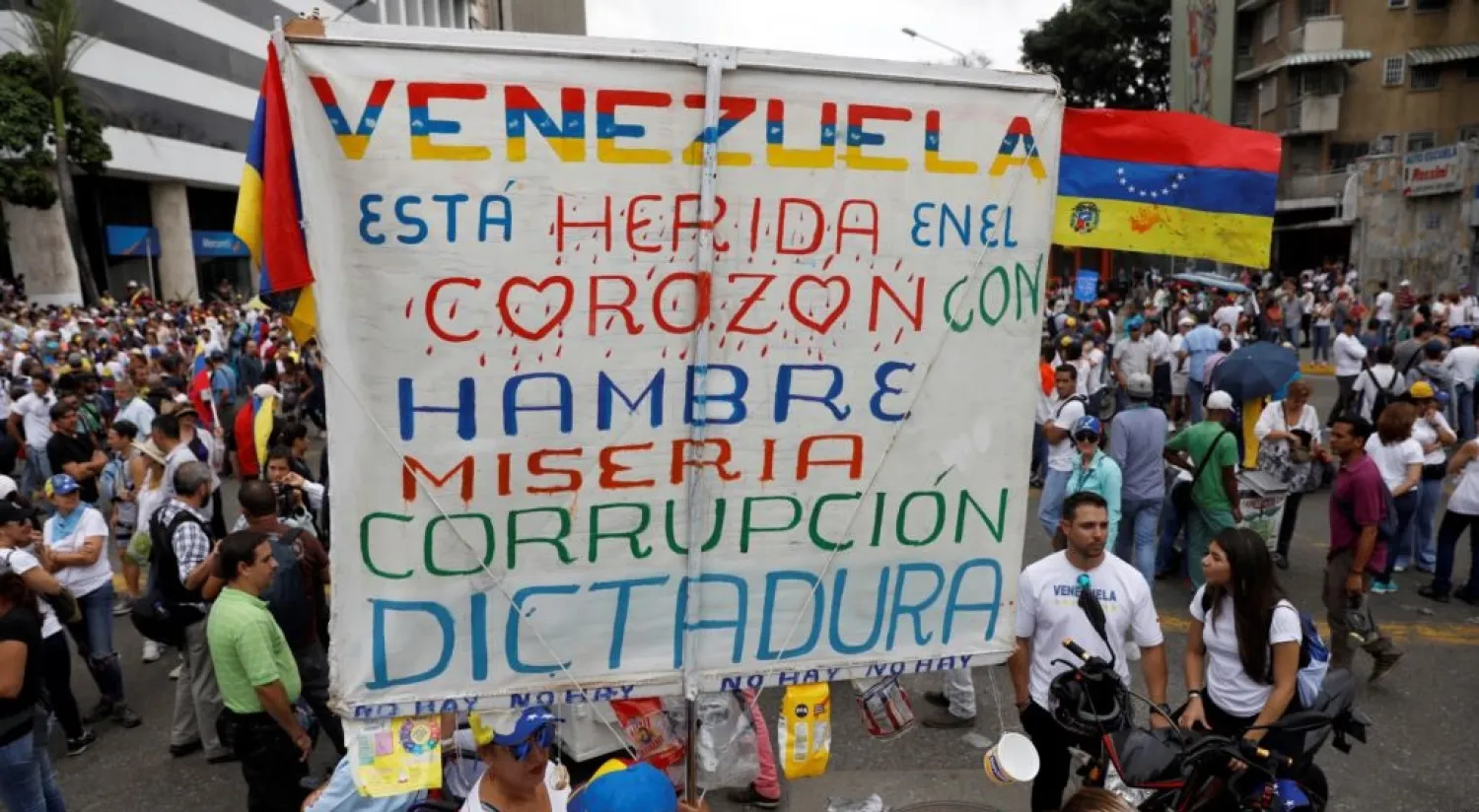

Venezuela Opposition Receives EU Human Rights Prize, Vows to Run in 2018 Polls

The opposition in Venezuela received a European Union prize for human rights. (Reuters)
TT

Venezuela Opposition Receives EU Human Rights Prize, Vows to Run in 2018 Polls

The opposition in Venezuela received a European Union prize for human rights. (Reuters)

The opposition in Venezuela, which has fought a fierce political battle against President Nicolas Maduro’s efforts to consolidate his power, received on Wednesday a European Union prize for human rights.

The opposition urged the world to keep a close eye on an upcoming presidential election where it aspires to end two decades of socialist rule in the OPEC nation.

Maduro’s adversaries failed to dislodge him during months of street protests this year that turned violent killing more than 125 people. The opposition has been left dismayed to see him consolidate his power in recent months.

But they hope a presidential vote due in 2018 will galvanize exhausted and despondent supporters, and want foreign pressure for reforms to an election system they say is at the service of Maduro’s “dictatorship”.

“In the next few months, there should be a presidential election and we ask Europe and the free world to pay full attention,” Julio Borges, head of the opposition-led National Assembly, said, receiving the Sakharov Prize.

“The regime has kidnapped democracy, and installed hunger and misery,” he added during the ceremony at the EU parliament in Strasbourg.

The prize, named after Soviet physicist and dissident Andrei Sakharov, was awarded this year to Venezuela’s National Assembly and “all political prisoners”, according to the citation.

Venezuela’s opposition won National Assembly elections in 2015, but the legislature has been sidelined by verdicts from the pro-government Supreme Court and the controversial election this year of a pro-Maduro Constituent Assembly superbody.

Another opposition leader Antonio Ledezma, who recently escaped house arrest in Venezuela and fled to Spain, said the EU prize ceremony was a painful moment because of the scores of opposition activists still jailed.

“I cannot be happy receiving this prize knowing that in the dungeons of Venezuela there remain, unjustly deprived of liberty, more than 300 political prisoners,” he said.

Maduro, the 55-year-old successor to Hugo Chavez who has ruled Venezuela since 2013, denies the existence of political prisoners, saying all activists in detention are there for legitimate charges such as coup-plotting and violence.

The opposition has a dilemma in choosing its candidate for the 2018 race, given that its most popular figures cannot run: Leopoldo Lopez is under house arrest, while Henrique Capriles is prohibited from holding office.

On Monday, opposition parties said they will not be bullied out of participating in future elections.

As the ruling socialists captured a majority of mayoral seats across Venezuela on Sunday, Maduro said that opposition parties would be banned from future elections as punishment for boycotting the races.

Juan Mejia, a leader of opposition party Voluntad Popular, called the vote an "electoral farce," saying that his party would not be eliminated by a presidential decree.

"This party does not kneel," he said. "This party does not back down and does not give up on its principles."

Three of the four biggest opposition parties refused to take part in Sunday's contests, protesting what they called an electoral system rigged by a "dictator."

The tense exchange stems from Sunday's voting, which marked the last nationwide elections before next year's presidential race, in which Maduro is expected to seek another term despite his steep unpopularity.

At a rally held Sunday in the colonial center of Caracas, Maduro announced that pro-government candidates swept the mayoral offices as hundreds of supporters shouted "Go Home, Donald Trump!"

Communications minister Jorge Rodriguez said Monday that government candidates won 308 of 335 mayor seats.

"The imperialists have tried to set fire to Venezuela to take our riches," Maduro told the crowd. "We've defeated the American imperialists with our votes, our ideas, truths, reason and popular will."

US State Department spokeswoman Heather Nauert condemned Maduro's threat in a tweet as "yet another extreme measure to close the democratic space" in Venezuela and consolidate power in an "authoritarian dictatorship."



Trump Hints at Land Strike as Venezuela Pressure Mounts

A US Air Force C-130J Super Hercules aircraft approaches for landing at Rafael Hernandez Airport, amid tensions between US President Donald Trump's administration and the government of Venezuelan President Nicolas Maduro, in Aguadilla, Puerto Rico, December 28, 2025. (Reuters)
TT

Trump Hints at Land Strike as Venezuela Pressure Mounts

A US Air Force C-130J Super Hercules aircraft approaches for landing at Rafael Hernandez Airport, amid tensions between US President Donald Trump's administration and the government of Venezuelan President Nicolas Maduro, in Aguadilla, Puerto Rico, December 28, 2025. (Reuters)

A throwaway remark last week by President Donald Trump has raised questions about whether US forces may have carried their first land strike against drug cartels in Venezuela.

Trump said the US knocked out a "big facility" for producing trafficking boats, as he was discussing his pressure campaign against Venezuelan President Nicolas Maduro in an interview broadcast Friday.

"They have a big plant or a big facility where they send, you know, where the ships come from," Trump said in an interview with billionaire supporter John Catsimatidis on the WABC radio station in New York.

"Two nights ago we knocked that out. So we hit them very hard."

Trump did not say where the facility was located or give any other details. US forces have carried out numerous strikes in both the Caribbean Sea and eastern Pacific Ocean since September, killing more than 100 people.

The Pentagon referred questions about Trump's remarks to the White House. The White House did not respond to requests for comment from AFP.

There has been no official comment from the Venezuelan government.

Trump has been saying for weeks that the United States will "soon" start carrying out land strikes targeting drug cartels in Latin America, but there have been no confirmed attacks to date.

The Trump administration has been ramping up pressure on Maduro, accusing the Venezuelan leader of running a drug cartel himself and imposing an oil tanker blockade.

Maduro has accused Washington of attempting regime change.


UN Chief Says ‘Get Serious’ in Grim New Year Message

 UN Secretary-General Antonio Guterres. (AFP)
UN Secretary-General Antonio Guterres. (AFP)
TT

UN Chief Says ‘Get Serious’ in Grim New Year Message

 UN Secretary-General Antonio Guterres. (AFP)
UN Secretary-General Antonio Guterres. (AFP)

The United Nations urged global leaders Monday to focus on people and the planet in a New Year's message depicting the world in chaos.

"As we enter the new year, the world stands at a crossroads. Chaos and uncertainty surround us. Division. Violence. Climate breakdown. And systemic violations of international law," UN Secretary-General Antonio Guterres said in a video message.

In 2026, as war rages in Ukraine and elsewhere, world leaders must work to ease human suffering and fight climate change, he added.

"I call on leaders everywhere: Get serious. Choose people and planet over pain," said Guterres, criticizing the global imbalance between military spending and financing for the poorest countries.

Military spending is up nearly 10 percent this year to $2.7 trillion, which is 13 times total world spending on development aid and equivalent to the entire gross domestic product of Africa, he said.

Wars are raging at levels unseen since World War II, he added.

"In this New Year, let's resolve to get our priorities straight. A safer world begins by investing more in fighting poverty and less in fighting wars. Peace must prevail," said Guterres, who will be serving his last year as secretary general.


Türkiye and Armenia Agree to Simplify Visa Procedures to Normalize Ties

Türkiye’s President Recep Tayyip Erdogan, right, and Armenia's Prime Minister Nikol Pashinyan shake hands before a meeting at Prague Castle in Prague, Czech Republic, Thursday, Oct. 6, 2022. (Turkish Presidency via AP, File)
TT

Türkiye and Armenia Agree to Simplify Visa Procedures to Normalize Ties

Türkiye’s President Recep Tayyip Erdogan, right, and Armenia's Prime Minister Nikol Pashinyan shake hands before a meeting at Prague Castle in Prague, Czech Republic, Thursday, Oct. 6, 2022. (Turkish Presidency via AP, File)

Türkiye and Armenia have agreed to simplify visa procedures as part of efforts to normalize ties, Türkiye’s Foreign Ministry announced Monday, making it easier for their citizens to travel between the two countries.

Relations between Türkiye and Armenia have long been strained by historic grievances and Türkiye’s alliance with Azerbaijan. The two neighboring countries have no formal diplomatic ties and their joint border has remained closed since the 1990s.

The two countries, however, agreed to work toward normalization in 2021, appointing special envoys to explore steps toward reconciliation and reopening the frontier. Those talks have progressed in parallel with efforts to ease tensions between Armenia and Azerbaijan.

Türkiye supported Azerbaijan during its 2020 conflict with Armenia for control of the Karabakh region, known internationally as Nagorno-Karabakh, a territorial dispute that had lasted nearly four decades.

The Turkish Foreign Ministry said in a statement posted on social platform X that Ankara and Yerevan agreed that holders of diplomatic, special and service passports from both countries would be able to obtain electronic visas free of charge as of Jan. 1.

“On this occasion, Türkiye and Armenia reaffirm once again their commitment to continue the normalization process between the two countries with the goal of achieving full normalization without any preconditions,” the ministry said.

Türkiye and Armenia also have a more than century-old dispute over the deaths of an estimated 1.5 million Armenians in massacres, deportations and forced marches that began in 1915 in Ottoman Türkiye. Historians widely view the event as genocide.

Türkiye denies the deaths constituted genocide, saying the toll has been inflated and those killed were victims of civil war and unrest. It has lobbied to prevent countries from officially recognizing the massacres as genocide.