


Bahrain: Our Legislative, Judicial Systems Protect Human Rights

Bahrain: Our Legislative, Judicial Systems Protect Human Rights
TT

Bahrain: Our Legislative, Judicial Systems Protect Human Rights

Bahrain: Our Legislative, Judicial Systems Protect Human Rights

Bahraini Ministry of Foreign Affairs issued a report entitled "The Legal protection of Human Rights: Achievements and Challenges" in response to Amnesty International's allegations in its report on the human rights situation in Bahrain published last September.

Amnesty International's report contained false allegations and interpretations of what it called "suppression of the opposition".

The report affirmed Bahrain's pride in its human rights record and its adherence to most of basic human rights conventions, like the International Covenant on Civil and Political Rights and the United Nations Convention on the Rights of the Child.

The Ministry stated that Bahrain recognizes the importance of promoting respect for human rights and its protection, a process that is both challenging and difficult.

Therefore, the Kingdom of Bahrain exerts all efforts to promote and protect human rights in spite of all challenges, including external interference in its affairs and sovereignty, increased sectarian and extremist dangers, regional conflicts, intolerance, terrorism and violations of citizens' right to live in safety.

These terrorist acts violate the right to safety and impede efforts to ensure stability and comprehensive development, added the statement.

The ministry reiterated Bahrain's efforts, in accordance with the law, to confront and deal with terrorism while protecting human rights through national protection mechanisms that monitor the respect of national laws and institutions without compromising social, political and civil rights of individuals. These mechanisms, the ministry added, have become an important factor in activating the legislative provisions and working to respect them.

In its report, Amnesty International earlier stated that several of its investigators looked into alleged human rights violations during the period from June 2016 to June 2017. However, Amnesty failed to mention its method of verifying the credibility of its sources, and the objective indicators it had set for itself in reading media reports or other references.

Amnesty International sought to collect information on allegations of human rights violations, stressing that there was a severe lack of access to credible information, indicated the ministry.

The Ministry explained that legal means have been provided to ensure criminal and disciplinary accountability for those charged with committing acts of torture or cruel, degrading treatment.

The Public Prosecution also affirmed it will challenge these facts as provided by the law and will determine disciplinary responsibility, irrespective of rank or position.

Accordingly, the Special Investigation Unit referred many cases to the competent governmental authority to try those found guilty of omission or disciplinary negligence, in addition to what is referred to the competent criminal courts in the light of criminal responsibility.

As for the shutdown of al-Wasat newspaper, the report stated that the legal procedures to suspend the issuance of the newspaper in June 2017 came as a result of its repeated violations to Law of Press, Printing and Publishing of 2002, and national and international press and media covenants.

Concerncing Amnesty International's recommendation on freedom of assembly, the ministry stressed it will ensure that there is no prohibition on the exercise of the right to peaceful assembly, especially when it is done in accordance with legal provisions ensuring safety of participants, maintain public order and morals, and protect the rights and freedoms of others.

The ministry established Special Investigation Unit in accordance with the decision of the Attorney-General of 2012, and the General Secretariat Ombudsman, which is an administratively and financially-independent body of the Ministry of Interior.

The ministry also established a new Directorate of Internal Investigations, which is responsible of examining complaints related to allegations of wrongdoing by any members of the public security forces. It has also issued the Code of Conduct for Policemen under Ministerial Resolution.

Regarding allegations of arbitrary strip of citizenship and forced deportation, Foreign Ministry stated that the deprivation of nationality occurs in accordance with the constitution and mechanism provided by the law either based on judicial decisions or upon the order of Interior Minister after government's approval.

In its report, the Ministry of Foreign Affairs affirmed that the government has compensated victims of human rights violations and adopted a civil settlement initiative to compensate the victims of the events of February and March 2011.



Syria: SDF’s Mazloum Abdi Says Implementation of Integration Deal May Take Time

People sit outdoors surrounded by nature, with the Tigris river flowing in the background, following a long atmospheric depression, near the Syrian-Turkish border in Derik, Syria, February 16, 2026 REUTERS/Orhan Qereman
TT

Syria: SDF’s Mazloum Abdi Says Implementation of Integration Deal May Take Time

People sit outdoors surrounded by nature, with the Tigris river flowing in the background, following a long atmospheric depression, near the Syrian-Turkish border in Derik, Syria, February 16, 2026 REUTERS/Orhan Qereman

Mazloum Abdi, commander of the Syrian Democratic Forces, said the process of merging the SDF with Syrian government forces “may take some time,” despite expressing confidence in the eventual success of the agreement.

His remarks came after earlier comments in which he acknowledged differences with Damascus over the concept of “decentralization.”

Speaking at a tribal conference in the northeastern city of Hasakah on Tuesday, Abdi said the issue of integration would not be resolved quickly, but stressed that the agreement remains on track.

He said the deal reached last month stipulates that three Syrian army brigades will be created out of the SDF.

Abdi added that all SDF military units have withdrawn to their barracks in an effort to preserve stability and continue implementing the announced integration agreement with the Syrian state.

He also emphasized the need for armed forces to withdraw from the vicinity of the city of Ayn al-Arab (Kobani), to be replaced by security forces tasked with maintaining order.


Israeli Far-Right Minister to Push for ‘Migration’ of West Bank, Gaza Palestinians 

A Palestinian man checks leather belts as people prepare for Ramadan, in the old city of Hebron in the Israeli-occupied West Bank, February 17,2026. (Reuters)
TT

Israeli Far-Right Minister to Push for ‘Migration’ of West Bank, Gaza Palestinians 

A Palestinian man checks leather belts as people prepare for Ramadan, in the old city of Hebron in the Israeli-occupied West Bank, February 17,2026. (Reuters)

Israel's far-right Finance Minister Bezalel Smotrich said he would pursue a policy of "encouraging the migration" of Palestinians from the occupied West Bank and Gaza Strip, Israeli media reported Wednesday.

"We will eliminate the idea of an Arab terror state," said Smotrich, speaking at an event organized by his Religious Zionism Party late on Tuesday.

"We will finally, formally, and in practical terms nullify the cursed Oslo Accords and embark on a path toward sovereignty, while encouraging emigration from both Gaza and Judea and Samaria.

"There is no other long-term solution," added Smotrich, who himself lives in a settlement in the West Bank.

Since last week, Israel has approved a series of measures backed by far-right ministers to tighten control over the West Bank, including in areas administered by the Palestinian Authority under the Oslo Accords, in place since the 1990s.

The measures include a process to register land in the West Bank as "state property" and facilitate direct purchases of land by Jewish Israelis.

The measures have triggered widespread international outrage.

On Tuesday, the UN missions of 85 countries condemned the measures, which critics say amount to de facto annexation of the Palestinian territory.

"We strongly condemn unilateral Israeli decisions and measures aimed at expanding Israel's unlawful presence in the West Bank," they said in a statement.

"Such decisions are contrary to Israel's obligations under international law and must be immediately reversed.

"We underline in this regard our strong opposition to any form of annexation."

UN Secretary-General Antonio Guterres on Monday called on Israel to reverse its land registration policy, calling it "destabilizing" and "unlawful".

The West Bank would form the largest part of any future Palestinian state. Many on Israel's religious right view it as Israeli land.

Israeli NGOs have also raised the alarm over a settlement plan signed by the government which they say would mark the first expansion of Jerusalem's borders into the occupied West Bank since 1967.

The planned development, announced by Israel's Ministry of Construction and Housing, is formally a westward expansion of the Geva Binyamin, or Adam, settlement situated northeast of Jerusalem in the West Bank.

The current Israeli government has fast-tracked settlement expansion, approving a record 52 settlements in 2025.

Excluding Israeli-annexed east Jerusalem, more than 500,000 Israelis live in West Bank settlements and outposts, which are illegal under international law.


Maliki Can Withdraw as Candidacy as Iraq PM the Easy or Hard Way

Members of the Coordination Framework hold a meeting. (Iraqi News Agency)
TT

Maliki Can Withdraw as Candidacy as Iraq PM the Easy or Hard Way

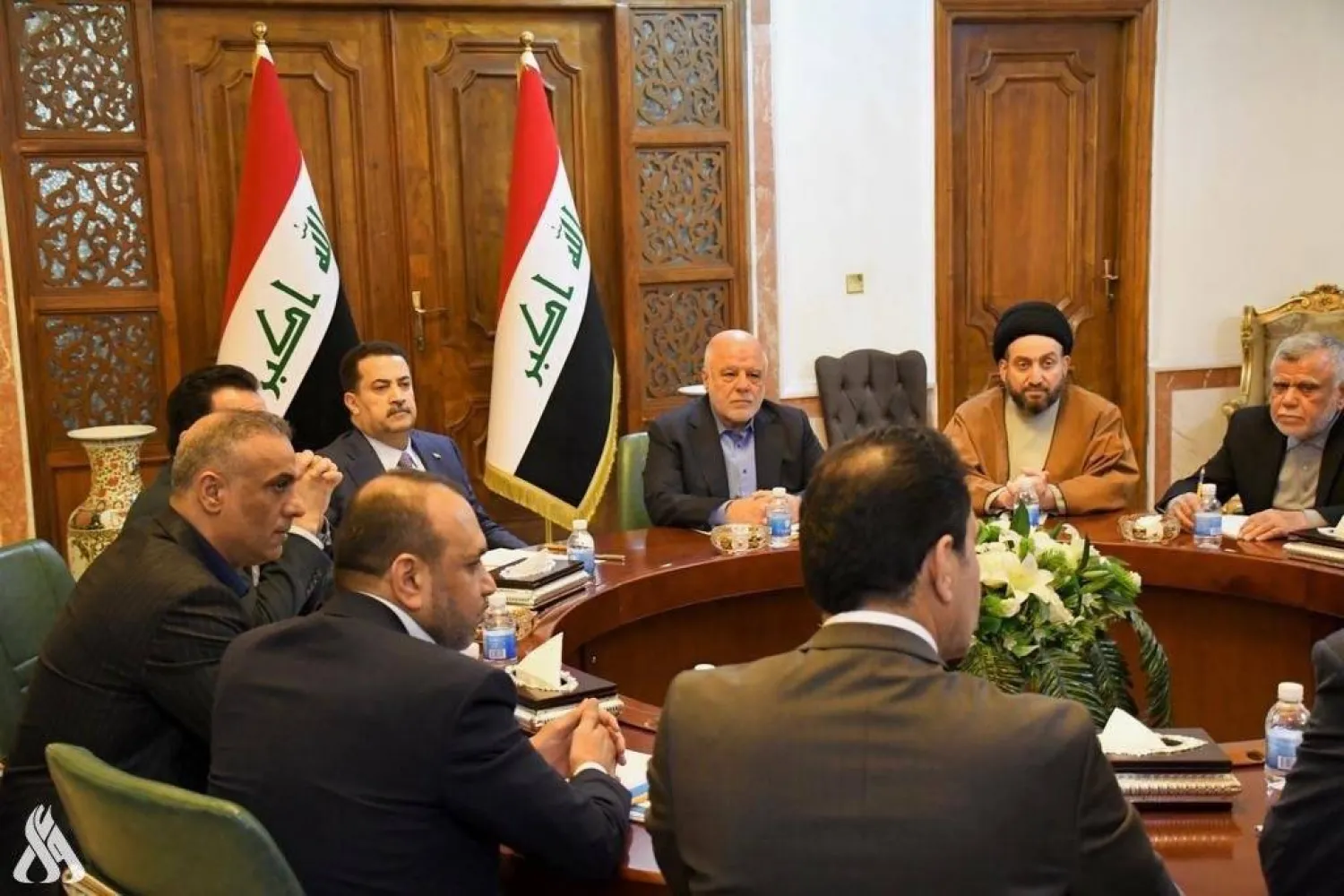
Members of the Coordination Framework hold a meeting. (Iraqi News Agency)

Iraqi Former Prime Minister Nouri al-Maliki declined at the last minute to attend a meeting of the pro-Iran Coordination Framework on Monday night that was aimed at settling the crisis over his nomination as prime minister.

Instead of declaring that he was pulling out as candidate, as had been expected, Maliki informed his close circle that he is “following through with his nomination to the end,” trusted sources told Asharq Al-Awsat.

Iraq has come under intense pressure from the US to withdraw the nomination. In January, President Donald Trump warned Baghdad against picking Maliki as its PM, saying the United States would no longer help the country.

“Last time Maliki was in power, the Country descended into poverty and total chaos. That should not be allowed to happen again. Because of his insane policies and ideologies, if elected, the United States of America will no longer help Iraq,” Trump wrote on Truth Social.

Maliki also dismissed as “extortion and intimidation” talks of renewed US sanctions on Iraq, added the sources.

However, circles within the Coordination Framework have started to “despair” with the impasse over naming a new prime minister and are weighing the possibility of taking “difficult” choices, they revealed. Maliki has become a prisoner of his own nomination.

The Sunni Progress Party (Takadum) had voiced its reservations over Maliki’s nomination before Trump made his position clear and which has since weighed heavily on Iraq.

‘Indefinitely’

Maliki’s decision to skip the Framework’s meeting on Monday forced the coalition to postpone it “indefinitely”, exposing more differences inside the alliance that have been festering for months. The dispute over the post of prime minister is threatening to evolve into one that threatens the unity of the coalition itself.

Several sources told Asharq Al-Awsat that Maliki had sent the Framework a written message on Monday night informing them that he will not attend the meeting because “he was aware that discussions will seek to pressure him to withdraw his candidacy.”

Maliki was the one to call for the meeting to convene in the first place, they revealed.

Reports have been rife in Iraq that Shiite, Sunni and Kurdish political leaderships have all received warnings that the US would take measure against Iraq if Maliki continued to insist on his nomination.

Former Foreign Minister Hoshyar Zebari told Dijlah TV that “Shiite parties” had received two new American messages reiterating the rejection of Maliki’s nomination.

Necessary choice

Maliki and the Framework are now at an impasse, with the latter hoping the former PM would take it upon himself to withdraw his candidacy in what a leading Shiite figure said would help protect the unity of the coalition.

Leading members of the coalition were hoping to give Maliki enough time to decide himself to withdraw, but as time stretches on, the coalition may take matters into its own hands and take “necessary” choices, said the figure.

Other sources revealed, however, that Maliki refuses to voluntarily withdraw from the race believing that this is a responsibility that should be shouldered by the Framework. This has effectively left the alliance with complex and limited choices to end the crisis.

Sources close to Maliki said he has made light of US threats to impose sanctions, saying that if they were to happen, Iraq will emerge on the other side stronger, citing other countries that came out stronger after enduring years of pressure.

Moreover, he is banking on an American change in position, saying mediators have volunteered to “polish his image before Trump and his team.” Members of Maliki’s State of Law coalition declined to comment on this information.

Sources inside the Framework said the coalition may “ultimately withdraw Maliki’s nomination if he becomes too much of a burden on an already weary alliance.”

Doing so may cost them a strong ally in Maliki and force the Framework to yield to Washington’s will, said the Shiite figure. “Maliki may come off as stubborn and strong, but he is wasting his realistic options at this critical political juncture,” it added.

The Framework is divided between a team that is banking on waiting to see how the US-Iran tensions will play out to resolve the crisis and on Maliki voluntarily withdrawing his nomination. The other team is calling for the coalition to resolve the crisis through an internal vote.

Leading Shiite figures told Asharq Al-Awsat that opponents of Maliki’s nomination in the coalition have no choice but to apply internal pressure inside the Framework, which is on the verge of collapse.