


MSF: 6,700 Rohingya Killed in 1st Month of Myanmar Violence

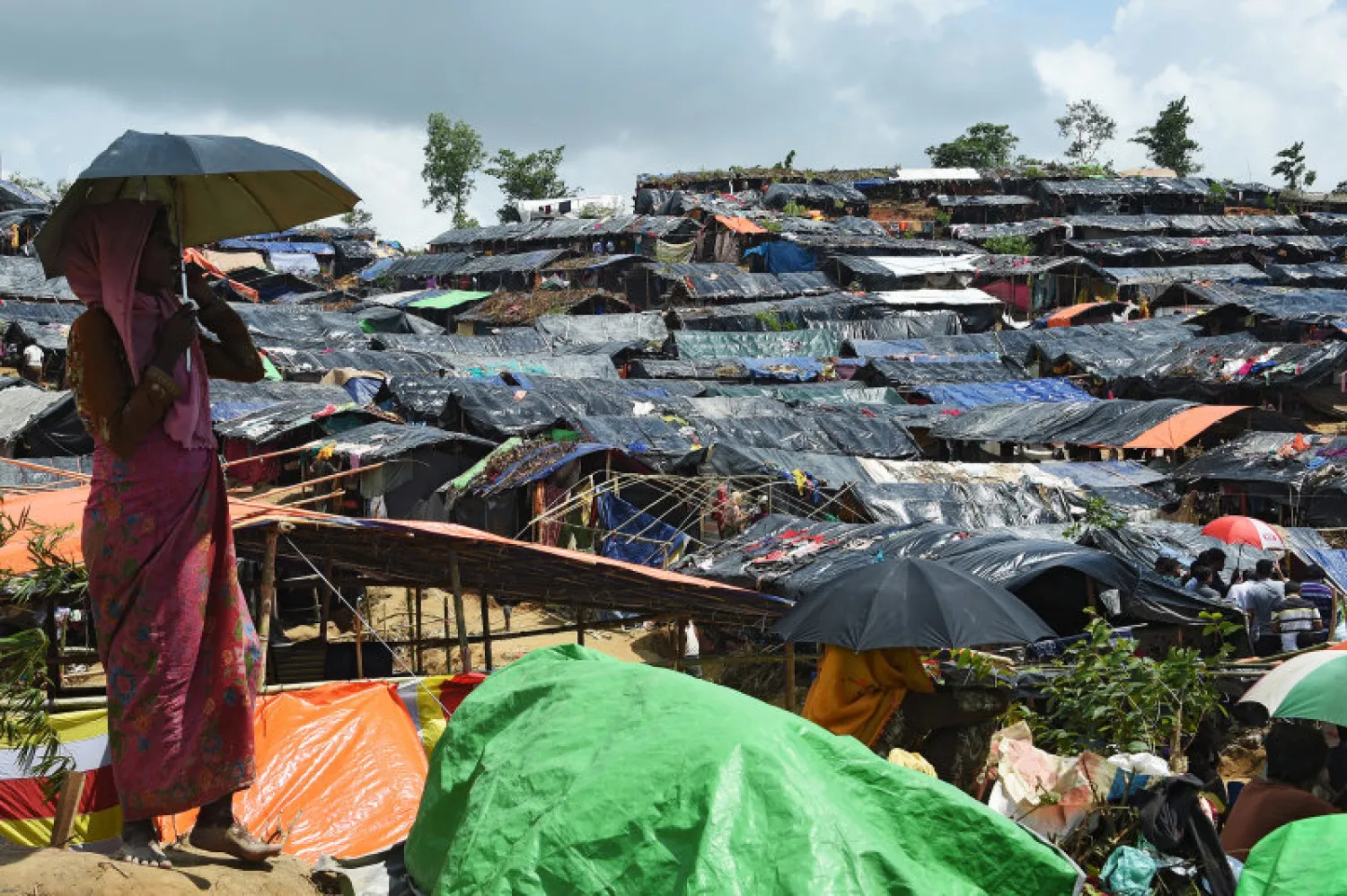
A Rohingya refugee shelters from the sun under an umbrella while looking on at the refugee camp of Balukhali, near the locality of Ukhia on September 21, 2017. (AFP PHOTO / DOMINIQUE FAGET)
TT

MSF: 6,700 Rohingya Killed in 1st Month of Myanmar Violence

A Rohingya refugee shelters from the sun under an umbrella while looking on at the refugee camp of Balukhali, near the locality of Ukhia on September 21, 2017. (AFP PHOTO / DOMINIQUE FAGET)

At least 6,700 Rohingya Muslims were killed in the first month of the Myanmar army crackdown that began in late August in Rakhine state, Doctors Without Borders (MSF) said on Thursday.

"At least 6,700 Rohingya, in the most conservative estimations, are estimated to have been killed, including at least 730 children below the age of five," MSF said.

The figure is the highest estimated death toll yet of violence that erupted on August 25 and triggered a massive refugee crisis, with more than 620,000 Rohingya fleeing Myanmar for Bangladesh over a three-month period.

The UN and US have described the military operation as "ethnic cleansing" of the Muslim minority, but have not released specific death tolls.

MSF's findings come from six surveys of more than 11,426 people in Rohingya refugee camps and cover the first month after the crisis erupted.

"We met and spoke with survivors of violence in Myanmar, who are now sheltering in overcrowded and unsanitary camps in Bangladesh," said the group's medical director Sidney Wong. 

"What we uncovered was staggering, both in terms of the numbers of people who reported a family member died as a result of violence, and the horrific ways in which they said they were killed or severely injured."

Rohingya refugees have shocked the globe with consistent stories of security forces and ethnic Rakhine Buddhist mobs driving them out of their homes with bullets, rape and arson that reduced hundreds of villages to ash.

Earlier this month the United Nations High Commissioner for Human Rights Zeid Ra'ad Al Hussein said the military-led crackdown appeared to include "elements of genocide".

The MSF surveys put a number to the horrors.

Gunshot wounds were the cause of death in 69 percent of the cases, according to the aid organization.

Another nine percent were reported burned alive inside houses, while five percent died from fatal beatings.

For children under five, nearly 60 percent died after being shot, MSF found.

"I think the MSF figure is an underestimate," Mohammad Zuabir, a Rohingya teacher and community leader who has been a refugee in Bangladesh for 25 years, told AFP.

"Almost every Rohingya family has one or multiple members killed in the violence. When people fled their villages in Rakhine, they saw roads and homes littered with dead bodies," he added.



Israeli Air Force Deploys First Laser Interception System

FILED - 26 March 2024, Israel, Jerusalem: Israel Katz attends a meeting at a hotel in Jerusalem. Photo: Christoph Soeder/dpa
TT

Israeli Air Force Deploys First Laser Interception System

FILED - 26 March 2024, Israel, Jerusalem: Israel Katz attends a meeting at a hotel in Jerusalem. Photo: Christoph Soeder/dpa

Israel's defense ministry said on Sunday it had deployed a new "Iron Beam" laser system for the air force to intercept aerial threats.

The laser system's main developers, the ministry's research and development department and defense contractor Rafael, delivered it to the air force at a ceremony in northern Israel.

"For the first time globally, a high-power laser interception system has achieved full operational maturity, successfully executing multiple interceptions," Defense Minister Israel Katz said at the ceremony, according to a statement.

"This monumental achievement... delivers a critical message to our enemies, near and far alike: do not challenge us, or face severe consequences," AFP quoted him as saying.

The handover marks a major milestone in a project more than a decade old.
"Israel has become the first country in the world to field an operational laser system for the interception of aerial threats, including rockets and missiles," said Yuval Steinitz, chairman of Rafael.

The laser system seeks to enhance and slash the cost of Israel's interception of projectiles, and will supplement other aerial defense capacities such as the more well-known Iron Dome.

Iron Dome offers short-range protection against missiles and rockets. The David's Sling system and successive generations of Arrow missiles are Israeli-American technology built to bring down ballistic missiles.

The defense ministry announced in early December that the laser system was complete, and would be deployed by the end of the month.

During the 12-day war launched by Israel against Iran in June, the country's missile defense system failed to intercept all the projectiles fired by Tehran toward Israeli territory.

Israel has since acknowledged being hit by more than 50 missiles during the war with Iran, resulting in 28 deaths.


Trump Says Had 'Productive' Call with Putin Ahead of Zelensky Meeting

US President Donald Trump takes part in a Christmas Eve dinner in the ballroom of his Mar-a-Lago club in Palm Beach, Florida, US, December 24, 2025. REUTERS/Jessica Koscielniak
TT

Trump Says Had 'Productive' Call with Putin Ahead of Zelensky Meeting

US President Donald Trump takes part in a Christmas Eve dinner in the ballroom of his Mar-a-Lago club in Palm Beach, Florida, US, December 24, 2025. REUTERS/Jessica Koscielniak

US President Donald Trump said he had a productive telephone call with his Russian counterpart Vladimir Putin on Sunday ahead of a planned meeting in Florida with Ukraine's leader Volodymyr Zelensky.

"I just had a very good and productive telephone call with President Putin of Russia" before the planned talks with Zelensky at Trump's Florida estate at 1:00 pm local time (1800 GMT), the US leader said on Truth Social.

Putin said Ukraine was in no hurry for peace and if it did not want to resolve their conflict peacefully, Moscow would accomplish all its goals by force.

Putin's remarks on Saturday, carried by state news agency TASS, followed a vast Russian drone and missile attack that prompted Zelensky to say Russia was demonstrating its wish to continue the war while Kyiv wanted peace.


Russia Sends 3 Iranian Satellites into Orbit, Report Says

In this photo released by Roscosmos space corporation on Thursday, Feb. 29, 2024, the Soyuz-2.1b rocket blasts off at the Vostochny cosmodrome outside the city of Tsiolkovsky, about 200 kilometers (125 miles) from the city of Blagoveshchensk in the far eastern Amur region, Russia. A Russian Soyuz rocket successfully put an Iranian satellite into orbit along with 18 Russian satellites on Thursday. (Roscosmos space corporation via AP)
TT

Russia Sends 3 Iranian Satellites into Orbit, Report Says

In this photo released by Roscosmos space corporation on Thursday, Feb. 29, 2024, the Soyuz-2.1b rocket blasts off at the Vostochny cosmodrome outside the city of Tsiolkovsky, about 200 kilometers (125 miles) from the city of Blagoveshchensk in the far eastern Amur region, Russia. A Russian Soyuz rocket successfully put an Iranian satellite into orbit along with 18 Russian satellites on Thursday. (Roscosmos space corporation via AP)

Russia on Sunday sent three Iranian communications satellites into orbit, the second such launch since July, Iranian state television reported.

The report said that a Russian rocket sent the satellites to circle the Earth on a 500-kilometer (310-mile) orbit from the Vostochny launchpad in eastern Russia. The three satellites are dubbed Paya, Kowsar and Zafar-2.

The report said that Paya, weighing 150 kilograms (330 pounds), is the heaviest satellite that Iran has ever deployed into orbit. Kowsar weighs 35 kilograms (77 pounds), but the report didn't specify how heavy Zafar-2 is.

The satellites feature up to 3-meter resolution images, applicable in the management of water resources, agriculture and the environment. Their life span is up to five years.

Russia occasionally sends Iran's satellites into orbit, highlighting the strong ties between the two countries. In July, a Russian rocket sent Iranian communications satellite Nahid-2 into orbit.

Russia, which signed a “strategic partnership” treaty with Iran in January, strongly condemned the Israeli and US strikes on Iran that came during a 12-day air war in June and killed nearly 1,100 Iranians, including military commanders and nuclear scientists. Retaliatory missile barrages by Iran killed 28 people in Israel.

As a long-standing project, Iran from time-to-time launches satellite carriers to send its satellites into space.

The United States has said that Iran’s satellite launches defy a UN Security Council resolution and called on Tehran to undertake no activity involving ballistic missiles capable of delivering nuclear weapons. UN sanctions related to Iran’s ballistic missile program expired in 2023.