Russia Sends 3 Iranian Satellites into Orbit, Report Says

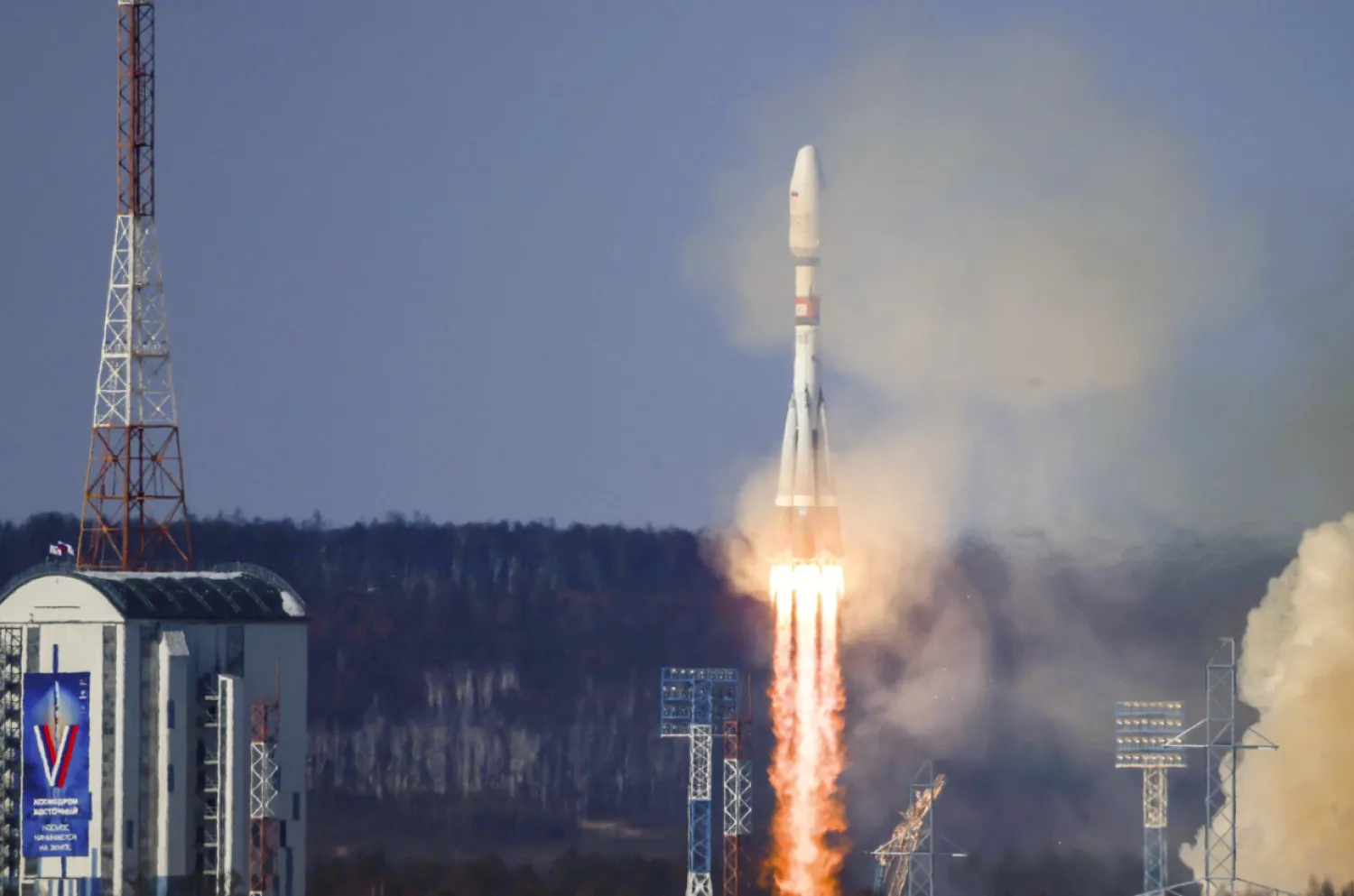
In this photo released by Roscosmos space corporation on Thursday, Feb. 29, 2024, the Soyuz-2.1b rocket blasts off at the Vostochny cosmodrome outside the city of Tsiolkovsky, about 200 kilometers (125 miles) from the city of Blagoveshchensk in the far eastern Amur region, Russia. A Russian Soyuz rocket successfully put an Iranian satellite into orbit along with 18 Russian satellites on Thursday. (Roscosmos space corporation via AP)
TT

Russia Sends 3 Iranian Satellites into Orbit, Report Says

In this photo released by Roscosmos space corporation on Thursday, Feb. 29, 2024, the Soyuz-2.1b rocket blasts off at the Vostochny cosmodrome outside the city of Tsiolkovsky, about 200 kilometers (125 miles) from the city of Blagoveshchensk in the far eastern Amur region, Russia. A Russian Soyuz rocket successfully put an Iranian satellite into orbit along with 18 Russian satellites on Thursday. (Roscosmos space corporation via AP)

Russia on Sunday sent three Iranian communications satellites into orbit, the second such launch since July, Iranian state television reported.

The report said that a Russian rocket sent the satellites to circle the Earth on a 500-kilometer (310-mile) orbit from the Vostochny launchpad in eastern Russia. The three satellites are dubbed Paya, Kowsar and Zafar-2.

The report said that Paya, weighing 150 kilograms (330 pounds), is the heaviest satellite that Iran has ever deployed into orbit. Kowsar weighs 35 kilograms (77 pounds), but the report didn't specify how heavy Zafar-2 is.

The satellites feature up to 3-meter resolution images, applicable in the management of water resources, agriculture and the environment. Their life span is up to five years.

Russia occasionally sends Iran's satellites into orbit, highlighting the strong ties between the two countries. In July, a Russian rocket sent Iranian communications satellite Nahid-2 into orbit.

Russia, which signed a “strategic partnership” treaty with Iran in January, strongly condemned the Israeli and US strikes on Iran that came during a 12-day air war in June and killed nearly 1,100 Iranians, including military commanders and nuclear scientists. Retaliatory missile barrages by Iran killed 28 people in Israel.

As a long-standing project, Iran from time-to-time launches satellite carriers to send its satellites into space.

The United States has said that Iran’s satellite launches defy a UN Security Council resolution and called on Tehran to undertake no activity involving ballistic missiles capable of delivering nuclear weapons. UN sanctions related to Iran’s ballistic missile program expired in 2023.


Iran Negotiator Ghalibaf Says Hormuz Will Not Open until US Meets Demands

Iran's parliamentary Speaker Mohammad Bagher Qalibaf speaks during a news conference in Beirut on Oct. 12, 2024. (AP)
TT

Iran Negotiator Ghalibaf Says Hormuz Will Not Open until US Meets Demands

Iran's parliamentary Speaker Mohammad Bagher Qalibaf speaks during a news conference in Beirut on Oct. 12, 2024. (AP)

Iran's top negotiator Mohammad Bagher Ghalibaf said on Tuesday that the strategic Strait of Hormuz will not be opened until the United States meets Tehran's demands, including lifting a naval blockade.

"I want to state clearly that the Strait of Hormuz will not be opened until the American commitments stipulated in the memorandum of understanding... are implemented," Ghalibaf said in a speech broadcast on state television.

He listed the removal of the blockade, the lifting of oil sanctions and unfreezing of Iran's assets abroad among the demands, which were included in an Iran-US truce in June that later collapsed, reported AFP.

War between Iran and the United States broke out on February 28 after US-Israeli attacks on the Iranian republic, triggering a conflict across the region.

Diplomatic efforts have since April 8 put an end to intense bombardments, but sporadic clashes have persisted, especially in and around the Strait of Hormuz.

Iran has kept control of the strait, a vital global energy conduit, since the war broke out, requiring vessels to seek permission and pay transit service fees -- a move opposed by Washington and several regional countries.

Iran and Oman, both coastal states on Hormuz, have for weeks been discussing the future of navigation through the strait, with Tehran saying the geographical coordinates of the route envisaged by both countries "have been agreed upon".

On Monday, Iran said that talks were "continuing in a serious manner" and views were being exchanged on the text of a "joint statement".

US President Donald Trump called for Tehran to surrender in a war that has become a growing political burden at home.

Ghalibaf during his speech said Iran was "ready to inflict an even more crushing defeat on the enemy, proportionate to its actions and advances".


Firefighters Push to ‘Encircle’ Belgian Wildfire

 Belgian firefighters work in a forest affected by a wildfire in Waimes, in the High Fens (Hautes Fagnes) region, Belgium, August 18, 2026. (Reuters)
Belgian firefighters work in a forest affected by a wildfire in Waimes, in the High Fens (Hautes Fagnes) region, Belgium, August 18, 2026. (Reuters)
TT

Firefighters Push to ‘Encircle’ Belgian Wildfire

 Belgian firefighters work in a forest affected by a wildfire in Waimes, in the High Fens (Hautes Fagnes) region, Belgium, August 18, 2026. (Reuters)
Belgian firefighters work in a forest affected by a wildfire in Waimes, in the High Fens (Hautes Fagnes) region, Belgium, August 18, 2026. (Reuters)

Firefighters launched a potentially decisive push Tuesday to encircle Belgium's largest wildfire in a century, despite wind and rain hampering air support operations over the High Fens nature reserve.

The blaze charring the vast expanse of boggy peatlands, pine trees and hiking trails grew over the weekend to half the size of Manhattan -- 3,000 hectares (7,500 acres) -- with hundreds of firefighters working night and day to wrestle it under control.

"We are trying to definitively encircle the fire today," regional government spokesperson Nicolas Yernaux told AFP.

In areas where firefighters could operate, he confirmed the fire was "under control and contained."

But a hard-to-access front towards the German border remains a concern -- with residents in the border town of Monschau already under evacuation orders due to the smoke hazard.

Firefighters worked through the night to make a crucial link-up between the eastern and northern fronts, under very difficult access conditions.

"We're talking about one or two kilometers, and we're on the verge of achieving it," Yernaux told AFP, despite "sustained winds" blowing towards the German border.

Water-bombing aircraft from several countries have been deployed -- with two Norwegian helicopters the latest to fly in on Monday night -- but they have been repeatedly grounded by low cloud and rain. There are also aircraft from Germany, Sweden and the Netherlands.

Yernaux said it was unclear given weather conditions when they would be able to take off again.

"There may be windows of opportunity this morning, but it may not be before tonight."

A huge area has been blanketed by a thick plume of yellowish smoke, with fumes detected as far as eastern France, where authorities issued an air-pollution alert.

The smoke triggered evacuations in one Belgian village and two hamlets of a second -- with residents of the hamlet of Sourbrodt given the green light to return home on Monday night.

- As long as it takes -

Europe has been swept by weeks of devastating wildfires fueled by dry conditions and a historically hot summer, with France, Greece, Portugal and Spain also battling major fires.

The High Fens blaze broke out in an area that was ravaged by massive fires in 1911, during a similar period of heatwaves.

It is the country's largest wildfire since.

During a visit on site with King Philippe on Monday, Belgium's interior minister Bernard Quintin told media it could take "several weeks" of soaking and dousing the area to prevent the fire from reigniting -- even once brought under control.

On-site operations have been made much harder by the fens' terrain -- a patchwork of heath, peat bogs and raised wooden boardwalks where heavy vehicles risk sinking into the ground -- and firefighters struggle to tackle the fire at close range.

They have been counting heavily on aerial assistance to bring the situation under control.

Local farmers have also poured in to help, working shifts to oversee a ballet of tractors pulling in tankers of water from a nearby lake.

"We'll take it in turns as long as it needs -- the team is all set," a farmer from nearby Waremme, told AFP Monday. "We'll keep going until the finish line."

Like much of Europe, Belgium has experienced a new spell of intense heat and drought in recent days.

Temperatures reached as high as 37C in some parts of the country last week, creating conditions conducive to wildfire outbreaks.


Japan's Defense Minister Says Cooperation with US, S.Korea 'Critical' for Region

Japan's Defense Minister Shinjiro Koizumi (C) reacts as he talks with Australian Deputy Prime Minister and Defense Minister Richard Marles (L) during a meeting at Parliament House in Canberra on August 18, 2026. (Photo by HILARY WARDAUGH / AFP)
TT

Japan's Defense Minister Says Cooperation with US, S.Korea 'Critical' for Region

Japan's Defense Minister Shinjiro Koizumi (C) reacts as he talks with Australian Deputy Prime Minister and Defense Minister Richard Marles (L) during a meeting at Parliament House in Canberra on August 18, 2026. (Photo by HILARY WARDAUGH / AFP)

Japan's defense minister said Tuesday that cooperation between his country, the United States and South Korea was "critical", after US President Donald Trump scaled back military drills with Seoul, said AFP.

"As Japan faces the most severe and complicated security environment in the post-war era, the cooperation among Japan, the United States and South Korea is critical to the peace and stability of the region," Shinjiro Koizumi said in Australia after talks with his counterpart Richard Marles.