

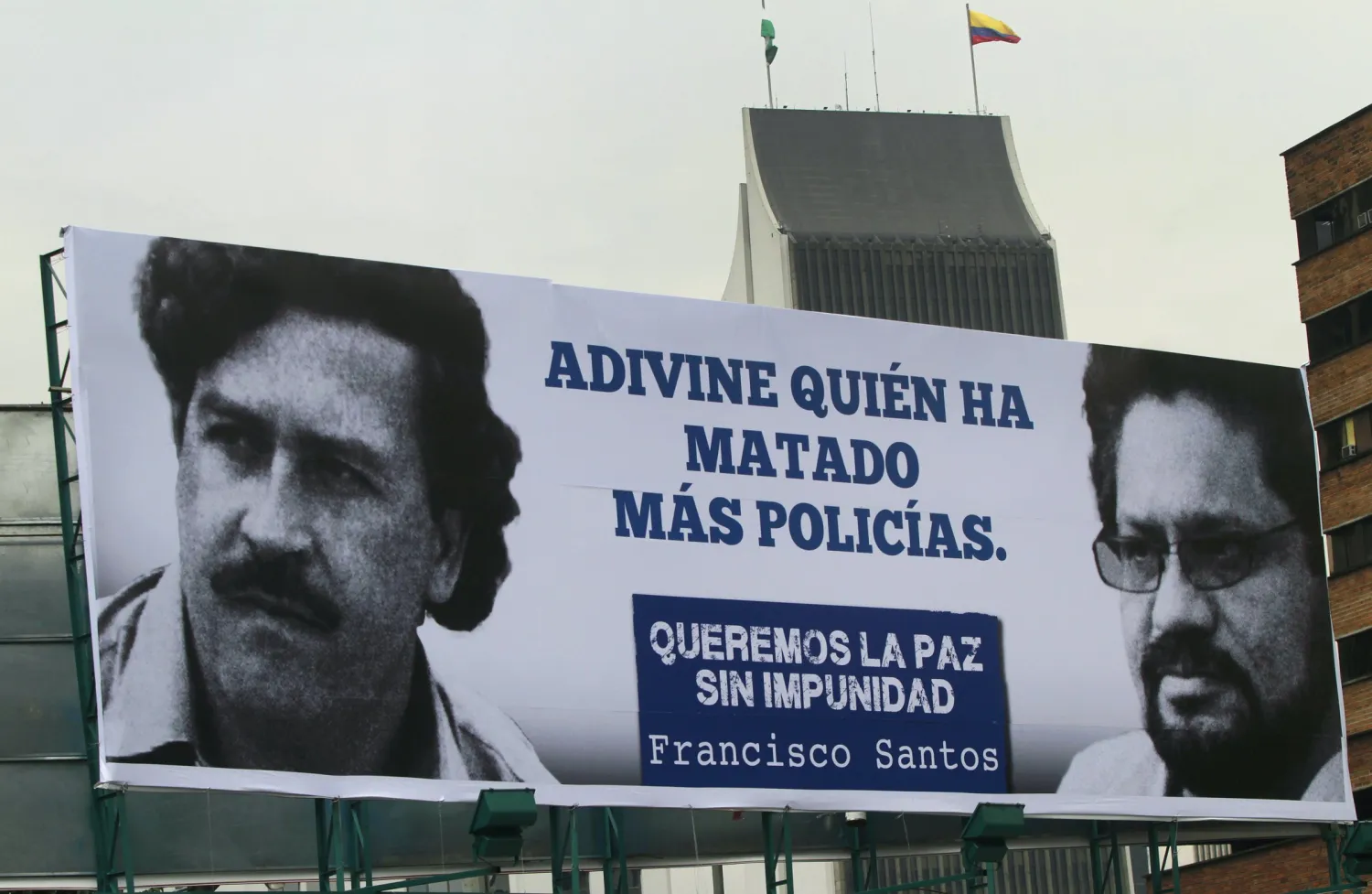

Pablo Escobar…from Drug Lord to Saint in Colombia

A sign comparing Pablo Escobar, left, with FARC leader and chief negotiator Ivan Marquez in Medellin, April 15, 2013. REUTERS/Albeiro Lopera
TT

Pablo Escobar…from Drug Lord to Saint in Colombia

A sign comparing Pablo Escobar, left, with FARC leader and chief negotiator Ivan Marquez in Medellin, April 15, 2013. REUTERS/Albeiro Lopera

Three decades ago, Maria Ines Suarez was living in a neighborhood that residents of the Colombian city of Medellin knew as "the rubbish dump."

The 68-year-old woman recalls: “I shared a one-room shack with my five children. We washed in a well and used candles for light. We rummaged through garbage for food.”

According to a report published by the German news agency (dpa), the retired domestic worker now lives in a comfortable house in a neighborhood created by and named after her benefactor, the late drug lord Pablo Escobar, one of the most violent criminals in history, whom local residents revere almost as a saint.

"Many people keep his picture in their homes and light candles for him," Yamile Zapata says at her hairdressing salon near an outdoor wall painting paying tribute to Escobar.

The Drug Lord had donated houses to about 400 poor families in the area while trying to launch a political career in the 1980s.

Twenty-four years after "the Boss" was gunned down by police, or, as many believe in Medellin, shot himself in the ear while being besieged on a rooftop, at age 44, his figure still seems omnipresent in Colombia's second-largest city.

"His hitmen killed my uncle. He did nothing good, only made poor children dream of having a gun and a motorbike, instead of wanting to study," said Sebastian Lopez, a tourism company employee.

Many people in Medellin tell stories about relatives or acquaintances who associated with or were killed by the Medellin cartel headed by Escobar.

He dominated cocaine trade to the United States and earned him a fortune worth tens of billions of dollars.

He bombed a plane he mistakenly believed to carry another presidential candidate in 1989, blew up secret police headquarters and nearly toppled the government through assassinations, bribes and bombings aimed at intimidating it into submission.

Many houses in Medellin are still believed to hide Escobar's drug money inside their walls.

Interest in Escobar has only been increased by local Colombian television series and hit Netflix show "Narcos."

About half a dozen tourism operators now taking dozens of visitors to see places associated with the drug lord almost daily.

The sights include a white multi-storey building called Monaco, one of Escobar's residences, which was once bombed by the rival Cali drug cartel. The local authorities have left the building in police custody, unsure what to do with it.

Further away, on a green hillside where Escobar built a luxury prison for himself, residents of an elderly people's home that now operates there stroll in the garden.

The "prison" grounds contain a helicopter pad, a building where Colombia's top football teams came to play for Escobar, and a chapel with a statue of the crucified Christ surrounded by golden guns.

"The administrators here pretend the statue was brought in by local priests, because they don't want the place to be associated with Pablo Escobar," a tourism guide says.

Escobar's grave at the Montesacro cemetery has meanwhile become a site of pilgrimage. "People come here daily to pray and ask him for help," says Federico Arrollave, a cemetery employee known as "the angel" guarding the grave covered with flowers.

"Pablo is making more money dead than alive" for Medellin through the tourism industry, jokes Escobar's brother Roberto Escobar, who served 14 years in prison and now runs a museum in one of Pablo's former houses.

Museum employees refer to the drug lord respectfully as "Don Pablo," to his hitmen as "the boys," describe him as a Robin Hood who dished out money to the poor, and even claim that he "wanted to finish with corruption."

Medellin Mayor Federico Gutierrez is anything but pleased with the tourism industry booming around Escobar in the city taking pride in its Metro train and environmental policies.

He issued a public letter criticizing a Panama travel agency for advertising "narco tours" in 2016 and lashed out at U.S. Rapper Wiz Khalifa, who visited the grave in Montesacro in March.

"One really notices how this guy has not had to suffer from the violence of these drug traffickers. This shameless man, instead of taking flowers to Pablo Escobar, should have taken flowers to the victims, and owes an apology to the city," Gutierrez said.

Cocaine trafficking continues in Colombia, where the surface of illegal coca fields increased by up to 50% to up to 150,000 hectares in 2016, according to the newspaper El Tiempo.

The growth has continued despite a peace deal that the government signed in November 2016 with the guerrilla movement FARC, which was involved in the drug trade.



Trying to Improve Your Health and Wellness in 2026? Keep it Simple

A man is silhouetted against the sky at sunset as he jogs in a park at the close of a hot summer day, Aug. 1, 2022, in Kansas City, Mo. (AP Photo/Charlie Riedel, File)
TT

Trying to Improve Your Health and Wellness in 2026? Keep it Simple

A man is silhouetted against the sky at sunset as he jogs in a park at the close of a hot summer day, Aug. 1, 2022, in Kansas City, Mo. (AP Photo/Charlie Riedel, File)

The new year is a time when many try to start new good habits and commit to improving health and wellness.

But resolutions, lofty as they may be, can turn daunting quickly with all the advice and sometimes contradicting information coming at you from news reports, advertisers, influencers, friends and even politicians.

But they don't have to be.

This year, The Associated Press got the downlow on all manner of health and wellness claims and fads. The good news is that the experts mostly say to keep it simple.

As 2026 arrives, here's what you can skip, what you should pay attention to and how to get credible information when you are inevitably faced with more confusing claims next year.

Protein and fiber are important, but you probably don't need to pay more When it comes to your diet, experts say most people can skip the upcharge. If you're eating enough, you're probably getting enough protein and don't need products that promise some big boost.

And it's true that most people could use more fiber in their diets. But, please, ditch the “fiber-maxxing” trend. Instead, eat whole foods such as fruits, vegetables, beans and whole grains.

A good skin care routine is not expensive or complicated That 20-step skin care routine and $200 serum some TikToker sold you on? Dermatologists say you really don't need it. Stay away from the beef tallow and slather on a good sunscreen instead (yes, even if you have darker skin ), they say.

And the same rule for simplicity applies to that hourlong “everything shower." The best showers are simple and short, dermatologists say, no "double cleansing" required.

There are many simple ways to get that workout in If the gym and all its equipment feel intimidating, you can drop the illusion that a good workout requires either. This year, the comeback of calisthenics put the focus back on no frills, bodyweight workouts you can do in the comfort of home. Research shows calisthenics helps with muscle strength and aerobic conditioning. You may eventually need weightlifting or other equipment, but it is a great place to start to build consistency and confidence.

Be wary of wellness fads and treatments — they are often too good to be true Even if you imbibe too much this New Year's Eve, doctors say you can do without “ IV therapy ” which have vitamins you can get more easily and cheaper in pill form — if you even need more, which is unlikely if you have a balanced diet. You're pretty much just paying for “expensive urine,” one doctor said.

Same for “wellness” focused products like microbiome testing kits that generate information that doctors can't actually act on. And if you don't have diabetes, there's scant evidence that you need a continuous glucose monitor.

To improve your health, go back to the basics The idea of a panacea pill, product or routine can be enticing. But science already knows a lot about how to improve mental and physical health, and they are tried and true:

1. Whether you're in the city or the country — walk more. Research shows walking is great for physical and mental health. It's so good for you, doctors are literally prescribing time in the outdoors to their patients.

2. Take steps to get certain health metrics under control, likehigh blood pressure, which often goes undiagnosed and is known to cause a range of health problems down the road. Prioritize getting enough sleep, and make sure your family does too. Don't just eat right — eat slower.

3. Give your mind some care too. Set better boundaries with your technology andregain and retrain your attention span. Build out your social networks and invest inall forms of love for the people around you.

These lifestyle changes don't just make you feel better in the moment. Research shows they impact your life for years to come, by lowering the risk of dementia and many other health issues.

Don't know who to trust? Start with your doctor It can be tough to know who to listen to about your health, faced with compelling personal stories on social media from people who swear something worked from them, or clever marketing and advertising from companies that scare you or promise an easy fix.

Doubts have been raised this year about established medicine, including the safety of food dyes, fluoride dental treatments,hepatitis B shot for newborns, and hormone therapies for menopause.

While the medical system is not perfect, your doctor remains the best person to talk to about prevention, health concerns and potential treatments.

If you can't get to a human doctor and turn to Dr. Google instead, be sure to follow these tips and never use it to diagnose yourself. When you do get that doctor's appointment, you can make the most of it by bringing a list of written questions — and don't hesitate to ask for any clarification you need.


Citrus Harvest Season Kicks off in AlUla

The citrus harvest in AlUla is a significant agricultural and economic event  - SPA
The citrus harvest in AlUla is a significant agricultural and economic event - SPA
TT

Citrus Harvest Season Kicks off in AlUla

The citrus harvest in AlUla is a significant agricultural and economic event  - SPA
The citrus harvest in AlUla is a significant agricultural and economic event - SPA

The citrus harvest season has officially begun in AlUla Governorate, which is renowned for its agricultural production, according to SPA.

Citrus groves in AlUla cover approximately 654.57 hectares and contain around 261,826 trees, yielding about 6,545.65 tons of fruit annually.

The governorate produces a variety of delicious and nutritious citrus fruits, most notably navel oranges, citron, and sweet lemons. The citrus harvest season typically runs from December to March.

These fruits are distinguished by their high quality, attributed to the governorate's unique climate and fertile soil, resulting in exceptional flavor and high nutritional value.

The citrus harvest in AlUla is a significant agricultural and economic event that highlights the diversity of the governorate's agricultural production. It also plays a crucial role in supporting agricultural activity and promoting local products in the marketplace.


Saudi Arabia's Qassim National Park Records Third Consecutive Arabian Oryx Births

Saudi Arabia's Qassim National Park recorded the birth of an Arabian oryx for the third consecutive year. (SPA)
TT

Saudi Arabia's Qassim National Park Records Third Consecutive Arabian Oryx Births

Saudi Arabia's Qassim National Park recorded the birth of an Arabian oryx for the third consecutive year. (SPA)

Saudi Arabia's Qassim National Park in Buraidah recorded the birth of an Arabian oryx for the third consecutive year, reported the Saudi Press Agency on Monday.

The development is an important environmental milestone that reflect the ongoing success of release and reintroduction programs led by the National Center for Wildlife (NCW), which aims to preserve endangered wild species and boost biodiversity in their natural habitats.

The achievement exemplifies a pioneering collaboration between the NCW and the National Center for Vegetation Cover Development and Combating Desertification through initiatives such as vegetation enhancement, natural habitat rehabilitation, and the creation of suitable conditions for the breeding and sustainability of wild species.

Qassim National Park is one of several national parks implementing afforestation and environmental rehabilitation projects under the Saudi Green Initiative, strengthening the region’s ecological diversity and showcasing the role of national parks as models of successful environmental sustainability programs in the Kingdom.