


Lebanon’s Electricity Crisis Worsens, Plunging Several Regions in Darkness

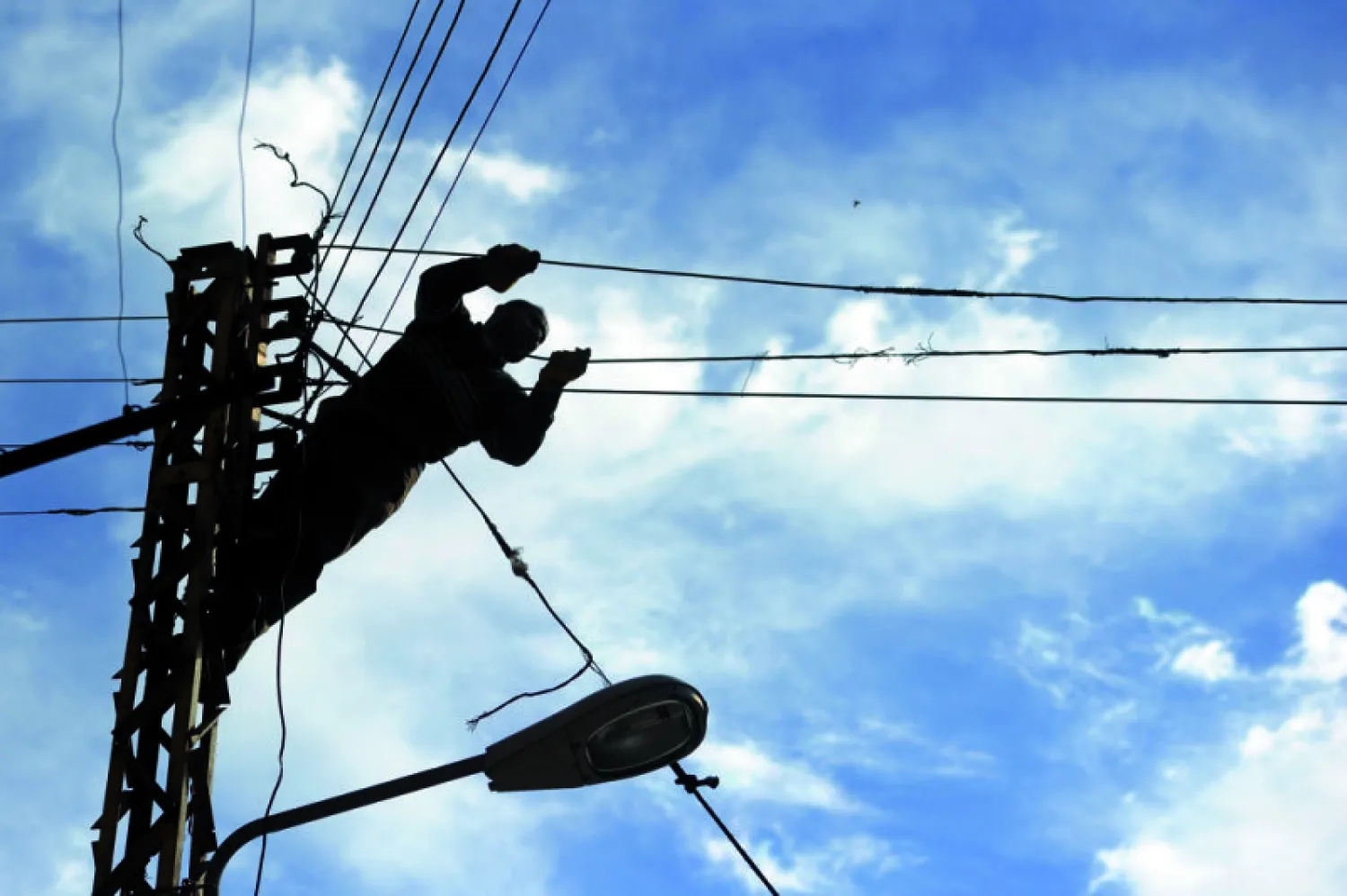
A month-long strike by energy sector workers in Lebanon has plunged several regions in darkness. (AFP)
TT

Lebanon’s Electricity Crisis Worsens, Plunging Several Regions in Darkness

A month-long strike by energy sector workers in Lebanon has plunged several regions in darkness. (AFP)

Lebanon’s electricity crisis entered a critical phase due to the strike the sector’s workers have been holding since nearly a month over their failed pay raise.

The workers have refused to fix malfunctions in the power grid and they have also prevented technical teams from Electricite du Liban (EDL) from entering malfunctioning power stations. This has consequently left many regions in the country without power.

A meeting was held on Monday night between Finance Minister Ali Hassan Khalil, Energy Minister Cesar Abi Khalil, head of the General Labor Union Beshara al-Asmar and the EDL workers union to address the crisis.

They tackled the new wage scale that was approved last year and the EDL workers’ share of the hike in an attempt to persuade them to suspend their strike, which they started on December 10.

They have been staging the strike after they failed to reach an agreement with the Finance Ministry to resolve the problem linked to the raise in their salaries. The new wage scale that was approved in 2017 covers public sector employees.

Despite the optimism expressed by the finance and energy ministers that the crisis will be resolved soon, the KVA company that distributes power to EDL announced that it has been unable to carry out its services due to the strike and financial difficulties it is facing.

It therefore called on the people to directly contact EDL concerning all issues related to malfunctions and services linked to the company.

Khalil for his part said that Monday’s meeting was aimed at finding an agreement that ensures the interest of the state and the interest of all concerned parties.

Abi Khalil stated that an agreement will be reached soon.

Amid the public outcry over the power outages, head of the parliamentary energy committee MP Mohammed Qabbani told Asharq Al-Awsat: “The workers’ strikes is part of a greater problem in the electricity sector.”

“The reckless disregard of the laws has led us to this crisis,” he added.

The power “catastrophe” is not new and it dates back to 2003 when a law drafted by late former Prime Minister Rafik Hariri was approved, he explained. The law calls for forming the regulatory authority for the energy sector and involving the private sector in power production.

His stance was echoed by economic and financial expert Marwan Iskandar, who told Asharq Al-Awsat: “The electricity sector is the greatest burden on the Lebanese state in the 21st century because it has not taken any step forward, neither in terms of reform nor in terms of development.”

Since Hariri’s assassination in 2005, no new contract in the power sector was signed and no new power plant was renovated or constructed, he noted.

The only accomplishment to speak of was the leasing of the two Turkish power vessels, but at a very high cost, he continued.

The power crisis is not limited to technical aspects, but political factors come into play.

Qabbani said: “Unfortunately, the political side that has been handling the sector since 2008 (the Free Patriotic Movement of President Michel Aoun) refuses to implement the law that regulates the sector.”

“It only wants to spend for the sake of spending as if some sides want spending and do not want power. They make major tenders that they have an interest in and they do not care if this project succeeds or not,” he continued.

In addition, the MP said that the parliament has been handling the electricity file since 2011 and it issued law 181 that sets a deadline of no more than three months to appoint the members of the regulatory authority.

“No one has respected this law. More specifically, the political side that has been controlling this file since 2011 has not respected it,” the lawmaker explained.

Iskandar backed this stance, saying: “All the projects devised by the ministers of a specific political bloc (the March 8 camp) have cost the Lebanese treasury 17 billion dollars since 2011.”

Add to that various other costs and the sum climbs up to 30 billion dollars, meaning 40 percent of the country’s public debt has gone to the “failed power sector,” he stressed.

Moreover, he stated that in 2011, the Energy Ministry was granted 1.2 billion dollars to provide the country with electricity 24 hours a day, but it only managed 750 megawatts through the leasing of the Turkish ships.

“They are now talking about leasing new vessels at very high costs,” he told Asharq Al-Awsat.

“If they do so, then Lebanon will not receive any aid from the International Bank, International Monetary Fund or Arab donor funds,” Iskandar warned.

“The first condition these international financial groups demand of Lebanon is fixing the electricity file,” he stressed.

Asmar meanwhile denied that the power sector workers’ strike was politically motivated, saying that their problem dates back to 2012 and it only came to the spotlight a few days ago after some employees had not gotten paid in three months.


Italy Arrests 7 Accused of Raising Millions for Hamas

Palestinian Hamas members secure the area as Egyptian workers accompanied by members of the International Committee of the Red Cross (ICRC) search for the remains of the last Israeli hostage in the Zeitoun neighborhood of Gaza City on December 8, 2025. (Photo by Omar AL-QATTAA / AFP)
TT

Italy Arrests 7 Accused of Raising Millions for Hamas

Palestinian Hamas members secure the area as Egyptian workers accompanied by members of the International Committee of the Red Cross (ICRC) search for the remains of the last Israeli hostage in the Zeitoun neighborhood of Gaza City on December 8, 2025. (Photo by Omar AL-QATTAA / AFP)

Italian police said Saturday that they have arrested seven people suspected of raising millions of euros for Palestinian group Hamas.

Police also issued international arrests for two others outside the country, said AFP.

Three associations, officially supporting Palestinian civilians but allegedly serving as a front for funding Hamas, are implicated in the investigation, said a police statement.

The nine individuals are accused of having financed approximately seven million euros ($8 million) to "associations based in Gaza, the Palestinian territories, or Israel, owned, controlled, or linked to Hamas."

While the official objective of the three associations was to collect donations "for humanitarian purposes for the Palestinian people," more than 71 percent was earmarked for the direct financing of Hamas" or entities affiliated with the movement, according to police.

Some of the money went to "family members implicated in terrorist attacks," the statement said.

Among those arrested was Mohammad Hannoun, president of the Palestinian Association in Italy, according to media reports.

Interior Minister Matteo Piantedosi posted on X that the operation "lifted the veil on behavior and activities which, pretending to be initiatives in favor of the Palestinian population, concealed support for and participation in terrorist organizations."


Türkiye Holds Military Funeral for Libyan Officers Killed in Plane Crash

The Libyan national flag flies at half-mast in Tripoli on December 24, 2025, after the head of Libya's armed forces and his four aides died in a plane crash in Türkiye. (AFP)
TT

Türkiye Holds Military Funeral for Libyan Officers Killed in Plane Crash

The Libyan national flag flies at half-mast in Tripoli on December 24, 2025, after the head of Libya's armed forces and his four aides died in a plane crash in Türkiye. (AFP)

Türkiye held a military funeral ceremony Saturday morning for five Libyan officers, including western Libya’s military chief, who died in a plane crash earlier this week.

The private jet with Gen. Muhammad Ali Ahmad al-Haddad, four other military officers and three crew members crashed on Tuesday after taking off from Ankara, Türkiye’s capital, killing everyone on board. Libyan officials said the cause of the crash was a technical malfunction on the plane.

Al-Hadad was the top military commander in western Libya and played a crucial role in the ongoing, UN-brokered efforts to unify Libya’s military.

The high-level Libyan delegation was on its way back to Tripoli, Libya’s capital, after holding defense talks in Ankara aimed at boosting military cooperation between the two countries.

Saturday's ceremony was held at 8:00 a.m. local time at the Murted Airfield base, near Ankara, and attended by the Turkish military chief and the defense minister. The five caskets, each wrapped in a Libyan national flag, were then loaded onto a plane to be returned to their home country.

Türkiye’s military chief, Selcuk Bayraktaroglu, was also on the plane headed to Libya, state-run news agency TRT reported.

The bodies recovered from the crash site were kept at the Ankara Forensic Medicine Institute for identification. Justice Minister Yilmaz Tunc told reporters their DNA was compared to family members who joined a 22-person delegation that arrived from Libya after the crash.

Tunc also said Germany was asked to help examine the jet's black boxes as an impartial third party.


Syrian Foreign Ministry: Talks with SDF Have Not Yielded Tangible Results

SDF fighters are seen at a military parade in Qamishli. (Reuters file)
TT

Syrian Foreign Ministry: Talks with SDF Have Not Yielded Tangible Results

SDF fighters are seen at a military parade in Qamishli. (Reuters file)

A source from the Syrian Foreign Ministry said on Friday that the talks with the Kurdish Syrian Democratic Forces (SDF) over their integration into state institutions “have not yielded tangible results.”

Discussions about merging the northeastern institutions into the state remain “hypothetical statements without execution,” it told Syria’s state news agency SANA.

Repeated assertions over Syria’s unity are being contradicted by the reality on the ground in the northeast, where the Kurds hold sway and where administrative, security and military institutions continue to be run separately from the state, it added.

The situation “consolidates the division” instead of addressing it, it warned.

It noted that despite the SDF’s continued highlighting of its dialogue with the Syrian state, these discussions have not led to tangible results.

It seems that the SDF is using this approach to absorb the political pressure on it, said the source. The truth is that there is little actual will to move from discussion to application of the March 10 agreement.

This raises doubts over the SDF’s commitment to the deal, it stressed.

Talk about rapprochement between the state and SDF remains meaningless if the agreement is not implemented on the ground within a specific timeframe, the source remarked.

Furthermore, the continued deployment of armed formations on the ground that are not affiliated with the Syrian army are evidence that progress is not being made.

The persistence of the situation undermines Syria’s sovereignty and hampers efforts to restore stability, it warned.
