
Afrin: The Thorn in Turkey’s Side

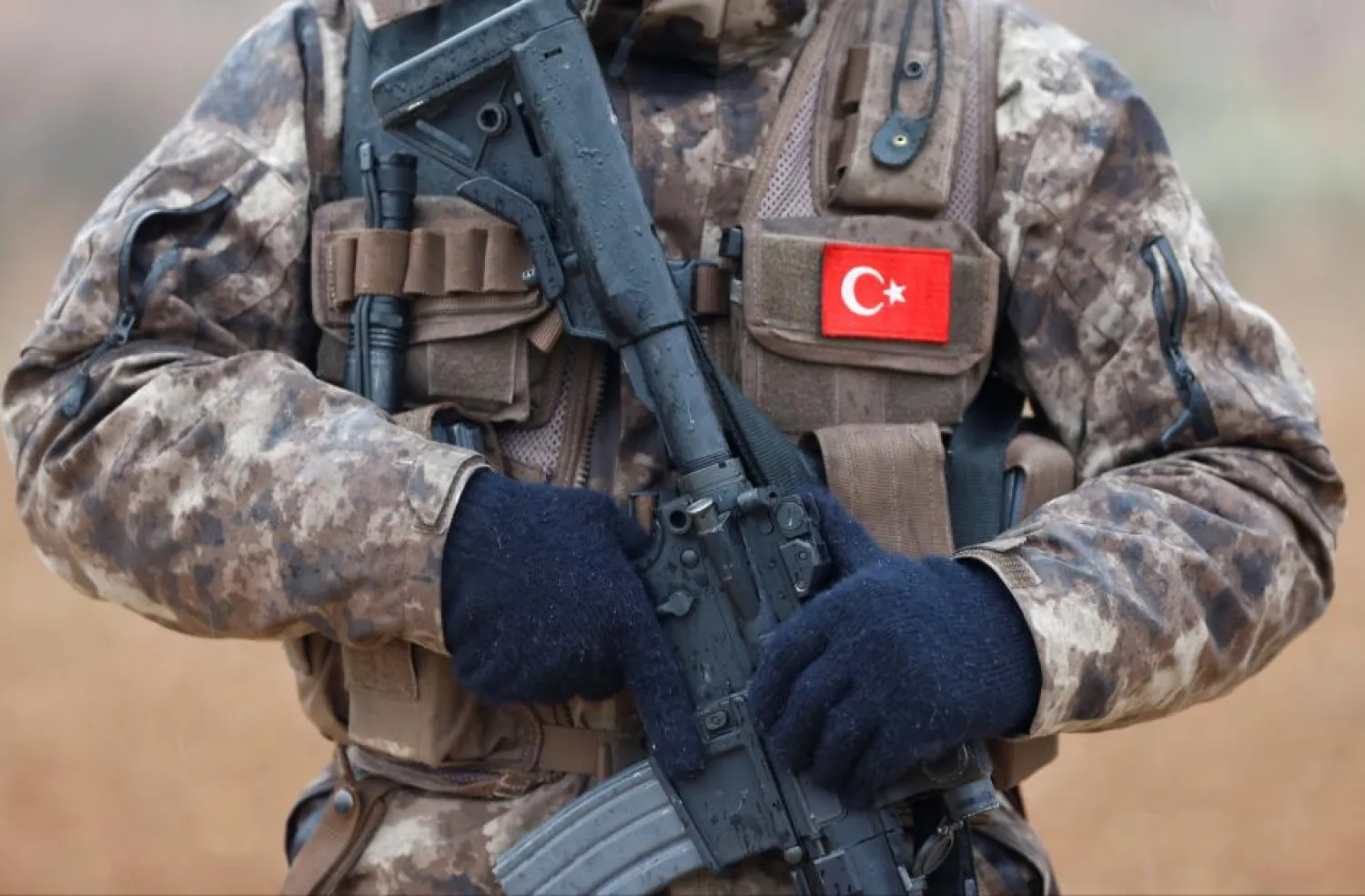
A member of Turkish police special forces stands guard in Azaz, Syria January 24, 2018. (Reuters)
TT

Afrin: The Thorn in Turkey’s Side

A member of Turkish police special forces stands guard in Azaz, Syria January 24, 2018. (Reuters)

Turkey’s Operation Olive Branch in Afrin is more than just about expelling Kurdish militias, which Ankara deems as “terrorist”, from its borders with Syria. In reality, the operation will serve to consolidate Turkish military presence in northern Syria ahead of forming a “safe zone” 30 kilometers into Syrian territory.

This will allow Ankara to tighten its grip, through the help of Syrian allies, on the northern part of the country that lies between the Idlib province and west of the Euphrates River. This was implied when Turkish Foreign Minister Mevlut Cavusoglu announced that President Recep Tayyip Erdogan had informed US President Donald Trump that there was a need to withdraw American troops from Syria’s Manbij.

Amid the American silence and ineffective Syrian regime statements, the operation reveals Russian-Turkish agreements to allow Ankara to go ahead with its offensive. This operation threatens the Kurdish dream of establishing a “federal state” in northern Syria and places obstacles ahead of the negotiations over a political solution in Syria, which Moscow wants the Kurds to be a part of.

Ankara had threatened a year ago to launch a military operation against the Afrin enclave in the northwestern most part of Syria and it stayed true to its word, kicking it off a week ago, under the name Olive Branch. It said that the operation was aimed at “cementing security and stability on our borders and in the region. It is aimed at eliminating the terrorists of the Kurdistan Workers’ Party (PKK), Democratic Union Party, Kurdish People’s Protection Units and ISIS in the city of Afrin and saving the people in the region from the oppression of the terrorists.”

The city of Afrin itself has not been targeted by the Turkish strikes, making it a destination for refugees from the border villages, which have so far been the main focus of attacks.

The Turkish operation appears limited exclusively against Kurdish militias that control the city and its countryside. Afrin is one of three regions that are part of the Kurdish vision of the “Democratic Federation of Northern Syria”, which they had declared in the past. It includes the al-Jazeera province that includes the al-Hasakeh region and the countrysides of the al-Raqqa province, the Ain al-Arab (Kobane) province that the militias expanded to include Manbij, 70 kilometers north of Aleppo city, and the Afrin province.

In order to prevent the three provinces from being connected to each other, Turkey launched in August 2016 the Euphrates Shield Operation in which it was able to cut through to the city of al-Bab, 30 kms north of Aleppo. This way, it was able to bar the Kurdish separatists from linking their three provinces together and obstruct their dream of establishing the federal state, which is known as Rojava.

Since then, Turkey has been determined to eliminate the Kurds from Afrin because it views them as an extension of the PKK, which Ankara labels as terrorist. It also has its sights set on Manbij and its countryside, leading observers to believe that it is seeking to control the regions extending from the Idlib province’s eastern borders with Turkey in northwest Syria and the western banks of the Euphrates in northern Aleppo.

Attack on Manbij

Turkish statements do not indicate that the battle in Afrin will end with its forces seizing control of the city. They instead reveal that Ankara will widen its operations towards Manbij, where the US has military bases.

An informed source told Asharq Al-Awsat that the Kurds’ American allies assured them that the Turkish forces will not attack Manbij. This is seen as a clear sign that Washington was not ready to abandon it, while Ankara’s statements on this issue can be interpreted as “intimidation.”

Political solution efforts thwarted

The most significant repercussions of the Afrin operation so far is that it thwarted efforts to reach a political solution in Syria with the participation of the separatist Kurds. The Americans want the Kurds to take part in the talks despite Turkish objections. After their participation in the Geneva talks became complicated, Russian officials announced before the Olive Branch Operation that the Kurds will be part of the Syrian national dialogue congress scheduled for Sochi next week. Their attendance has been put in doubt however after the Kurds accused the Russians of granting Ankara cover for their military operation.

A high-ranking Kurdish source told Asharq Al-Awsat that in wake of the Afrin operation, the Kurds refuse to take part in the Sochi talks.

“We will not head to Sochi under the bombardment. Turkey is attacking us under Russian cover and support, so how can we head to a conference that Ankara is attending and which has been called for by Russia?” he wondered.

Dr. Hisham Jaber, head of the Middle East Center for Studies and Political Research in Beirut, said that the Afrin military offensive “undoubtedly obstructed the Sochi talks.” The Turks no doubt do not want the Sochi path either.

Turkish-Kurdish conflict

Meanwhile, despite Turkey’s repeated assertions that the Afrin operation was linked to its national security, the separatist Kurds view the offensive from a different angle. They see that it is part of “Turkey’s enmity towards the Kurds.”

Head of the Kurdish Center for Studies Nawwaf Khalil told Asharq Al-Awsat that Turkey’s ruling Justice and Development Party is not only antagonizing the PKK and Democratic Union Party in Syria, but it is antagonizing all Kurds. He noted that Ankara’s opposition to the Iraqi Kurds’ secession from Iraq revealed its view of all Kurds in the region.

Turkey is not taking into account the 500,000 refugees that have fled to Afrin from other parts of Syria during the war, he continued. “We will prove that we are capable of defending ourselves, even if everyone abandoned us.”

Afrin in exchange for Idlib

The Kurds believe that the Operation Olive Branch revealed a possible deal between Russia and the Syrian regime on one side and Turkey on the other to trade Afrin for the Idlib region.

Experts said that Russia is seeking a solution in Idlib that sees the regime reimpose its control, which gave Turkey the green light to enter Afrin that will act as a “consolation prize” instead of Idlib. “Turkey has grown tired of the Idlib file, which has become a burden on it. It will not however abandon it without getting anything in return. This is why it is leaning towards trading it for Afrin.”

Egypt, Trump Reaffirm Strategic Alliance in 2025 amid Regional Turmoil

Egyptian President Abdel Fattah al-Sisi meets President Donald Trump ahead of a world leaders' summit on ending the Gaza war, in Sharm el-Sheikh, Egypt, October 13, 2025. (Reuters)
TT

Egypt, Trump Reaffirm Strategic Alliance in 2025 amid Regional Turmoil

Egyptian President Abdel Fattah al-Sisi meets President Donald Trump ahead of a world leaders' summit on ending the Gaza war, in Sharm el-Sheikh, Egypt, October 13, 2025. (Reuters)

After months of speculation over the trajectory of Egyptian-US relations, fueled by persistent talk of strain and an impending rift, a high-level meeting between President Donald Trump and President Abdel Fattah al-Sisi in Sharm el-Sheikh reaffirmed the resilience of the strategic alliance between Cairo and Washington, even as the region remains in turmoil.

The meeting followed a turbulent period marked by Trump’s adoption of a proposal to relocate Gaza’s population, an idea firmly rejected by Sisi and one that prompted warnings of a diplomatic crisis between the two longtime allies.

The subsequent signing of a Gaza peace agreement in Sharm el-Sheikh sent a clear signal that, despite sharp disagreements over policy, the foundations of the bilateral relationship remain intact.

Early in Trump’s second term, media reports said Sisi had scrapped plans to visit Washington. As the year draws to a close, speculation has said that the visit may happen. Trump has acknowledged Sisi as a friend and said he would be happy to meet him as well.

Trump’s election victory late last year raised Egyptian hopes of strengthening the strategic partnership. Sisi voiced that expectation in a congratulatory post on X, stating that he looked forward to working together with Trump to achieve peace, preserve regional peace and stability, and strengthen the strategic partnership.

Those hopes were tested when Trump floated a plan to “clean out Gaza” and relocate its residents to Egypt and Jordan. Cairo rejected the idea outright, mobilized international opposition, unveiled an alternative plan for Gaza’s reconstruction and hosted an emergency summit on the issue in March.

Limited public engagement

David Butter, a research fellow in the Middle East and North Africa program at Chatham House, noted that the striking feature of Egypt-US ties over the past year has been their low public profile.

Aside from Trump’s appearance in Sharm el-Sheikh, there was not much happening in the open, he told Asharq Al-Awsat.

Amr Hamzawy, an Egyptian political scientist and director of the Middle East program at the Carnegie Endowment for International Peace, described the first year of Trump’s second term as difficult for bilateral relations.

He said it began with talk of displacement and a “Middle East Riviera” in Gaza, but Egyptian diplomacy succeeded in shifting the trajectory.

Trump’s peace plan, he said, ultimately signaled rejection of displacement and spoke of security and political tracks for Gaza and a broader political process for the Palestinian issue, though details remain unclear.

Hamzawy added that the year opened from a tough starting point that followed what he called President Joe Biden’s hesitant stance on Gaza, when displacement was first discussed.

After nearly a year of Egyptian political and diplomatic effort, he said, displacement dropped from Washington’s agenda, even if it remains a risk that cannot be ignored.

Historically, Egypt has been a pivotal state for US national security, given its geography, demographic weight and diplomatic role, according to a recent report by the Congressional Research Service.

Gaza, the main test

The Gaza war shaped Egyptian-US relations during Trump’s first year back in office. Washington backed Egyptian-Qatari mediation to halt the war. US Secretary of State Marco Rubio thanked Cairo after a truce was reached between Israel and Hamas in January.

When hostilities resumed, however, Egypt faced complex diplomatic choices with both Washington and Israel. It rejected Trump’s call to resettle Gaza’s population, while its reconstruction plan failed to gain US or Israeli acceptance.

Cairo also drew criticism from Trump for declining to join US strikes against Yemen’s Houthis, the Congressional Research Service (CRS) revealed.

Butter noted that ties with the Trump administration were strained over Gaza after Sisi canceled a Washington visit early in the year, following Trump’s “Middle East Riviera” remarks, which left contacts at a minimum.

He said Trump’s Sharm el-Sheikh visit, the signing of the Gaza agreement and the celebration of his plan’s success offered a chance to reset relations. Egypt, he added, has become indispensable to Trump’s administration in Gaza.

Hamzawy said Gaza dominated the first year of Trump’s term, giving Egypt a chance to restore its standing with US and European decision-makers as a key mediator. Cairo put its vision on the table, he said, shifting US thinking toward parallel security and political tracks and from talk of disarmament to limiting weapons.

Throughout the year, Egypt publicly counted on Trump to end the Gaza war. In July, Sisi urged him in a televised address to press for a halt, saying Trump was capable of doing so.

Analysts Daniel Byman and Jon Alterman wrote in Foreign Policy that Egypt is indispensable to international responses to the Gaza war, even if it remains a difficult partner for Washington and Israel. The conflict, they said, restored diplomatic focus on Egypt and strengthened its leverage.

Sara Kira, director of the European North African Center for Research, said relations in Trump’s second term differ from his first. The earlier term saw broad alignment and personal warmth from Trump, particularly on counterterrorism, she said. The second term has been marked by divergence.

That surfaced in April when Trump called for free passage for US commercial and military vessels through the Suez Canal in exchange for US efforts to protect the waterway.

Positive signals despite differences

Despite disagreements over Gaza, there were positive signs elsewhere. Early in the year, the US State Department froze new funding for most aid programs worldwide, exempting humanitarian food programs and military aid to Israel and Egypt.

Washington did not include Egypt on a travel ban list issued in June. Trump said Egypt was a country with which the United States dealt closely and that things there were under control. Egypt was also spared higher US tariffs. Cairo has repeatedly stressed the depth and resilience of the strategic relationship.

Kira said Egypt exerted maximum pressure to achieve peace and stop the Gaza war, eventually convincing Washington of its approach and reaching a peace agreement in Sharm el-Sheikh. She said Egypt acted pragmatically and astutely, reading Trump’s personality and US interests.

As talks on the second phase of the Gaza agreement stall, Egypt continues to rely on the Trump administration to advance its plan. Cairo remains in contact with Washington and is working with it to prepare a donor conference for Gaza’s reconstruction, which has yet to receive sufficient momentum from the Trump administration.

The dialogue extends beyond Gaza to Libya, Sudan, Lebanon and Iran, as well as water security, led by Ethiopia’s Grand Ethiopian Renaissance Dam (GERD), which Egypt fears could affect its Nile water share.

GERD

In mid-June, Trump stirred controversy in Egypt when he wrote on Truth Social that the United States had “stupidly” funded the dam Ethiopia built on the Blue Nile, triggering a severe diplomatic crisis with Egypt.

In August, the White House released a list of Trump’s foreign policy achievements, which included a purported agreement between Egypt and Ethiopia over the dam.

Trump has repeatedly spoken of his administration’s efforts to resolve the dispute, but those claims have yet to translate into concrete action.

Hamzawy said there is an opportunity for Washington to mediate and revive an agreement reached near the end of Trump’s first term.

Charles Dunne of the Arab Center Washington DC wrote recently that Trump’s stance may please Cairo but could also produce adverse outcomes if Washington does not assume a mediation role.

The United States hosted talks with the World Bank in 2020 during Trump’s first term, but they failed after Ethiopia refused to sign the draft agreement.

Military ties endure

Military cooperation continued largely as usual. Since 1946, the United States has provided Egypt with about $90 billion in aid, with a sharp increase after 1979, which successive administrations have framed as an investment in regional stability, according to the CRS.

For more than a decade, Congress has imposed human rights conditions on part of Egypt’s aid.

Between fiscal years 2020 and 2023, the Biden administration and Congress withheld approximately $750 million in military funding. Trump’s technical annex to the proposed fiscal 2026 budget seeks $1.3 billion in military assistance for Egypt without conditions, the CRS said.

Hamzawy said the administration is far from imposing conditionality, noting that relations rest on mutual interests between a major power and a positively influential middle power.

Since the Gaza war, the Biden and Trump administrations have accelerated US arms sales to Egypt. The State Department notified Congress of military sales totaling $7.3 billion. In July, the Pentagon announced that the State Department had approved the sale of an advanced air defense missile system to Egypt, valued at approximately $4.67 billion. Egypt also hosted the Bright Star military exercises in September.

Kira said ties with Washington are driven by interests and that Cairo has positioned itself as a core regional player.

Hamzawy said Egypt occupies a central place in US Middle East thinking, as Washington needs a spectrum of allies, with Egypt at the heart of that network.


Why Metal Prices are Soaring to Record Highs

A salesman displays gold chains at an Indian jewelry store in September. Idrees MOHAMMED / AFP
TT

Why Metal Prices are Soaring to Record Highs

A salesman displays gold chains at an Indian jewelry store in September. Idrees MOHAMMED / AFP

Precious and industrial metals are surging to record highs as the year ends, driven by economic and geopolitical uncertainty, robust industrial demand and, in some cases, tight supply.

Below AFP examines the reasons for the surge in demand.

- Safe havens -

Gold and silver are traditionally seen as safe-haven assets, and demand has soared amid mounting geopolitical tensions, from US President Donald Trump's tariffs onslaught to wars in Ukraine and Gaza, as well as recent pressure by Washington on Caracas.

Investors are also uneasy about rising public debt in major economies and the risk of a bubble in the artificial intelligence sector.

These uncertainties are driving up gold and silver, with other metals now starting to see the impact as investors seek to diversify their portfolios, explained John Plassard, an analyst at Cite Gestion Private Bank.

"Metal is once again becoming insurance rather than just a speculative asset," he told AFP.

- A weak dollar -

Traditional safe havens like the dollar and US Treasuries have become less attractive this year.

Uncertainty around Trump's presidency and the prospect of further Federal Reserve interest rate cuts, have weakened the dollar, reducing its appeal to investors.

As a result, many investors are turning to gold and silver.

Gold has climbed more than 70 percent this year and passed $4,500 an ounce for the first time on Wednesday, while silver reached a record high of $72 an ounce, with prices up about 2.5 times since January.

A weak dollar is also boosting industrial metals, since commodities priced in dollars become cheaper for buyers when the currency falls.

- Fresh demand -

Industrial demand has surged in recent months, driven by the rise of artificial intelligence and the energy transition.

Copper, used for solar panels, wind turbines, electric vehicle batteries and data centers, has seen strong gains as a result.

Prices hit a record on Wednesday, topping $12,000 a ton, helped further by China, the world's largest copper consumer, announcing new measures to boost demand.

Aluminium, a cheaper alternative to copper, and silver are also benefiting from the AI boom and the shift to renewable energy.

Platinum and palladium, used in car catalytic converters, have also risen, reaching a record high and a three-year high respectively, after the European Union decided to allow sales of new internal combustion vehicles beyond 2035.

- Tight supply -

Copper prices have been lifted this year by fears of US tariffs, prompting companies to stockpile ahead of their introduction, with duties imposed on semi-finished products and potentially extending to refined copper.

Supply risks from disruptions at mines in the Democratic Republic of Congo, Chile and Indonesia have added to the price surge.

Physical markets for silver, platinum, and aluminium are also tight.

According to Ole Hansen, an analyst at Saxo Bank, thin holiday trading, which increases volatility, and investor fear of missing out have further amplified the rise at the end of the year.


How Trump’s Decisions Reshaped Syria

A photo of US President Donald Trump meeting Syrian President Ahmed al-Sharaa in Washington on Nov. 10 (AFP)
TT

How Trump’s Decisions Reshaped Syria

A photo of US President Donald Trump meeting Syrian President Ahmed al-Sharaa in Washington on Nov. 10 (AFP)

In a crowded regional and international landscape shaped by overlapping security, strategic, economic, and political pressures, the administration of US President Donald Trump has moved since its return to the White House in January 2025 to recalibrate its approach to Syria.

After years of US policy marked by hesitation and competing agendas, particularly under the administrations of Barack Obama and Joe Biden, Washington is now pursuing a more direct and openly pragmatic course, one focused on achieving tangible results on the ground and managing delicate balances, rather than ideological commitments or long-term strategic gambles.

The shift reflects profound changes inside Syria itself, led by the collapse of the former regime and the emergence of a new government seeking to consolidate domestic legitimacy and secure international recognition.

These developments coincide with the persistent threat posed by ISIS, a retreat in Iranian influence, and the expanding regional roles of Saudi Arabia, Türkiye, and Qatar.

Within this evolving landscape, Washington is repositioning its policy in line with what officials describe as Trump’s Middle East doctrine, centered on enforcing stability, limiting the costs of direct military involvement, and opening pathways for reconstruction, development, and investment.

Interests before ideology

Commenting on this shift, Firas Fahham, a researcher at the Abaad Studies Center, said President Trump’s policy toward Syria could be described as “decidedly pragmatic,” focusing primarily on international and economic interests while setting aside the ideological or intellectual background of Syria’s new government.

Fahham said the central pillar of the emerging convergence between Washington and Damascus was preventing the return of Iranian influence to Syria, a goal that sits at the top of the current US administration’s priorities.

He added that this approach could not be separated from the positions of Arab states allied with the United States, which have openly supported the new Syrian government, led by Saudi Arabia, followed by Türkiye and Qatar.

Fahham said the Trump administration had shown a willingness to respond to these positions, viewing them as a key foundation for rebuilding regional alliances.

Comparing the approach with previous administrations, Fahham said the policies of Obama and Biden had been closer to allowing Iran a free hand in the region and supporting minority influence, particularly through close cooperation with the Syrian Democratic Forces, known as the SDF.

He said this had complicated the landscape and weakened prospects for establishing a strong central state capable of maintaining security and preventing the return of extremist groups.

From Riyadh to Washington...turning points

Fahham traced key milestones in Trump’s new policy, saying the starting point came during meetings held in Riyadh in June, when the US president, at the request of Saudi Crown Prince Mohammed bin Salman, announced the lifting of sanctions on Syria.

He described the move as the first positive signal from Washington toward Damascus. This was followed by a trilateral meeting bringing together Trump, the Saudi Crown Prince, and Syrian President Ahmed al-Sharaa, during which the US president offered notable praise for his Syrian counterpart, reflecting Washington’s desire for political openness.

The most important moment, Fahham said, came at the Washington summit held in November, when Trump received President al-Sharaa at the White House in what he described as a pivotal turning point.

Following the meeting, the US administration began concrete efforts to pressure Congress to repeal the Caesar Act, while announcing Syria’s inclusion in the international coalition against ISIS.

This, Fahham said, shifted the relationship from limited coordination to something resembling an alliance.

The SDF and the future of eastern Syria

On the issue of the Syrian Democratic Forces, Fahham said the Trump administration was dealing with the matter from a strictly practical standpoint, balancing its interests with Syria’s new government, reflected in reduced support for the SDF compared with the Biden era, and its interests with its Turkish ally.

Washington, he said, now views Damascus as the most effective actor in the fight against ISIS.

This assessment, he said, was based on recommendations from US research centers. They concluded that previous reliance on the Kurdish component alone, and practices associated with it in eastern Syria, had created a sense of grievance that ISIS later exploited for recruitment.

As a result, the administration became convinced that cooperation with Damascus was more effective.

In a related context, Fahham said Washington viewed Israeli incursions in southern Syria with dissatisfaction, considering them destabilizing and contrary to Trump’s vision for regional development.

The United States, he added, fears that weakening the Syrian government could reopen the door to renewed Iranian influence and ISIS activity.

As for the southern province of Sweida, Fahham said the US administration supports integrating the province into the state, citing remarks by US envoy Tom Barrack, who stated that decentralization had failed in the Middle East, reflecting a preference for backing a unified Syria.

A parallel reading from the military establishment

From another angle, researcher on armed groups Raed al-Hamed offered a complementary reading of the US position.

He said that although Trump, during his first term, had moved toward withdrawing forces and ending the partnership with the SDF, warnings from senior military commanders about a possible ISIS resurgence after the battle of Baghouz in March 2019 prompted him to keep about 2,000 troops in Syria.

Al-Hamed noted that the partnership with the SDF dated back to the battle of Kobani in 2015, when Washington relied on the group as a ground force.

However, he said the new policy following the fall of Bashar al-Assad’s regime and Syria’s entry into the international coalition was now based on refusing to recognize any independent entity east of the Euphrates and rejecting federal formulas similar to Iraq’s Kurdistan region.

Al-Hamed said the new policy offered no real US guarantees to the SDF in the face of Türkiye and coincided with pressure to integrate the group into Syria’s military and security institutions, in line with the vision of the Syrian government, which rejects any armed presence outside the framework of the state.

This, he said, is still rejected by the SDF as the deadline approaches for implementing the March agreement with the government in Damascus, scheduled for the end of this year.

Overall, the Syrian scene appears to have entered a pivotal phase that goes beyond traditional conflict equations, laying the groundwork for a new reality governed by the language of interests and reciprocal security arrangements.

While Washington and its regional allies, particularly Riyadh and Ankara, are betting on the ability of the new leadership in Damascus to impose stability and end years of chaos, observers say the success of this path will depend on developments on the ground in the coming months.

The ability of the “new republic” to balance the demands of internal reconciliation with the conditions of external alliances will be the decisive test in determining whether this turn truly marks the opening chapter of an end to years of US hesitation in the region.