

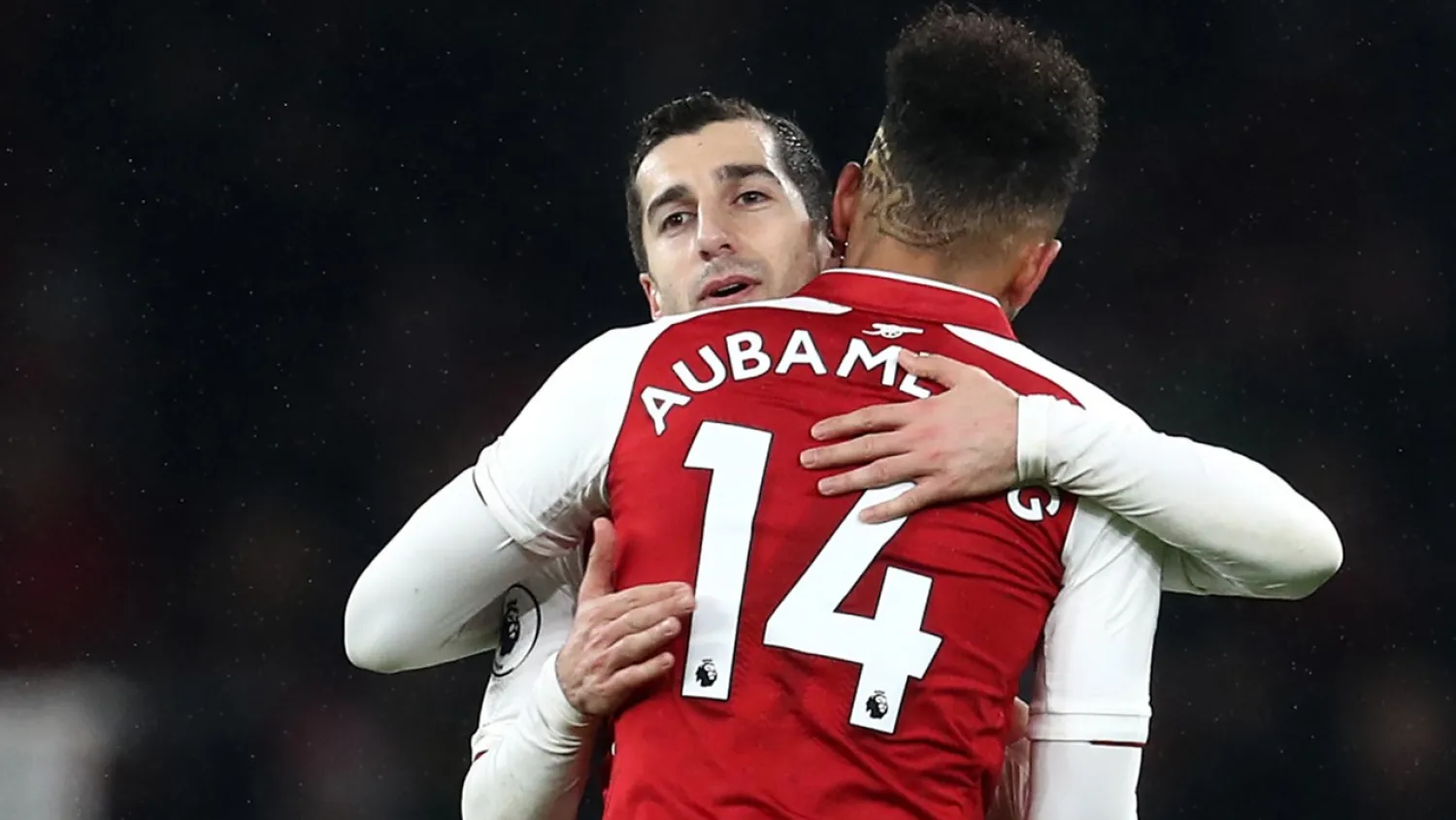

Aubameyang and Mkhitaryan Chemistry Gives Arsenal Hope of Fast Football again

Arsenal's Pierre-Emerick Aubameyang and Henrikh Mkhitaryan. (Getty Images)
TT

Aubameyang and Mkhitaryan Chemistry Gives Arsenal Hope of Fast Football again

Arsenal's Pierre-Emerick Aubameyang and Henrikh Mkhitaryan. (Getty Images)

A few years ago, when Jens Lehmann was in between spells as an Arsenal player and coach, he explained a key to the Invincibles team with a teasing question: “What is the fastest thing on a football pitch?” he asked cryptically, looking smug as he waited for the wrong answer. “It’s not the ball,” he added, before the big reveal: “Nobody is faster on the pitch than a thought. And then the ball comes. And then the players come. I can honestly say between 2003 and 2006 we played such fast football. One touch. It was amazing to see.”

Fast football. That is one of the aspects that has declined at Arsenal in recent years as the speedometer has dropped off. The high-velocity style Arsène Wenger encouraged when he arrived in England, the full-throttle bursts Lehmann watched take off in front of him, have become less prominent. When Arsenal struggle and slip into endless sideways probing, becoming exposed to the kind of errors and breaks that got punished so typically at Swansea, that is when they look a world away from the best Wenger teams of old.

Alexis Sánchez got fast football, with his indefatigable darting runs, sudden passes (even if they could be reckless) and the urgency he visibly demanded of others. But while he offered that individually, it is notable that Arsenal have not played with a high-speed team style for a while. That is partly because it is hard to achieve without an entire XI of extremely gifted and intelligent players. It does not help, though, that they have not reliably been built around a sprinter as their center-forward since Thierry Henry.

In the last couple of seasons Sánchez had the odd stint as a central striker, as did Theo Walcott and occasionally Danny Welbeck. Olivier Giroud’s best asset was never pace. Alexandre Lacazette came in last summer for a record fee but is still finding his way in the team.

Enter Pierre-Emerick Aubameyang and Henrikh Mkhitaryan. By Arsenal’s normal transfer standards this has been a radical January. Bringing in these two players allows them to attempt to regain a sense of fast football.

It is underestimating Aubameyang to pigeonhole him as a speed merchant alone – his timing to peel into spaces and connections with team-mates in creating as well as running on to chances make him more rounded than that. That said, his pace should have a strong impact in how Arsenal attack. The other obvious contribution on the fast football front is the fact he is coming as part of a proven pair. The bond with Mkhitaryan, given the understanding they shared at Borussia Dortmund, brings instant automatisms to Arsenal in the final third. Mesut Özil will presumably click into that pretty easily as well.

In the last campaign that Aubameyang and Mkhitaryan played together at Dortmund, 2015-16, their combined figures were superb: 59 goals and 31 assists between them, with a lot of the goals reflecting the rapport they had with each other; one providing and the other finishing.

In the summer of 2016 Wenger went striker shopping, on the hunt for a quick frontman, but a player of the caliber and expense of Aubameyang seemed miles off the radar. He courted Jamie Vardy to no avail and ended up with a gamble on Lucas Pérez, who returned to Spain on loan after a season in which Wenger was unwilling to offer him many chances to find some rhythm.

Arsenal have tended to give the impression they improvise rather than work to some refined strategic masterplan when it comes to transfers. With this in mind, there is a concern the position of Lacazette may become a side dish as Arsenal tuck into the new and exciting main course of Aubameyang and Mkhitaryan.

It is out of character for Arsenal to spend heavily on a new striker in the summer and then six months later spend even more heavily on another one. The question of how Lacazette and Aubameyang link – whether they play together, compete for the same spot or one is shifted out of their favored position – is an important one. Lacazette will not be thrilled if he feels he is unfairly pushed aside but, if Wenger can keep everyone happy and motivated, he has promising attacking tools at his disposal.

Constructing a new and balanced frontline, as quickly as possible, will go some way to determining how competitive Arsenal can be in the second half of the season as they adjust to life after Sánchez. The nagging issues in terms of defensive concentration will not be fixed by that but more clinical forward play could help ease some of the pressure.

At the start of the season the idea Arsenal would offload Sánchez, Giroud and Walcott in the same January window scored somewhere between fanciful and bonkers on the transfer scale. The trio scored more than two-thirds of the team’s goals last season (Sánchez 30, Giroud 16 and Walcott 19). Arsenal are usually way more conservative in the market. They cannot be accused of that this time.

Critics of Ivan Gazidis’s “catalyst for change” movement can see this January window as evidence of something new. That would have been impossible if Arsenal had flunked in their very public pursuit of Aubameyang.

The release of Sánchez never looked likely to put them in a stronger position but they have tried their utmost to turn a negative into a shiny positive. Parading the signatures of Aubameyang and a freshly contracted Özil on deadline day, in addition to the newly welcomed Mkhitaryan, outlines how Arsenal’s best (perhaps only?) form of defense has to be a fresh attack.

The Guardian Sport


Salah Steers Egypt into Africa Cup Knockout Stages After VAR Denies South Africa Late Penalty

 Egypt's forward #10 Mohamed Salah shoots from the penalty spot to score the team's first goal during the Africa Cup of Nations (CAN) Group B football match between Egypt and South Africa at Adrar Stadium in Agadir on December 26, 2025. (AFP)
Egypt's forward #10 Mohamed Salah shoots from the penalty spot to score the team's first goal during the Africa Cup of Nations (CAN) Group B football match between Egypt and South Africa at Adrar Stadium in Agadir on December 26, 2025. (AFP)
TT

Salah Steers Egypt into Africa Cup Knockout Stages After VAR Denies South Africa Late Penalty

 Egypt's forward #10 Mohamed Salah shoots from the penalty spot to score the team's first goal during the Africa Cup of Nations (CAN) Group B football match between Egypt and South Africa at Adrar Stadium in Agadir on December 26, 2025. (AFP)
Egypt's forward #10 Mohamed Salah shoots from the penalty spot to score the team's first goal during the Africa Cup of Nations (CAN) Group B football match between Egypt and South Africa at Adrar Stadium in Agadir on December 26, 2025. (AFP)

Mohamed Salah scored again on Friday as Egypt's 10 men held on to beat South Africa 1-0 to reach the knockout stages of the Africa Cup of Nations.

Salah, who secured the Pharaohs’ opening win with a stoppage-time strike against Zimbabwe on Monday, did it again in Agadir and his penalty before the break secured progression from Group B.

But South Africa should arguably have been given a penalty in stoppage time when Yasser Ibrahim blocked a shot with his arm. After a long delay, the referee decided against awarding the spot kick after consulting video replays and Ibrahim sank to the ground in relief.

“We didn’t have much luck. We also had several refereeing decisions go against us,” South Africa coach Hugo Broos said.

Salah converted his penalty after he was struck in the face by the hand of the retreating South Africa forward Lyle Foster. Salah showed no ill effects from the blow and sent his shot straight down the middle while goalkeeper Ronwen Williams dived to his right.

There was still time before the break for Egypt defender Mohamed Hany to get sent off, after receiving a second yellow card for a foul on Teboho Mokoena.

Goalkeeper Mohamed El Shenawy was Egypt’s key player in the second half.

“We gave our all in this match right until the end, and we also hope for the best for what comes next,” the 37-year-old El Shenawy said.

Earlier, Angola and Zimbabwe drew 1-1 in the other group game, a result that suited neither side after opening losses.

Egypt leads with 6 points from two games followed by South Africa on 3. Angola and Zimbabwe have a point each. The top two progress from each group, along with the best third-place finishers.

Zambia drew 1-1 with Comoros in the early Group A fixture after both lost their opening games, meaning the winner of the late match could be sure of progressing.


Draper to Miss Australian Open Due to Injury

 Jack Draper, of Great Britain, reacts after defeating Federico Agustin Gomez, of Argentina, during the first round of the US Open tennis championships, Aug. 25, 2025, in New York. (AP)
Jack Draper, of Great Britain, reacts after defeating Federico Agustin Gomez, of Argentina, during the first round of the US Open tennis championships, Aug. 25, 2025, in New York. (AP)
TT

Draper to Miss Australian Open Due to Injury

 Jack Draper, of Great Britain, reacts after defeating Federico Agustin Gomez, of Argentina, during the first round of the US Open tennis championships, Aug. 25, 2025, in New York. (AP)
Jack Draper, of Great Britain, reacts after defeating Federico Agustin Gomez, of Argentina, during the first round of the US Open tennis championships, Aug. 25, 2025, in New York. (AP)

Briton Jack Draper said on Friday he will not compete in next month's Australian Open, citing ongoing recovery from an injury.

Draper, 10th in the world rankings, was forced to withdraw from the second round of ‌the US Open ‌in August ‌due ⁠to bone ‌bruising in his left arm.

"Unfortunately, me and my team have decided not to head out to Australia this year. It's a really, ⁠really tough decision," the British ‌number one said in ‍a video ‍posted on X.

The 24-year-old ‍is targeting a February return alongside preparation for the defense of his Indian Wells title in March.

"This injury has been the most difficult ⁠and complex of my career," Draper added. "It's weird, it always seems to make me more resilient. I'm looking forward to getting back out there in 2026 and competing."

The Australian Open begins on January 18 in ‌Melbourne.


Morocco Forced to Wait for AFCON Knockout Place After Mali Draw

Football - CAF Africa Cup of Nations - Morocco 2025 - Group A - Morocco v Mali - Prince Moulay Abdellah Stadium, Rabat, Morocco - December 26, 2025 Morocco's Ismael Saibari reacts after Mali's Lassine Sinayoko scored their first goal. (Reuters)
TT

Morocco Forced to Wait for AFCON Knockout Place After Mali Draw

Football - CAF Africa Cup of Nations - Morocco 2025 - Group A - Morocco v Mali - Prince Moulay Abdellah Stadium, Rabat, Morocco - December 26, 2025 Morocco's Ismael Saibari reacts after Mali's Lassine Sinayoko scored their first goal. (Reuters)

Morocco missed the chance to guarantee their spot in the last 16 of the Africa Cup of Nations after Lassine Sinayoko's second-half penalty earned Mali a 1-1 draw with the hosts on Friday.

The match was a tale of two spot-kicks, with Brahim Diaz giving Morocco the lead from a penalty deep in first-half injury time and Sinayoko replying on 64 minutes.

The stalemate at the Prince Moulay Abdellah Stadium in the capital Rabat ended Morocco's world record winning run which had been taken to 19 matches with their 2-0 victory over Comoros in the tournament's opening game.

It also means Morocco have not yet confirmed their place in the knockout phase, although they are on top of Group A with four points from two games.

Mali come next on two points alongside Zambia, who drew 0-0 with minnows Comoros earlier in Casablanca.

Morocco next face Zambia on Monday and a victory in that match against the 2012 champions will ensure that the hosts go through as group winners.

"We'll look back at the second half and see what the problem was but we didn't play the way we did in the first half. We didn't impose our game and had to drop off. The penalty changed the game a bit," Morocco midfielder Azzedine Ounahi told broadcaster beIN Sports.

"We go into the third game with the same approach, to win the game and finish top of the group."

Morocco captain Achraf Hakimi, the African player of the year, was again an unused substitute as he continues his recovery from an ankle injury suffered playing for Paris Saint-Germain at the start of November.

- Mbappe watches on -

His former PSG teammate Kylian Mbappe, the current Real Madrid superstar and France skipper, was among the spectators in the crowd of 63,844 and appeared to be wearing a Morocco shirt with Hakimi's number two on it.

With Hakimi on the sidelines, Mbappe's Real Madrid teammate Diaz was the main attraction on the pitch -- the little number 10 forced a good save from Mali goalkeeper Djigui Diarra on 17 minutes and then played a key part in the penalty which led to the opening goal just before the interval.

Mali defender Nathan Gassama brushed the ball with his hand as he tried to stop Diaz dribbling past him inside the box, and the referee eventually awarded a spot-kick following a lengthy look at the pitchside VAR monitor.

Morocco's Soufiane Rahimi had a spot-kick saved against Comoros but this time Diaz sent the goalkeeper the wrong way for his second goal of the tournament.

However, Walid Regragui's side, the best team in Africa according to the FIFA rankings, could not build on that as Mali won a penalty of their own just after the hour mark.

Sinayoko went down under a clumsy challenge by Jawad El Yamiq and 29-year-old Cameroonian referee Abdoul Abdel Mefire awarded the penalty after eventually being called over to check his screen.

Auxerre striker Sinayoko, having been booked apparently for something he said to the referee, kept his cool to stroke in the reward and restore parity.

Morocco substitute Youssef En-Nesyri was denied by a good Diarra save and Mali then held on through 10 minutes of stoppage time for a point, as the final whistle was greeted with jeers from the home fans.
