


Why Italian Football Does Not Make Sense In The English Language

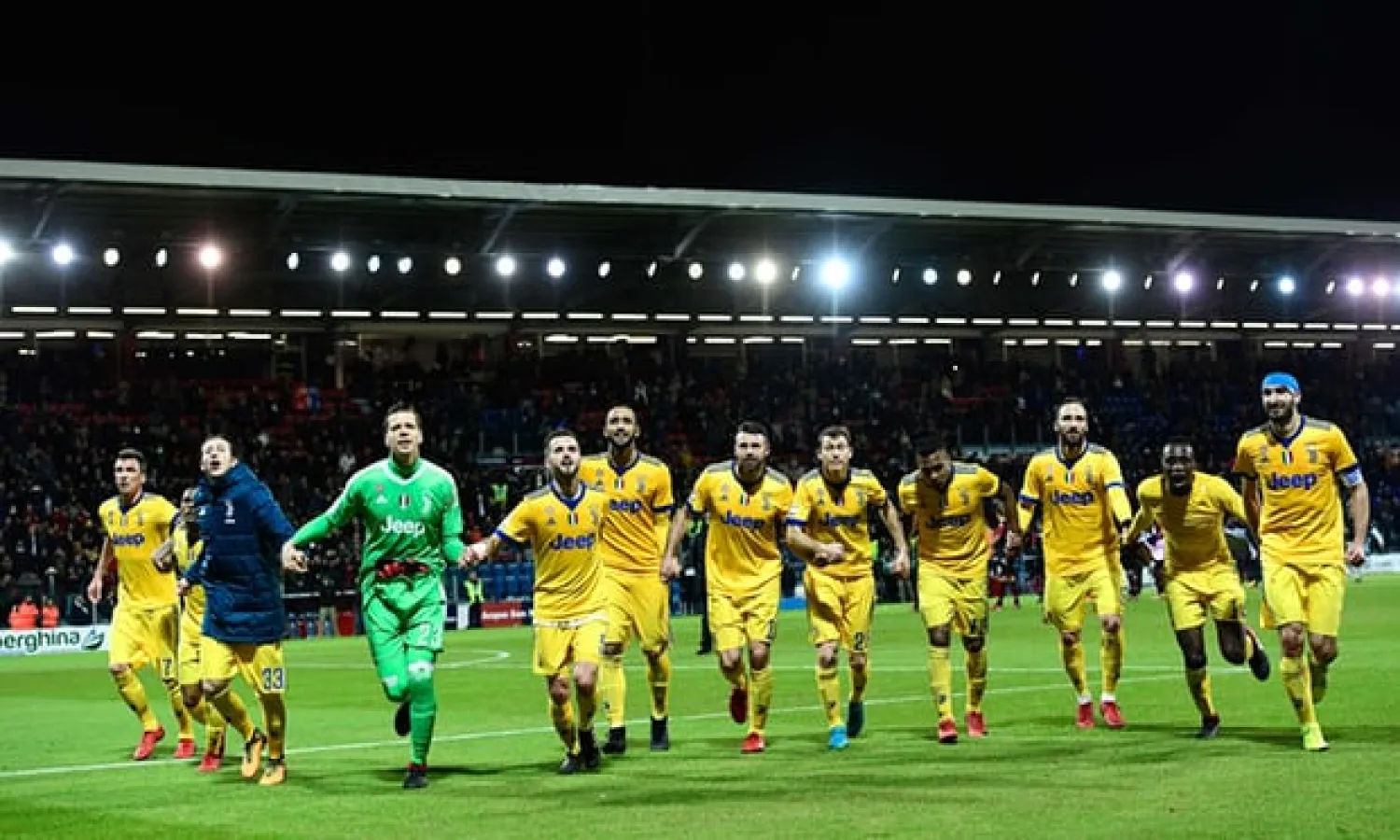
 Juventus players celebrate after beating Cagliari at the Sardegna Arena. Photograph: Miguel Medina/AFP/Getty Images
Juventus players celebrate after beating Cagliari at the Sardegna Arena. Photograph: Miguel Medina/AFP/Getty Images
TT

Why Italian Football Does Not Make Sense In The English Language

 Juventus players celebrate after beating Cagliari at the Sardegna Arena. Photograph: Miguel Medina/AFP/Getty Images
Juventus players celebrate after beating Cagliari at the Sardegna Arena. Photograph: Miguel Medina/AFP/Getty Images

As a football fan living in the US, I’m amazed at how many games are available on TV these days. On any Saturday or Sunday, I can choose from at least 10 games on my basic cable package. Football fans in the US tend to focus their attentions on the Premier League, which has as much to do with the crispness of its presentation as the action on the pitch. The periphery is perfect: the stadiums are beautiful, modernised and full, and the the fans are present and loud. But, more than anything, the games are so watchable because of the commentary.

NBC, who show all 380 Premier League matches live in the US, do not put out the exact same broadcast as the one shown in the UK, but they do employ commentators with British presenters, which lends everything immediacy and authenticity. This is what sets the Premier League apart from the rest of the big European leagues. When we watch games from Spain, Germany, France or Italy, we are watching something in translation.

I have followed Italian football intently for more than half of my life – especially during the three years I spent living there – but I increasingly find myself watching Serie A games without the sound as it almost feels like a contaminant. It’s not that the quality of the commentary in English is that bad – it is pretty bad, though – it’s more that the words used just don’t fit the game the way Italian commentary does. Rather than watching a Serie A game, I feel as if I’m listening to somebody else watching the game, with an added layer of detachment.

It’s not just that the observations are more astute and the passion is more intense, but the Italian language manages to mesh perfectly with the action it describes. Italians even have their own name for the game: calcio, literally “kick”, preferring not to Latinise the word “football” as the Spanish (fútbol), French (le foot) and Portuguese (futebol) all do. In my very first Italian class, a student asked the teacher why Italians do not just use a simple variation, like in Spain, and the teacher replied, without even the hint of a smile: “Because we are much better at soccer than the Spanish.”

Italian football is often criticised for being overly dramatic, with players spending too much time feigning injury, encircling the referee or dropping to the grass with their faces in their hands after they have missed opportunities. These criticisms carry weight but, given the language of the game in Italy, it is hard to see how the game could be any other way. An Italian match is more than just that; it is a performance in which the players are fighting not just to win but to win over the audience.

In Italian a player does not play a position (posizione), but rather their role (ruolo). Managers often speak in post-match interviews about how a player has “interpreted their role” or how the team has “interpreted the match” as a whole. The playmaker is called a regista, or “director”, while players who exchange passes are said to dialogare, literally “to dialogue”.

A goal is not scored, but rather “authored” (l’autore del gol). A player who is often at the centre of the action becomes the game’s protagonista, with the potential to risolvere la partita, or “resolve the match”. A particularly creative player may also be praised for his fantasia, while a true legend of the game, such as Roberto Baggio, is a maestro.

A team’s passing or possession may be referred to as its fraseggio, which means literally its “phrasing”, a term used to describe musical expression. A player’s individual move is a numero, his error or lapse in judgment is a pasticcio, or “pastiche”, while his shot on goal is a conclusione, which, should he miss, is considered fallita, or “failed”, the same word Italians use to describe bankruptcy.

A ball is not won from the opposing team, but conquistato, or “conquered”, and is not trapped but addomesticato, “domesticated”. A challenge from an opposing player is a contrasto, or “conflict”; a match-up is a duello; and a penalty-kick is a rigore, or “rigour”. All this drama plays out in front of the pubblico whose cori, or “choruses”, are as likely to be jeering the victorious team as celebrating them depending on the performance itself.

It’s hard to know whether the style of play adapted to suit the language of the stage or the lexicon was developed in response to the style of the action. Either way, this colourful commentary certainly lends Serie A matches gravitas. Suddenly the level of drama on the pitch makes sense. The highest praise a commentator can bestow upon a match is that of spettacolo, the word for both “spectacle” and a “play”. When an opposing coach lost to Napoli at the end of last year, he praised his opponents in wonder as una sinfonia, “a symphony”.

When looking to describe new trends in the game, Italian commentators often look abroad, incorporating many English terms such as pressing, tap-in, assist, cross, dribbling and stretching, which are appallingly pronounced and sometimes even carry a reimagined meaning. Dribbling, for instance, becomes a noun in Italian rather than a verb; so instead of a player beating an opponent with a dribble, he is said to have executed a “dribbling”. Similarly, an assist does not have to lead to a goal, just a goalscoring opportunity. Whether misunderstandings or not, these neologisms only add to the charm and idiosyncrasy of the calcio lexicon.

Serie A has other problems when presented on TV – including empty stands and outdated stadiums – but the language barrier is the biggest issue for me. Fans of the Bundesliga, Ligue 1 and La Liga probably have similar complaints and this may explain why English speakers flock to the Premier League. Having all these games on TV is amazing but, in the same way that the coffee from my Italian espresso maker never quite tastes as good at home, these football matches are lost in translation. Something is missing, so I watch and sip in silence.

The Guardian Sport


Salah Unaffected by Liverpool Turmoil Ahead of AFCON Opener, Says Egypt Coach

Liverpool's Mohamed Salah sits on the bench before the English Premier League soccer match between Liverpool and Brighton and Hove Albion in Liverpool, England, Saturday, Dec. 13, 2025. (AP)
TT

Salah Unaffected by Liverpool Turmoil Ahead of AFCON Opener, Says Egypt Coach

Liverpool's Mohamed Salah sits on the bench before the English Premier League soccer match between Liverpool and Brighton and Hove Albion in Liverpool, England, Saturday, Dec. 13, 2025. (AP)

Mohamed Salah has shown no signs of being distracted by the uncertainty surrounding his future at Liverpool as he prepares to lead Egypt into the Africa Cup of Nations, Pharaohs coach Hossam Hassan said on Sunday.

"Salah's morale in training is very high, as if he were just starting out with the national team, and I believe he will have a great tournament with his country," Hassan told reporters ahead of Egypt's opening AFCON game against Zimbabwe in Agadir on Monday.

"I feel his motivation is very, very strong. Salah is an icon and will remain so. He is one of the best players in the world, and I support him in everything he does," Hassan added.

Salah did not start any of Liverpool's last five games before departing for the Cup of Nations in Morocco and things came to a head following the recent Premier League draw at Leeds United when he claimed he had been "thrown under the bus" by his coach at Anfield, Arne Slot.

That suggested a move away from the troubled Premier League champions during the January transfer window was a real possibility.

"I don't consider what happened to him to be a crisis. These things often happen between players and coaches," Hassan added.

"We've been in contact with him by phone from the beginning, and I met with him when he joined the national team camp. His focus is entirely on the tournament."

Salah, 33, is aiming to lead Egypt to a record-extending eighth AFCON title in Morocco. He has never won the continental title, but ended up on the losing side in final defeats by Cameroon in 2017 and Senegal in 2022.

His goals this year have already helped Egypt qualify for the World Cup.

"Whenever Salah's performances dip with his club, he regains his strength with the national team and becomes even better, whether by contributing to goals or scoring himself. Then he returns to his club even stronger," Hassan added.

"He needs to win the cup by helping us and by helping himself."

Egypt will also face South Africa and Angola in Group B at the Cup of Nations, with all three of their games in the first round being played in Agadir.


Pressure on Morocco to Deliver as Africa Cup of Nations Kicks Off

Morocco's head coach Walid Regragui speaks during a press conference at Prince Moulay Abdellah Stadium in Rabat, Morocco, 20 December 2025. (EPA)
TT

Pressure on Morocco to Deliver as Africa Cup of Nations Kicks Off

Morocco's head coach Walid Regragui speaks during a press conference at Prince Moulay Abdellah Stadium in Rabat, Morocco, 20 December 2025. (EPA)

Morocco carry a huge weight of expectation into their opening game at the Africa Cup of Nations on Sunday as the hosts, with star man Achraf Hakimi returning from injury, aim to see off stiff competition to claim continental glory.

Senegal, reigning champions Ivory Coast, Mohamed Salah's Egypt and a Nigeria side led by Victor Osimhen are among the biggest rivals for Morocco at the AFCON, which runs into the New Year with the final on January 18.

Morocco, Africa's best team in the FIFA rankings in 11th place, kick off the tournament on Sunday at 1900 GMT against minnows Comoros at the new 69,000-seat Prince Moulay Abdellah Stadium in Rabat.

There is huge pressure on the Atlas Lions, semi-finalists at the 2022 World Cup who come into the Cup of Nations on a world-record run of 18 consecutive victories.

"I have always said the objective is to win this AFCON at home in front of our fans," coach Walid Regragui insisted on Saturday.

"The country that will have the most difficulty winning the AFCON is Morocco, because of the expectation on us," he nevertheless warned as they look to claim the title for the first time since 1976.

"The pressure on us is positive, but anything other than victory will be a failure."

Paris Saint-Germain right-back Hakimi, the African player of the year, says he is ready to take part despite not having played since suffering an ankle injury in early November.

"I feel good," said Hakimi, although Regragui admitted that the former Real Madrid man may not play against Comoros with further Group A matches to come against Mali and Zambia.

Hakimi added: "I'm not thinking about me as an individual. If I only play one minute and the team wins, then that's fine."

They have been good at winning of late -- Morocco won the recent Under-20 World Cup and the country's triumph in the FIFA Arab Cup final against Jordan in Doha this week brought fans onto the streets in celebration.

For Morocco, this tournament is also about showcasing some world-class stadiums as it hosts a first AFCON since 1988.

The Prince Moulay Abdellah Stadium, which will also stage the final, is one of four being used in Rabat.

A huge 75,000-seat stadium in Tangier will host a semi-final, while games will also be played in Casablanca, Marrakesh, Agadir and Fez as the country builds towards the 2030 World Cup which it will co-host with Spain and Portugal.

The introduction of FIFA's expanded Club World Cup last June and July forced the Confederation of African Football (CAF) to push back its flagship tournament.

They could not wait until next June because of the World Cup, and they can no longer stage the Cup of Nations in January and February because of the new UEFA Champions League format.

The only solution was to start in December and continue into the New Year, at a time when many European leagues -- where so many African stars play -- take a break.

Confederation of African Football president Patrice Motsepe on Saturday acknowledged the need to address the scheduling problem as he announced a decision to play the Cup of Nations every four years following a planned edition in 2028.

"We want to make sure that there is more synchronization," said Motsepe, and that "the football calendar worldwide is more in harmony".

Morocco are aiming to follow the example of Ivory Coast, who won the last AFCON as hosts in 2024.

North African teams have won four of the last five editions held in the region, including Algeria's triumph in Egypt in 2019.

It remains to be seen whether the doubts surrounding Salah's Liverpool future impact Egypt's chances of winning a record-extending eighth title.

Elsewhere Senegal, winners in 2022 and with a squad featuring Sadio Mane and Iliman Ndiaye, are serious contenders.

Runners-up last year, Nigeria will hope to make amends here for missing out on World Cup qualification.

In contrast, Ghana and Cape Verde are both going to the World Cup, but neither are present in Morocco.

After Sunday's opening game there will be three matches on Monday, including South Africa against Angola and Egypt versus Zimbabwe in Group B.


Isak Injury Leaves Slot Counting Cost of Liverpool Win at Spurs

 Liverpool's Alexander Isak reacts after sustaining an injury during the English Premier League soccer match between Tottenham and Liverpool in London, Saturday, Dec. 20, 2025. (AP)
Liverpool's Alexander Isak reacts after sustaining an injury during the English Premier League soccer match between Tottenham and Liverpool in London, Saturday, Dec. 20, 2025. (AP)
TT

Isak Injury Leaves Slot Counting Cost of Liverpool Win at Spurs

 Liverpool's Alexander Isak reacts after sustaining an injury during the English Premier League soccer match between Tottenham and Liverpool in London, Saturday, Dec. 20, 2025. (AP)
Liverpool's Alexander Isak reacts after sustaining an injury during the English Premier League soccer match between Tottenham and Liverpool in London, Saturday, Dec. 20, 2025. (AP)

Arne Slot was left to count the cost of Liverpool's chaotic 2-1 win at nine-man Tottenham after Alexander Isak's rare goal was followed by a potentially damaging injury.

Isak fired Liverpool into a second-half lead in north London with a clinical finish, only to limp off moments later after being injured by Micky van de Ven's failed attempt to stop him scoring.

The Sweden striker's third goal for Liverpool since his British record £125 million ($166 million) move from Newcastle on transfer deadline day had offered hope that he was finally set to live up to his hefty price tag.

Instead, Reds boss Slot now faces an anxious wait to determine how long the 26-year-old will be sidelined with his ankle problem.

Slot would only say that Isak's injury was "not a good thing".

It could not have come at a worse time for fifth-placed Liverpool after Egypt forward Mohamed Salah's departure to the Africa Cup of Nations and an injury to Dutch winger Cody Gakpo.

Adding to Slot's fitness issues, Isak only came off the bench at half-time after right-back Conor Bradley was injured.

Although Liverpool are unbeaten in their last six games in all competitions -- winning three in a row -- the brief flicker of promise engendered by the sight of Hugo Ekitike, Florian Wirtz and Isak combining for the opening goal was quickly snuffed out.

The trio cost around £300 million to bring to Anfield in the close-season, with only Ekitike, the least expensive of the group, living up to the hype during the Premier League champions' troubled first half of the season.

French striker Ekitike maintained his strong start to life with Liverpool by heading their second goal against Tottenham.

But even then, Liverpool made heavy weather of it as Tottenham, already down to 10 men after Xavi Simons' first-half dismissal for a crude foul on Virgil van Dijk, pulled one back through Richarlison in the closing stages.

Tottenham captain Cristian Romero's stoppage-time dismissal for a needless second booking after he kicked Ibrahima Konate let Liverpool off the hook just as they looked set to blow the lead in a frenzied finale.

Breathing a sigh of relief, Slot said: "A good goal (for Isak), assisted by Florian Wirtz, and I said last week already players are getting better, the team is getting better.

"I thought to be honest with nine, we will probably be able then to keep them away from our goal, but it looked as if we were down to nine and they were on 11 because it was attack after attack after attack.

"Again, it wasn't perfect, especially not in the last 10 minutes but in the meantime, we pick up points and I see the team developing in a way I like to see."

Meanwhile, under-fire Tottenham boss Thomas Frank blasted referee John Brooks.

Frank was furious with Simons' red card -- which was upgraded from a booking after a VAR review -- and the failure to disallow Ekitike's goal for a push on Romero.

"I don't like this as a red card. I think the game is probably too big to say gone, but for me it's not reckless and it's not exceptional force," said Frank, whose side are languishing in 13th place.

"He is chasing Van Dijk. He is trying to put pressure and then he changes direction. Unfortunately, his foot is on Achilles. You can say 'Ah, you need to be smarter, don't do it and all that' but so are we not allowed to have physical contact anymore?

"The second goal is a mistake from the referee. There are two hands in the back. I don't understand how you can do that.

"I think that was the biggest mistake in my opinion and from VAR but apparently that was not enough."
