


Despite Israel Spat, Lebanon Signs First Offshore Gas, Oil Deals

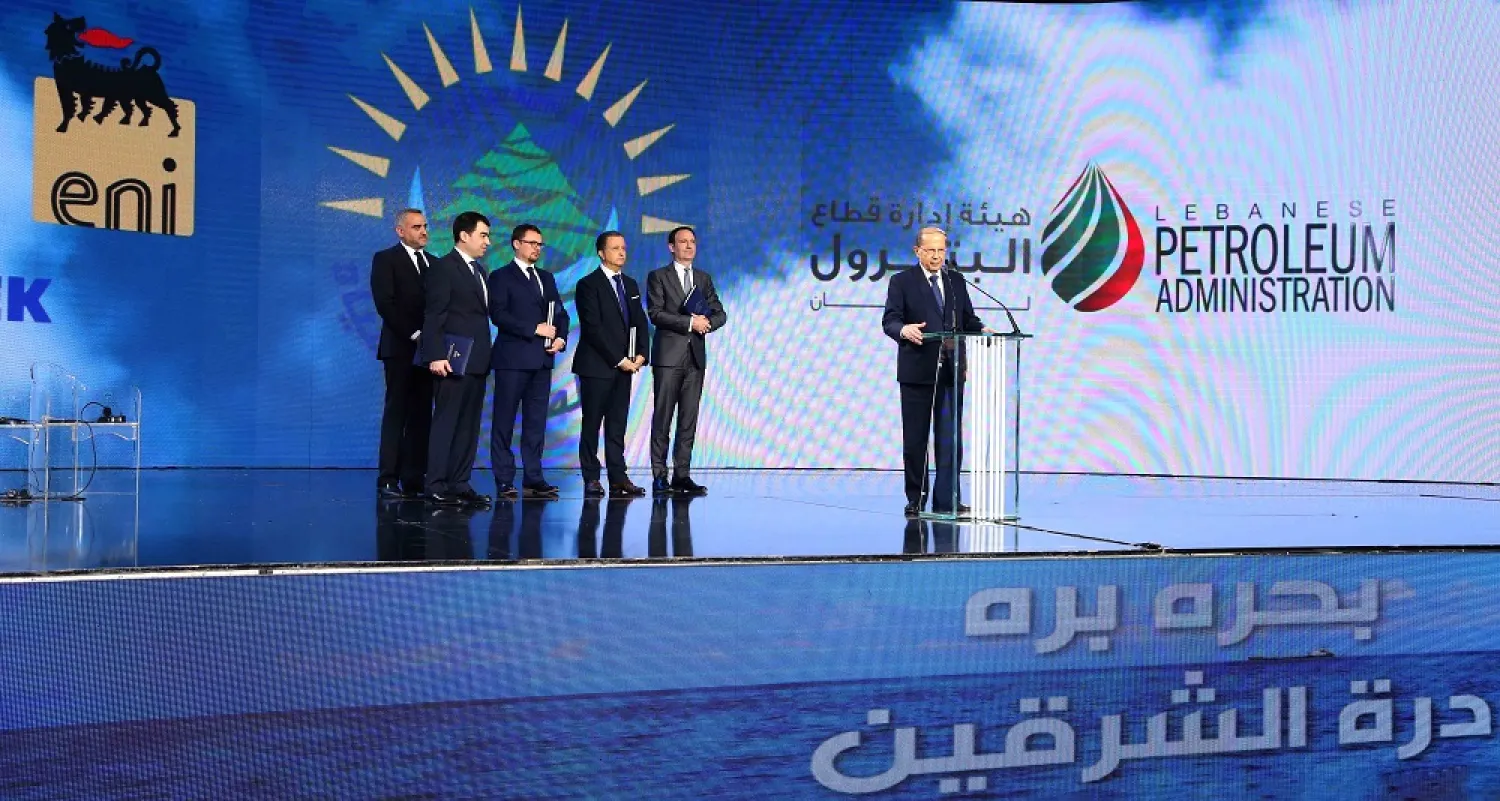
Lebanese President Michel Aoun speaks during a ceremony marking the signing of offshore oil and gas exploration deals. (Dalati & Nohra)
TT

Despite Israel Spat, Lebanon Signs First Offshore Gas, Oil Deals

Lebanese President Michel Aoun speaks during a ceremony marking the signing of offshore oil and gas exploration deals. (Dalati & Nohra)

Amid a simmering dispute with Israel over the demarcation of the shared marine border, Lebanon signed on Friday its first agreements for offshore oil and gas exploration.

The deal includes exploration in two blocks, including one that is contested with Israel.

The signing ceremony was held Friday afternoon in Beirut and was attended by President Michel Aoun.

"We have achieved a big dream and Lebanon has entered a new era today," Aoun said at the ceremony.

A consortium of France’s Total, Italy’s Eni and Russia’s Novatek signed the agreements for the two blocks, which are among five that Lebanon put up for tender in the country’s much-delayed first licensing round.

Lebanon’s energy minister said the dispute with Israel would not stop Lebanon benefiting from potential undersea reserves in the contentious Block 9, while consortium operator Total said it would not drill the block’s first well near the disputed zone.

Israel and Lebanon, which regard each other as enemy states, have exchanged threats and condemnation over the tender, amid rising tensions over territorial and marine boundaries between them.

“Today, we announce that we have started our petroleum path ... after signing the agreements and launching the exploration activities,” Lebanese Energy Minister Cesar Abi Khalil said at a ceremony in Beirut.

The contracts had already been signed on January 29.

Data suggests there are reserves in Lebanon’s waters, but no exploratory drilling has taken place to estimate their size.

Abi Khalil has said a second offshore licensing round will happen once the first commercially viable discovery is made.

The first exploratory well will be drilled in Block 4 in 2019, said Stephane Michel, Total’s head of exploration and production in the Middle East and North Africa.

The second well will be drilled in Block 9 more than 25 km (15 miles) from the maritime border claimed by Israel, he said at the ceremony. “There is no reason not to proceed in this way,” Michel added.

Lebanon has an unresolved maritime border dispute with Israel over a triangular area of sea of around 860 sq km (330 square miles) that extends along the edge of three of its total 10 blocks.

Total said in a statement the disputed waters comprise 8 percent of Block 9 and that its exploration well “will have no interference at all with any fields or prospects” in the disputed sliver of water.

Lebanese and Israeli officials said David Satterfield, acting assistant US secretary of state, was in Israel last week and in Lebanon this week on a mediation mission. US officials confirmed his travels without detailing his agenda.

Abi Khalil told Reuters the heightened tension between the two countries in recent weeks has “not had an effect” on the consortium’s plans to explore.

Lebanon's Foreign Minister Jebran Bassil warned Israel not to try to hinder the drilling on the Lebanese side saying that Beirut can also stop offshore development on the Israeli side.

Earlier this week, Israeli Defense Minister Avigdor Lieberman described Lebanon's exploration tender as "very provocative" and suggested that Lebanon had put out invitations for bids from international groups for a gas field "which is by all accounts ours."

His comments drew sharp condemnation from Prime Minister Saad Hariri, who described Lieberman's comments as a "blatant provocation that Lebanon rejects."

Lebanon is on the Levant Basin in the eastern Mediterranean where a number of big sub-sea gas fields have been discovered since 2009.

Eni reported the Mediterranean’s largest discovery in 2015: the Zohr field off Egypt which holds an estimated 30 trillion cubic feet of gas. On Thursday Eni said it and Total had discovered a promising natural gas field off Cyprus.

Fuad Krekshi, Eni’s executive vice president of the Middle East, said Eni’s entry into Lebanon’s market is a “natural consequence” of its existing role in the Mediterranean region.

Total, with 40 percent, heads the consortium drilling Lebanon’s first offshore well. Eni also holds 40 percent and Novatek 20 percent.

Vyacheslav Mishin, head of Novatek’s new Lebanon office, said the projected global growth in natural gas and LNG consumption was key to his company’s future growth.

“The Middle East market for LNG consumption is forecast to grow by more than 100 percent by 2030,” he said.

Potential reserves could be used domestically or exported.

Both are attractive for Lebanon which has been short of electricity since its 1975-90 civil war and has an anemic economy battered by war in neighboring Syria and political tensions. Lebanon has a debt of $80 billion or 145 percent of its gross domestic product making it one of the world's highest.

It is also hoped the developing oil and gas industry will create jobs and economic growth. To this end, the EPA contracts say 80 percent of people employed by the consortium should be Lebanese, with priority given to local suppliers and contractors.

But the commercial viability of potential reserves depends on energy market prices, the ability to secure customers and the cost and politics of building export infrastructure.

“For all the fields in the region, there are commercial, political, and technical challenges that hinder exploitation for the purposes of export,” Tareq Baconi, a European Council on Foreign Relations visiting fellow on MENA energy told Reuters.

“Many of the challenges for export will be faced by Lebanon as well when, and if, it discovers offshore reserves,” he said.



Lebanon Says Two Killed in Israeli Strike on Palestinian Refugee Camp

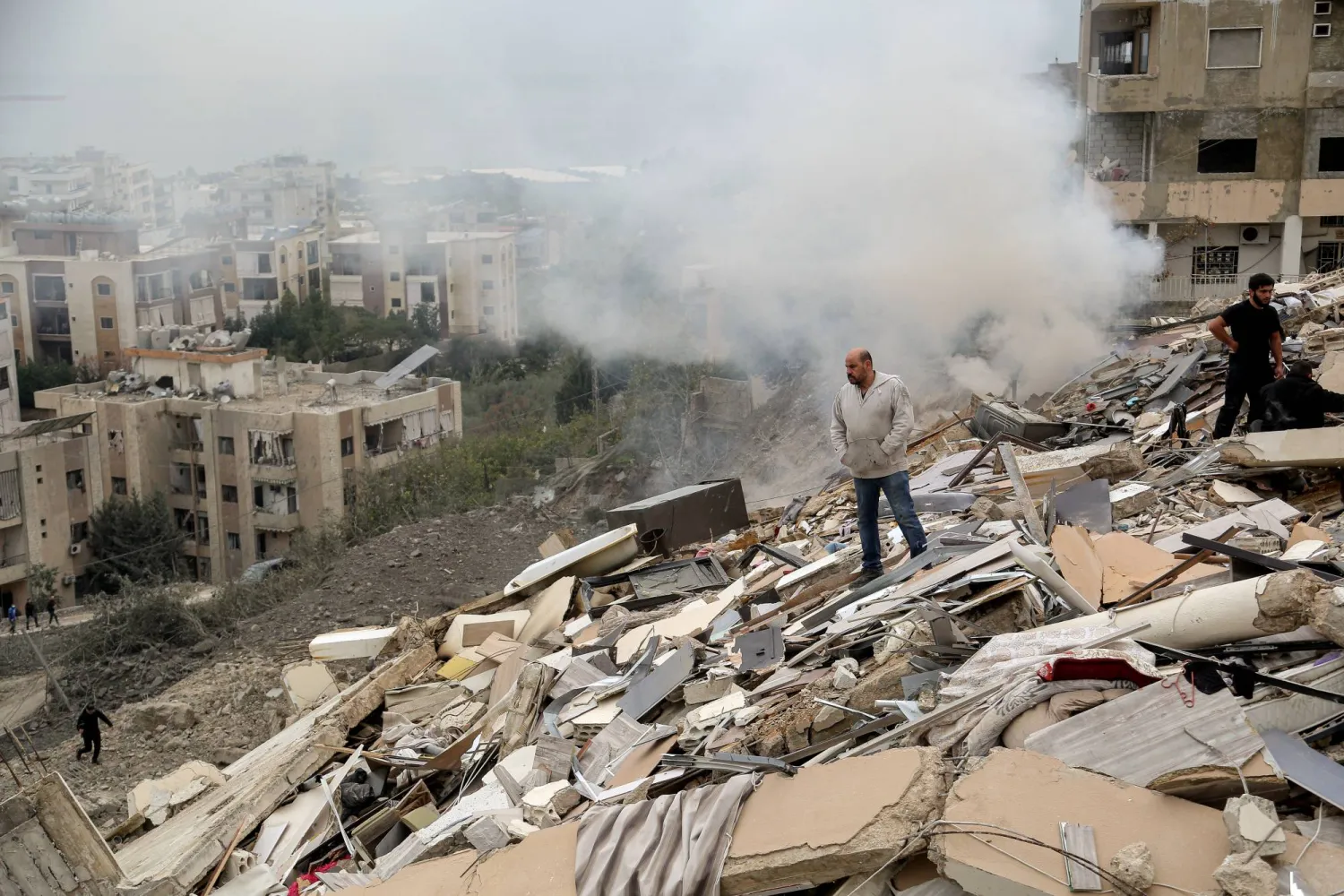
22 January 2026, Lebanon, Qnarit: People inspect the damage of a building that was destroyed by an Israeli air raid on the southern Lebanese village of Qnarit. (dpa)
TT

Lebanon Says Two Killed in Israeli Strike on Palestinian Refugee Camp

22 January 2026, Lebanon, Qnarit: People inspect the damage of a building that was destroyed by an Israeli air raid on the southern Lebanese village of Qnarit. (dpa)

Lebanon said an Israeli strike on the country's largest Palestinian refugee camp killed two people on Friday, with Israel's army saying it had targeted the Palestinian group Hamas. 

The official National News Agency said "an Israeli drone" targeted a neighborhood of the Ain al-Hilweh camp, which is located on the outskirts of the southern city of Sidon. 

Lebanon's health ministry said two people were killed in the raid. The NNA had earlier reported one dead and an unspecified number of wounded. 

An AFP correspondent saw smoke rising from a building in the densely populated camp as ambulances headed to the scene. 

The Israeli army said in a statement that its forces "struck a Hamas command center from which terrorists operated", calling activity there "a violation of the ceasefire understandings between Israel and Lebanon" and a threat to Israel. 

The Israeli military "is operating against the entrenchment" of the Palestinian group in Lebanon and will "continue to act decisively against Hamas terrorists wherever they operate", it added. 

Israel has kept up regular strikes on Lebanon despite a November 2024 ceasefire that sought to halt more than a year of hostilities with Hezbollah. 

Israel has also struck targets belonging to Hezbollah's Palestinian ally Hamas, including in a raid on Ain al-Hilweh last November that killed 13 people. 

The UN rights office had said 11 children were killed in that strike, which Israel said targeted a Hamas training compound, though the group denied it had military installations in Palestinian camps in Lebanon. 

In October 2023, Hezbollah began launching rockets at Israel in support of Hamas at the outset of the Gaza war, triggering hostilities that culminated in two months of all-out war between Israel and the Iran-backed Lebanese group. 

On Sunday, Lebanon said an Israeli strike near the Syrian border in the country's east killed four people, as Israel said it targeted operatives from Palestinian group Islamic Jihad. 


UN Says It Risks Halting Somalia Aid Due to Funding Cuts 

A Somali trader marks watermelons for sale at an open-air grocery market as Muslims start the fasting month of Ramadan, the holiest month in the Islamic calendar, within Bakara market in Mogadishu, Somalia, February 18, 2026. (Reuters)
TT

UN Says It Risks Halting Somalia Aid Due to Funding Cuts 

A Somali trader marks watermelons for sale at an open-air grocery market as Muslims start the fasting month of Ramadan, the holiest month in the Islamic calendar, within Bakara market in Mogadishu, Somalia, February 18, 2026. (Reuters)

The UN's World Food Program (WFP) warned Friday it would have to stop humanitarian assistance in Somalia by April if it did not receive new funding.

The Rome-based agency said it had already been forced to reduce the number of people receiving emergency food assistance from 2.2 million in early 2025 to just over 600,000 today.

"Without immediate funding, WFP will be forced to halt humanitarian assistance by April," it said in a statement.

In early January, the United States suspended aid to Somalia over reports of theft and government interference, following the destruction of a US-funded WFP warehouse in the capital Mogadishu's port.

The US announced a resumption of WFP food distribution on January 29.

However, all UN agencies have warned of serious funding shortfalls since Washington began slashing aid across the world following President Donald Trump's return to the White House last year.

"The situation is deteriorating at an alarming rate," said Ross Smith, WFP Director of Emergency Preparedness and Response, in Friday's statement.

"Families have lost everything, and many are already being pushed to the brink. Without immediate emergency food support, conditions will worsen quickly.

"We are at the cusp of a decisive moment; without urgent action, we may be unable to reach the most vulnerable in time, most of them women and children."

Some 4.4 million people in Somalia are facing crisis-levels of food insecurity, according to the WFP, the largest humanitarian agency in the country.

The Horn of Africa country has been plagued by conflict and also suffered two consecutive failed rainy seasons.


Hamas Says Path for Gaza Must Begin with End to ‘Aggression’ 

Makeshift tents of displaced Palestinian families among the ruins of their homes at sunset during the holy month of Ramadan in Jabaliya northern Gaza Strip on, 19 February 2026. (EPA)
TT

Hamas Says Path for Gaza Must Begin with End to ‘Aggression’ 

Makeshift tents of displaced Palestinian families among the ruins of their homes at sunset during the holy month of Ramadan in Jabaliya northern Gaza Strip on, 19 February 2026. (EPA)

Discussions on Gaza's future must begin with a total halt to Israeli "aggression", the Palestinian movement Hamas said after US President Donald Trump's Board of Peace met for the first time.

"Any political process or any arrangement under discussion concerning the Gaza Strip and the future of our Palestinian people must start with the total halt of aggression, the lifting of the blockade, and the guarantee of our people's legitimate national rights, first and foremost their right to freedom and self-determination," Hamas said in a statement Thursday.

Trump's board met for its inaugural session in Washington on Thursday, with a number of countries pledging money and personnel to rebuild the Palestinian territory, more than four months into a fragile ceasefire between Israel and Hamas.

Israeli Prime Minister Benjamin Netanyahu has insisted however that Hamas must disarm before any reconstruction begins.

"We agreed with our ally the US that there will be no reconstruction of Gaza before the demilitarization of Gaza," Netanyahu said.

The Israeli leader did not attend the Washington meeting but was represented by his foreign minister Gideon Saar.

Trump said several countries had pledged more than seven billion dollars to rebuild the territory.

Muslim-majority Indonesia will take a deputy commander role in a nascent International Stabilization Force, the unit's American chief Major General Jasper Jeffers said.

Trump, whose plan for Gaza was endorsed by the UN Security Council in November, also said five countries had committed to providing troops, including Morocco, Kazakhstan, Kosovo and Albania.