


Despite Israel Spat, Lebanon Signs First Offshore Gas, Oil Deals

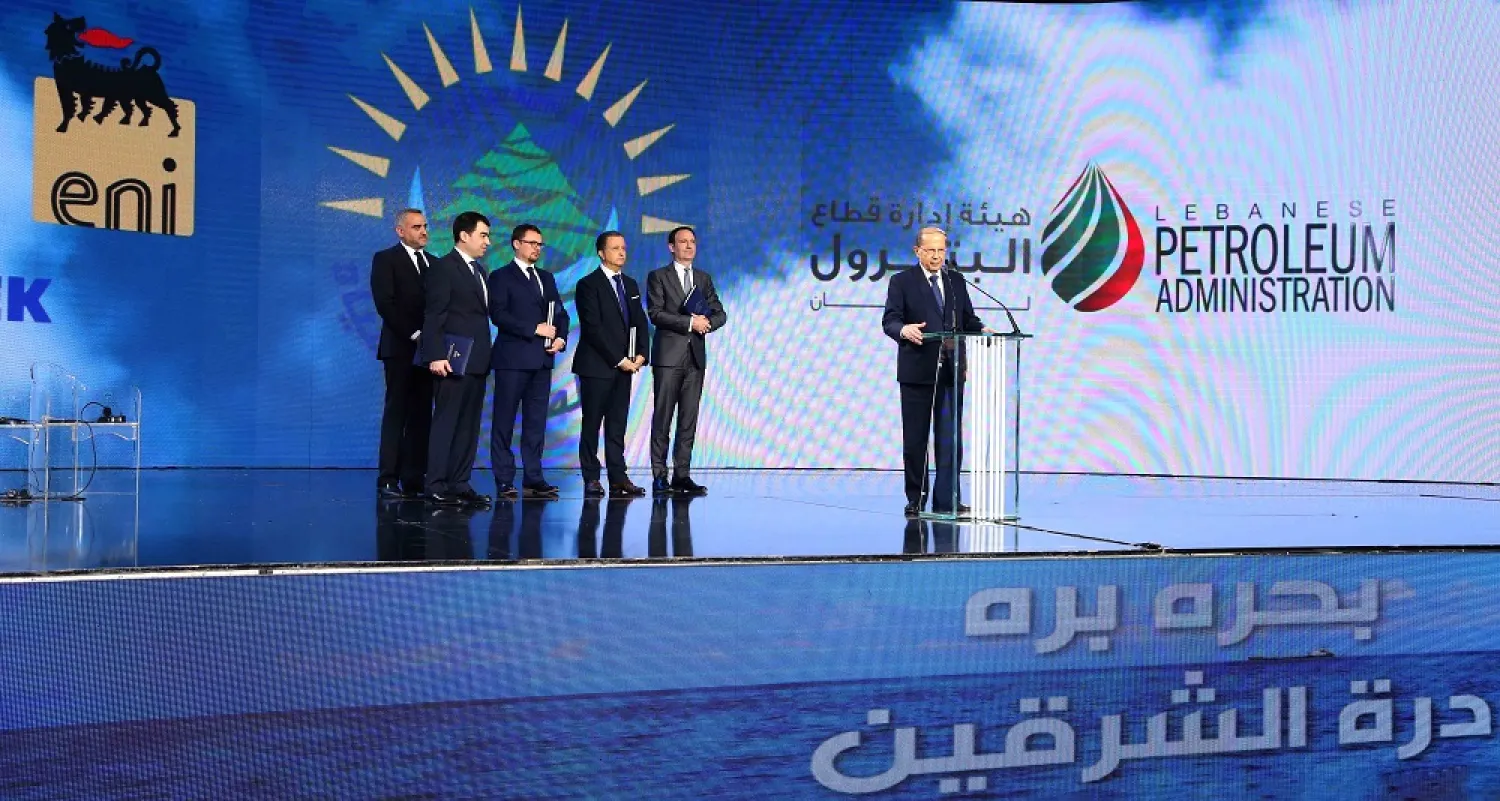
Lebanese President Michel Aoun speaks during a ceremony marking the signing of offshore oil and gas exploration deals. (Dalati & Nohra)
TT

Despite Israel Spat, Lebanon Signs First Offshore Gas, Oil Deals

Lebanese President Michel Aoun speaks during a ceremony marking the signing of offshore oil and gas exploration deals. (Dalati & Nohra)

Amid a simmering dispute with Israel over the demarcation of the shared marine border, Lebanon signed on Friday its first agreements for offshore oil and gas exploration.

The deal includes exploration in two blocks, including one that is contested with Israel.

The signing ceremony was held Friday afternoon in Beirut and was attended by President Michel Aoun.

"We have achieved a big dream and Lebanon has entered a new era today," Aoun said at the ceremony.

A consortium of France’s Total, Italy’s Eni and Russia’s Novatek signed the agreements for the two blocks, which are among five that Lebanon put up for tender in the country’s much-delayed first licensing round.

Lebanon’s energy minister said the dispute with Israel would not stop Lebanon benefiting from potential undersea reserves in the contentious Block 9, while consortium operator Total said it would not drill the block’s first well near the disputed zone.

Israel and Lebanon, which regard each other as enemy states, have exchanged threats and condemnation over the tender, amid rising tensions over territorial and marine boundaries between them.

“Today, we announce that we have started our petroleum path ... after signing the agreements and launching the exploration activities,” Lebanese Energy Minister Cesar Abi Khalil said at a ceremony in Beirut.

The contracts had already been signed on January 29.

Data suggests there are reserves in Lebanon’s waters, but no exploratory drilling has taken place to estimate their size.

Abi Khalil has said a second offshore licensing round will happen once the first commercially viable discovery is made.

The first exploratory well will be drilled in Block 4 in 2019, said Stephane Michel, Total’s head of exploration and production in the Middle East and North Africa.

The second well will be drilled in Block 9 more than 25 km (15 miles) from the maritime border claimed by Israel, he said at the ceremony. “There is no reason not to proceed in this way,” Michel added.

Lebanon has an unresolved maritime border dispute with Israel over a triangular area of sea of around 860 sq km (330 square miles) that extends along the edge of three of its total 10 blocks.

Total said in a statement the disputed waters comprise 8 percent of Block 9 and that its exploration well “will have no interference at all with any fields or prospects” in the disputed sliver of water.

Lebanese and Israeli officials said David Satterfield, acting assistant US secretary of state, was in Israel last week and in Lebanon this week on a mediation mission. US officials confirmed his travels without detailing his agenda.

Abi Khalil told Reuters the heightened tension between the two countries in recent weeks has “not had an effect” on the consortium’s plans to explore.

Lebanon's Foreign Minister Jebran Bassil warned Israel not to try to hinder the drilling on the Lebanese side saying that Beirut can also stop offshore development on the Israeli side.

Earlier this week, Israeli Defense Minister Avigdor Lieberman described Lebanon's exploration tender as "very provocative" and suggested that Lebanon had put out invitations for bids from international groups for a gas field "which is by all accounts ours."

His comments drew sharp condemnation from Prime Minister Saad Hariri, who described Lieberman's comments as a "blatant provocation that Lebanon rejects."

Lebanon is on the Levant Basin in the eastern Mediterranean where a number of big sub-sea gas fields have been discovered since 2009.

Eni reported the Mediterranean’s largest discovery in 2015: the Zohr field off Egypt which holds an estimated 30 trillion cubic feet of gas. On Thursday Eni said it and Total had discovered a promising natural gas field off Cyprus.

Fuad Krekshi, Eni’s executive vice president of the Middle East, said Eni’s entry into Lebanon’s market is a “natural consequence” of its existing role in the Mediterranean region.

Total, with 40 percent, heads the consortium drilling Lebanon’s first offshore well. Eni also holds 40 percent and Novatek 20 percent.

Vyacheslav Mishin, head of Novatek’s new Lebanon office, said the projected global growth in natural gas and LNG consumption was key to his company’s future growth.

“The Middle East market for LNG consumption is forecast to grow by more than 100 percent by 2030,” he said.

Potential reserves could be used domestically or exported.

Both are attractive for Lebanon which has been short of electricity since its 1975-90 civil war and has an anemic economy battered by war in neighboring Syria and political tensions. Lebanon has a debt of $80 billion or 145 percent of its gross domestic product making it one of the world's highest.

It is also hoped the developing oil and gas industry will create jobs and economic growth. To this end, the EPA contracts say 80 percent of people employed by the consortium should be Lebanese, with priority given to local suppliers and contractors.

But the commercial viability of potential reserves depends on energy market prices, the ability to secure customers and the cost and politics of building export infrastructure.

“For all the fields in the region, there are commercial, political, and technical challenges that hinder exploitation for the purposes of export,” Tareq Baconi, a European Council on Foreign Relations visiting fellow on MENA energy told Reuters.

“Many of the challenges for export will be faced by Lebanon as well when, and if, it discovers offshore reserves,” he said.


ISIS Lashes Out at Syria's Sharaa, Announces ‘New Phase of Operations’

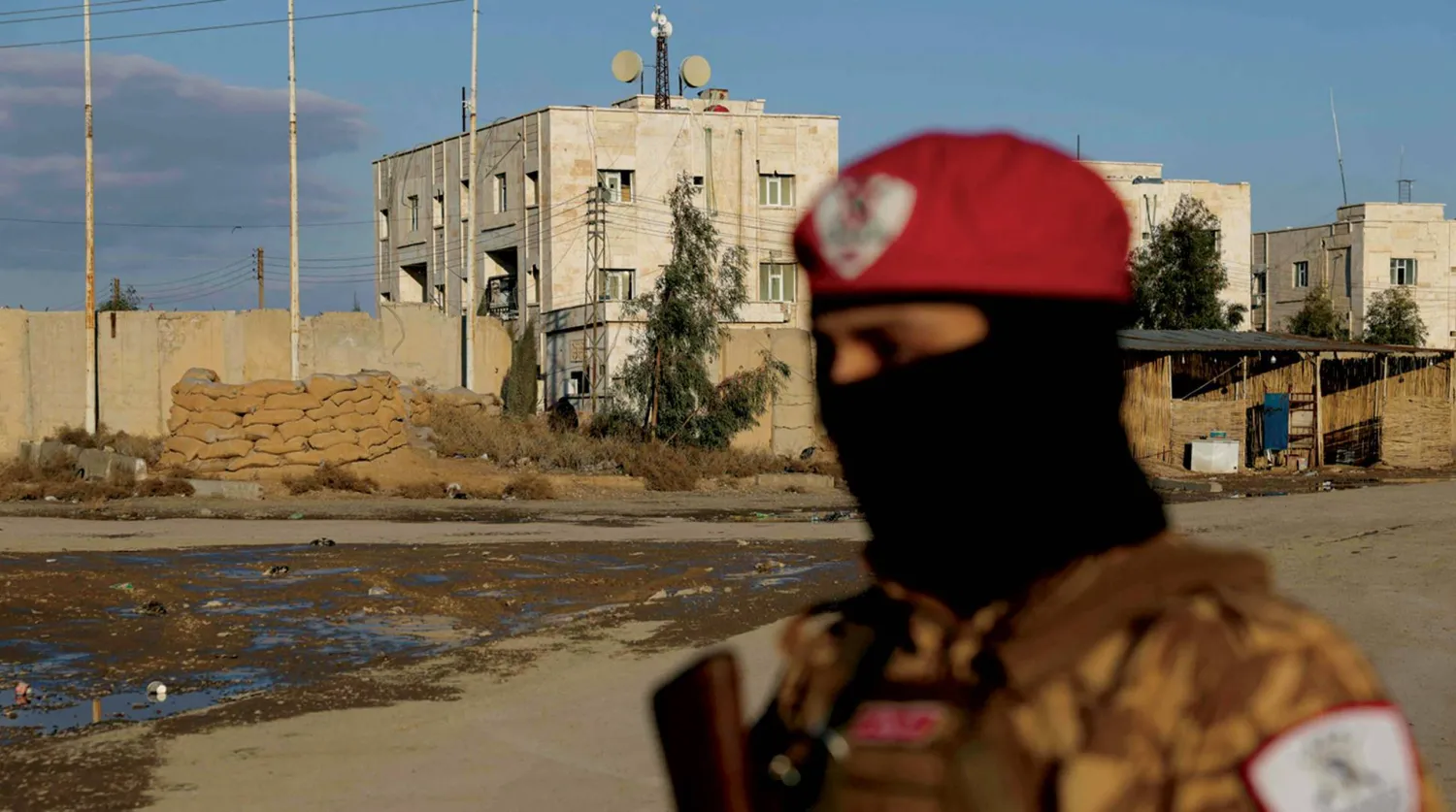
A Syrian government soldier outside Al-Aqtan prison in Raqqa, which holds ISIS detainees (AFP)
TT

ISIS Lashes Out at Syria's Sharaa, Announces ‘New Phase of Operations’

A Syrian government soldier outside Al-Aqtan prison in Raqqa, which holds ISIS detainees (AFP)

Syria’s Defense Ministry said on Sunday that a Syrian army soldier and a ‌civilian were killed a day earlier by “unknown assailants” in the northern city of Raqqa.

ISIS claimed ‌responsibility for two attacks targeting Syrian army personnel in northern and eastern Syria.

The militant group said on its Dabiq news agency that it had targeted “an individual of the apostate Syrian regime” in the city of Mayadin in Deir Ezzor province using a pistol, and attacked two other personnel with machine guns in Raqqa.

The attacks came after ISIS blasted Syria’s interim president, Ahmad al-Sharaa, calling him a “puppet without a soul” controlled by Western countries, adding that his fate eventually will be similar to that of ousted leader Bashar Assad.

In an audio message released late Saturday by the group’s spokesman, who identifies himself as Abu Huzaifa al-Ansari, he called on ISIS followers around the world to attack Jewish and Western targets as they have in past years.

The ‌group also said it had begun a “new phase of operations” in Syria.

Al-Ansari sent greetings to ISIS militants from the group’s leader Abu Hafs al-Hashemi al-Qurayshi who was named as the head of the group three years ago.

The audio is the first to be released by the group in months and comes after ISIS was blamed for attacks that left dozens dead or wounded in recent months in Syria, Iraq, Pakistan and other parts of the world.

The latest incidents come two days after ISIS claimed responsibility for another attack in Deir Ezzor that killed a member of the Interior Ministry’s internal security forces and wounded another.

In December, the group was blamed for an attack in central Syria that left three Americans dead and triggered intense US airstrikes on the extremists’ suspected hideouts in the country.


Hamas Official Says Group in Final Stage of Choosing New Chief

Tents are erected to house displaced Palestinian families in the al-Zahara neighborhood, north of the Nuseirat refugee camp in the central of Gaza Strip on February 21, 2026. (Photo by Eyad Baba / AFP)
TT

Hamas Official Says Group in Final Stage of Choosing New Chief

Tents are erected to house displaced Palestinian families in the al-Zahara neighborhood, north of the Nuseirat refugee camp in the central of Gaza Strip on February 21, 2026. (Photo by Eyad Baba / AFP)

A senior Hamas official told AFP on Sunday that the Palestinian movement was in the final phase of selecting a new leader, with two prominent figures competing for the position.

Hamas recently completed the formation of a new Shura Council of more than 80 members, a consultative body largely composed of religious scholars, as well as a new 18-member political bureau, the official said.

Since the war in Gaza began after Hamas's October 7, 2023 attack on Israel, Israeli forces have killed several Hamas leaders, including two former chiefs.

"The movement has completed its internal elections in the three regions and has reached the final stage of selecting the head of the political bureau," the official said, speaking on condition of anonymity as he was not authorized to speak publicly.

According to AFP, he said the race for the group's leadership was now between Khaled Meshaal and Khalil al-Hayya.

A second Hamas source confirmed the development, while a third source said the new leader would lead the movement only "for one year.”

Despite a US-brokered ceasefire that entered its second phase last month, violence has continued in Gaza, with Israel and Hamas blaming each other for violating the agreement.

Members of the council are elected every four years by representatives from Hamas's three branches: the Gaza Strip, the occupied West Bank and the movement's external leadership.

Hamas prisoners in Israeli jails are also eligible to vote.

The council subsequently elects the political bureau, which in turn selects the head of the movement.


Berri to Asharq Al-Awsat: Parliamentary Elections Will Be Held on Time 

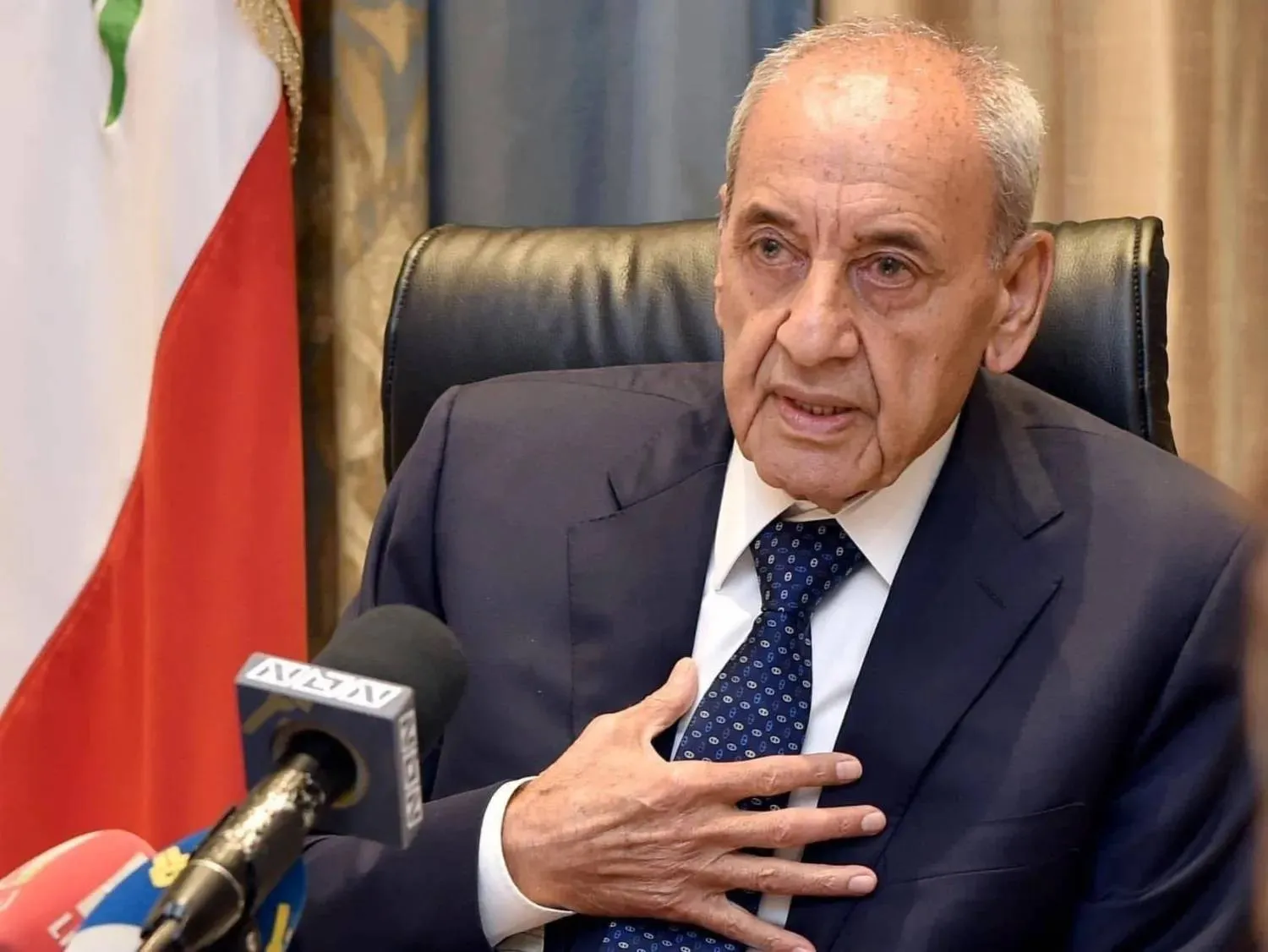
Parliament Speaker Nabih Berri. (Lebanese parliament)
TT

Berri to Asharq Al-Awsat: Parliamentary Elections Will Be Held on Time 

Parliament Speaker Nabih Berri. (Lebanese parliament)

Lebanon continues to come under pressure to postpone the parliamentary elections in May with international powers believing that priority in the country lies in disarming Hezbollah and granting Prime Minister Nawaf Salam’s government more time to approve financial, economic and administrative reforms.

Israel also continues to apply pressure on Lebanon as it maintains its attacks against Hezbollah, targeting its members and fighters across the country and delivering a message that it has no choice but to disarm.

Despite the pressure, parliament Speaker Nabih Berri stressed that the elections will be held on time.

In remarks to Asharq Al-Awsat, he said he had conveyed this position to the ambassadors of the quintet committee countries, who want to delay the polls.

“I do not support the postponement or the extension of parliament’s term,” he added.

“I was the first to announce my nomination,” he noted, explaining that he did so to block claims that he wanted to delay the elections and extend the term of parliament.

“This is a message to whom it may concern inside Lebanon and beyond: I am committed to seeing the elections through to the end,” Berri declared, saying he had advised several members of his Amal movement to submit their candidacies.

Moreover, the speaker said the postponement “was not justified.”

The elections will be held on time and according to the current electoral law, he vowed. “Those who want to postpone them should assume responsibility for their position and not blame it on others.”

Commenting on the latest Israeli strikes on Lebanon that targeted the central and northern Bekaa in the east, he described them as a “new war aimed at pressuring the country to surrender to Tel Aviv’s conditions.”

A prominent military source told Asharq Al-Awsat that the raids sought to deliver a message to Hezbollah members and fighters that they no longer had a safe place to hide.

Israel can pursue them and assassinate them anywhere, it added.

The success of these attacks means that the Iran-backed party has been breached, something that has been acknowledged by several of its MPs, who have vowed to investigate the issue, it said.