

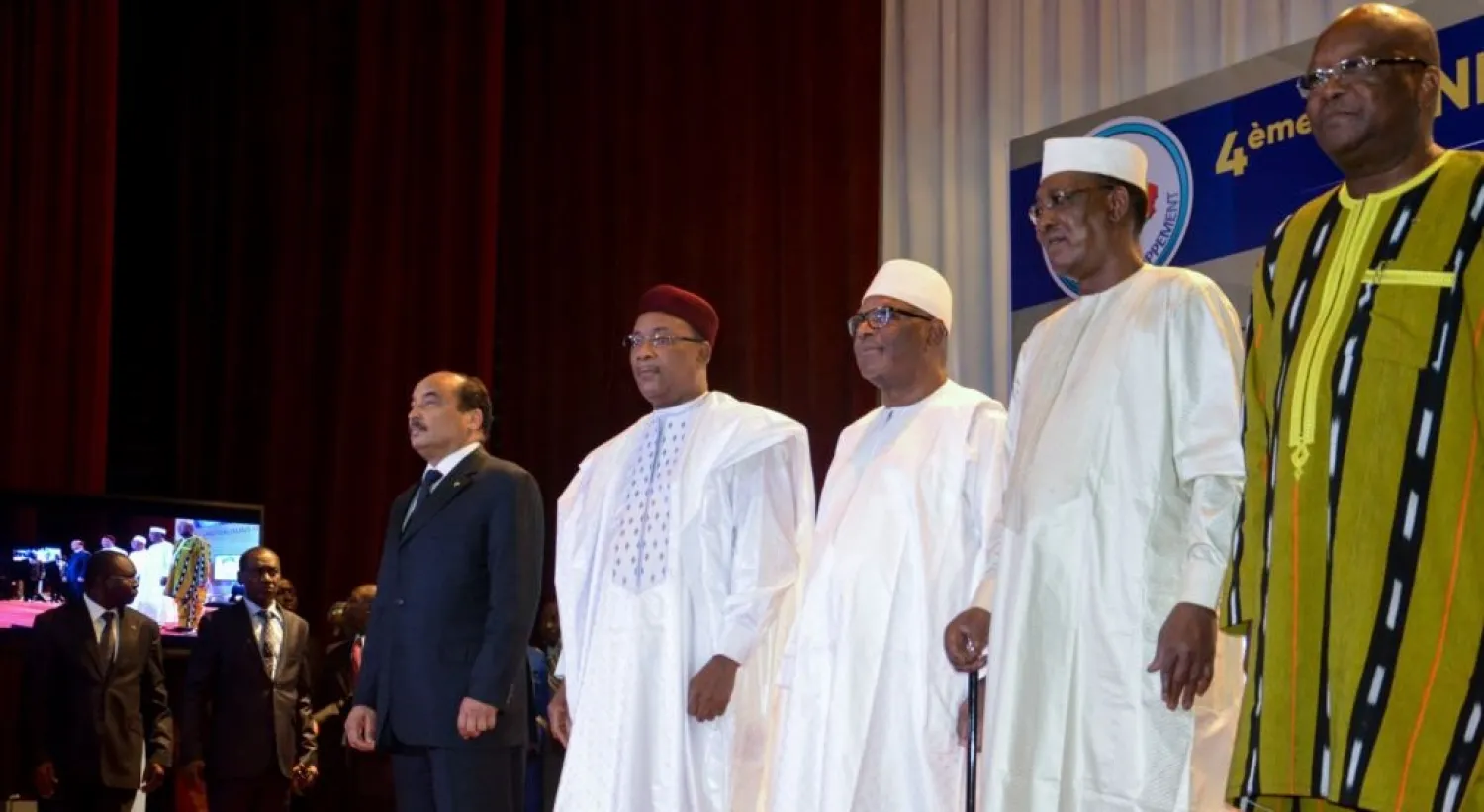

International Donors Pledge over $500 Million for Sahel Force

The presidents of Mauritania, Nigeria, Mali, Chad and Burkina Faso meet at a G5 Sahel summit in Niamey on February 5. (AFP)
TT

International Donors Pledge over $500 Million for Sahel Force

The presidents of Mauritania, Nigeria, Mali, Chad and Burkina Faso meet at a G5 Sahel summit in Niamey on February 5. (AFP)

International donors pledged on Friday 414 million euros ($510 million) for the joint African force tackling extremists in the Sahel.

The pledges came at a summit in Brussels of 32 leaders and 60 delegations meant to show political, development and security support for Burkina Faso, Chad, Mali, Mauritania and Niger.

The 5,000-strong G5 Sahel force for the five countries was seeking around 400 million euros for its mission along mostly desert borders, including near Libya — the main jumping-off point for thousands of African migrants bound for Italy.

Donations to the G5 so far have been led by Saudi Arabia with 100 million euros, while the United Arab Emirates has given 30 million euros and the US $60 million.

Friday's high-level meeting attended by French President Emmanuel Macron and German Chancellor Angela Merkel and other top European leaders comes after two soldiers from France's counter-terror force in West Africa were killed when their vehicle hit a mine in northeastern Mali.

The G5 force aims to train and equip 5,000 local troops to patrol hotspots and restore authority in lawless areas. As well as fighting militants, the force also tackles smuggling and illegal immigration networks that operate in the vast, remote areas on the margins of the Sahara.

Opening the conference, European Commission President Jean-Claude Juncker said "security and development must go hand in hand" in the Sahel, an area almost as big as the EU where a fifth of the population do not have reliable food supplies.

The bloc has budgeted nearly eight billion euros for development assistance in the Sahel from 2014 to 2020 and on Friday, France is expected to announce 1.2 billion euros over the next five years.

The EU's diplomatic chief Federica Mogherini said more pledges from individual countries were expected, saying "the price of not having peace has to be paid every day".

The amount pledged "goes far beyond our initial expectations," she added. "It's a tremendous result that allows us to begin putting the force into operation."

The G5 Sahel force has so far set up a headquarters and command structure and carried out two operations, with French support, in the troubled "tri-border" area where Mali, Niger and Burkina Faso meet.

Intended to become fully operational in mid-2018, the G5 Sahel force operates alongside France's 4,000 troops in the area and the UN's 12,000-strong MINUSMA peacekeeping operation in Mali.

"We expect in 2018 that we will be delivering more in terms of body armor, counter-IED material, trucks and even a hospital which will be built, we think, in Mali later this year," an EU official said.

But missing from Friday's conference agenda is one of the major destabilizing factors in north Africa -- the chaos in Libya, which plunged into chaos after the fall of leader Moammar Gaddafi in 2011.

Rival forces are vying for influence across the oil-rich country, with two rival administrations governing different parts of the territory.

"The Libyan crisis has been, we know, the detonator of the degradation of the security situation in the Sahel, and day after day, it contributes to its amplification," said Niger President Mahamadou Issoufou, the current chair of the G5 Sahel group.

"We must put an end to this chaos by restoring the authority of the Libyan state to the whole of its territory."

"The Sahel is one of Europe's frontiers. The Sahel is a shield, a dike that must never burst," Issoufou said. He reminded the leaders that "security is a global public good."

Macron's office said the fact so many countries were attending the Brussels summit was "proof of the collective realization of the Sahel's importance for the stability of Africa and also Europe".

France insists the G5 force is not an "exit strategy" for Operation Barkhane, its own anti-extremist mission in the region.

The EU also insists the force is not just about security. Brussels said political help and development assistance are vital in a region wracked by extreme poverty, harsh climate, food shortages and health crises.

"We need to support these five countries, especially also to give hope to the next generations so that they have also a future in their own country," said Luxembourg Prime Minister Xavier Bettel.



Japan Fires Missile in Joint Drill with US and Allies in Northern Philippines, Facing South China Sea

US and Philippine troops in a foxhole participate in counter-landing live fire exercises during Balikatan, the annual joint military exercises between the US and the Philippines, at Long Point Beach, Brgy. Aporawan, Aborlan, Palawan, Philippines, April 27, 2026. REUTERS/Eloisa Lopez Purchase Licensing Rights
TT

Japan Fires Missile in Joint Drill with US and Allies in Northern Philippines, Facing South China Sea

US and Philippine troops in a foxhole participate in counter-landing live fire exercises during Balikatan, the annual joint military exercises between the US and the Philippines, at Long Point Beach, Brgy. Aporawan, Aborlan, Palawan, Philippines, April 27, 2026. REUTERS/Eloisa Lopez Purchase Licensing Rights

Japan's Self-Defense Forces fired a Type 88 anti-ship missile during a joint maritime exercise with US, Australian, and Philippine forces on Wednesday, hitting a decommissioned Philippine Navy ship in waters facing the disputed South China Sea.

The drill took place as Manila and Tokyo began talks on a potential defense equipment transfer, made possible by Japan's decision to scrap restrictions on military exports, said Reuters.

Discussions include the possible early transfer of Abukuma class ‌destroyers and TC-90 ‌aircraft to the Philippines, Japan's Defense Minister Shinjiro ‌Koizumi ⁠said.

Philippine Defense Secretary ⁠Gilberto Teodoro and Koizumi witnessed the live missile firing on the ground, while Philippine President Ferdinand Marcos Jr. watched the exercise from military headquarters in Manila via a live video feed, the president's office said.

"The exercise showcased coordinated maritime strike operations among allied forces and highlighted the AFP's growing capability to operate alongside international partners in promoting regional security and freedom of ⁠navigation," it said in a statement.

The Philippine military said ‌two Type 88 volleys were fired, hitting ‌the BRP Quezon within six minutes of the launch. The strike took ‌place about 75 km (46.6 miles) off the coast of Paoay in the ‌northern Philippines, which faces the South China Sea.

The Philippine Department of National Defense said Japan's Type 88 missile system was "designed to defend coastal areas and deter maritime threats."

"I'm very, very proud and happy that we were able to ‌pull this off for the first time and it will only get larger in scope with more partners," ⁠Teodoro said.

The ⁠live-fire drill was part of the annual war games held by Manila and Washington, known as "Balikatan", or "shoulder-to-shoulder".

Japan, together with Canada, Australia, France and New Zealand, are joining Balikatan as active participants for the first time, highlighting Manila's widening network of security partnerships.

On May 2, Filipino and American troops also deployed the anti-ship missile NMESIS in Batanes province, near Taiwan, as tensions simmer over the self-governed island that China views as its own territory.

More than 17,000 troops are taking part in this year's exercises, including around 1,400 from defense treaty ally Japan and 10,000 from the United States, even though Washington remains heavily engaged in the Middle East.

Beijing routinely criticizes Manila's joint military exercises with allies, saying they heighten regional tensions.


London Police Set Up Specialist Jewish Protection Team

Members of the Jewish community ride past a memorial wall, dedicated both to the victims of the October 7 attacks in Israel and Iranians killed in recent protests in Iran, on Limes Avenue in Golders Green after a suspected arson attack in London, Britain, April 28, 2026. REUTERS/Toby Melville
TT

London Police Set Up Specialist Jewish Protection Team

Members of the Jewish community ride past a memorial wall, dedicated both to the victims of the October 7 attacks in Israel and Iranians killed in recent protests in Iran, on Limes Avenue in Golders Green after a suspected arson attack in London, Britain, April 28, 2026. REUTERS/Toby Melville

British police are setting up a new team of 100 officers including counter terrorism specialists to help protect Jewish communities across London after a series of antisemitic attacks including the stabbing of two men.

The plan announced on Wednesday for a dedicated protection team comes as officers announced more arrests for antisemitism, including detaining a 35-year old man on Saturday after rocks were thrown at an ambulance belonging to the Jewish community, Reuters reported.

London's top police boss ⁠Mark Rowley said ⁠Jewish communities were facing "sustained threats" from hostile state actors as well as extreme right-wing groups, elements of the extreme left and terrorists.

Detectives are examining whether the arson incidents have possible Iranian links, after British security officials warned that Iran ⁠was using criminal proxies to carry out hostile activity.

Since late March, there have been a number of high-profile arson attacks with four Jewish ambulances burned and synagogues targeted. Last week, two Jewish men were also stabbed. Both victims survived the attack.

Over the past four weeks, police said they had arrested around 50 people for antisemitic hate crimes and charged eight individuals. On top of ⁠that, ⁠28 arrests have been made as part of investigations alongside counter terrorism policing for arson and other serious incidents.

"This new team will be primarily focused on protecting the Jewish community, which faces some of the highest levels of hate crime alongside significant terrorist and hostile state threats," said a statement from London's Metropolitan Police force.

British Prime Minister Keir Starmer convened a meeting on Monday with business, health and cultural leaders aimed at trying to tackle antisemitism.


US Military Strike on Alleged Drug Boat Kills 3 in Eastern Pacific

This screen grab from a video posted on the X account of US Southern Command (SOUTHCOM) on May 5, 2026, shows a vessel before being struck at the direction of Commander General Francis L. Donovan on May 5, 2026. (Photo by US Southern Command / AFP)
TT

US Military Strike on Alleged Drug Boat Kills 3 in Eastern Pacific

This screen grab from a video posted on the X account of US Southern Command (SOUTHCOM) on May 5, 2026, shows a vessel before being struck at the direction of Commander General Francis L. Donovan on May 5, 2026. (Photo by US Southern Command / AFP)

The US military launched another strike Tuesday on a vessel suspected of transporting drugs in the eastern Pacific Ocean, killing three men.

The attack came a day after US forces struck an alleged drug boat in the Caribbean Sea, killing two people.

The Trump administration’s campaign of blowing up alleged drug-trafficking vessels in Latin American waters has persisted since early September and killed at least 191 people in total.

Despite the Iran war, the strikes have ramped up again in recent weeks, showing that the administration’s aggressive measures to stop what it calls “narcoterrorism” in the Western Hemisphere are not letting up. The military has not provided evidence that any of the vessels were carrying drugs.

The attacks began as the US built up its largest military presence in the region in generations and came months ahead of the raid in January that captured then-Venezuelan President Nicolás Maduro. He was brought to New York to face drug trafficking charges and has pleaded not guilty.

In the attack Tuesday, US Southern Command once again said it had targeted the alleged drug traffickers along known smuggling routes. According to The Associated Press, it posted a video on X showing a boat cruising along the water before a huge explosion left the vessel in flames.

President Donald Trump has said the US is in “armed conflict” with cartels in Latin America and has justified the attacks as a necessary escalation to stem the flow of drugs into the United States and fatal overdoses claiming American lives. But his administration has offered little evidence to support its claims of killing “narcoterrorists.”

Critics, meanwhile, have questioned the overall legality of the boat strikes.