


Libya: Chairman of High Council Survives Assassination Attempt

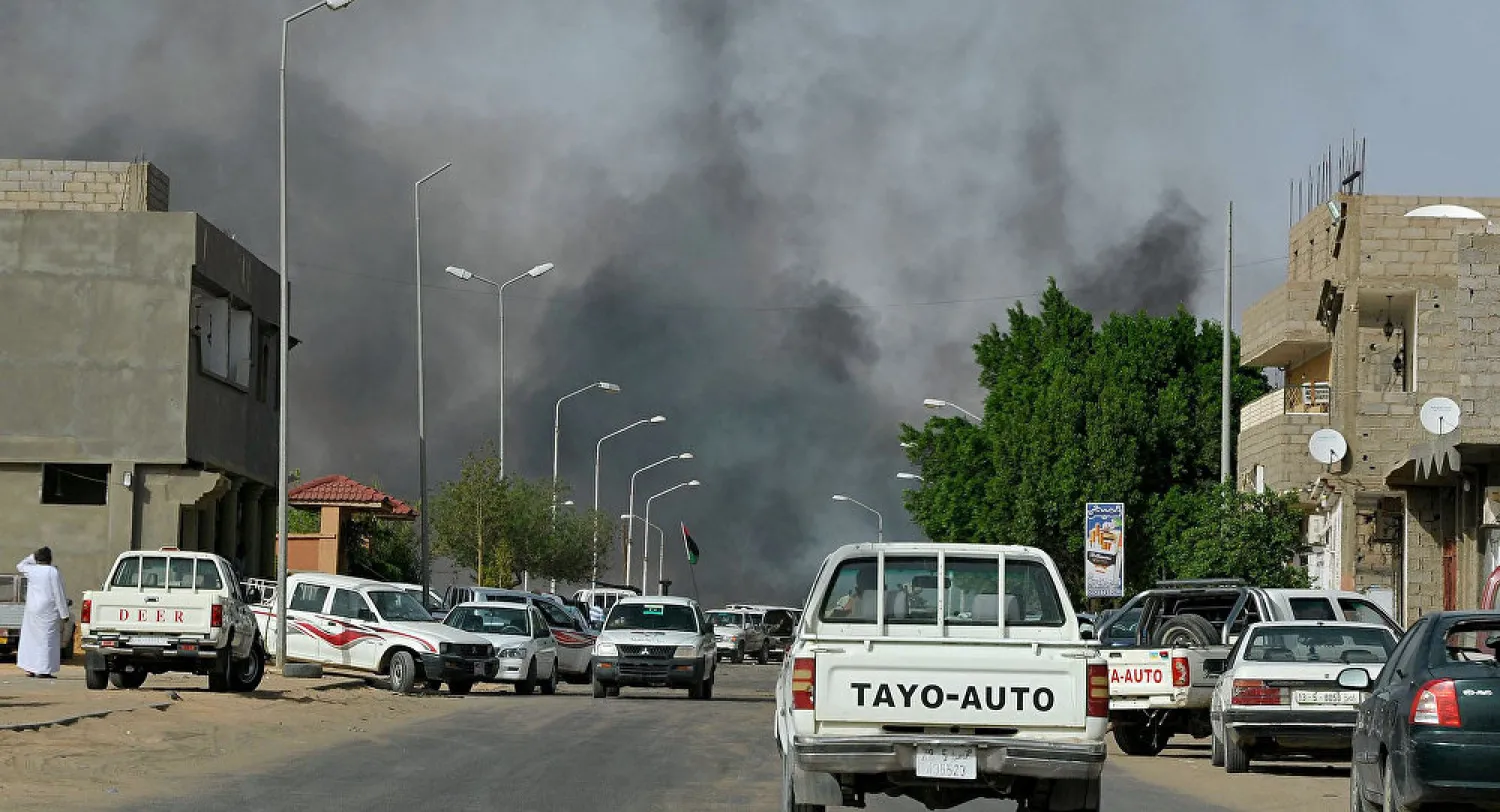
Smoke rising in Sabha, South Libya (AFP 2018/ STR)
TT

Libya: Chairman of High Council Survives Assassination Attempt

Smoke rising in Sabha, South Libya (AFP 2018/ STR)

High Council of State (HCS) announced on Wednesday its chairman Abdulrahman al-Sweihli survived an assassination attempt.

The media office of the Council reported that Sweihli and members of his accompanying delegation were ambushed during his visit to the cities of Gharyan and Yefran by an armed group of "al-Karama" in the area of Thaher al-Jabal.

Meanwhile, Asharq Al-Awsat learned that the sixth negotiation meeting aimed at unifying the Libyan military will be held in Cairo, Egypt, under the auspices of the Egyptian authorities next week.

The convoy of Sweihli was ambushed and came under fire in Guwalish district while en route to visit Yefren town after visiting the city of Gharyan on Wednesday.

"Our security personnel in cooperation with the Gharyan security department as well as those of the western military zone helped thwart the attack. The attackers ran away, while two of our security personnel were injured and four Gharyan policemen were kidnapped," HCS media office said in a statement.

HCS Head and delegation went on with their visit destination despite the ambush and thanked the Gharyan, Yefren and western mountain areas' dignitaries councils for their reception.

No one claimed responsibility for the latest assassinate attempt, knowing that over the past two years several senior officials were subject to similar assassination attempts.

On Wednesday, Sweihli met with a delegation of commanders and officers of "al-Bunyan al-Marsous" operation, against terrorist organizations in the coastal city of Sirte.

Meanwhile, a Libyan military official told Asharq Al-Awsat that officers from different military areas will return to Cairo next week to complete discussions on the definition of the high commander of the Libyan armed forces, noting that there is an agreement that Marshal Khalifa Hafter remains the commander-in-chief of the national army.

During Cairo negotiations, the National Army's delegation wants the army's supreme commander to be the commander-in-chief, while the group of officers negotiating on behalf of Fayez Serraj's government wants the next political authority to be in charge, according to the official who spoke on condition of anonymity.

Prime Minister of Government of National Accord (GNA) Serraj, preceded Cairo meetings with a new resolution appointing Abdul Basset Marwan commander of Tripoli's military district, after he was promoted from Brigadier General to General.

On the other hand, Serraj said that the Electoral Commission continues to prepare for the presidential and parliamentary elections, which the UN mission plans to hold by September.

The Prime Minister's remarks came during a meeting in Tripoli with Italy's ambassador to Libya, Giuseppe Perrone, who renewed his country's support for what he called "Serraj's compromise approach" and his efforts to achieve security and stability in Libya.

A statement issued by Serraj's office reported the Italian ambassador's support of the efforts of UN envoy Ghassan Salama, hoping that they will lead to the elections this year.

Meanwhile, British Ambassador to Libya Frank Becker, who also met Serraj in Tripoli, renewed his country's commitment to supporting the efforts of Serraj to achieve stability in Libya.

A statement issued by the United Nations Support Mission in Libya (UNSMIL), expressing its concern about the deteriorating security situation in southern Libya, drew wide criticism.

UNSMIL said it is concerned by the ongoing violence in Sabha and calls on all parties to refrain from acts that endanger civilian lives and contribute further to the destruction of Libya’s infrastructure.

"Buildup of armed forces in the South risks further escalation and calls on all parties to work towards a ceasefire agreement, advance dialogue and reconciliation efforts, and refrain from rhetoric that may inflame the situation," the Mission warned.

In an unrelated matter, Libya's top prosecutor al-Sadiq al-Sour announced efforts to deliver the remains of Egyptian Christians who were killed in Sirte in February 2015 by ISIS militants. He also discussed Libyan fuel smuggling to Europe, and involvement of Libyan security elements in the killing of 600 illegal immigrants.

Sour pointed out that the Libyan authorities received a request from Egypt's Attorney General through Libya's Foreign Ministry for judicial assistance, in analyzing the remain.

Libya's top prosecutor says criminal groups are smuggling Libyan fuel on board fishing vessels to Europe. He told reporters on Wednesday their investigations revealed that smugglers use sea routes to move subsidized fuel from the western coastal cities of Zuwara and Zawiya to Malta, Italy, Turkey, Spain and Greece.

Sour indicated that hundreds of fuel stations are involved in the smuggling of their portions of subsidized diesel and that smugglers have made at least $100 million in the past three years.

Sour also discussed the case of Osama al-Jidran, brother of the former oil-field commander of the central region Ibrahim al-Jadran, indicating Osama is wanted for cases related to terrorism..

The top prosecutor concluded that Saif al-Islam Gaddafi's case is being discussed in the Court of Appeal, without going into further details.



Libya’s Sabratha on Alert after Killing of Militia Figure ‘Al-Amo’

Members of the Apparatus for Combating Security Threats (file photo)
TT

Libya’s Sabratha on Alert after Killing of Militia Figure ‘Al-Amo’

Members of the Apparatus for Combating Security Threats (file photo)

Security forces fanned out across the coastal city of Sabratha, 70 km west of Tripoli, after militia leader Ahmed al-Dabbashi, known as al-Amo, was killed during a raid, triggering clashes that left two members of a state security body dead, residents and officials said.

Witnesses reported a heavy security presence across the Libyan city on Saturday, as the Apparatus for Combating Security Threats, a formation aligned with the Government of National Unity, said it had established control over Sabratha after neutralizing al-Amo.

The apparatus said late on Friday that two members of its western branch died of their wounds after what it described as an attack by criminal groups loyal to al-Amo near a traffic light by the city hospital. It said the deaths would be recorded in its roll of military honor, and vowed to keep pursuing anyone it deems a threat to Libya’s security.

Earlier, the apparatus said al-Amo was killed when its units stormed a hideout used by his network. It said his brother, Saleh al-Dabbashi, was arrested and that six of its personnel were seriously wounded and taken to intensive care.

A Libyan security source, speaking to local media on condition of anonymity, said the Defense Ministry in the Tripoli-based government was reviewing the situation after losing influence in several districts from Janzour in the east to the outskirts of Ajilat in the west.

The source accused the ministry of having previously backed and directed al-Amo to tie down forces from the nearby city of Zawiya on Sabratha's western flank. The Defense Ministry did not immediately comment.

Although the apparatus is an official body within the unity government, it operates with a degree of autonomy in the field, putting it in frequent friction with Defense Ministry-aligned formations in western Libya. The apparatus’s deputy chief is Mohamed Bahroun, known as “al-Far,” a powerful figure in the west.

Strategic coastal hub

Sabratha sits on the main coastal highway that runs from the Tunisian border through western towns to Zawiya and Janzour on the approaches to Tripoli.

Control of the city confers leverage over a vital overland supply route between Tunisia and the capital, and helps block any western advance toward Tripoli.

Sabratha also offers access to a small port and lies close to energy infrastructure, including the strategic Mellitah oil and gas complex.

Since 2014, the city has been a flashpoint for competing authorities in Tripoli and their allied local forces, as well as factions aligned with eastern-based rivals.

It has seen repeated bouts of fighting and shifts in control, most dramatically in 2016 when ISIS briefly seized the city before being driven out with US air support. The episode cemented Sabratha’s weight in both local and international security calculations.

In recent years Sabratha has become a center of gravity for the Apparatus for Combating Security Threats, which reports to the Interior Ministry. That presence has fueled regular friction with Defense Ministry units and long-standing local militias.

Power balance shifts

Analysts say the killing of al-Amo and the apparatus’s subsequent sweep through the city mark a sharp turn in the local balance of power, strengthening the apparatus while dealing a blow to Prime Minister Abdul Hamid al-Dbeibah’s government west of the capital.

The developments came as al-Dbeibah inaugurated Libya’s National Museum in Tripoli on Friday evening at an event attended by foreign diplomats, describing the museum as a repository of national memory and a legacy for future generations.

Al-Dabbashi, long wanted internationally on allegations of human trafficking and narcotics smuggling, retained loyalists in and around Sabratha despite periodic crackdowns.

His death, the arrest of his brother, and the deployment of state units across key intersections suggest an effort by the apparatus to consolidate control and deter reprisals.

The situation in Sabratha remained tense on Saturday, residents said, with security units maintaining checkpoints and patrols along the coastal road and within the city.


Hezbollah Creates New Entities to Evade Pressure on Al-Qard Al-Hasan

One of Al-Qard Al-Hasan’s buildings in Beirut’s southern suburbs. AP file photo
TT

Hezbollah Creates New Entities to Evade Pressure on Al-Qard Al-Hasan

One of Al-Qard Al-Hasan’s buildings in Beirut’s southern suburbs. AP file photo

Hezbollah in Lebanon has begun taking steps that appear likely to lead to the closure of its financial arm Al-Qard Al-Hasan, or to sharply curtail its role, after mounting US pressure and measures by Lebanon’s central bank. 

The moves are part of what sources describe as a legal repositioning inside the country, aimed at easing international and domestic pressure to shut the institution down.

As part of this shift, the group has established a licensed commercial entity that has begun carrying out part of Al-Qard al-Hasan’s activities by providing loans to its supporters. There are expectations that additional institutions could be created to take over other functions.

Hezbollah had previously rejected US demands conveyed through Lebanese authorities to close the institution, accusing Washington of seeking to “dry up financial resources in order to eliminate the party’s presence and prevent it from providing social services,” according to remarks by its Secretary-General Naim Qassem in a speech last month.

In recent years, Al-Qard Al-Hasan has been known as an institution that provides interest free loans, secured by gold or financial guarantees from other depositors. 

The number of its clients exceeded 300,000 people in 2024, benefiting from its concessional loans. It also provided agricultural, industrial, and commercial loans to small enterprises. 

The institution, which operated more than 34 branches across Lebanon, also distributed financial checks to those affected by the war, funded by Hezbollah after the latest conflict.

Amid international pressure on Lebanon to shut it down, the institution appeared to adopt what financial sources told Asharq Al-Awsat was a “legal repositioning policy,” seeking “legal alternatives that would allow it to continue operating,” following a series of domestic measures, including a decision by the Banque du Liban barring dealings with it.

Commercial entity

Al-Qard Al-Hasan has indeed begun to transform, with the first signs appearing in the form of a commercial company specializing in the buying and selling of gold on installment plans, which was established and began operating in early December. 

Two sources in Beirut’s southern suburbs told Asharq Al-Awsat they were surprised, after completing transactions at the institution, to receive invoices issued by an entity called “Jood,” rather than Al-Qard Al-Hasan.

One of them said they went to the institution to obtain a small loan of $1,800 secured by his wife’s gold, only to discover that procedures had changed. “They did not carry out a gold pledge transaction as before,” they said. 

“Instead, the process was conducted through two contracts. The first involved purchasing the gold in exchange for an official invoice, followed by another commercial transaction in which the same quantity of gold was sold back to us on installments, also against an official invoice.”

Under the purchase contract, he said, payments are made over 18 months in fixed monthly installments, with the gold delivered 15 days after the final installment is paid. “It is the same method used in the past, but the paperwork is different,” they added.

Promise of sale by installments

The second source said they were also able to obtain a loan in the same way and found that the installment purchase invoice included a contract with four conditions. They explained that the invoice was issued by “Jood” and included the company’s registration number and a fiscal invoice number, indicating it is subject to Lebanon’s commercial transaction laws and applicable regulations.

Asharq Al-Awsat reviewed the terms of the invoice included in the contract, which state that the invoice “constitutes a promise of sale by installments, and the sale is not considered final until the full value of the invoice is paid.”

The second clause states that all installments become immediately due if the buyer fails to pay two installments. It also authorizes the buyer, as the invoice holder, to make payment on his behalf. The fourth clause stipulates that the buyer must collect the gold within a period not exceeding 15 days from the date of paying the final installment, and that in the event of a delay, storage fees of $0.02 per gram per month will be added.

Fragmentation of services

This step is seen as part of a broader transformation plan by the institution in response to external and domestic pressure to shut it down. 

Lebanese sources familiar with international demands said the shift “signals the failure of all attempts to rescue it through talks between the party and Lebanese authorities.”

They added that “the party’s conviction has pushed it to fragment the services provided by the institution in a way that allows it to continue offering some services if it complies with demands to close it entirely.”

The association states online that it “aims to help people by granting loans for specified periods, contributing to solving some of their social problems,” and that it seeks to “strengthen the spirit of cooperation, mutual support, and solidarity among members of society.”

The sources said that following the fragmentation of services, gold pledging has been removed from the institution’s functions and transferred to the commercial entity, enabling it to continue providing services within the bounds of the law. This follows the suspension of other services, including ATM services. 

The move also sends a message to Lebanese authorities that these services are being offered within a legal framework, through official invoices, and are subject to taxes and commercial transaction regulations.

However, the same sources noted that in this arrangement, official financial disclosure applies to clients rather than depositors and sources of funds, “which complicates the assumption of international acceptance of this transformation.”

They said three proposals had previously been submitted to regularize the status of Al-Qard Al-Hasan, all of which were rejected by the United States. The first was to operate as a mutual aid association. 

The second was to become a licensed financial company, which was also rejected by the Banque du Liban. 

The third proposal was to operate as a financial cooperative providing concessional loans, similar to cooperatives that exist in Lebanon and abroad, subject to Lebanese law and declaring its clients. All proposals were “rejected outright,” the sources said.

US rejection

This assessment aligns with Lebanese financial estimates that any transformation by the institution is unlikely to gain US approval. A senior Lebanese financial source told Asharq Al-Awsat it was “unlikely that this repositioning will be accepted by the US Treasury Department, which scrutinizes tedious financial details in Lebanon.”

Lebanon, the source said under conditions of anonymity, is “under strict oversight by the US Treasury due to widespread cash circulation,” and US estimates indicate that cash outside the banking sector cannot be controlled. 

“This measure is part of the cash economy operating outside the banking sector,” they said.

They added that the repositioning would not satisfy the United States, which has decided the institution must be shut down and has conveyed that to the Lebanese state. 

“Changing the form will not satisfy them as long as the core remains,” they said, referring to the continued existence of Al-Qard Al-Hasan and the continuation of its services in another guise.

“From a legal standpoint, and under Lebanon’s prevailing laws, excluding the central bank, a commercial company can carry out buying and selling activities, including installment sales,” they said. 

“But that does not mean the fundamental problem has been resolved, which is US rejection, because liquidity will remain outside the banking sector and will continue, from the American perspective, to be viewed with suspicion under the current political circumstances.”


Trump Pledges Retaliation After 3 Americans Killed in Syria

Trump Pledges Retaliation After 3 Americans Killed in Syria
TT

Trump Pledges Retaliation After 3 Americans Killed in Syria

Trump Pledges Retaliation After 3 Americans Killed in Syria

US President Donald Trump said Saturday “there will be very serious retaliation” against ISIS after three Americans, two soldiers and their civilian interpreter, were killed by a single gunman in an ambush targeting a joint US-Syrian government patrol in central Syria.

“We mourn the loss of three great patriots in Syria. We know how it happened, an ambush,” he told reporters at the White House.

Earlier, the Pentagon said initial assessments showed the attack was carried out by ISIS.

However, a Syrian Interior Ministry spokesperson said the attacker was a member of the Syrian security forces who held extremist ideas.

Nour Eddin al-Baba said Syrian forces had issued intelligence warnings to US-led forces and that the assailant was known to authorities ahead of the deadly attack.

He told Syrian state television that leadership in the country’s Internal Security Forces in the Badia region had alerted the US-led international coalition against ISIS in Syria about preliminary information “indicating a possible breach or expected ISIS attacks.”

“However, (coalition) forces did not take the Syrian warnings into account,” al-Baba said.

According to the Pentagon, the attacker was killed by “partner forces,” in a sign to the Syrian government forces.

Syrian state news agency SANA quoted a security source as saying that Syrian service personnel were injured, without providing further details.

US Secretary of Defense Pete Hegseth wrote on X, “Let it be known, if you target Americans — anywhere in the world — you will spend the rest of your brief, anxious life knowing the United States will hunt you, find you, and ruthlessly kill you.”

The US-led coalition has carried out airstrikes and ground operations in Syria targeting ISIS suspects in recent months, often with the involvement of Syria's security forces. Syria last month also carried out a nationwide campaign arresting more than 70 people accused of links to the group.

The United States has troops stationed in northeastern Syria as part of a decade-long effort to help a Kurdish-led force there.