

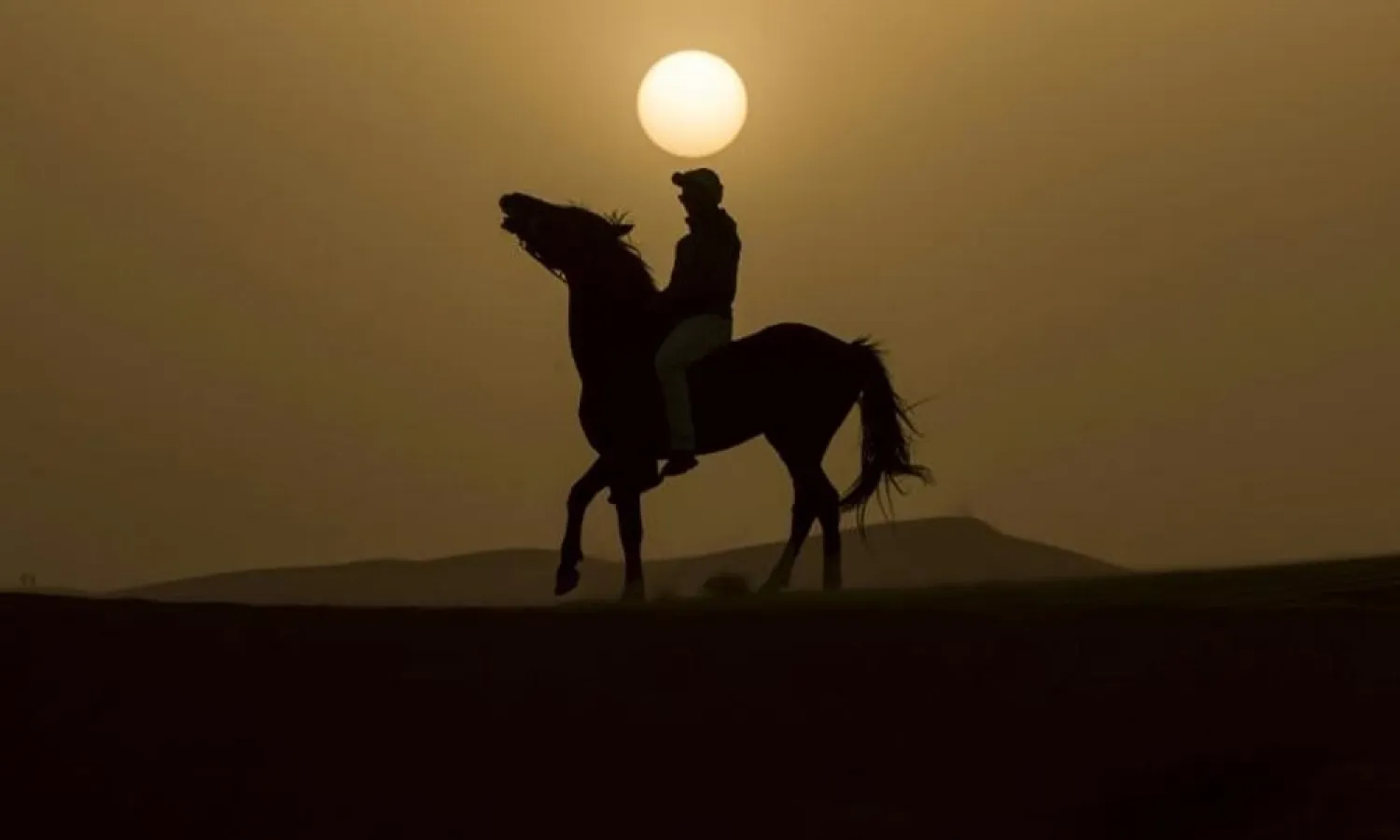

Morocco Desert Stallion Race Pushes Limits of Endurance

A rider competes during the Gallops of Morocco equestrian race in the desert of Merzouga in the southern Moroccan Sahara desert on March 1, 2018. (AFP)
TT

Morocco Desert Stallion Race Pushes Limits of Endurance

A rider competes during the Gallops of Morocco equestrian race in the desert of Merzouga in the southern Moroccan Sahara desert on March 1, 2018. (AFP)

Battling gusts of sandy wind, riders from across the world struggled to control feisty stallions as they raced in the first Gallops of Morocco, a desert endurance challenge.

In a country with an ancient history of horsemanship, the event in the wilderness of Merzouga was the first of its kind -- a six-day test of stamina, navigation and teamwork, said an Agence France Presse report on Saturday.

Competitors spend four to seven hours a day in the saddle, covering up to 30 kilometers (18 miles) of rough terrain a day.

"You need a certain physical resistance," said Deborah Amsellem, 30, who headed from Toulouse, France, with four friends to take part in the race near the oasis town of Erfoud.

"It's not very technical, but you're riding stallions, real alpha males," she said.

Riders use stopwatches to pace themselves and GPS devices to find their way through the sandy plains, deep dunes, rocky hills and passes.

The unforgiving terrain and fickle weather are not the only challenges: competitors must ride Barb stallions they have never met.

The North African breed, originally a warhorse, is known for its toughness and stamina but also for its hot temper, said AFP.

Fifteen teams took part in the late February adventure, made up of 80 horse-lovers, enthusiasts of everything from trail riding to polo.

Organizers say the event is designed for "rather hardy riders who should be in good physical condition and have a feel for horses in order to cope with the distances."

Saif Ali al-Rawahi, coach of a team from Oman, described the event as "very difficult".

"There are kilometers in the mountains and in the desert," he said. "The horses have to ride on high dunes, the weather is not so good, very windy. It's difficult for horses and riders."

Oman was the site of the first "Gallops" race in 2014, and Rawahi's group of five soldiers from the Gulf sultanate's cavalry are accustomed to endurance races. Even they had to make do with coming fifth.

"The trek is not just a race for professionals," said Benoit Perrier, a race official.

On the first day alone, several riders fell off their horses and some gave up entirely -- while others said they were exhausted but enjoying the challenge.

"If we wanted to ride the same distance in the Lille region (northern France), there would be highways and barbed wire," said French businessman Gregoire Verhaeghe.

"Here we have a real sense of space."

Having taken part in the Paris-Dakar rally four times, he said he loves the desert and made no complaint about the bad weather.

His family's team came first.

Riding unknown horses, Barb stallions specially brought in from across the country for the occasion, is part of the experience, reported AFP.

Omar Benazzou, an official from Morocco's equestrian governing body SOREC, said he had headed to the event "out of curiosity".

The Barb, long associated with North Africa's Berber ethnic group, "is a horse with a big heart, sturdy, docile, resilient and can cover long distances," he said.

Morocco is determined to develop equestrian tourism, benefiting from its unique breeds to attract new visitors.

The southern desert is a favorite destination for those seeking an outdoors experience.

"You have hiking, car rallies, mountain biking and discovery trips," said Sadoq Abdedaim, owner of the upscale hotel chain Xaluca.

Claire Biyache, a French rider with eight years' experience who took part in the Gallops event, praised the "beautiful" surroundings.

"We've seen lots of very different scenery, sometimes very black, very mineral, sometimes dunes, sometimes oases," she said.

The adventure came at a price. For Deborah, a student, the $5,200 (4,200 euro) fee was "a real stretch".

But Dato Beh Chun Chuan, a Malaysian businessman who flew to Morocco specially for the race, said it was "very cheap".

"The most important thing is to have fun and have friends," he said. "Winning is not my main agenda in life."

The 62-year-old millionaire owns a polo club with 54 horses and employs four Argentinian riders to play with him.

His team at the desert race included fellow businessmen and bankers with "money to spend", he said.

His only regret was that his bivouac was not comfortable enough.

He was not able to rent a helicopter to return to the hotel for the night.


Digital Age Brings Denmark’s 400-Year-Run Postal Service to Historic End

Mailboxes have been removed from all around Denmark. (EPA-EFE/Shutterstock)
TT

Digital Age Brings Denmark’s 400-Year-Run Postal Service to Historic End

Mailboxes have been removed from all around Denmark. (EPA-EFE/Shutterstock)

Beside the railroad tracks of Copenhagen’s train station, right in the heart of the Danish capital, stands a red-brick building with an ornate façade and a copper-clad cupola still turning green over time.

When it opened in 1912 as the Central Post Building, its grandeur echoed the booming postal and telegraph services that crisscrossed Denmark, connecting Danes to one another.

A little over a century later and that building, now a luxury hotel, presides over a city, and a country, where the postal service no longer delivers letters, according to CNN.

Denmark’s state-run postal service, PostNord, will deliver its last ever letter on Tuesday, as the digital age brings its 400-year-run to an end. This makes Denmark the first country in the world to decide that physical mail is no longer either essential or economically viable.

Denmark’s postal service delivered more than 90% fewer letters in 2024 than in 2000. The US Postal Service delivered 50% less mail in 2024 than in 2006.
And as our correspondence has moved largely online – transfiguring into WhatsApp messages, video calls, or just an exchange of memes – our communication and language have changed accordingly.

Letters themselves “will change status” too, often coming to represent more intimate messages than their digital counterparts, said Dirk van Miert, a professor at the Huygens Institute in the Netherlands who specializes in early modern knowledge networks.

The knowledge networks that letters facilitated for centuries are “only expanding” in their online form, expediting both access to that knowledge as well as the rise of disinformation, he told CNN.

PostNord has been removing the 1,500 mailboxes scattered across Denmark since June. When it sold them off to raise money for charity on December 10, hundreds of thousands of Danes tried to buy one.

For each mailbox, they paid either 2,000 ($315) or 1,500 ($236) Danish krone, depending on how worn they were.

Instead of posting letters, Danes will now have to drop them off at kiosks in shops, from where they will be couriered by private company DAO to both domestic and international addresses. PostNord will continue delivering parcels, however, as online shopping remains ever popular.

Denmark is one of the world’s most digital nations; even its public sector utilizes several online portals, minimizing any physical government correspondence and making it much less reliant on postal services than many other countries.

Still, the need for physical correspondence continues around the world, even if it is diminished.

Almost 2.6 billion people remain offline, according to the UN-affiliated Universal Postal Union, and many more “lack meaningful connectivity,” thanks to inadequate devices, poor coverage and limited digital skills. Rural communities, women and those living in poverty are among the worst affected, it added.

And even in countries like Denmark, some groups who are more reliant on postal services, like older people, may be adversely affected by the changes, advocacy groups say.

“It’s very easy for us to access our mail on the phone or a website... but we forgot to give the same possibilities to those who are not digital,” said Marlene Rishoej Cordes, a spokesperson for the DaneAge Association, which advocates for older people.

The letter has undergone transformations before, in both medium and style. “It changed formats from papyrus or wax tablets... then paper later on, vellum in the Middle Ages, and now we have electronic devices,” said Van Miert.

In the 17th century, following the traditions laid down by great philosopher-letter-writers, like Cicero and Erasmus, students were taught “how to write a proper letter, a letter of consolation, praise or congratulations,” he added. “For a diplomatic letter, a wholly different style was required than for a personal, or what they called a familiar, letter.”

Letters have come to represent an “element of nostalgia” and a permanence that technology cannot match, Nicole Ellison, a professor at the University of Michigan specializing in computer-mediated communication, told CNN.

Still, like the students who altered their letter-writing styles according to different contexts, digital communication has evolved to compensate for some of the personal touches and emotional cues a handwritten letter can convey.

Nonetheless, the demise of the letter is already sparking nostalgia in Denmark.

“Look closely at the picture here,” one Danish user on X said, alongside a photo of a mailbox. “Now in 5 years I will be able to explain to a 5-year-old what a mailbox was in the old days.”


Cities Around the World Welcome 2026 with Fireworks and Heightened Security

Fireworks are seen over Sydney Harbour during the New Year's Eve midnight display, at Mrs Macquaries Point in Sydney, 01 January 2026. EPA/DAN HIMBRECHTS
TT

Cities Around the World Welcome 2026 with Fireworks and Heightened Security

Fireworks are seen over Sydney Harbour during the New Year's Eve midnight display, at Mrs Macquaries Point in Sydney, 01 January 2026. EPA/DAN HIMBRECHTS

From Sydney to Paris to New York City, crowds rang in the new year with exuberant celebrations filled with thunderous fireworks or light shows, while others took a more subdued approach.

As the clock struck midnight in Japan, temple bells rang and some climbed mountains to see the year’s first sunrise, while a light show with somersaulting jet skis twinkled in Dubai. The countdown to 2026 was projected onto the Arc de Triomphe in Paris, while in Moscow people celebrated in the snow, The Associated Press reported.

In New York City's Times Square, revelers braved frigid temperatures to celebrate with the famed New Year’s Eve ball drop.

In Rio de Janeiro, crowds packed more than 4 kilometers (2 1/2 miles) of the city’s Copacabana Beach for concerts and a 12-minute fireworks show, despite high tides and large waves that rocked barges carrying fireworks.

Other events were more subdued. Hong Kong held limited celebrations following a recent fire at an apartment complex that killed 161 people.

Australia saluted the new year with defiance less than a month after its worst mass shooting in almost 30 years.

Crowds bundled up against the chilly temperatures cheered and embraced as the New Year’s Eve ball covered in more than 5,000 crystals descended down a pole and confetti fell in Times Square.

Revelers wearing tall celebratory hats and light-up necklaces had waited for hours to see the 12,350-pound (5,602-kilograms) ball drop. The festivities also included Tones and I performing John Lennon's “Imagine” just before midnight.

The television hosts interviewed visitors who were attending from such places as Florida, Mexico and South Korea, and read people's wishes for the new year.

A sixth grader from Dallas, Texas, told one of the hosts that he wants to get good grades in 2026 and have a better year.

Police in the city had planned additional anti-terrorism measures at the ball drop, with “mobile screening teams.” It was not in response to a specific threat, according to NYPD Commissioner Jessica Tisch.

Moments after the ball dropped it rose again, sparkling in red, white and blue, to mark the country’s upcoming 250th birthday.

A few miles away in a decommissioned subway station, Zohran Mamdani was sworn in as mayor during a private event just after midnight Thursday.

A heavy police presence monitored crowds watching fireworks in Sydney.

Many officers openly carried rapid-fire rifles, a first for the event, after two gunmen targeted a Hannukah celebration at Bondi Beach on Dec. 14, killing 15.

An hour before midnight, victims were commemorated with a minute of silence, and the crowd was invited to show solidarity with Australia’s Jewish community.

New South Wales Premier Chris Minns had urged residents not to stay away from festivities, saying extremists would interpret smaller crowds as a victory: “We have to show defiance in the face of this terrible crime."

Indonesia scaled back festivities in solidarity with communities devastated by floods and landslides in parts of Sumatra a month ago that killed over 1,100. Fireworks on the tourist island of Bali were replaced with traditional dances.

Hong Kong rang in 2026 without fireworks over Victoria Harbor after the massive fire in November. Facades of landmarks were turned into countdown clocks and a light show at midnight.

And in Gaza, Palestinians said they hope the new year brings an end to the conflict between Israel and Hamas.

“The war humiliated us,” said Mirvat Abed Al-Aal, displaced from the southern city of Rafah.

Around Europe Pope Leo XIV closed out the year with a plea for the city of Rome to welcome foreigners and the fragile. Fireworks erupted over European landmarks, from the Colosseum in Rome to the London Eye.

In Paris, revelers converged around the glittering Champs-Élysées avenue. Taissiya Girda, a 27-year-old tourist from Kazakhstan, expressed hope for a calmer 2026.

“I would like to see happy people around me, no war anywhere,” she said.

“Russia, Ukraine, Palestine, Israel, I want everybody to be happy and in peace."

In Scotland, where New Year’s is known as Hogmanay, First Minister John Swinney urged Scots to follow the message of “Auld Lang Syne” by national poet Robert Burns and show small acts of kindness.

Greece and Cyprus turned down the volume, replacing traditional fireworks with low-noise pyrotechnics in capitals. Officials said the change was intended to make celebrations more welcoming for children and pets.


Heavy Snow in Poland Leaves Drivers Stranded in Tailbacks of up to 20 Km

Cars drive on a road during heavy snowfall in central Warsaw, Poland, 30 December 2025. (EPA)
TT

Heavy Snow in Poland Leaves Drivers Stranded in Tailbacks of up to 20 Km

Cars drive on a road during heavy snowfall in central Warsaw, Poland, 30 December 2025. (EPA)

Heavy snowfall in Poland caused tailbacks stretching as far as 20 km (12.43 miles) on a motorway between ​the capital Warsaw and the Baltic port city of Gdansk during the night, police said on Wednesday.

While the situation left hundreds of people trapped in their cars in freezing conditions, by the early hours of ‌Wednesday morning traffic ‌was moving again, ‌according ⁠to ​police.

"The ‌difficult situation began yesterday after 4 p.m., when the first trucks on the S7 route... began having trouble approaching the slopes," said Tomasz Markowski, a spokesperson for police in the northern city of ⁠Olsztyn.

"This led to a traffic jam stretching approximately ‌20 kilometers overnight." Deputy Infrastructure Minister ‍Stanislaw Bukowiec ‍told a press conference that nobody had ‍been hurt as a result of the difficult situation on the roads.

Anna Karczewska, a spokesperson for police in Ostroda, said officers had ​tried to help drivers who found themselves stuck. Ostroda lies on ⁠the highway about 40 km west of Olsztyn.

"We helped as much as we could, and we had coffee and hot tea for the drivers, which the Ostroda City Hall had prepared for us," she said.

State news agency PAP reported that there had also been some disruption to railways and airports, ‌but that services were returning to normal.
