Egyptian Artists Add Festive Mood to Presidential Elections

 Egyptian actor Adel Imam/AFP
Egyptian actor Adel Imam/AFP
TT

Egyptian Artists Add Festive Mood to Presidential Elections

 Egyptian actor Adel Imam/AFP
Egyptian actor Adel Imam/AFP

During the past three days of elections, a large number of Egyptian artists voted for the new President in a festive mood.

Their fame on television and cinema screens was therefore transmitted to polling stations across the country, and was quickly spread in short videos or photos on the social media.

One of those leading artists is actor Adel Imam, also nicknamed the Zaeem or the leader. Imam was filmed on Wednesday telling an employee responsible for checking names at the voters’ list, “eating pasta and stuffed zucchini was behind your obesity.”

The employee then replied to Imam that sitting down for long hours to watch his plays was behind her obesity.

Then the two were filmed while laughing at the jokes they made.

Some social media users also spread the photo of actor Lublouba while kissing the voting paper. She was then quoted as saying, “I kissed the paper because I was happy I voted. I did not know someone was taking a photo.”

Egyptian belly dancer, Sama el-Masry drove the attention of the media by attending one of the polling stations riding a motorcycle.

Voters raced to take photos with her before she casted her vote.

At one of the polling station in Misr al-Gadida, actress Laila Elwi spread an optimistic mood when she said, “Today, Egypt is happy to have you.”
Some voters had offered Elwi roses after she casted her vote.

Also, some reports said that Egyptian actor Hussein Fahmy has casted his voted twice, the first time in the UAE and the second time inside Egypt.

However, following the news, the National Elections Authority (NEA) held a press conference asserting that it was impossible for any voter to cast his ballot more than once because the NEA systematically removed the names of those who voted abroad from the voter database after the end of polls outside Egypt.

Popular singer Hakim was seen touring the streets of west Cairo in a convertible car, singing a song entitled “Abo el Regoula,” he had released this month calling on Egyptians to cast their votes.


UN Identifies 214 Firms Linked to Israeli Settlements

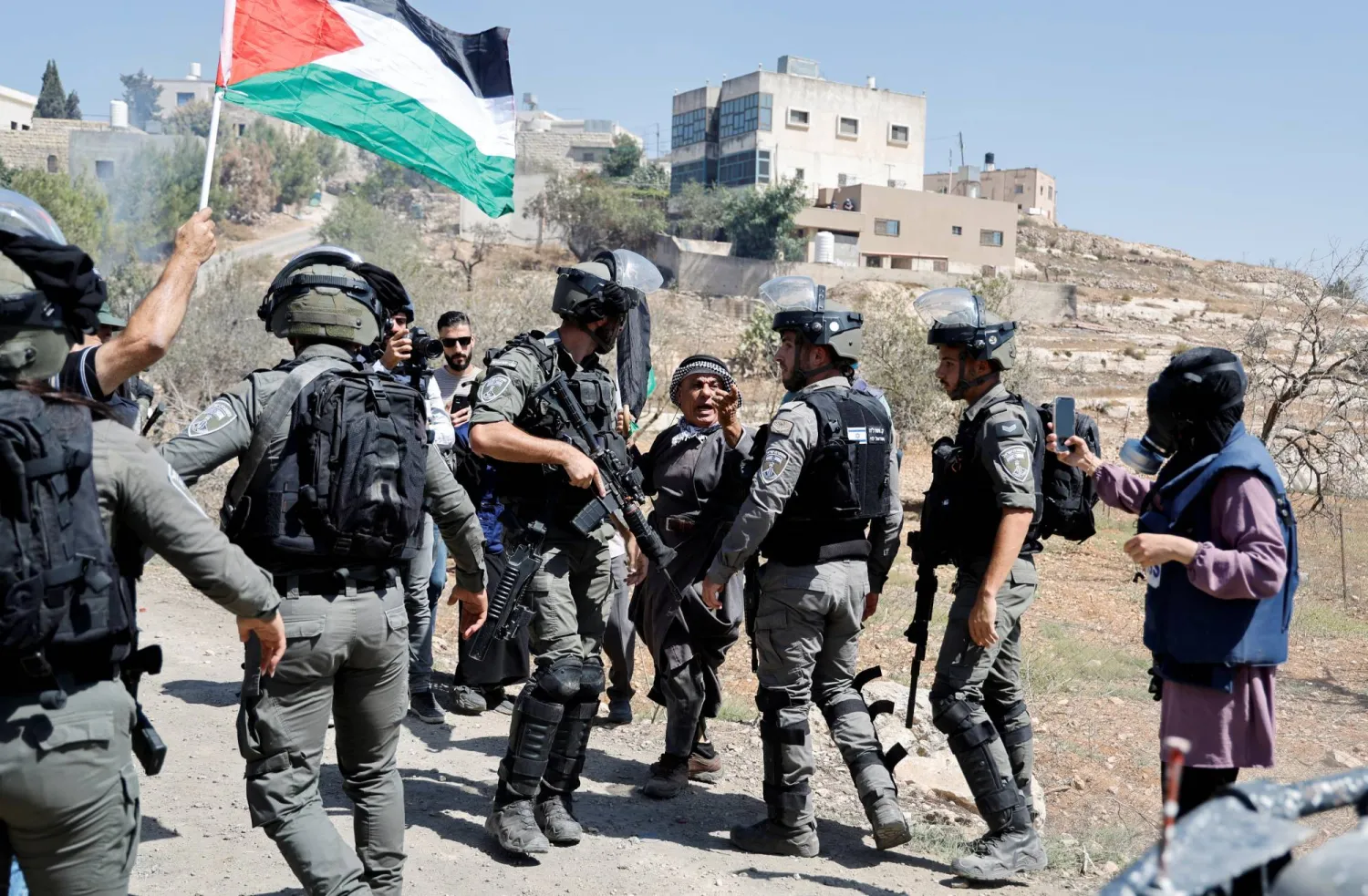
Palestinians protest against Israeli settlements near Nablus in the occupied West Bank (Reuters)
TT

UN Identifies 214 Firms Linked to Israeli Settlements

Palestinians protest against Israeli settlements near Nablus in the occupied West Bank (Reuters)

The United Nations on Friday released a fresh update of its database of companies with activities in Israeli settlements in Palestinian territories, listing 214 firms from 11 countries.

Since last year's update, the UN rights office added an additional 61 companies to the database and had removed five companies.

But major firms like Airbnb, Booking.com, Motorola Solutions and TripAdviser remained on the list.

The report, which was harshly criticized by Israel, served as a "reminder to companies that they have human rights responsibilities", UN rights chief Volker Turk said in a statement.

Firms, he said, "are expected to conduct due diligence to ensure that they do not become involved in human rights violations or abuses".

While most of the companies were based in Israel, others were based in Canada, China, France, Germany, Luxembourg, the Netherlands, Portugal, Spain, Britain and the United States.

There were two Spanish companies removed from the database since last year, along with one each from Canada, Israel and Portugal.

The list was first produced in 2020 after a UN Human Rights Council resolution called for a database of firms that profited from business in illegally occupied Palestinian territory.

The UN rights office was asked to list companies found to be taking part in any of 10 activities, including construction, surveillance, demolitions and destruction of agricultural land in Israeli settlements in the West Bank, including East Jerusalem.

Despite a requirement for the database to be updated annually, it has been revised just twice before, in 2023 and 2025.

The list is not exhaustive.

It only reviews companies about which it received submissions during set timeframes, the last of which closed in June 2024.

In all, it has received submissions about 596 companies, of which it has so far reviewed 381.

Israel, which has been harshly critical of the database from the start, slammed it again Friday as "a distorted mechanism... established solely to persecute the Jewish state".

The country's mission to the UN in Geneva charged that it was "a political tool" used by the rights office "to advance a smear campaign against business enterprises that committed no wrongdoing".

Israel has controlled the West Bank since 1967 in an occupation considered illegal under international law.


Lebanon PM Stresses Need to 'Avert Vacuum' if UN Force Leaves

16 February 2026, Lebanon, Beirut: Lebanese Prime Minister Nawaf Salam is pictured during a meeting at the Prime Minister's office. (dpa)
TT

Lebanon PM Stresses Need to 'Avert Vacuum' if UN Force Leaves

16 February 2026, Lebanon, Beirut: Lebanese Prime Minister Nawaf Salam is pictured during a meeting at the Prime Minister's office. (dpa)

Lebanon's Prime Minister Nawaf Salam insisted at the UN Friday on the need to "avert the vacuum" that would be caused by withdrawing the UN peacekeeping mission deployed in the south of his country without a viable replacement.

"What we wish to stress here and today is the need to avert the vacuum that UNIFIL's withdrawal could create, were it to take place without agreement on a new international force to replace it," he said.


South Lebanon Children Return to School Destroyed by Israel Strike

Displaced children play during an activity organized by the NGO Save the Children at a school turned into a shelter for displaced families in Tyre, southern Lebanon, August 27, 2026. (Reuters)
TT

South Lebanon Children Return to School Destroyed by Israel Strike

Displaced children play during an activity organized by the NGO Save the Children at a school turned into a shelter for displaced families in Tyre, southern Lebanon, August 27, 2026. (Reuters)

In southern Lebanon, eight-year-old Yara Ajami started the academic year this week in a doorless, windowless classroom after her school was destroyed by an Israeli strike.

Well known in the area for its excellence, Ajami's elementary school in Burj Qalaway was struck by Israel in May.

"We are happy to be back (to school), but we were happier before. We used to draw, play, but now there are no desks or chairs," the young girl with braided hair said as she climbed a bare concrete staircase.

Rather than go to their old school building, Ajami and the other students returning to classes after the summer break on Monday were diverted to a nearby structure still under construction that was being built to house preschoolers.

The sun shone through unglazed windows into unfinished classrooms as children followed their lessons, while outside clumps of twisted rebar jutted from the ground like dead bushes where walls used to stand.

The students come from areas heavily hit by Israeli attacks and most were displaced during the war, with some -- like Ajami -- returning to find their homes damaged or destroyed.

- 'Sadness in their eyes' -

"There is sadness in their eyes, each one of them has a story," school principal May Mehdi told AFP from the courtyard.

"But I am happy they are here," she said, showing on her phone what the school, her pride, once looked like.

Mehdi does not have an office in the current building, which does not even have a teacher's lounge.

Around 250 students are registered in the 24-classroom school, which used to have at least 600 school-goers before the start of the latest war in March, when Hezbollah attacked Israel in support of Tehran, following US-Israeli attacks on Iran.

Israel responded with major airstrikes and a ground invasion that killed more than 4,300 people, including 261 children according to Lebanese authorities.

More than a million people were displaced, but more than 800,000 returned since June, when a US-Iran memorandum of understanding and a Lebanon-Israel framework agreement significantly reduced the violence.

In some schools in the south that have been converted into shelters, displaced people and students now share the space, with floors reserved for each group.

The Israeli army has repeatedly accused Hezbollah of using civilian buildings, including schools, to launch attacks or hide weapons.

Rights groups, however, have accused Israel of possible war crimes in its war with Hezbollah.

Lebanese authorities accuse Israel of systematically destroying villages in the south, including homes, schools, places of worship and water and electricity infrastructure.

- 'Destruction, insecurity, displacement' -

Many of Burj Qalaway's children were unable to start the school year, being still displaced or fearing to return to the town, less than a kilometre (mile) away from Israeli troops occupying a swathe of the south.

On Thursday, an Israeli strike hit Qantara, a nearby village.

Earlier this month, UNICEF said that nearly 100,000 students in Lebanon were unable to return to their schools for the academic year due to "damage, destruction, insecurity, or displacement".

The UNICEF report also stated that 436 schools were damaged by the war, while 37 were completely destroyed.

The Burj Qalaway school previously boasted a laboratory, a computer room, and an interactive room.

Government-funded prefabricated units are being installed on the school premises where rubble has not yet been cleared.

- 'Make my father proud' -

Teacher Hoda Najdi gave her class while emphasizing to her students the importance of continuing their education and achieving good results despite the difficult circumstances.

"My home was destroyed and so was my school... (but) the students give us the strength and will to continue," the 42-year-old told AFP.

Student Mohammed Mozannar, who was displaced from one place to another in Beirut during the war, said he was "very happy to be back to make up for" the lost year.

"I had no books, no phone and no internet" to follow lessons online, he said.

"I now want to make my father proud."

But the return to school also brought back painful memories for some, like 14-year-old Rawan Fakih.

"I remembered the activities we used to do, I remembered how stressful exams were... and I remembered my friend who was killed" by an Israeli strike, she said.