


Palestine Insists on International Investigation over Land Day Victims

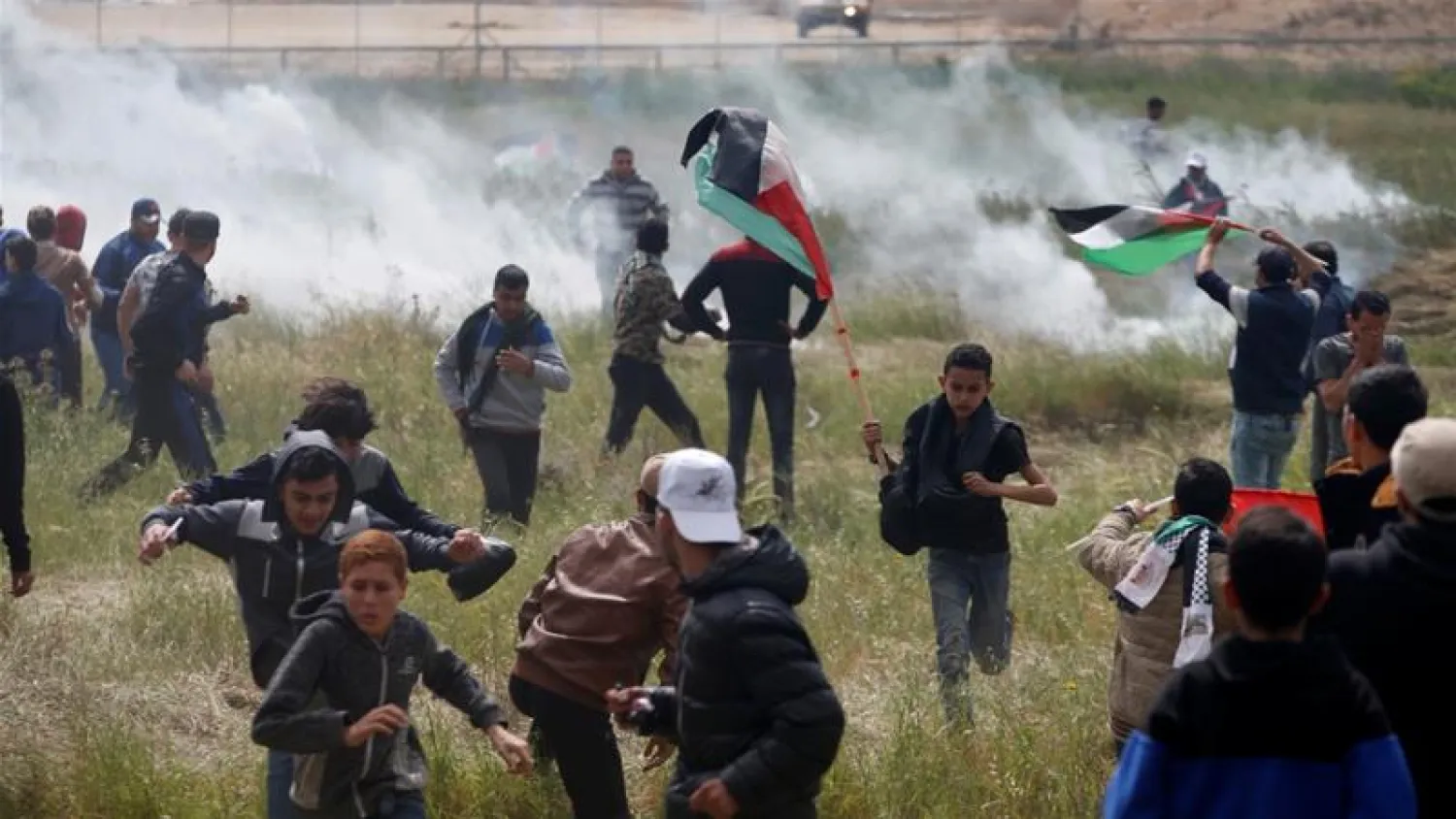
 Palestinian demonstrators on Land Day (Reuters)
Palestinian demonstrators on Land Day (Reuters)
TT

Palestine Insists on International Investigation over Land Day Victims

 Palestinian demonstrators on Land Day (Reuters)
Palestinian demonstrators on Land Day (Reuters)

Palestinian officials announced that Palestinian Authority is demanding an international investigation into the killing of several unarmed Palestinian citizens near Gaza Strip during protests for Land Day.

Palestine's representative to the UN Human Rights Council, Ibrahim Khraisha, confirmed that the Secretary-General of the United Nations was working with all the parties in the Security Council to find a mechanism to investigate Land Day incidents.

Khraishi said that: "it did not end with the US rejection."

Palestinian Ambassador to UN Riyad Mansour is coordinating with Kuwait, which originally called for an extraordinary session of the Security Council, to issue a statement or resolution that includes an investigation into the killing of 17 Palestinians last Friday, during the Return March in Gaza Strip.

"If the Security Council fails, the matter will be discussed in Geneva and a meeting with the High Commissioner for Human Rights is needed," Khraisha said.

United States has blocked a draft statement by the United Nations Security Council proposed by Kuwait which demanded an "independent and transparent investigation" under international law into the bloody events on Friday's Land Day protests.

At least 17 Palestinian protesters were killed and more than 1400 injured, 758 of which were injured with live ammunition.

The statement also expressed "grave concern at the situation at the border" and stressed "the right to peaceful protest".

UN Secretary-General Antonio Guterres called on Friday for an independent investigation into deadly clashes in Gaza, while Security Council members urged restraint on both sides.

Similarly, European Union foreign policy chief Federica Mogherini called on Saturday for an independent and transparent investigation into the Israeli military's use of live fire during mass rallies.

However, Israel refused to cooperate with any international party in the investigation saying it targeted several Palestinians who were trying to cross the borders. It also condemned the Security Council for holding a meeting on Gaza on Passover.

Israeli Envoy to UN Danny Danon lodged an official complaint with the UN Security Council for holding the emergency session during the first night of Passover, accusing Kuwait of hijacking the consultations and forcing an open session.

"The State of Kuwait, with full knowledge that our permanent mission, Israel and Jews everywhere were observing the first night of Passover, hijacked the consultations, forced an open session and invited the Palestinian delegation to present remarks that they had been advised to prepare well in advance. Israel was not given the same advance notice and was barred from taking part in the deliberations due to the observance of our religious holiday,” wrote Danon.

“Once again, Hamas has exploited women and children as human shields, including by dressing young children in military uniforms and arming them with guns and ammunition,” he added.

In turn, Fatah member, Mohammad Ashtiyeh, indicated that eventually Israel should be put on trial and punished for its crimes committed against the Palestinian people, lastly killing 17 citizens in Gaza during the peaceful demonstration demanding an end to the occupation.

Ashtiyeh told a delegation of Oxford students that what happened in Gaza recently requires “serious stance by the international community that obliges Israel to abide by international laws and treaties and to provide international protection to the Palestinian people.”

Palestinian President Mahmoud Abbas has called for the protection of the Palestinian people on several occasions, most recently on Friday.

Since Friday, Gaza border has been witnessing daily confrontations and organizers say the march will continue until May 15, the anniversary of the Palestinian Nakba Day.

Israel admitted Sunday that it held the bodies of two armed Palestinian civilians from Gaza who were killed by the Israeli forces.

Coordinator of Government Activities in the Territories Yoav Mordechai wrote an Arabic post on his Facebook page claiming the two Palestinians were “armed with rifles and an explosive device. They intended to carry out a terrorist operation in Israel.”

The two Palestinians were Mosaab Salol and Mohammed Rabaya.

For his part, Israeli Prime Minister Benjamin Netanyahu refused any international or internal investigation into the killing of Palestinian protesters. He even praised Israeli troops and thanked soldiers for allowing the nation to celebrate the Passover holiday. He added: “Well done to our soldiers. Israel acts vigorously and with determination to protect its sovereignty and the security of its citizens.”

Israel will refuse to participate in any potential international probe into the actions on the Gaza border Friday that led to the deaths of 17 Palestinians, Defense Minister Avigdor Liberman told Army Radio on Sunday morning.

Sources at Israeli army indicated that the law that obligates the army to investigate any incident of the death of a non-military person by Israeli forces does not apply to the situation in Gaza.

However, an investigation will be conducted only by Israeli forces experienced officers, not by a non-military external party.

"The investigation will be thorough and will contribute to drawing lessons and making proper judicial decisions,” they added.



Sudanese Political, Civil Groups Propose Ramadan Truce

The war in Sudan, ongoing since mid-April 2023, has caused extensive destruction across the country (AFP)
TT

Sudanese Political, Civil Groups Propose Ramadan Truce

The war in Sudan, ongoing since mid-April 2023, has caused extensive destruction across the country (AFP)

A broad coalition of Sudanese political and civil forces has made an urgent appeal to the leadership of the Sudanese Armed Forces and the Rapid Support Forces (RSF), calling for a “comprehensive humanitarian truce” during the holy month of Ramadan.

The initiative calls for a temporary cessation of hostilities, guarantees for the protection of civilians, and unhindered humanitarian aid delivery, amid increasingly dire humanitarian conditions as Sudanese citizens observe their fourth consecutive Ramadan under gunfire and shelling.

More than ten Sudanese political parties made the appeal, some of which are part of the Civil Democratic Alliance of the Forces of the Revolution (“Sumoud”), led by former Prime Minister Abdalla Hamdok.

Prominent signatories include the National Umma Party, the Federal Gathering, and the Sudanese Congress Party.

The document was also endorsed by parties outside the “Sumoud” alliance, most notably the Arab Baath Socialist Party and the Democratic Unionist Party, alongside various civil and trade union groups.

The appeal urges both warring parties — the army and the RSF — to announce a humanitarian truce beginning on the first day of Ramadan. The proposal includes a ceasefire, the safeguarding of civilian facilities, the opening of safe corridors for relief organizations, the immediate release of civilian detainees, and the initiation of prisoner exchange arrangements under international supervision to ensure compliance with humanitarian law.

It also calls for clear monitoring and implementation mechanisms to prevent either side from exploiting the truce for military gains.

The signatories stressed that the initiative comes in response to the worsening humanitarian crisis, particularly among vulnerable groups such as women, children, and the elderly, and to the mounting threats to the lives of millions, which they say require urgent intervention.

This marks the second initiative put forward by political and civil forces to halt the war since its outbreak in 2023. The first resulted in the signing of what became known as the “Addis Ababa Declaration” between the Civil Democratic Forces Alliance (Taqaddum) and the RSF. The declaration was addressed to the army leadership, which neither rejected nor signed it.

Since the fall of the cities of El-Fasher and Babanusa, as well as the town of Heglig in West Kordofan State, clashes between the army and the RSF intensified in South and North Kordofan before subsiding in recent weeks and shifting into more “technical” warfare.

This phase has seen the increased use of combat drones, jamming devices, guided artillery, and aerial munitions, leading to a rise in civilian casualties and injuries.


Anger in Iraq Over Use of ‘Greatest Arab Poet’ in Ramadan Ad

The late Iraqi poet Muhammad Mahdi al-Jawahiri serves tea to Prime Minister Mohammed Shia al-Sudani, as portrayed in a Ramadan advertisement
TT

Anger in Iraq Over Use of ‘Greatest Arab Poet’ in Ramadan Ad

The late Iraqi poet Muhammad Mahdi al-Jawahiri serves tea to Prime Minister Mohammed Shia al-Sudani, as portrayed in a Ramadan advertisement

Baghdad - A promotional video produced by a local platform and sponsored by several companies has sparked widespread criticism in Iraq over content described as “irresponsible,” according to the Iraqi Writers and Authors Union, for allegedly insulting the “Greatest Arab Poet,” Muhammad Mahdi al-Jawahiri (1899–1997), as well as former royal-era prime minister Nuri al-Said (1888–1958).

Although the production company branded the advertisement “Unified Iraq,” it depicted al-Jawahiri in an AI-generated image serving tea to Prime Minister Mohammed Shia al-Sudani inside his office. In a similar scene, Nuri al-Said was shown serving tea to former parliament speaker Mohammed al-Halbousi, triggering a wave of public outrage.

Alongside the controversy over the AI-generated portrayals of al-Jawahiri and al-Said, another debate erupted after the video showed US Chargé d’Affaires Joshua Harris, British Ambassador Irfan Siddiq, French Ambassador Patrick Durel, and German Ambassador Daniel Krebber at a banquet, appearing to be hosted by Farhad Alaaldin, the Iraqi prime minister’s adviser for foreign affairs.

The advertisement also briefly featured the late Iraqi president, Jalal Talabani, holding an umbrella while walking through the streets of Erbil, the capital of the Kurdistan Region, raising further questions about its purpose.

While the video included a song about “a unified Iraq as a homeland of peace,” critics said its central narrative — built around a homeless young beggar — was confusing and poorly defined. Sources close to the production team told Asharq Al-Awsat that the creators had “their own artistic methods” of expressing the idea.

Government Distances Itself

Amid the mounting backlash, the prime minister’s office expressed rejection of “the virtual video in which al-Jawahiri appeared in a manner inconsistent with the prime minister’s respect and appreciation for his literary and national stature.”

Al-Sudani instructed the Communications and Media Commission to launch an urgent investigation into the entities that produced, promoted, or published the advertisement, citing its alleged offense to cultural icons and state institutions, as well as what he described as the irresponsible and unprofessional use of artificial intelligence technologies.

He also signaled the possibility of legal action against the party responsible for producing what he called “the offensive video against Iraq and its national symbols.”

In contrast, the production company asserted that the PM’s office had prior knowledge of the project, and that the same applied to al-Halbousi. However, sources denied being aware of the inclusion of al-Jawahiri and Nuri al-Said in the work.

The sources also suggested that a government official may have been involved in facilitating the production in cooperation with Al-Bayan University, whose building and offices appeared in the advertisement.

“Deliberate Insult”

The Iraqi Writers and Authors Union condemned what it called an “insult to the immortal al-Jawahiri” after the video showed him serving tea to the prime minister.

In a statement, the union said the act reflected “a deliberate offense to a poet distinguished by his immense cultural and moral value, and his well-known national and humanitarian positions.”

It urged relevant authorities to take a firm and deterrent stance against “irresponsible acts aimed at distorting facts and undermining Iraq’s national symbols.”

The union added that al-Jawahiri remained a national symbol “we proudly present to the world and refuse to see insulted by any party.”

The union was founded in al-Jawahiri’s home in 1959 and he became Iraq’s first journalists’ syndicate head the same year.

Claims of Prior Approvals

Facing intense criticism, the advertisement’s author and head of the production company said all participating political figures had approved the details of the project and filming inside their offices.

She stated that the scenes featuring al-Sudani and al-Halbousi were real, with only the figures of al-Jawahiri and Nuri al-Said later added using artificial intelligence.

In a statement on Instagram, al-Jumaili said the project took two months to complete and was reviewed by several international parties before being shown in Iraq, adding that “no step was taken without official approvals.” She did not specify the nature of those entities or whether the political figures were aware of the AI portrayals alongside them.

She argued that the backlash was politically driven and overlooked the advertisement’s positive messages, later explaining that the tea-serving scenes symbolized a “national identity” passed from past intellectual and political leaders to a new generation of leaders.


Trump to Preside over First Meeting of Board of Peace with Many Gaza Questions Unresolved

US President Donald Trump speaks during a Black History Month event in the East Room of the White House in Washington, DC, on February 18, 2026. (Photo by SAUL LOEB / AFP)
TT

Trump to Preside over First Meeting of Board of Peace with Many Gaza Questions Unresolved

US President Donald Trump speaks during a Black History Month event in the East Room of the White House in Washington, DC, on February 18, 2026. (Photo by SAUL LOEB / AFP)

US President Donald Trump will preside over the first meeting of his Board of Peace on Thursday with unresolved questions on the future of Gaza hanging over an event expected to include representatives from more than 45 nations.

The disarmament of Hamas militants, the size of the reconstruction fund and the flow of humanitarian aid to the war-battered populace of Gaza are among the major questions likely to test the effectiveness of the board in the weeks and months ahead.

Trump is to address the group at the Donald J. Trump US Institute of Peace - a building in Washington the president recently renamed for himself - and announce that participating nations have raised $5 billion for the reconstruction fund.

The money is expected to be a ‌down payment on ‌a fund that will likely need many more billions.

Trump's Board of Peace has been controversial. It includes Israel but not Palestinian representatives and Trump's suggestion that the Board could eventually address challenges beyond Gaza has stirred anxiety that it could undermine the UN's role as the main platform for global diplomacy and conflict resolution.

Senior US officials said Trump will also announce that several nations are planning to send thousands of troops to participate in an International Stabilization Force that ⁠will help keep the peace in Gaza.

Disarming Hamas militants in order for the ‌peacekeepers to begin their mission remains a major sticking point, ‌and the force is not expected to deploy for weeks or months.

The Palestinian group Hamas, fearful of Israeli ‌reprisals, has been reluctant to hand over weaponry as part of Trump's 20-point Gaza plan that brought ‌about a fragile ceasefire last October in the two-year Gaza war.

"We are under no illusions on the challenges regarding demilitarization, but we have been encouraged by what the mediators have reported back," a senior administration official said.

MOST SECURITY COUNCIL MEMBERS NOT ATTENDING

Delegations from 47 countries plus the European Union are expected to attend the event, US officials ‌said. The list includes Israel and a wide array of countries from Albania to Vietnam.

It does not, however, include permanent United Nations Security Council members ⁠like France, Britain, Russia ⁠and China.

Speakers at the event are expected to include Trump, Secretary of State Marco Rubio, US envoys Steve Witkoff and Jared Kushner, former British Prime Minister Tony Blair, who is expected to have a senior role in the board, US ambassador to the UN Mike Waltz, and High Representative for Gaza Nickolay Mladenov, among other attendees.

A member of the peace board, who declined to be named, said the Gaza plan faces formidable obstacles. Establishing security in the enclave is a precondition for progress in other areas, but the police force is neither ready nor fully trained, said the official.

The official added that a key unresolved question is who would negotiate with Hamas. The peace board’s representatives could do so with countries that have influence over Hamas - notably Qatar and Türkiye- but Israel is deeply skeptical of both.

Another major issue is the flow of aid, which the official described as “disastrous” and in urgent need of scaling up. Even if aid surges in, it remains unclear who will distribute it, the official said.