Peter Munk, Entrepreneur Who Founded Barrick Gold, Dies at 90

Peter MunkPhotographer: Scott Eells/Bloomberg
TT

Peter Munk, Entrepreneur Who Founded Barrick Gold, Dies at 90

Peter MunkPhotographer: Scott Eells/Bloomberg

Peter Munk, the Canadian immigrant who founded Barrick Gold Corp. in the early 1980s and transformed it from a small-scale operation into a global empire, has died. He was 90.

He died Wednesday in Toronto, according to a company statement. No cause was given.

A serial entrepreneur, Munk’s ventures ranged from high-end electronics to real estate. But it was as founder of Toronto-based Barrick, the world’s largest gold producer, that he amassed most of his wealth, the bulk of which he pledged would go to charities after his death.

“He was a unique fellow, probably the most unforgettable guy I knew,” former Canadian Prime Minister Brian Mulroney said Wednesday by phone. “He was a genuine leader; a visionary who built great companies and then, at the height of his wealth and authority, proceeded to distribute most of it.”

Born in Budapest on Nov. 8, 1927, to Lajos Munk and Katharina Adler, Munk fled Nazi-occupied Hungary in 1944 with his father’s family. His mother, who left the marriage when Peter was 4 and had survived the Auschwitz concentration camp, committed suicide in 1988.

Odd Jobs

In 1948, Munk’s father sent him from an internment camp in Switzerland to live in Canada with an uncle. In a 1998 interview, Peter Munk said he initially dreaded the move. “But I was determined to succeed,” Munk said. “I probably had enough misguided self-confidence to think I could do it in Canada even though I couldn’t speak the language and didn’t have any contacts.”

Munk would later describe his first years in Canada as a kind of love affair. After the deprivation of postwar Europe, food was abundant and friends welcomed him into their homes with open fridges. He worked a series of odd jobs -- selling Christmas trees, harvesting tobacco, clearing bush -- and graduated from the University of Toronto with a degree in electrical engineering in 1952.

‘Half Full’

Munk’s account of his childhood and early years in Canada reflected an optimism that remained throughout his life, according to his daughter, Nina Munk, a New York-based journalist. “For my father, the glass is always half full,” she said in a July 2017 interview.

It was a quality that would be tested by the shifts in fortune that are the hallmark of an entrepreneur’s life. Nina was born in 1967, the year Munk’s first business, Clairtone Sound Corp., collapsed. Her father remembered it as “the worst year of his life,” according to her 2008 book about the venture, “The Art of Clairtone.”

For almost a decade Clairtone’s mid-century Danish-inspired stereos were purchased by celebrities such as Frank Sinatra, Hugh Hefner and jazz musician Oscar Peterson. But cost overruns, a too-early foray into color television and an ill-fated shift of operations to Nova Scotia contributed to steep losses in the late 1960s. Munk was ejected from management in 1968 and later sued for insider trading. His first big success was also his most humiliating failure.

Living Well

At the same time, his first marriage, to Linda Gutterson, fell apart. In 1969 she moved to Switzerland with Nina and her older brother, Anthony. Munk would later tell Nina he spent more money on Anthony’s school tuition than he earned that year. In fact, Munk’s lifestyle changed little over the years: regardless of how business was doing, he always wore bespoke Italian suits, monogrammed Charvet shirts and Borsalino hats, Nina recalled, while priding himself on avoiding the decadence of the mega-rich.

“We always lived well,” Nina said. “To my father, deals that went south, share prices that collapsed, companies that went bust were merely blips on the path to success. He never doubted he would make it all back, and then some. So why engage in belt-tightening?”

In 1970, Munk decamped to London where he and business partner David Gilmour started their next venture, developing a 7,000-acre resort in Fiji and 50 hotels throughout the Pacific Basin.

‘Snotty Guys’

The audacity of the venture, coming on the heels of the Clairtone failure, suggests more than optimism was at play. Canadian author Peter C. Newman wrote there were three great motivators in Munk’s life: restitution, redemption and revenge. “It was about giving the finger to all those snotty guys from Upper Canada College and Harvard’s business school who never waved goodbye as he departed for his exile in the South Pacific after the Clairtone fiasco,” according to Newman’s 2014 article in Maclean’s, a Canadian publication.

In 1979, Munk returned to Canada and in 1981 he sold Southern Pacific Properties, walking away with about $100 million. A year earlier he had started Barrick Petroleum, an oil and gas exploration company, but soon shifted to gold. Renamed Barrick Resources, the company went public on the Toronto Stock Exchange in 1983. Three years later, Munk purchased a small Nevada gold mine called Goldstrike for $62 million. The company’s geologists discovered new gold deposits at the site, which became one of the world’s richest gold mines.

Bre-X Hoax

Munk’s other deals included amassing a 43 percent stake in Trizec Corp. in 1994 as the real-estate developer sought protection from debt holders. In 2006 Brookfield Properties Corp. and buyout firm Blackstone Group LP acquired the firm for $8.9 billion. In 2007, he bought a former Soviet-era naval base in Montenegro, transforming it into a five-star resort and yacht marina on the Adriatic.

Occasionally, his best deals were the ones that got away. In 1997, Barrick lost a bid for control of Bre-X Minerals Ltd. and its Busand gold deposit in Indonesia. Bre-X soared to a market value of C$6 billion ($4.6 billion) before declaring bankruptcy after claims of huge reserves in Indonesia were found to be a hoax.

Unscathed, Barrick expanded during a decade-long upturn in gold prices, becoming the world’s biggest producer with the acquisition of Placer Dome Inc. in 2006 for about $10 billion, including debt, a record in the industry.

‘The Biggest’

“The ultimate goal is to be the biggest,” Munk said at a May 2011 Bloomberg summit. “Why wouldn’t it be? Why would you be happy with halfway?”

Combining Barrick with rival Newmont Mining Corp. would have secured that goal; the latest talks failed in 2014, the same year Munk stepped down as Barrick’s chairman at age 86. Today, Barrick maintains only a slim lead on Newmont in terms of production and the latter’s market capitalization is higher than Barrick’s.

Upon retiring in 2014 at age 86, Munk handed control to John Thornton and vowed to remain involved in the company. “You can take maybe Munk out of Barrick, you cannot take Barrick out of Munk,” he said at an annual shareholders meeting.

A foundation established with his second wife, Melanie Bosanquet, whom he married in 1973, serves a vehicle for the bulk of his philanthropy. Donations, encompassing personal ones by Munk, include more than $175 million to the Peter Munk Cardiac Centre and the University Health Network where it is housed; about $40 million to the University of Toronto’s Munk School of Global Affairs; and $43 million to the Technion-Israel Institute of Technology.

Munk had five children: Anthony, Nina, Marc-David, Natalie and Cheyne. Linda Gutterson died in 2013.

Bloomberg


Moody’s Establishes Regional HQ in Riyadh, Deepening Presence in Region

(FILES) Signage for Moody's Corporation is displayed at their headquarters at 7 World Trade Center on March 18, 2025 in New York City. (Photo by ANGELA WEISS / AFP)
TT

Moody’s Establishes Regional HQ in Riyadh, Deepening Presence in Region

(FILES) Signage for Moody's Corporation is displayed at their headquarters at 7 World Trade Center on March 18, 2025 in New York City. (Photo by ANGELA WEISS / AFP)

Moody’s Corporation announced that it has established its regional headquarters in Riyadh, reflecting ongoing commitment to support the development of the Kingdom’s capital markets and economy.

“This investment aligns to the Kingdom's Vision 2030 initiative and underscores its dynamism and growth,” Moody’s said in a statement this week.

The new regional headquarters marks an expansion of Moody’s presence in Saudi Arabia, where the company first opened an office in 2018, and reflects its longstanding commitment to the Middle East.

“The headquarters will strengthen Moody’s engagement with Saudi institutions and enable broader access to Moody’s decision grade data, analytics and insights,” said the statement.

“Our decision to establish a regional headquarters in Riyadh reflects our confidence in Saudi Arabia’s strong economic momentum, as well as our commitment to helping domestic and international investors unlock opportunities with our expertise and insights,” said President and Chief Executive Officer of Moody’s Rob Fauber.

“We are well positioned to provide the analytical capabilities and market intelligence that investors and institutions need to navigate evolving markets across the Middle East,” the statement quoted him as saying.

Mahmoud Totonji will lead the regional headquarters as General Manager.


Saudi Arabia Launches First Endowment Fund for Environmental, Water and Agricultural Sustainability

The launch of the Namaa Endowment Fund (Asharq Al-Awsat)
TT

Saudi Arabia Launches First Endowment Fund for Environmental, Water and Agricultural Sustainability

The launch of the Namaa Endowment Fund (Asharq Al-Awsat)

Saudi Arabia has launched its first endowment fund dedicated to advancing environmental, water and agricultural sustainability, reinforcing efforts to strengthen the Kingdom’s non-profit sector and long-term development.

Minister of Environment, Water and Agriculture Eng. Abdulrahman Al-Fadhli on Tuesday inaugurated the Namaa Endowment Fund at the ministry’s headquarters, in the presence of senior officials and stakeholders.

The fund is designed to support economic and social development goals, address community needs, increase the non-profit sector’s contribution to GDP, and promote sustainable management of environmental, water and agricultural resources.

Al-Fadhli said the fund represents a new model of institutional endowment work and a practical mechanism to expand developmental impact while ensuring the sustainability of non-profit initiatives.

Developed in partnership with the General Authority for Awqaf, the fund aims to build assets commensurate with its ambitions, enabling higher returns and a wider impact over the long term.

It will pursue carefully structured investments that balance financial performance with developmental outcomes, with the potential to own or benefit from real estate assets that can be used by non-profit organizations.

Encouraging Private-Sector Participation

Al-Fadhli added that the ministry, in cooperation with the General Authority for Awqaf, the Capital Market Authority and AlAhli Capital, will support the fund and encourage contributions from the private sector, business leaders and the wider public.

Contributions will be made through a licensed digital platform under strict financial governance. He called on all segments of society to contribute in support of sustainable development across the environment, water and agriculture sectors.

Namaa will finance endowment initiatives within the ministry’s ecosystem, including the non-profit institutions Reef, Morooj and Saqaya. Its focus areas include water provision and conservation, afforestation, biodiversity protection, vegetation cover, the circular economy, sustainable agriculture and irrigation, and reducing food loss and waste.

Emad Alkharashi, Governor of the General Authority for Awqaf, announced an initial contribution of SAR100 million, describing it as a foundation for a sustainable endowment model.

He said the fund combines the legacy of endowments with modern investment practices to protect natural resources, strengthen food security and ensure lasting developmental impact.

Alkharashi added that the partnership with the ministry maximizes results and positions the fund as a model for directing endowments toward high-impact, long-term priorities through a transparent, well-governed institutional framework.


Makkah Gears Up for Ramadan with Tourism Drive, Record Hospitality Growth  

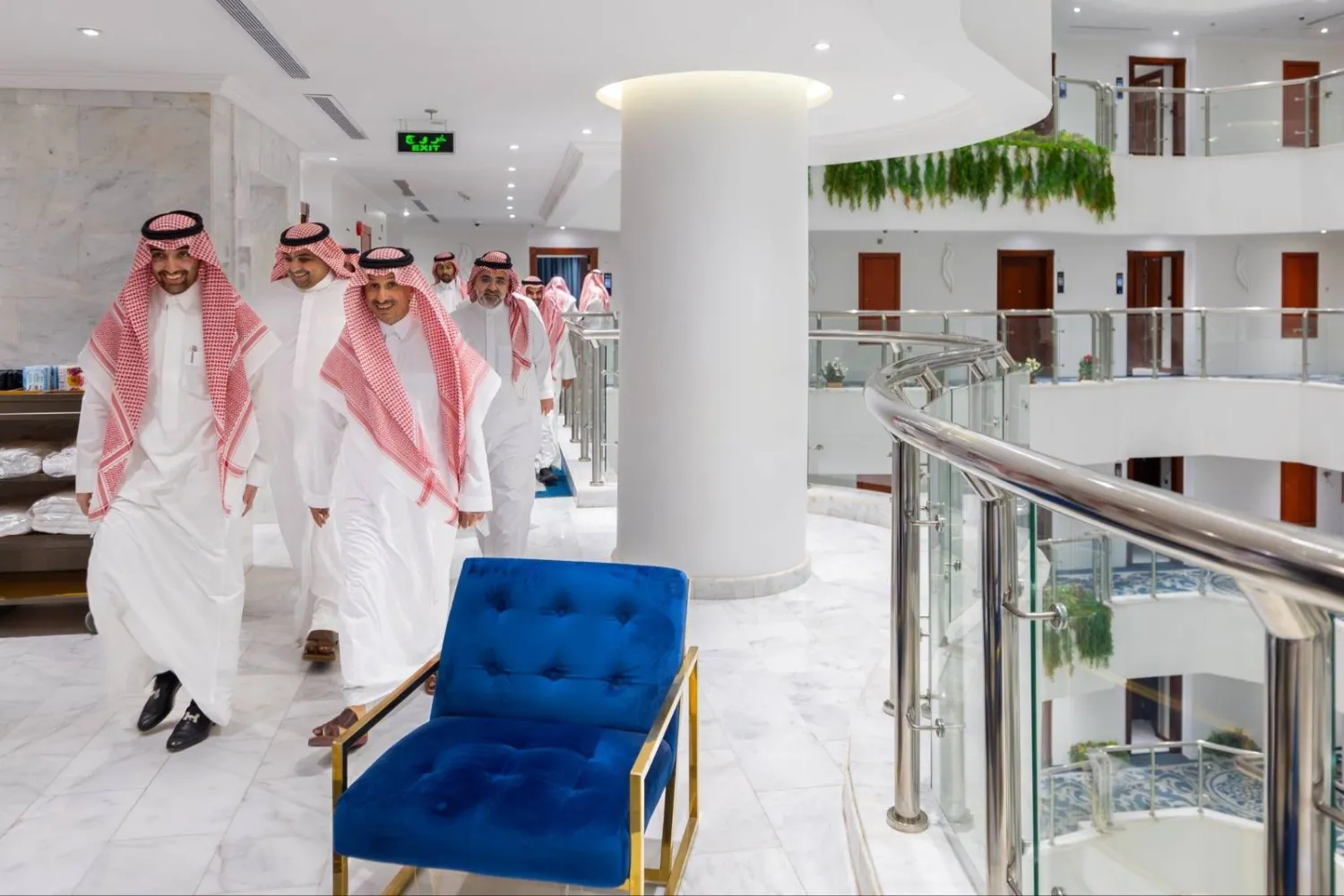
Tourism Minister Ahmed Al-Khateeb and other officials during his inspection tour on Tuesday. (Asharq Al-Awsat)
TT

Makkah Gears Up for Ramadan with Tourism Drive, Record Hospitality Growth  

Tourism Minister Ahmed Al-Khateeb and other officials during his inspection tour on Tuesday. (Asharq Al-Awsat)

Saudi Arabia’s Ministry of Tourism has raised the readiness of Makkah’s hospitality sector to its highest level ahead of the holy month of Ramadan, stressing that serving pilgrims and visitors remains a top national priority.

Makkah is preparing to receive worshippers and visitors amid a marked expansion in hospitality capacity. The city now has more than 2,200 licensed accommodation facilities, reflecting growth of 35 percent over the past year. The number of licensed hotel rooms has exceeded 380,000, up 25 percent, while total domestic and inbound tourism spending is projected to surpass SAR 143 billion ($38.1 billion) in 2025.

The wider Makkah region recorded unprecedented performance indicators last year, both in visitor numbers and tourism spending, underscoring sustained growth and operational readiness.

Total domestic and international visitors exceeded 50 million, marking a 14 percent increase compared with 2024.

Tourism Minister Ahmed Al-Khateeb announced the figures during an annual inspection tour on Tuesday, stressing that the indicators reflect a major expansion in accommodation capacity and record growth in visitor numbers.

The tour included inspections of temporary lodging facilities designated for pilgrims, part of a proactive plan to increase capacity during peak seasons, alongside early preparations for the upcoming Hajj.

Vision 2030 targets surpassed

Official data has shown that Saudi Arabia has exceeded its Vision 2030 targets for the Umrah. The number of pilgrims arriving from abroad rose from 8.5 million in 2019 to more than 18 million in 2025, surpassing the original goal of 15 million by 2030.

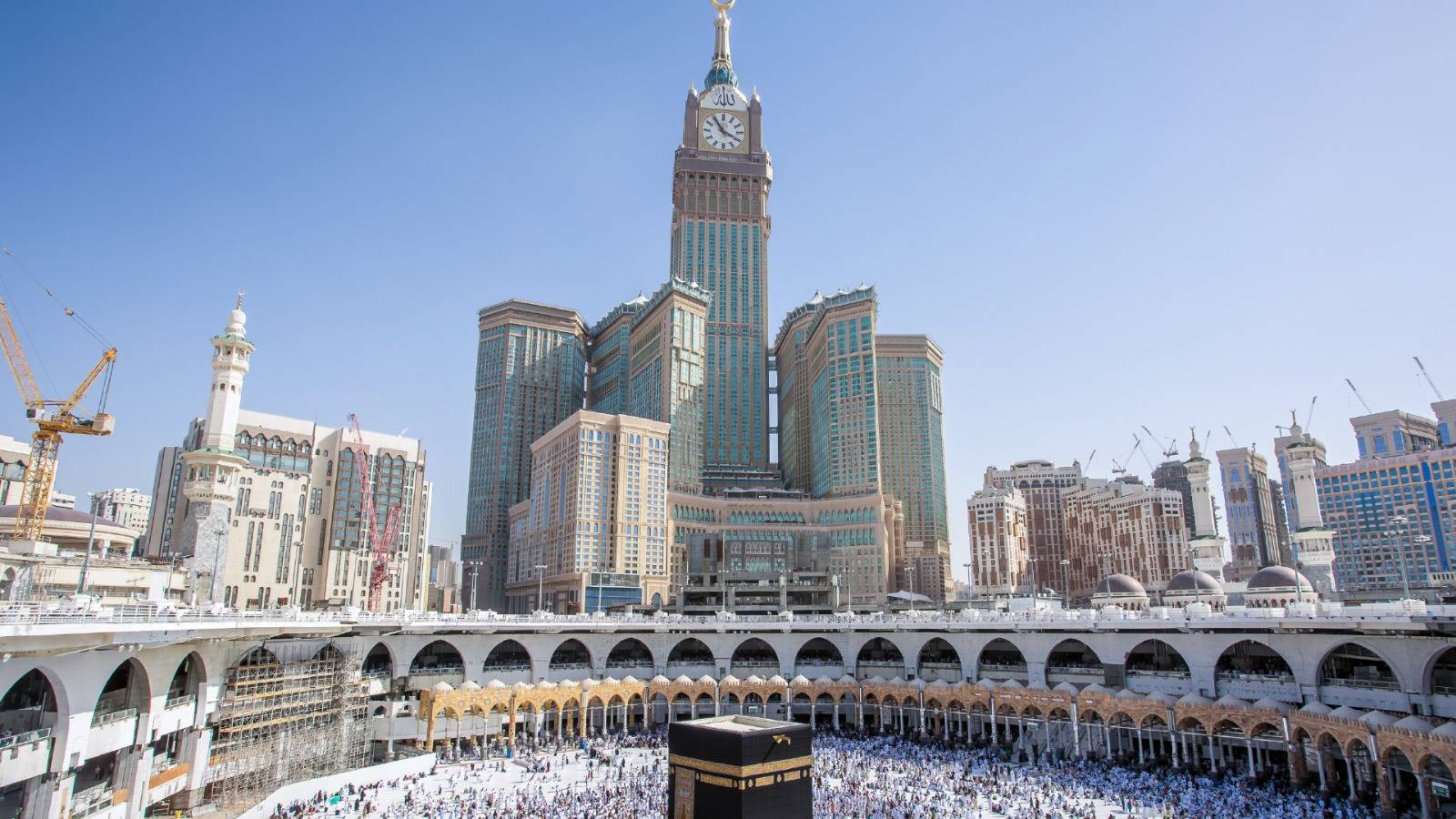
A number of hotels surrounding the Grand Mosque in Makkah. (General Authority for Awqaf)

Service quality indicators improved as well, with pilgrim satisfaction reaching 94 percent, exceeding Vision 2030 benchmarks.

Workforce development kept pace with demand, as the number of licensed tour guides rose to more than 980, a 23 percent increase.

Masar Mall project

Al-Khateeb announced a joint financing agreement between the Tourism Development Fund and the Arab National Bank with Hamat Holding to support the Masar Mall project. The development carries a total cost of SAR 936 million (about $250 million).

The project is expected to become the largest shopping center in Makkah with the capacity to accommodate around 20 million visitors annually.

Its location near the Haramain High-Speed Railway station and a direct pedestrian link to the Grand Mosque are expected to strengthen the city’s commercial and tourism infrastructure.

Jeddah: Gateway to pilgrims

Meanwhile, Jeddah continues to consolidate its position as a complementary destination to Makkah and a primary gateway for pilgrims, while also expanding its role as a coastal tourism hub.

The city welcomed more than 13 million domestic and international visitors in 2025, a 10 percent increase from 2024. Tourism spending reached SAR 28 billion ($7.47 billion), up 6 percent year on year.

Jeddah’s hospitality sector also expanded, with more than 500 licensed facilities and over 33,000 licensed rooms.

The city is currently developing 46 tourism projects valued at SAR 21 billion ($5.6 billion) and expected to add more than 11,000 hotel rooms and further strengthen its tourism infrastructure and economic value.