


Andrés Iniesta Begins Glorious Goodbye as an Era Draws to a Close

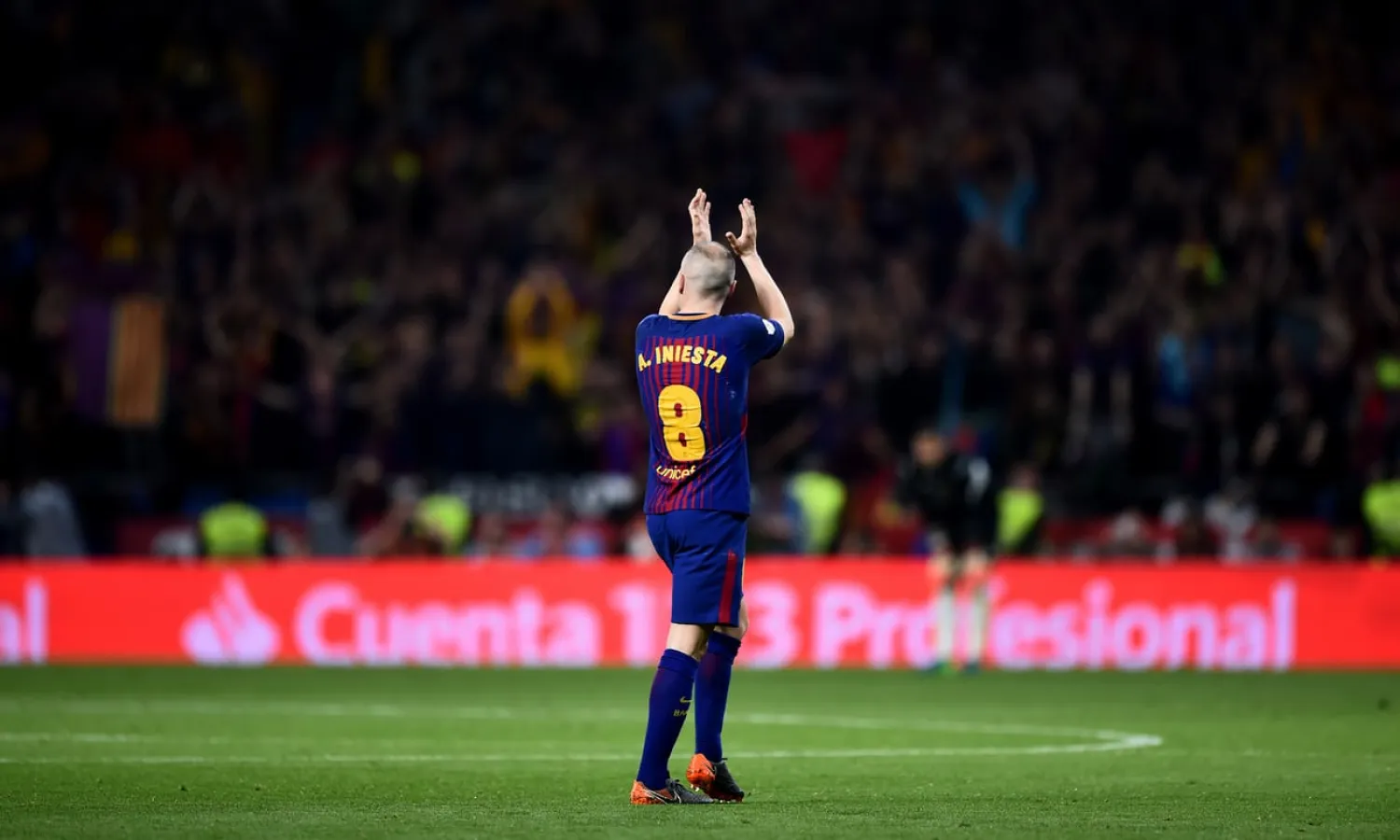
 Andrés Iniesta is given a standing ovation in Madrid after starring in Barcelona’s 5-0 Copa del Rey final victory over Sevilla. Photograph: Denis Doyle/Getty Images
Andrés Iniesta is given a standing ovation in Madrid after starring in Barcelona’s 5-0 Copa del Rey final victory over Sevilla. Photograph: Denis Doyle/Getty Images
TT

Andrés Iniesta Begins Glorious Goodbye as an Era Draws to a Close

 Andrés Iniesta is given a standing ovation in Madrid after starring in Barcelona’s 5-0 Copa del Rey final victory over Sevilla. Photograph: Denis Doyle/Getty Images
Andrés Iniesta is given a standing ovation in Madrid after starring in Barcelona’s 5-0 Copa del Rey final victory over Sevilla. Photograph: Denis Doyle/Getty Images

There were two minutes to go in the final, his final, when Andrés Iniesta began the long walk goodbye.

Slowly, swallowing hard, eyes red, he made his way across the pitch, team-mates coming to embrace him as he went, and all around the Metropolitano supporters got to their feet, applauding. They stood in the Barcelona end and they stood in the Sevilla end too. Iniesta’s name rolled around, accompanying him until he ducked out of sight, taking a seat on the bench. He sat there for a little while, tears forcing their way through, and then he got up again and went to collect the Copa del Rey, alone.

It was the 34th title of his career and a 35th will follow, but it was this one that felt like it marked the end: the last waltz. As he climbed up to collect the trophy, down on the grass Barcelona’s players waited for him, much as they had waited for him when, 51 minutes into his 670th game for Barcelona, he scored the fourth goal, ensuring this would always be his night: the Iniesta Final.

Collecting Lionel Messi’s pass, with a gentle shift of the hips, just a hint of a pause, he stepped past David Soria and rolled the ball in. He jumped into the air and at some point in that leap, sadness crept into the celebration, nostalgia flooding the stadium. They knew what this meant.

Any doubt disappeared when they saw the Barcelona’s players’ reaction, more eloquent than anything they could have said. “There were a lot of emotions in that goal,” Iniesta admitted. “Lots of emotions, lots of feelings, lots of years. I really wanted this final to go well and I’m happy.” The normal huddle broke up and then, almost one by one, they waited for Iniesta, a moment each. Eyes closed, Messi held him in an embrace that may become the image of the final, maybe even a generation; he held on just that little bit longer, like he didn’t want to let go.

There was something in that. In good times and bad Messi looks for Iniesta, and in bad times above all. It is in those moments when he seeks security, assurance, that he most wants the Spaniard at his side. “I know how difficult it is to do what he does,” Messi says in Iniesta’s book, The Artist.

“On the pitch I like him to be near me, especially when the game takes a turn for the worse, when things are difficult. That’s when I say to him: ‘Come closer.’ He takes control and responsibility.”It is a simple solution, successful for well over a decade and expressed on Saturday night, like a portrait of their era, Barcelona producing a performance that may have been as good as any since Wembley 2011. And yet time waits for no man, not even the man who sometimes seemed able to control it. You can slow the clock, but not stop it and when Messi looks for Iniesta next season, he will no longer be there … he’ll be 5,000 miles away; 22 years after arriving, 18 after meeting Messi, 16 since his debut, Iniesta is leaving Barcelona for China. An announcement is expected this week.

At 33, a starter in 24 of 33 league games and eight of 10 in the Champions League, on course to win a league and cup double, it may have come too soon. That, certainly, was the conclusion drawn after Saturday. China looks incongruous. The headline on the front of Sunday’s AS said it all: “Iniesta, don’t go!” But the appeals for him to stay will also reinforce his belief this is the right time to go. The right way, too: remember me like this.

Although Iniesta wouldn’t say so, something broke last year, and while a momentary fix was found, a “lifetime” contract signed and his role renewed, he didn’t want to leave too late, a long goodbye from the bench. Nor did he ever want to face the club he joined aged 12.

Iniesta described that day in September 1996 when he arrived at La Masia as the worst of his life. José Bermúdez, another resident, remembered him as “pale, tiny and sad, delicate and sensitive”. Iniesta couldn’t stop crying. A few hundred metres away in the Hotel Rallye, nor could his parents. His father, José Antonio, couldn’t sleep and the same went for Andrés’s grandfather. Together, they planned to go and get him, take him home. Mari, Iniesta’s mum, stopped them. “Let him try,” she insisted. So, they did.

They took him to school the next morning and then headed home to La Mancha. Iniesta felt abandoned when they weren’t there to pick him up that afternoon. Victor Valdés was there at the start. “His success was forged through silent tears,” Valdés says. It is some success. There have been two trebles as well, and the World Cup and the European Championship, twice in a row. Which makes it sound almost as easy as his football makes it look, but it hasn’t been.

Iniesta does not use the word depression but he has spoken eloquently about the “dark place” he was in before the 2010 World Cup, how he felt in “freefall”. He went into the 2009 Champions League final with a hole in his thigh, ordered not to shoot. He reached the World Cup struggling with injury, running around hotel corridors in the middle of the night, unseen by team-mates, trying to prove his fitness to himself. It says something that Vicente Del Bosque said he would wait for him, as long as it took; it says something too that when he suffered an injury 17 days before the 2009 final, Pep Guardiola insisted: “He plays.”

He played, the way only Iniesta could, the way that became symbolic of a generation: arguably the best that football in Spain, maybe anywhere, has seen. “An era departs with him,” said AS’s match report. “A style, too. A way of playing and a way of life.” After Rome, Alex Ferguson talked about how “he and Xavi get you on that carousel” and he experienced that again at Wembley in 2011, an era-defining display revived on Saturday.

In South Africa, he scored the winning goal, 116 minutes into the final, peeling off his shirt to reveal a vest underneath. “Dani Jarque, always with us,” it said, written by the physio Hugo before kick-off for Iniestain honour of the Espanyol captain, his friend, who had passed away after a sudden unexpected heart attack. Jarque’s wife Jessica watched the match on TV, her first in a year since his death. “Seconds before the goal, I knew it was coming. I started to cry before you scored,” she told Iniesta. As the ball sat up, he said he heard “the silence”.

And then he scored. The goal.

“Iniesta is leaving us,” ran one headline last week; the key word was “us”.

Iniesta is applauded at every stadium in Spain, but not just because of that goal and it is not just Spain. It happened in Turin and Lisbon too, and at the Bernabéu. On Saturday, it happened again; it was not the first time but it felt like the last, a touch of melancholy. “The last emperor,” Marca called him. “How happy he made us. Something in your soul dies when a friend goes; nothing will ever be the same,” one editorial read last week – and that too was in Madrid.

Iniesta belongs to everybody, like some shared treasure, held close but enjoyed together. Luis Enrique called him “world heritage”. When the goal went in on Saturday, on Cadena Ser radio the commentator joined those chanting his name. “The scriptwriter has done it; this final needed this moment,” Lluis Flaquer said. “Iniesta! Iniesta! Iniesta! We can’t leave here without joining in the chant, which is the chant of all football lovers, dedicated to a universal manchego.”

It is the player and the person, the way he is, that helps explain that. He is every man’s in part because he is everyman: there’s a normality about him which is not entirely normal in football, and he is universally admired. “He’s an amazingly good person; someone kicks him and he’s the one who says sorry,” Samuel Eto’o insists. Sergio Ramos disagrees: “You can’t kick him; it’s Andrés,” he says.

After Spain defeated Croatia at Euro 2012, Ivan Rakitic, still not the club-mate he would become said: “We can play against all of them, but against Iniesta it is different. He is another level again. He has everything: he’s so fast, he thinks so quickly, he’s in control.” That day, Fernando Torres noted: “When he has the ball, it’s like everything else stops. I’ve known him for 15 years and he’s never, ever had a bad game.” On Saturday, Vicenzo Montella described him as an “extra-terrestrial”.

Sometimes, though, it’s more than words. Some years ago now, Iniesta was recording a video, explaining to the camera as he walked through the move where he shifts the ball from one foot to another and back. He came to the defender, a fellow Barcelona player, and went past him. Swish, swish, and he was gone. He was “walking” everyone through it but it still happened so fast as to be almost imperceptible. There was something of that in Saturday’s goal; the ball doesn’t even change direction much; the defender does, as if Iniesta is controlling him too. That day, there were only five or six people there but there was an audible gasp – from professional players.

“Bloody hell,” one spat out.

There is work behind it but Iniesta believes it’s intuitive. “What I did at 12, I still do now,” he says. What he does delights; it also creates a sense of quiet awe, even among those for whom football holds fewer secrets. Del Bosque says it is like he is watching the game from the stands while still on the pitch, a player of “uncommon intelligence and awareness”. Paco Seirulo, fitness coach at Barcelona, talked about his “mastery of the relationship between space and time”.

The day that Iniesta was first invited to train, Luis Enrique was sent to pick him up at the gate because otherwise the security guard, Antonio, wouldn’t have let him past. Luis Enrique later called him “Harry Potter” but doesn’t recall it, despite Guardiola urging team-mates: “Remember this day, the day you first played with Andrés.” Guardiola knew; he’d been encouraged by his brother Pere to see Iniesta a few years before. As he left, he came across a friend. “I’ve just seen something incredible,” he said. That day, Guardiola also famously told Xavi: “You’re going to retire me. This lad is going to retire us all.” Now, after 670 games, Iniesta is going too. He goes like this, playing his way.

“He’s a phenomenon, a force of nature: no one plays like him and no one can compare to him,” wrote Xavi, the man who was closer to him than any other, who with Iniesta defined a generation. “Sometimes I get the feeling Andrés doesn’t realise how important he is: one day he’ll retire and we’ll see the magnitude of what he has done.” He surely knows now, as that day draws closer: he saw it on Saturday. “It’s emotional to see the affection and respect people have for me,” he said.

There is not long left, they know. Soon, maybe too soon, Messi will look across and see an empty space. They all will.

The Guardian Sport


Sinner Sees off Popyrin to Reach Doha Quarters

 Italy's Jannik Sinner greets the fans after defeating Australia's Alexei Popyrin in their men's singles match at the Qatar Open tennis tournament in Doha on February 18, 2026. (AFP)
Italy's Jannik Sinner greets the fans after defeating Australia's Alexei Popyrin in their men's singles match at the Qatar Open tennis tournament in Doha on February 18, 2026. (AFP)
TT

Sinner Sees off Popyrin to Reach Doha Quarters

 Italy's Jannik Sinner greets the fans after defeating Australia's Alexei Popyrin in their men's singles match at the Qatar Open tennis tournament in Doha on February 18, 2026. (AFP)
Italy's Jannik Sinner greets the fans after defeating Australia's Alexei Popyrin in their men's singles match at the Qatar Open tennis tournament in Doha on February 18, 2026. (AFP)

Jannik Sinner powered past Alexei Popyrin in straight sets on Wednesday to reach the last eight of the Qatar Open and edge closer to a possible final meeting with Carlos Alcaraz.

The Italian, playing his first tournament since losing to Novak Djokovic in the Australian Open semi-finals last month, eased to a 6-3, 7-5 second-round win in Doha.

Sinner will play Jakub Mensik in Thursday's quarter-finals.

Australian world number 53 Popyrin battled gamely but failed to create a break-point opportunity against his clinical opponent.

Sinner dropped just three points on serve in an excellent first set which he took courtesy of a break in the sixth game.

Popyrin fought hard in the second but could not force a tie-break as Sinner broke to grab a 6-5 lead before confidently serving it out.

World number one Alcaraz takes on Frenchman Valentin Royer in his second-round match later.


Ukraine's Officials to Boycott Paralympics over Russian Flag Decision

Milano Cortina 2026 Winter Olympics - Skeleton - Interview with Ukraine Youth and Sports minister Matvii Bidnyi - N H Hotel, Milan, Italy - February 12, 2026 Ukraine Youth and Sports Minister Matvii Bidnyi speaks after the disqualification of Ukrainian skeleton racer Vladyslav Heraskevych from the Winter Games. REUTERS/Kevin Coombs
TT

Ukraine's Officials to Boycott Paralympics over Russian Flag Decision

Milano Cortina 2026 Winter Olympics - Skeleton - Interview with Ukraine Youth and Sports minister Matvii Bidnyi - N H Hotel, Milan, Italy - February 12, 2026 Ukraine Youth and Sports Minister Matvii Bidnyi speaks after the disqualification of Ukrainian skeleton racer Vladyslav Heraskevych from the Winter Games. REUTERS/Kevin Coombs

Ukrainian officials will boycott the Paralympic Winter Games, Kyiv said Wednesday, after the International Paralympic Committee allowed Russian athletes to compete under their national flag.

Ukraine also urged other countries to shun next month's Opening Ceremony in Verona on March 6, in part of a growing standoff between Kyiv and international sporting federations four years after Russia invaded.

Six Russians and four Belarusians will be allowed to take part under their own flags at the Milan-Cortina Paralympics rather than as neutral athletes, the Games' governing body confirmed to AFP on Tuesday.

Russia has been mostly banned from international sport since Moscow invaded Ukraine. The IPC's decision triggered fury in Ukraine.

Ukraine's sports minister Matviy Bidny called the decision "outrageous", and accused Russia and Belarus of turning "sport into a tool of war, lies, and contempt."

"Ukrainian public officials will not attend the Paralympic Games. We will not be present at the opening ceremony," he said on social media.

"We will not take part in any other official Paralympic events," he added.

Ukrainian Foreign Minister Andriy Sybiga said he had instructed Kyiv's ambassadors to urge other countries to also shun the opening ceremony.

"Allowing the flags of aggressor states to be raised at the Paralympic Games while Russia's war against Ukraine rages on is wrong -- morally and politically," Sybiga said on social media.

The EU's sports commissioner Glenn Micallef said he would also skip the opening ceremony.

- Kyiv demands apology -

The IPC's decision comes amid already heightened tensions between Ukraine and the International Olympic Committee, overseeing the Winter Olympics currently underway.

The IOC banned Ukrainian skeleton racer Vladyslav Heraskevych for refusing to ditch a helmet depicting victims of the war with Russia.

Ukraine was further angered that the woman chosen to carry the "Ukraine" name card and lead its team out during the Opening Ceremony of the Games was revealed to be Russian.

Media reports called the woman an anti-Kremlin Russian woman living in Milan for years.

"Picking a Russian person to carry the nameplate is despicable," Kyiv's foreign ministry spokesman Georgiy Tykhy said at a briefing in response to a question by AFP.

He called it a "severe violation of the Olympic Charter" and demanded an apology.

And Kyiv also riled earlier this month at FIFA boss Gianni Infantino saying he believed it was time to reinstate Russia in international football.

- 'War, lies and contempt' -

Valeriy Sushkevych, president of the Ukrainian Paralympic Committee told AFP on Tuesday that Kyiv's athletes would not boycott the Paralympics.

Ukraine traditionally performs strongly at the Winter Paralympics, coming second in the medals table four years ago in Beijing.

"If we do not go, it would mean allowing Putin to claim a victory over Ukrainian Paralympians and over Ukraine by excluding us from the Games," said the 71-year-old in an interview.

"That will not happen!"

Russia was awarded two slots in alpine skiing, two in cross-country skiing and two in snowboarding. The four Belarusian slots are all in cross-country skiing.

The International Paralympic Committee (IPC) said earlier those athletes would be "treated like (those from) any other country".

The IPC unexpectedly lifted its suspension on Russian and Belarusian athletes at the organisation's general assembly in September.


'Not Here for Medals', Nakai Says after Leading Japanese Charge at Olympics

Ami Nakai of Japan competes during the women's short program figure skating at the 2026 Winter Olympics, in Milan, Italy, Tuesday, Feb. 17, 2026. (AP Photo/Ashley Landis)
TT

'Not Here for Medals', Nakai Says after Leading Japanese Charge at Olympics

Ami Nakai of Japan competes during the women's short program figure skating at the 2026 Winter Olympics, in Milan, Italy, Tuesday, Feb. 17, 2026. (AP Photo/Ashley Landis)

Ami Nakai entered her first Olympics insisting she was not here for medals — but after the short program at the Milano Cortina Games, the 17-year-old figure skater found herself at the top, ahead of national icon Kaori Sakamoto and rising star Mone Chiba.

Japan finished first, second, and fourth on Tuesday, cementing a formidable presence heading into the free skate on Thursday. American Alysa Liu finished third.

Nakai's clean, confident skate was anchored by a soaring triple Axel. She approached the moment with an ease unusual for an Olympic debut.

"I'm not here at this Olympics with the goal of achieving a high result, I'm really looking forward to enjoying this Olympics as much as I can, till the very last moment," she said.

"Since this is my first Olympics, I had nothing to lose, and that mindset definitely translated into my results," she said.

Her carefree confidence has unexpectedly put her in medal contention, though she cannot imagine herself surpassing Sakamoto, the three-time world champion who is skating the final chapter of her competitive career. Nakai scored 78.71 points in the short program, ahead of Sakamoto's 77.23.

"There's no way I stand a chance against Kaori right now," Nakai said. "I'm just enjoying these Olympics and trying my best."

Sakamoto, 25, who has said she will retire after these Games, is chasing the one accolade missing from her resume: Olympic gold.

Having already secured a bronze in Beijing in 2022 and team silvers in both Beijing and Milan, she now aims to cap her career with an individual title.

She delivered a polished short program to "Time to Say Goodbye," earning a standing ovation.

Sakamoto later said she managed her nerves well and felt satisfied, adding that having three Japanese skaters in the top four spots "really proves that Japan is getting stronger". She did not feel unnerved about finishing behind Nakai, who also bested her at the Grand Prix de France in October.

"I expected to be surpassed after she landed a triple Axel ... but the most important thing is how much I can concentrate on my own performance, do my best, stay focused for the free skate," she said.

Chiba placed fourth and said she felt energised heading into the free skate, especially after choosing to perform to music from the soundtrack of "Romeo and Juliet" in Italy.

"The rankings are really decided in the free program, so I'll just try to stay calm and focused in the free program and perform my own style without any mistakes," said the 20-year-old, widely regarded as the rising all-rounder whose steady ascent has made her one of Japan's most promising skaters.

All three skaters mentioned how seeing Japanese pair Riku Miura and Ryuichi Kihara deliver a stunning comeback, storming from fifth place after a shaky short program to capture Japan's first Olympic figure skating pairs gold medal, inspired them.

"I was really moved by Riku and Ryuichi last night," Chiba said. "The three of us girls talked about trying to live up to that standard."
