


A Radical Idea: Hold an Auction to Decide the World Cup Hosts to Stop Corruption

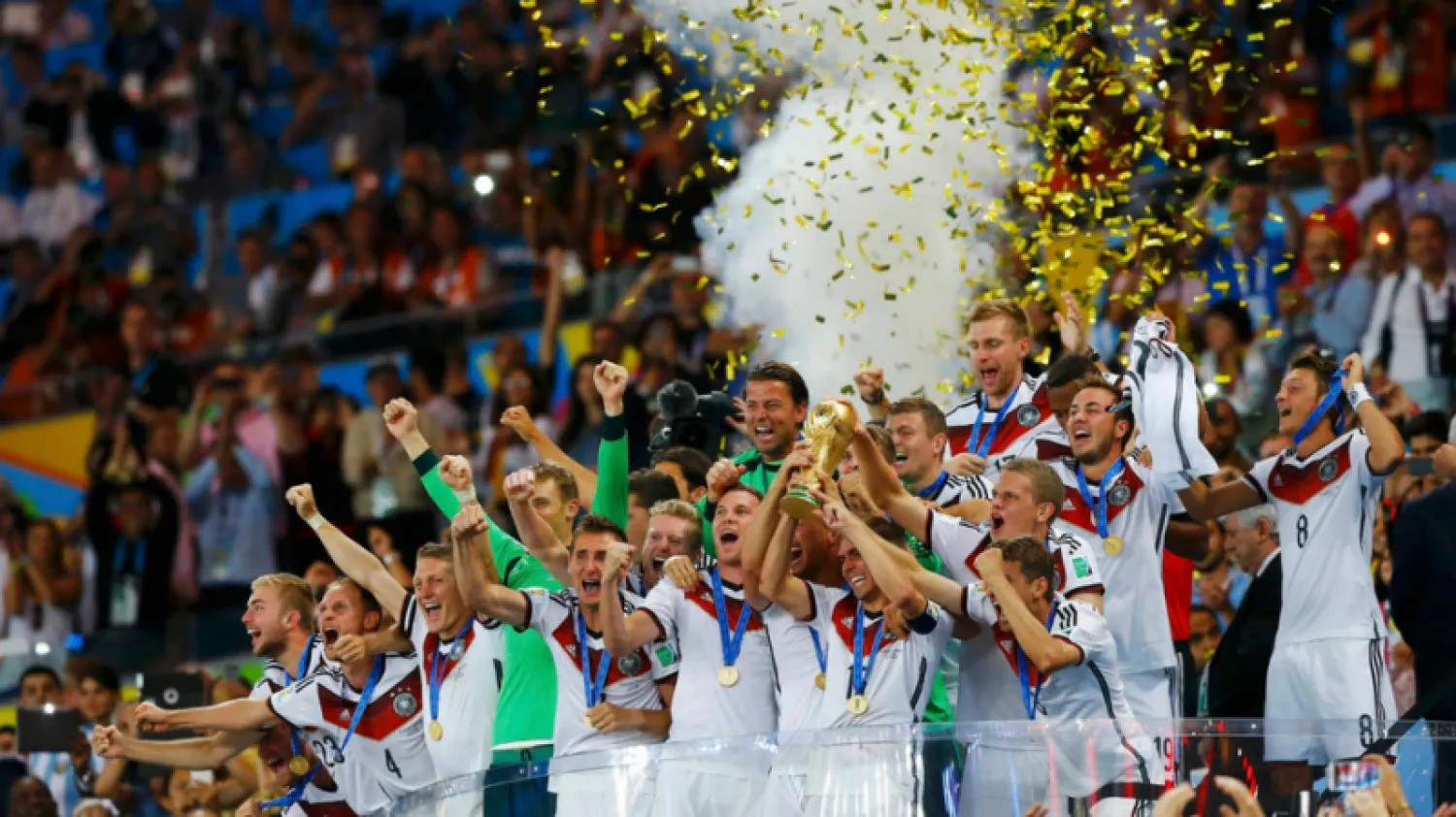
The German national team lifts the World Cup trophy after defeating Argentina in the 2014 final. (Reuters)
TT

A Radical Idea: Hold an Auction to Decide the World Cup Hosts to Stop Corruption

The German national team lifts the World Cup trophy after defeating Argentina in the 2014 final. (Reuters)

You can bet on anything these days. Crossfit. Portuguese futsal. Even ByuL versus Rogue in Starcraft II. Yet, curiously, finding odds about who will host the 2026 World Cup is nigh-on impossible – even though the vote between the Nafta bloc of the US, Canada and Mexico, and new kid on the block Morocco is only six weeks away.

One bookie told me he would be “asking to be picked off” if he offered prices, given the votes for mega-events such as the World Cups and Olympics. As he put it: “You only really get action from people who know something we don’t.”

Yet this time it is supposed to be different. Fifa has ripped up its rulebook following the fallout from awarding the 2018 and 2022 World Cup finals to Russia and Qatar respectively. It has promised greater scrutiny of bids, more transparency, and, most dramatically, changed voting rules so its 211 member associations will decide who hosts rather than two dozen senior executives.

The aim, according to a Fifa spokesman, is to “avoid a return to the secret and subjective decisions of the past”. Good luck with that. As the lack of bookies’ odds indicates, it’s hard to shake off the past. Look at the International Olympic Committee, which expanded its electorate after the Salt Lake City scandal – yet has been hit with investigations into vote-rigging when awarding the Rio and Tokyo Games.

Here is a radical suggestion. Give the World Cup – and the Olympics, for that matter – to the highest bidder.

Sure, it sounds crude. But it would at least be more honest. It recognizes that people are corruptible, and those with large enough wallets will always try to corrupt them. And so it stops it at a stroke. Why engage in backroom deals or bribes, for instance, when there is no advantage in doing so?

Think of the money that might be diverted into grassroots football and poorer nations. The Football Association lost £15m on England’s failed 2018 bid, as well as much of its dignity in cozying up to the likes of Jack Warner. Australia spent $40m of public money on its attempt to host in 2022. For what?

It would also stop political chicanery, too. Only last month US president, Donald Trump, sent a tweet that appeared close to breaching Fifa’s rules when he warned nations thinking of voting against the US/Canada/Mexico bid, saying: “It would be a shame if countries that we always support were to lobby against the US bid. Why should we be supporting these countries when they don’t support us [including at the United Nations]?”

However, Trump is far from alone. Before the 2018 World Cup vote, Russia’s President Vladimir Putin spent hours talking to Fifa delegates – and it probably was not about Moscow’s weather in June.

Of course rules would have to be put in place. Any bid would need to show it had the requisite stadia, security and infrastructure to host a World Cup. A country could not host the tournament more than once in a generation. And it would have to be seen as progressive on human rights and strong on anti-corruption. But once it passed those hurdles, it would be all systems go.

The worry, of course, is the World Cup would be tossed around the same four or five rich global powers. One idea to counter that would be to hold a lottery – rather than an auction – every fifth World Cup with the winner only having to pay a smaller fee, set in advance, to host the tournament.

Certainly David Forrest, an economist at the University of Liverpool, believes the benefits of an auction would negate the downsides. As he explains, in a sense there is already an auction for the World Cup and Olympics. It’s just that countries are spending millions on wooing potential voters – money that would be much better spent going straight into the sport if they win (and not spurned if they didn’t).

As he put it: “A transparent auction would see the money from the highest bid go to Fifa itself rather than to the pockets of Fifa’s voters, and it could be earmarked for supporting recreational football in poor countries. Some of it could be put into a reserve for subsidizing a less-developed nation to host the competition every fifth tournament.”

That is a battle for another day. For now, Fifa watchers are trying to decipher exactly what will happen when the vote finally takes place on June 13.

Some insist a shock Morocco win is now on the cards because Trump has alienated so many African nations by calling them “shithole countries”. Others whisper that some Fifa countries want to give the US a bloody nose in retaliation for the Department of Justice’s 2015 investigation into football-related corruption.

Yet it is easy to be seduced by the counterpoints – that Fifa president Gianni Infantino wants the World Cup back in the US because it could generate $5bn (£3.58bn) in economic activity, far higher than its rival, along with suggestions that Morocco’s bid still has to convince Fifa’s scrutineers to get into the vote.

Either way, vast sums have already been spent. Some of that, surely, could have been saved by simply holding an auction.

The Guardian Sport


Rodgers Takes Charge of Saudi Team Al-Qadsiah After Departure from Celtic 

Then-Celtic head coach Brendan Rodgers greets supporters after a Europa League soccer match between Red Star and Celtic at Rajko Mitic Stadium in Belgrade, Serbia, Sept. 24, 2025. (AP)
TT

Rodgers Takes Charge of Saudi Team Al-Qadsiah After Departure from Celtic 

Then-Celtic head coach Brendan Rodgers greets supporters after a Europa League soccer match between Red Star and Celtic at Rajko Mitic Stadium in Belgrade, Serbia, Sept. 24, 2025. (AP)

Brendan Rodgers has returned to football as the coach of Saudi Arabian club Al-Qadsiah, six weeks after resigning from Scottish champion Celtic.

Al-Qadsiah, whose squad includes Italian striker Mateo Retegui and former Real Madrid defender Fernandez Nacho, is in fifth place in the Saudi Pro League in its first season after promotion.

Rodgers departed Celtic on Oct. 27 and has opted to continue his managerial career outside Britain for the first time, having previously coached Liverpool, Leicester and Swansea.

In its statement announcing the hiring of Rodgers on Tuesday, Al-Qadsiah described him as a “world-renowned coach” and said his arrival “reflects the club’s ambitious vision and its rapidly growing sporting project.”

Aramco, the state-owned Saudi oil giant, bought Al-Qadsiah in 2023 in a move that has helped to transform the club’s status.

“This is a landmark moment for the club,” Al-Qadsiah chief executive James Bisgrove said. “The caliber of his experience and track record of winning reflects our ambition and long-term vision to establish Al-Qadsiah as one of Asia’s leading clubs.”

Rodgers is coming off winning back-to-back Scottish league titles with Celtic, where he won 11 major trophies across his two spells. He also won the FA Cup with Leicester.

Al-Qadsiah's last two coaches were former Liverpool striker Robbie Fowler and former Spain midfielder Michel.


Portugal to Return to F1 Calendar in 2027 and 2028 

12 July 2025, United Arab Emirates, Abu Dhabi: Red Bull driver Max Verstappen leads into turn one during the Abu Dhabi Grand Prix at the Yas Marina Circuit, Abu Dhabi. (dpa)
TT

Portugal to Return to F1 Calendar in 2027 and 2028 

12 July 2025, United Arab Emirates, Abu Dhabi: Red Bull driver Max Verstappen leads into turn one during the Abu Dhabi Grand Prix at the Yas Marina Circuit, Abu Dhabi. (dpa)

Formula One will return to Portugal's Portimao circuit in 2027 and 2028 after the Dutch Grand Prix at Zandvoort drops off the calendar.

Formula One announced a two-year deal in a statement on Tuesday.

The 4.6-km Algarve International circuit in the country's south last hosted the Portuguese Grand Prix in 2020 and 2021, both seasons impacted by the COVID-19 pandemic with stand-in venues.

In 2020, seven-times world champion Lewis Hamilton took his 92nd career win at Portimao, breaking the record previously held by Michael Schumacher. Hamilton also won in 2021.

"The interest and demand to host a Formula One Grand Prix is the highest that it has ever been," said Formula One chief executive Stefano Domenicali, thanking the Portuguese government and local authorities.

The financial terms of the deal were not announced.

"Hosting the Grand Prix in the Algarve reinforces our regional development strategy, enhancing the value of the territories and creating opportunities for local economies," said Economy Minister Manuel Castro Almeida.

Portugal first hosted a grand prix in Porto in 1958, with subsequent races at Monsanto and Estoril near Lisbon. The late Brazilian great Ayrton Senna took his first grand prix pole and win at the latter circuit in 1985.

Formula One announced last year that Zandvoort, a home race for four-times world champion Max Verstappen, would drop off the calendar after 2026.

The championship already features a record 24 races and Domenicali has spoken of European rounds alternating to allow others to come in.

Belgium's race at Spa-Francorchamps is due to be dropped in 2028 and 2030 as part of a contract extension to 2031 announced last January.


ATP to Introduce New Heat Policy from 2026 Season 

Novak Djokovic of Serbia cools himself with water during the men's singles semifinal match with Valentin Vacherot of Monaco, at the Shanghai Masters tennis tournament at Qizhong Forest Sports City Tennis Center, in Shanghai, China, Saturday, Oct. 11, 2025. (AP)
TT

ATP to Introduce New Heat Policy from 2026 Season 

Novak Djokovic of Serbia cools himself with water during the men's singles semifinal match with Valentin Vacherot of Monaco, at the Shanghai Masters tennis tournament at Qizhong Forest Sports City Tennis Center, in Shanghai, China, Saturday, Oct. 11, 2025. (AP)

The ATP Tour said it will introduce a new heat policy that will come into effect from 2026 after a string of retirements due to soaring temperatures and punishing humidity at the Shanghai Masters earlier this season.

The governing body of men's tennis said the rule, based on the internationally recognized Wet Bulb Globe Temperature (WBGT) index used to measure human heat stress in direct sunlight, had "clear thresholds" for cooling measures and suspension of play.

"The new heat rule provides a structured, medically supported approach to managing extreme heat, with the objective of safeguarding player health," the ATP said on Monday.

It added the rule would also improve conditions for fans, officials, ball persons and tournament staff.

If the WBGT reaches 30.1 C (86.18 F) or higher in the first two sets of a best-of-three-set singles match, a 10-minute cooling break after the second set can be requested by either player and will apply to both competitors.

During breaks, players can hydrate, change clothing, shower and receive coaching under the supervision of ATP medical staff, the governing body added. Play will be suspended when the WBGT goes past 32.2 C.

World number two Jannik Sinner's Shanghai title defense ended in agony in October when the Italian struggled to walk due to cramp in his right thigh before he retired in the deciding set of his third-round clash with Tallon Griekspoor.

At the same event, Novak Djokovic vomited during his encounter with Yannick Hanfmann while Holger Rune was heard asking an official during a medical timeout in his meeting with Ugo Humbert if players had to "die on court" amid the heat and humidity.

The need for a formal ATP heat rule had sprung up in August in Cincinnati when Arthur Rinderknech collapsed on court during a match in sweltering conditions, before handing Felix Auger-Aliassime the victory.

Previously, ATP regulations stated that decisions on the suspension of play due to adverse weather conditions - including extreme heat - lie with an onsite ATP supervisor who coordinates with medical teams at the venue as well as local authorities.

The new rule aligns the ATP with the WTA. The four Grand Slams have also formally implemented the rules that allow for extended breaks and match suspensions.

Several professional sports including football, Formula One and cycling have formal policies to deal with extreme weather.
