

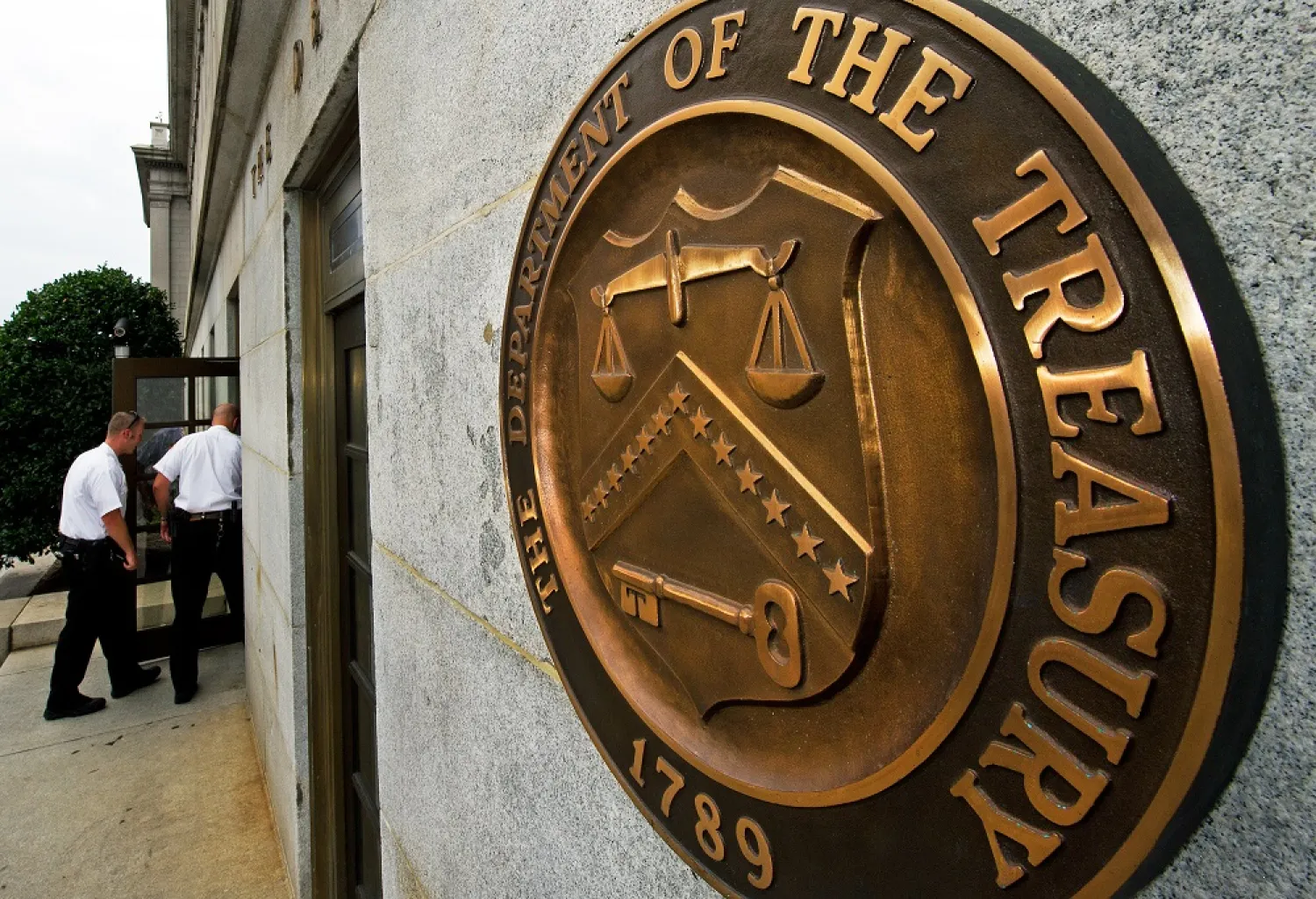

US Imposes Sanctions on Iran Central Bank Governor over Terror Links

The US imposed sanctions on Iran's central bank governor for his terrorism links. (AFP)
TT

US Imposes Sanctions on Iran Central Bank Governor over Terror Links

The US imposed sanctions on Iran's central bank governor for his terrorism links. (AFP)

The United States Treasury imposed sanctions on Tuesday on Valiollah Seif, the governor of the Central Bank of Iran. It accused him of helping the Iranian Revolutionary Guard Corps in transferring millions of dollars to Lebanon's “Hezbollah” group.

In the second move in a week taking aim at the money networks of the Revolutionary Guards, or IRGC, the US Treasury also blacklisted another senior official, Ali Tarzali, who works in the central bank's international division. It also targeted Iraq's Al-Bilad Islamic Bank and its top two executives, and a liaison between IRGC and “Hezbollah”, which Washington has designated an international terrorist group.

The Treasury said Seif covertly moved "hundreds of millions of dollars" to “Hezbollah” from the IRGC via Al-Bilad Islamic Bank.

The exact ramifications of the sanctions for Iran's economy were not immediately clear. The US said that the sanctions on Seif did not extend to Iran's central bank itself. Still, the US said it was imposing "secondary sanctions" on the Iranian bank officials, which could significantly increase Iran's isolation from the global financial system.

Typically, when the US punishes individuals with sanctions, it prohibits Americans or US companies from doing business with them. Secondary sanctions also apply to non-Americans and non-US companies. That means that anyone, in any country, who does business with Seif or Tarzali could themselves be punished with sanctions, cutting them off from the US financial system.

"The United States will not permit Iran's increasingly brazen abuse of the international financial system," said US Treasury Secretary Steven Mnuchin.

"The global community must remain vigilant against Iran's deceptive efforts to provide financial support to its terrorist proxies."

The Treasury said that Seif undermined the central bank's credibility by routing millions of dollars from the Quds Force, the expeditionary unit of Iran's hardline Revolutionary Guards, to al-Bilad Islamic Bank. Those funds were then used to "enrich and support the violent and radical agenda of ‘Hezbollah’," Treasury said.

Al-Bilad Islamic Bank and its CEO and chairman, Aras Habib, were also hit with US sanctions, as was Muhammad Qasir, who the Treasury said is a “Hezbollah” official who has been a "critical conduit" for transferring funds to “Hezbollah” from the Revolutionary Guards.

Tuesday's action seeks to cut off what the US called a "critical" banking network for Iran and deny those blacklisted access to the global financial system.

On Thursday, the Treasury announced sanctions against a "large scale" currency exchange network serving the Revolutionary Guards, hitting six individuals and three companies at the center of the network.

At the time, the US singled out the Central Bank of Iran as "complicit" in the operation, foreshadowing Tuesday's action.

The move against Seif came one week after President Donald Trump withdrew from the Iran nuclear accord and signaled plans to ratchet up pressure on the Iranian economy, and especially on the economic power of the Revolutionary Guards.



Trump Postpones Signing Order on AI Oversight

US President Donald Trump speaks during an event with Environmental Protection Agency Administrator Lee Zeldin in the Oval Office at the White House in Washington, DC, USA, 21 May 2026. EPA/AL DRAGO / POOL NEWS SERVICE OK
TT

Trump Postpones Signing Order on AI Oversight

US President Donald Trump speaks during an event with Environmental Protection Agency Administrator Lee Zeldin in the Oval Office at the White House in Washington, DC, USA, 21 May 2026. EPA/AL DRAGO / POOL NEWS SERVICE OK

US President Donald Trump on Thursday said he had postponed signing an executive order on AI because he "didn't like certain aspects of it."

Trump had planned to sign the order at a ceremony on Thursday afternoon attended by CEOs of AI companies.

The order would create a voluntary framework for AI developers to ⁠engage with the ⁠US government before the public release of covered models, two sources told Reuters on Wednesday.

The president also had planned to direct the US government to use the advanced models to improve the cybersecurity defenses of ⁠government systems, along with networks owned by sectors that are vital to the nation's economy, such as banks and hospitals, according to another source.

Concerns are growing across the US government and in the private sector about the cybersecurity risks posed by powerful new AI systems, including Anthropic’s Mythos.

Anthropic has warned that Mythos could supercharge complex cyberattacks, though cybersecurity experts ⁠told ⁠Reuters that fears of unfettered hacking are overstated.

The president's executive order, if implemented, could hurt the industry's profits if it slows the rollout of new models or prompts companies to change how they perform to address security concerns.

Trump, who spoke to reporters on Thursday in the Oval Office, did not say which parts of the order he didn't like.


Teen Among 3 Dead in Türkiye after Floods, Landslides Hit Southern Province

FILE - A Navy officer helps a woman cross a flooded street after heavy rain in Poza Rica, Veracruz state, Mexico, Oct. 12, 2025. (AP Photo/Felix Marquez, File)
TT

Teen Among 3 Dead in Türkiye after Floods, Landslides Hit Southern Province

FILE - A Navy officer helps a woman cross a flooded street after heavy rain in Poza Rica, Veracruz state, Mexico, Oct. 12, 2025. (AP Photo/Felix Marquez, File)

Three people have died during flooding in southern Türkiye on Thursday, officials said, as the Interior Ministry issued weather warnings for 15 of the country's 81 provinces.

Heavy rainfall in Hatay, the province most affected by a devastating earthquake in 2023, caused the Asi river, also known as the Orontes, to break its banks, submerging fields and villages. Roads and bridges were also washed away, The Associated Press reported.

Among the victims was a 15-year-old boy who died in a house that collapsed during a landslide in Antakya, the provincial capital, Hatay Gov. Mustafa Masatli said.

A 66-year-old man died when his car rolled into a ditch in Defne, while and another man, aged 62, was swept away in floodwaters in the Samandag district.

Masatli said the flooding had caused significant damage to agriculture across 2,900 hectares (7,166 acres) as disaster teams continued to assess the impact. Firefighters rescued many people by boat as residents bailed out their homes and tried to hold the waters at bay with makeshift barriers.


Sweden Sentences Teen over Plot to Kill Iranian Researcher

Swedish police are on the scene after a shooting during Friday prayers outside a mosque in Orebro, Sweden - File photo/EPA
TT

Sweden Sentences Teen over Plot to Kill Iranian Researcher

Swedish police are on the scene after a shooting during Friday prayers outside a mosque in Orebro, Sweden - File photo/EPA

A teenager who turned up on the doorstep of an Iranian researcher in southern Sweden armed with a knife was sentenced Thursday to almost four years in a young offenders institution.

The teenager was convicted along with two others of a plot to kill Arvin Khoshnood, a high-profile academic who maintains that the Iranian government was ultimately behind the attack.

The youngster was recruited through messaging apps by the other defendants and promised a payment to kill Khoshnood.

He showed up at Khoshnood's house in the city of Malmo in September last year and spoke to the researcher's wife.

The researcher stayed inside and called the police. He has since been living in hiding at another address, his lawyer told AFP during the trial.

"The court considers it established that A.N. armed himself with a knife and went to the victim's home with the intention of killing him," the Uddevalla court wrote in its ruling.

The court found there was not enough evidence for a charge of attempted murder and reclassified the offence as preparatory acts to commit murder.

The main defendant was handed three years and nine months in a juvenile detention center.

Khoshnood regularly appears in Swedish media as an expert on Iran.

On social media, he supports Reza Pahlavi, the son of the last Shah, who lives in exile in the United States and leads one of many opposition movements based abroad.