


Hezbollah Shifts Fight to Counter Israeli Expansion Attempts

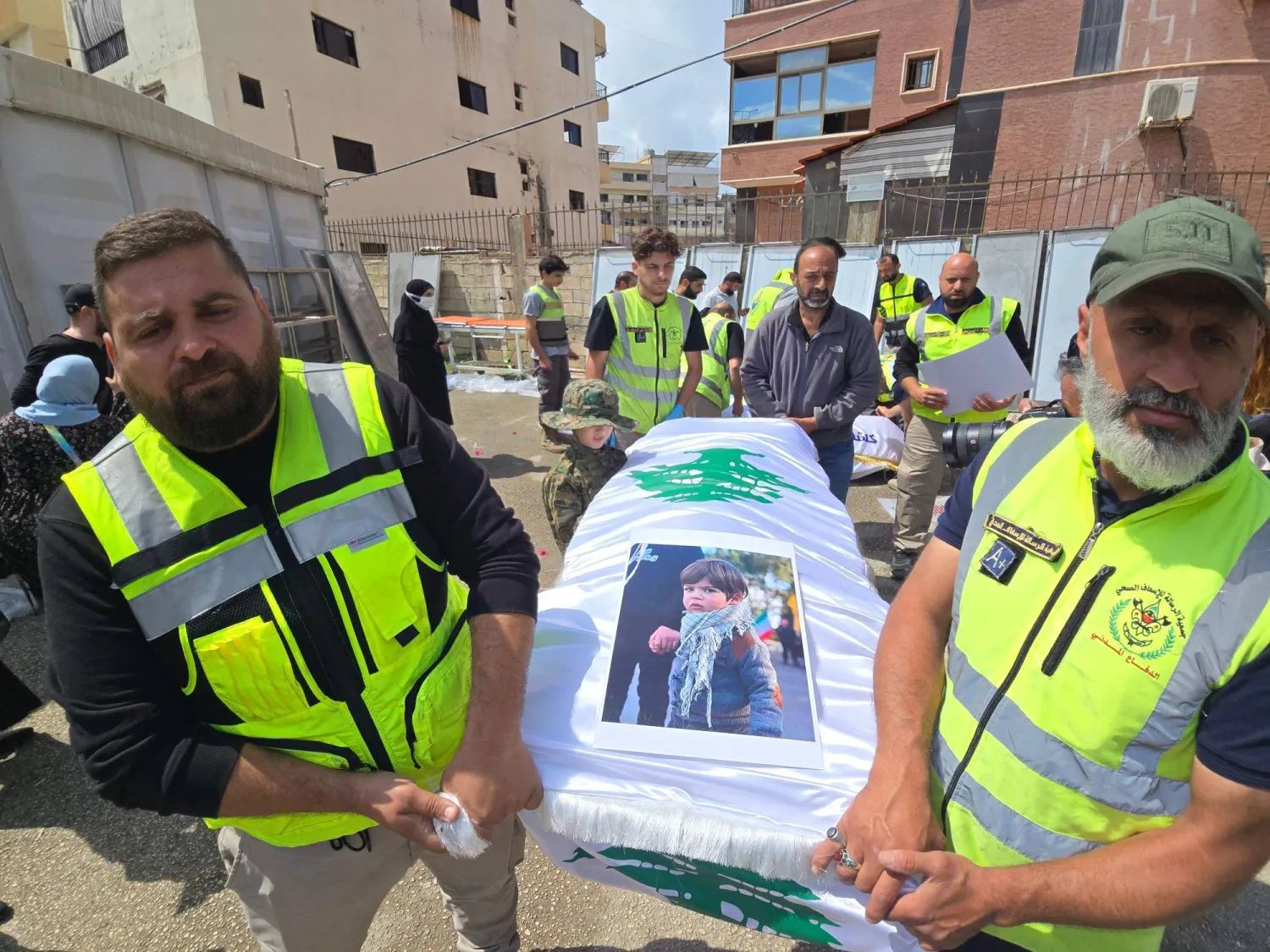
Officials carry the bodies of victims killed in the Israeli strike on the southern village of Deir Qanoun al-Nahr, outside Jabal Amel Hospital in the Tyre area of south Lebanon, before the bodies were transferred to their hometown for burial, as security conditions prevented families from holding the farewell ceremony in the village, on May 21, 2026. (Photo by KAWANT HAJU / AFP)
TT

Hezbollah Shifts Fight to Counter Israeli Expansion Attempts

Officials carry the bodies of victims killed in the Israeli strike on the southern village of Deir Qanoun al-Nahr, outside Jabal Amel Hospital in the Tyre area of south Lebanon, before the bodies were transferred to their hometown for burial, as security conditions prevented families from holding the farewell ceremony in the village, on May 21, 2026. (Photo by KAWANT HAJU / AFP)

Hezbollah sent a message to Arab and other embassies in Lebanon on Thursday, setting out its demands to their governments: an end to assassinations, the withdrawal of Israeli forces from Lebanese territory, the return of residents to their villages, and the release of detainees held by Israel.

It said the issue of its weapons should be addressed through “internal dialogue.”

The move came as military operations continued in south Lebanon, including an explosion in one village on the third line from the Israeli border, while Hezbollah focused on countering what it sees as Israeli attempts to expand deeper into Lebanese territory.

Hezbollah is trying to prevent any further Israeli advance in south Lebanon aimed at tightening control over villages within or around the “yellow line.” Security sources in the south told Asharq Al-Awsat the group’s pressure is concentrated on likely points of new incursions, especially around Zawtar in the eastern sector on the Litani River bank.

They said Israeli forces were trying to push through those vulnerable areas toward Lebanon’s interior, whether in Zawtar or Hadatha.

Israeli forces advanced on Wednesday into the eastern neighborhood of Hadatha, a town on the third line of border villages. Hezbollah said it had confronted the advance from several directions.

Local sources said later on Wednesday that Israeli forces carried out an explosion in the eastern neighborhood, alongside heavy air and artillery strikes on the town.

The advance began from Rshaf, a town on the second line of border villages. Rshaf is adjacent to Debel, a Christian town, many of whose residents have been displaced to the Christian towns of Rmeish and Ain Ebel, while others fled to areas deeper inside Lebanon during the third week of the expanded war.

Security sources in South Lebanon said Hezbollah intensified its operations in the area to prevent Israeli forces from entering Hadatha and seizing it.

They said the group had “concentrated its military weight in that area, in the face of an Israeli military weight focused on the same area to advance inland.”

The intensity was reflected in Hezbollah statements announcing rocket salvos and suicide drone attacks on gatherings of Israeli army vehicles and soldiers in Debel and Rshaf, as well as attacks around Hadatha “with attack drones and heavy rocket salvos in repeated waves.”

On the Israeli side, the Hebrew website Walla reported that Colonel Meir Biderman, commander of the 401st Brigade, was wounded in a Hezbollah attack in Debel.

It quoted a military source as saying Biderman “entered a building in south Lebanon that was known to be protected in order to sleep there, then came under attack by a drone.”

The source said the brigade commander was seriously wounded when the drone exploded.
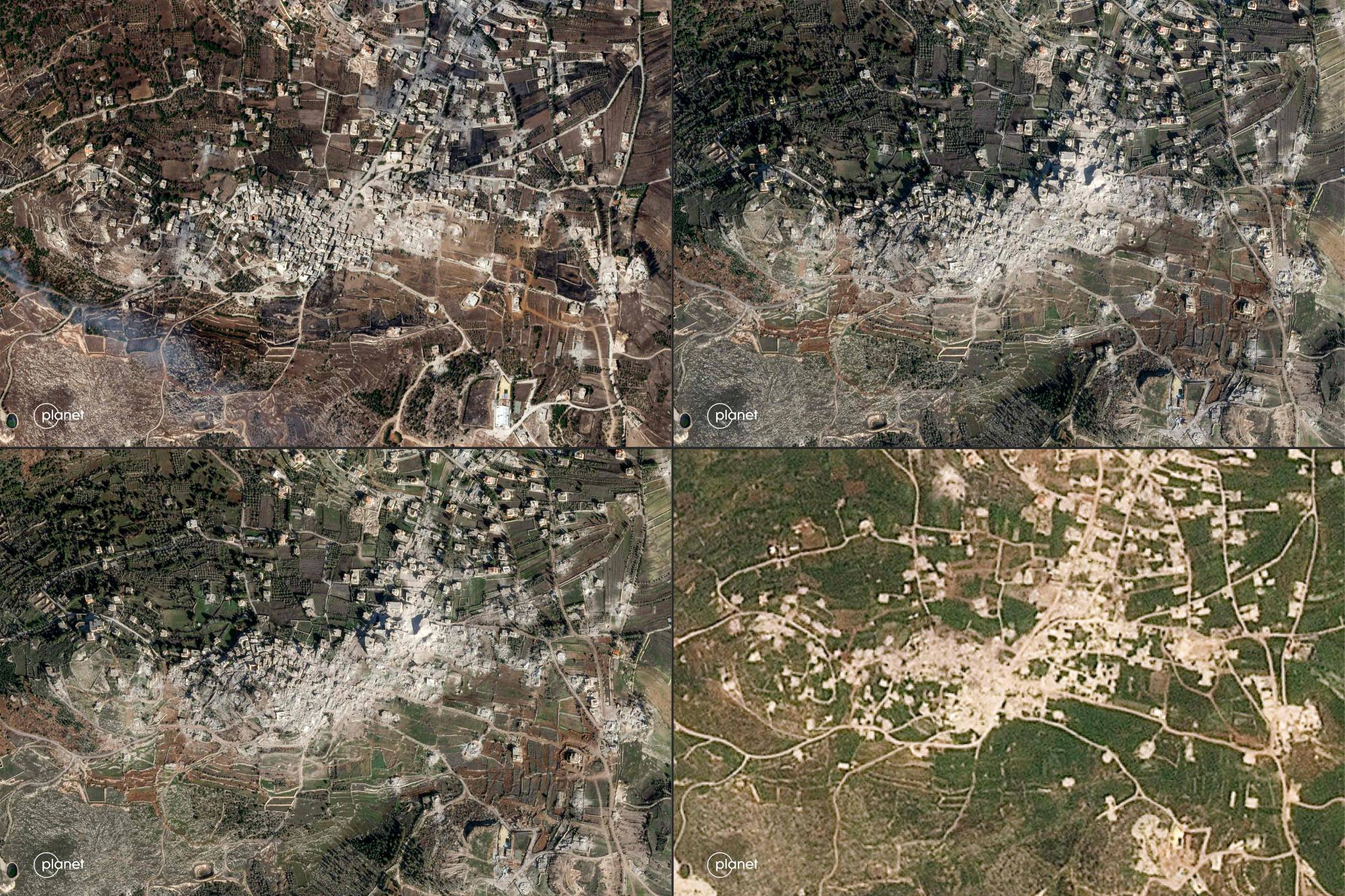
(COMBO) This combination of handout satellite images taken by Planet Labs PBC shows views of the village of Yaroun in southern Lebanon close to the border with Israel on (top L to R followed by bottom L to R) October 5, 2024; January 10, 2025; January 30, 2025; and on May 2, 2026. (Photo by 2026 Planet Labs PBC / AFP)

3,089 killed

Air and artillery strikes continued inside Lebanon. The Health Ministry said 3,089 people had been killed and 9,397 wounded from March 2 to May 21.

The escalation also continued on the ground. An Israeli drone struck a motorcycle in Froun, killing its driver. Artillery fire hit Kfar Dounin, Baraachit, Mansouri, Beit Yahoun and Touline. Israeli warplanes struck Ghandouriyeh.

Israeli warplanes also raided the outskirts of Touline and the road between Toura and Jennata in the Tyre district.

An Israeli drone dropped sound bombs near farmers in Haniyeh, south of Tyre, without causing casualties.
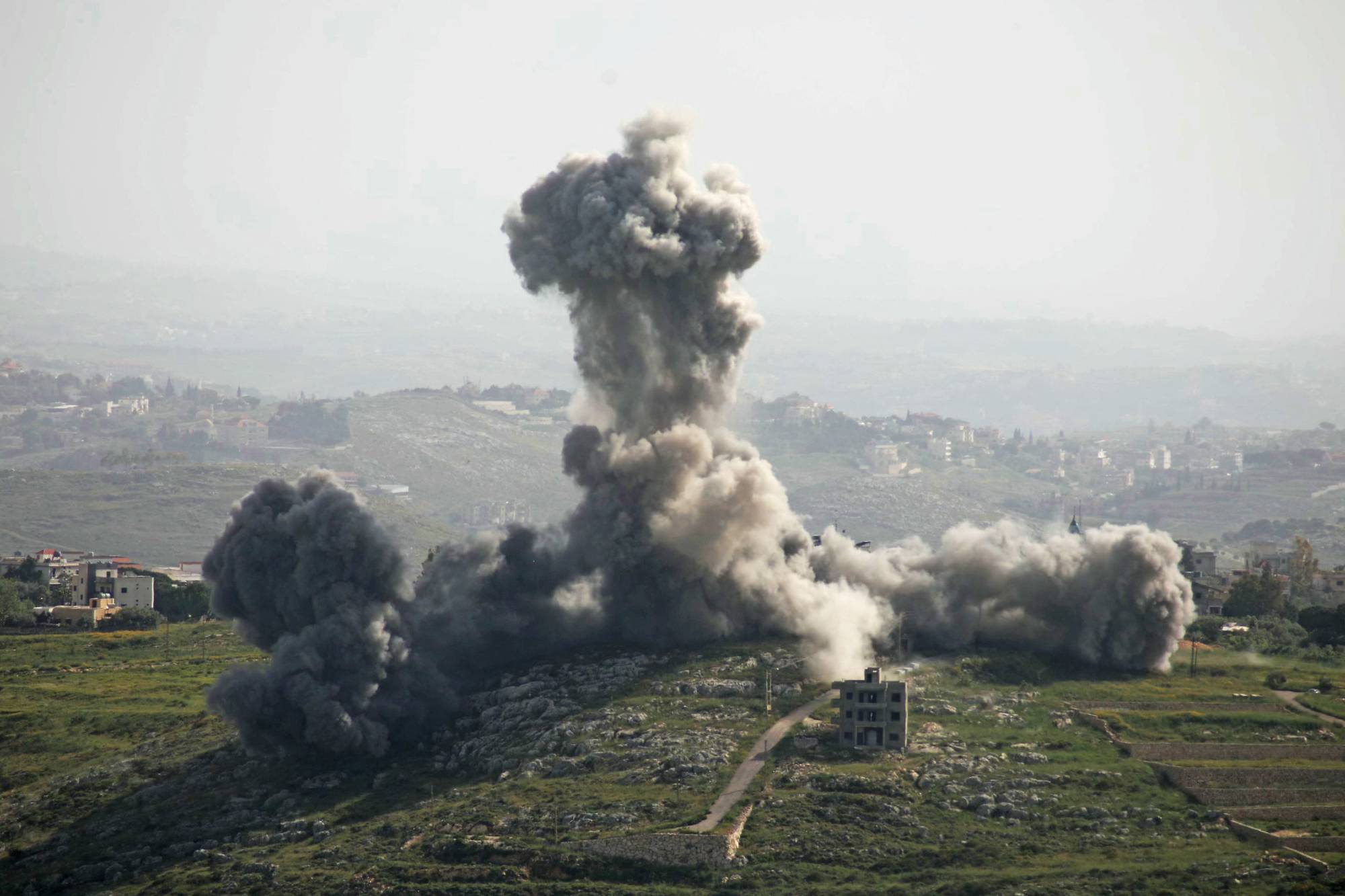
Smoke rises from the site of an Israeli airstrike that targeted the southern Lebanese village of Deir El Zahrani on May 13, 2026. (Photo by Kawnat HAJU / AFP)

Hezbollah turns to Western and Arab states

Against that backdrop, Hezbollah, through its parliamentary Loyalty to the Resistance bloc, turned to foreign and Arab diplomatic missions in Beirut. The message addressed governments on the situation in the south and sought to justify the fighting there.

In a memo explaining the field situation during the 15 months before it joined Iran’s support war, the bloc said political and diplomatic efforts “did not lead to a halt to these Israeli crimes against our country.”

It said the Lebanese government had failed to compel “the occupying entity” and the sponsors of the agreement to implement it, while the committee tasked with applying the agreement, “the mechanism,” had deliberately failed to do its job, worsening the suffering of the Lebanese people.

The bloc said: “Our demand as Lebanese, and the demand of everyone keen on the sovereignty, independence and freedom of their country, is to stop all forms of aggression against our national sovereignty by air, land and sea, to halt hostile actions, including the assassination of citizens and the targeting of civilian infrastructure, homes and public and private institutions, the withdrawal of the Israeli enemy army from our land to the internationally recognized borders, the return of residents to their villages and their reconstruction, and the release of detainees from occupation prisons.”

It added: “As for other issues linked to protecting Lebanon, they are a Lebanese matter that can be addressed through internal dialogue leading to the completion of a national security strategy to which all Lebanese commit,” a reference to Hezbollah’s disarmament.



Drone Strike on Central Sudan Market Kills 11

FILE - This grab from video shows smoke rising over Khartoum, Sudan, Sept. 26, 2024, after Sudan's military started an operation to take areas of the capital from its rival, the paramilitary Rapid Support Forces. (AP Photo/Rashed Ahmed, File)
TT

Drone Strike on Central Sudan Market Kills 11

FILE - This grab from video shows smoke rising over Khartoum, Sudan, Sept. 26, 2024, after Sudan's military started an operation to take areas of the capital from its rival, the paramilitary Rapid Support Forces. (AP Photo/Rashed Ahmed, File)

A drone strike hit a market in central Sudan on Saturday, killing 11 civilians and wounding dozens more, a rights group said, as escalating aerial attacks deepen the toll of one of the world's worst humanitarian crises.

The attack targeted the main market in Abu Zaeima, a paramilitary-controlled town in North Kordofan state, according to the Emergency Lawyers, a rights group that has documented abuses since fighting erupted in April 2023 between the army and the paramilitary Rapid Support Forces (RSF).

The group said the casualty figures could rise but did not specify who carried out the attack. Neither side has commented.

Emergency Lawyers said similar drone attacks had struck nearby villages and civilian vehicles less than a day earlier.

Two witnesses told AFP that another drone hit a fuel station later on Saturday in El-Obeid, the capital of North Kordofan, which has been partially encircled by RSF forces for months.

A medical source at a hospital there said the facility received four wounded civilians.

The attacks followed a deadly week in the broader Kordofan region.

Nearly 70 people were killed in two separate drone strikes in West and North Kordofan states, according to Emergency Lawyers and a local leader.

Drone warfare has become an increasingly prominent feature of Sudan's conflict. The UN says that between January and April, at least 880 civilians were killed in drone strikes nationwide.

Fighting has intensified in Kordofan and Blue Nile state near the Ethiopian border since the RSF captured El-Fasher last October, the military's last major stronghold in western Darfur.

Since then, more than 300,000 people have fled frontline areas, including El-Fasher and parts of Kordofan and Blue Nile, according to the UN.

Kordofan, rich in oil and arable land, is strategically significant, linking RSF strongholds in the neighboring Darfur region to the country's army-controlled east. The region remains largely contested between the army and the RSF.

Having entered its fourth year, the war has killed tens of thousands of people and forced more than 11 million from their homes, creating what the UN describes as the world's largest displacement and hunger crises.


Facing Settler Violence, Palestinian Farmers Race to Harvest

Palestinians are rushing to gather in their crops against a backdrop of violence from Israeli settlers. Zain JAAFAR / AFP
TT

Facing Settler Violence, Palestinian Farmers Race to Harvest

Palestinians are rushing to gather in their crops against a backdrop of violence from Israeli settlers. Zain JAAFAR / AFP

With pitchforks and a makeshift combine the size of a golf cart, Hamad Jazi and his nephews race under the blazing sun to collect wheat from their West Bank field.

Israeli settlers have recently set fire to crops in the area, and Jazi fears his wheat could suffer a similar fate.

Their village of As-Sawiyah, in the center of the occupied West Bank, sits in a valley dominated by hills on top of which three settlements stand.

"The settlers have set fires twice already -- yesterday and the day before," Jazi told AFP.

"If you think back 10, 15 or 20 years ago, this season used to be a season of abundance. Today, you are racing against time just to harvest quickly and leave," he added.

Excluding east Jerusalem, more than 500,000 Israelis live in the occupied West Bank in settlements that are illegal under international law, among some three million Palestinians.

Israel has occupied the West Bank since 1967.

Shielded by what rights groups describe as impunity from the law, some settlers have harassed rural Palestinian communities, vandalizing property and crops, committing arson and sometimes killing.

By all metrics, 2026 has been one of the most violent years to date, with an average of six attacks per day, according to data from UN humanitarian agency OCHA.

The surge in violence goes hand in hand with the proliferation of settlements in the West Bank, which part of the Israeli political class is threatening to annex.

Settlers in rural areas vandalize property and start fires, at times sowing terror in villages, as shown in videos posted on social media, sometimes by the perpetrators themselves.

The attacks have sparked criticism inside Israel, where the opposition accuses Prime Minister Benjamin Netanyahu's government and his far-right allies of turning a blind eye to acts of settler violence.

According to Mahmud Fatafta of the Palestinian Authority's agriculture ministry, settlers killed or stole 8,000 goats or sheep in the West Bank in 2026.

According to his ministry's data, 41,000 olive trees, a crop as emblematic to Palestinians as it is ubiquitous in the West Bank's rocky hills, were damaged by settlers or Israel's military in 2026.

- 'Steal our own crops' -

"In the past, when we went out into the fields, the olive harvest was a celebration; the grain harvest was a celebration," Jazi, his face worn by the sun, told AFP.

Now, "we live those moments like thieves. We go and 'steal' our own olives or our own crops", he said, complaining that the Israeli military requires him to coordinate with it before entering his fields.

Hikmat Abu Ras, head of As-Sawiya's village council, told AFP that his and neighboring communities have faced near daily attacks from settlers since the start of the war in Gaza in October 2023.

"They constantly carry out these practices in order to drive us off our land and prevent us from entering it," he said.

Abu Ras lamented increasing movement restrictions that further isolate communities like his.

"Gates block the entrances to villages, camps, and cities. Movement is restricted. You race against time just to make sure the settler does not come and seize what is on your land."


Egyptian Official to Asharq Al-Awsat: Syria Nominates New Ambassador Instead of Al-Ahmad, Approval Under Way

Egyptian Foreign Minister and his Syrian counterpart during a previous meeting in Cairo. (Egyptian Foreign Ministry)
TT

Egyptian Official to Asharq Al-Awsat: Syria Nominates New Ambassador Instead of Al-Ahmad, Approval Under Way

Egyptian Foreign Minister and his Syrian counterpart during a previous meeting in Cairo. (Egyptian Foreign Ministry)

The crisis surrounding Syria's nomination of Mohammad Taha Al-Ahmad as its ambassador to Egypt, first revealed in an Asharq Al-Awsat report published on June 1, appears to be heading toward a resolution. An Egyptian official source told Asharq Al-Awsat that Cairo has received the name of a new nominee from the Syrian side and is in the process of approving him.

Asharq Al-Awsat previously published a widely discussed report on what it described as "Egyptian reservations" that had delayed Cairo's acceptance of several members of the Syrian diplomatic mission. At the time, an informed source told Asharq Al-Awsat that there were objections to some members of the delegation, including Egypt's refusal to approve Syria's nominee for ambassador to Cairo.

The source explained in the June 1 report that the Syrian government had formally nominated Mohammad Taha Al-Ahmad as ambassador to Egypt. While the Egyptian government did not explicitly reject the nomination, it conveyed unofficial messages indicating that it did not consider him an acceptable candidate because of his political background.

Mohammad Taha Al-Ahmad currently serves as director of the Arab Affairs Department at Syria's Ministry of Foreign Affairs and Expatriates. He earned a bachelor's degree in agricultural engineering from the University of Aleppo in 2007, a master's degree in the financial and economic evaluation of agricultural projects from Cairo University in 2012, and a doctorate in agricultural development from the University of Idlib in 2020.

He held several ministerial positions in the Syrian Salvation Government before being appointed to his current position at the Foreign Ministry in May 2025. The following month, he was appointed head of the People's Assembly election committee.

The Syrian foreign minister during talks in Cairo last month. (Egyptian Foreign Ministry)

Another Nominee

An Egyptian official source told Asharq Al-Awsat that "the Syrian government has submitted another nominee to head the Syrian diplomatic mission in Cairo," noting that "the process is moving toward approval of the new nominee by the Egyptian authorities."

The source said that "matters are proceeding normally and positively with the Syrian side," without disclosing the nominee's identity.

Since the fall of Bashar Al-Assad, Egyptian-Syrian relations have been marked by cautious bilateral engagement, driven by Cairo's concerns over the issue of armed groups, before gradually shifting toward economic cooperation.

In late April, Egyptian President Abdel Fattah El-Sisi met Syrian President Ahmed Al-Sharaa on the sidelines of the Arab-European Consultative Summit in Cyprus. Media outlets in both Cairo and Damascus reported at the time that the two presidents held a "cordial discussion" on regional developments and ways to strengthen cooperation.

While the Egyptian source declined to reveal the name of the new nominee to head Syria's diplomatic mission in Cairo, Firas Al-Khalidi, coordinator of the Cairo Platform, a member of Syria's Constitutional Committee and a member of the Syrian Negotiations Commission, said that "the Syrian side has nominated Yahya Diab, a former diplomat who defected from Bashar Al-Assad's regime, as ambassador to Cairo."

Al-Khalidi told Asharq Al-Awsat that "the Egyptian side has accepted Diab's nomination to head the Syrian mission in Cairo."

The crisis over Syria's ambassadorial nomination to Cairo appears to be heading toward a resolution. (Egyptian Foreign Ministry)

Cautious Relations

Former Egyptian assistant foreign minister Ambassador Hussein Haridy said that "the Egyptian government has the right to reject any nominee to head a diplomatic mission, or any other diplomat, if it possesses information indicating that the nominee engaged in activities affecting its national security."

Haridy told Asharq Al-Awsat that "the Syrian side publicly announced Mohammad Taha Al-Ahmad's nomination to the embassy in Cairo before obtaining Egypt's approval," describing the move as contrary to established diplomatic practice.

In Haridy's view, "relations between Cairo and Damascus will remain cautious given the background of the current Syrian government."

He said that "the Egyptian side distinguishes between the historic people-to-people relationship between the two countries and its channels of communication with Syria's current government. There remain areas for cooperation between Cairo and Damascus, particularly at the economic level."

In January, Damascus hosted the first Egyptian-Syrian Economic and Investment Forum, with the participation of 26 leaders from Egyptian chambers of commerce and business organizations. The event aimed to build effective partnerships between the two countries' commercial chambers and explore opportunities for cooperation in trade, industry, services, infrastructure and reconstruction.

At the time, the Federation of Egyptian Chambers of Commerce said that the forum sought to create Syrian-Egyptian-European alliances through the Union of Mediterranean Chambers and to promote Syrian exports to Africa through the Federation of African Chambers.