

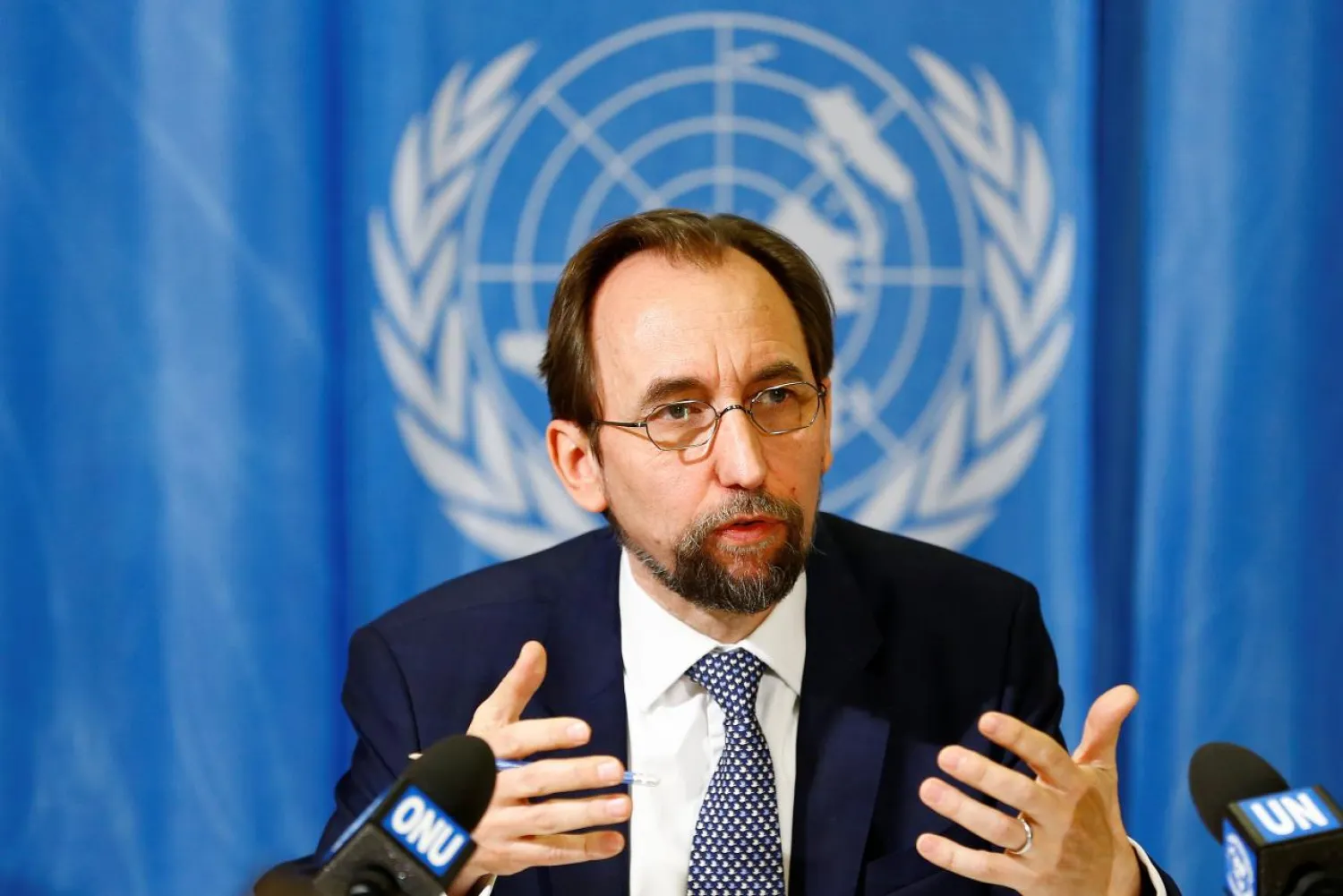

UN's Zeid Slams Israel's 'Wholly Disproportionate' Gaza Response

United Nations High Commissioner for Human Rights Zeid Ra'ad al-Hussein of Jordan speaks during a news conference at the United Nations European headquarters in Geneva, Switzerland, May 1, 2017. REUTERS/Pierre Albouy
TT

UN's Zeid Slams Israel's 'Wholly Disproportionate' Gaza Response

United Nations High Commissioner for Human Rights Zeid Ra'ad al-Hussein of Jordan speaks during a news conference at the United Nations European headquarters in Geneva, Switzerland, May 1, 2017. REUTERS/Pierre Albouy

The UN human rights chief lambasted on Friday Israel's deadly reaction to protests along the Gaza border as "wholly disproportionate", backing calls for an international investigation.

Addressing a special session of the UN Human Rights Council on the violence which has claimed more than 100 Gazan lives in six weeks, Zeid Ra'ad Al Hussein warned that "killing resulting from the unlawful use of force by an occupying power may also constitute willful killings, a grave breach of the Fourth Geneva Convention".

Violations of the Geneva Conventions adopted in 1949 following World War II are commonly called "war crimes" although Zeid did not explicitly use that word.

He pointed out though that while 60 Palestinians were killed and thousands injured in a single day of protests that coincided with Monday's move of the US embassy from Tel Aviv to Jerusalem, "on the Israeli side, one soldier was reportedly wounded, slightly, by a stone."

"The stark contrast in casualties on both sides is ... suggestive of a wholly disproportionate response," he told the council.

“Nobody has been made safer by the horrific events of the past week,” he said. “End the occupation, and the violence and insecurity will largely disappear.”

Israel has systematically deprived Palestinians of their human rights, with 1.9 million in Gaza “caged in a toxic slum from birth to death”, he exclaimed.

The special UN session comes after six weeks of mass protests and clashes along the Gaza border with Palestinian refugees demanding the right to return to their homes inside what is now Israel.

Israel has justified its actions, arguing it was necessary to stop mass infiltration from the blockaded Palestinian enclave which is run by the Hamas movement.

The council is due to consider a draft resolution calling for the urgent dispatch of "an independent, international commission of inquiry" -- the UN rights council's highest-level of investigation.

The draft resolution, which was presented by Pakistan on behalf of the Organization of Islamic Cooperation and backed by 47 UN member states, said investigators should probe "all violations of international humanitarian law and international human rights law ... in the context of the military assaults on large-scale civilian protests that began on 30 March 2018".

It said the aim should be to "establish the facts and circumstances" around "alleged violations and abuses including those that may amount to war crimes and to identify those responsible".

ISRAEL, US CRITICIZE UN

Zeid said he supported the call for an investigation "that is international, independent and impartial, in the hope the truth regarding these matters will lead to justice."

Israeli ambassador to the UN in Geneva, Aviva Raz Shechter, meanwhile slammed the special session Friday, saying it was "politically motivated and won’t improve the situation on the ground by even one iota."

"The unfortunate outcome of Monday's riots can only be attributed to Hamas's cynical exploitation of its own population, in a violent campaign against Israel," she said.

US representative Theodore Allegra also charged that the UN session was "blatantly taking sides” and disregarding the reason behind the recent violence.

But Zeid insisted that many of those injured and killed on Monday "were completely unarmed, (and) were shot in the back, in the chest, in the head and limbs with live ammunition," he said, saying there was "little evidence of any (Israeli) attempt to minimize casualties."

He said, "some of the demonstrators threw Molotov cocktails, used slingshots to throw stones, flew burning kites into Israel and attempted to use wire-cutters against the two fences between Gaza and Israel."

But he added: "these actions alone do not appear to constitute the imminent threat to life or deadly injury which could justify the use of lethal force."



Lebanese Army Says Soldier Killed in Israeli Attack in Southern Lebanon

A Lebanese army soldier inspects the site of an Israeli airstrike that targeted their checkpoint in Aamriyeh, south of the coastal city of Tyre, on March 30, 2026. (Photo by KAWNAT HAJU / AFP)
TT

Lebanese Army Says Soldier Killed in Israeli Attack in Southern Lebanon

A Lebanese army soldier inspects the site of an Israeli airstrike that targeted their checkpoint in Aamriyeh, south of the coastal city of Tyre, on March 30, 2026. (Photo by KAWNAT HAJU / AFP)

The Lebanese army said on Sunday that a soldier had been killed in an Israeli strike on southern Lebanon.

Meanwhile, an Israeli strike hit south Beirut on Sunday, Lebanese state media reported, with a medical source telling AFP it made impact about 100 metres away from a public hospital.

The strike hit Beirut's Jnah neighborhood near Rafik Hariri University Hospital, the largest public medical facility in the country.

Israel's military earlier warned it was carrying out strikes on Beirut.


Israeli Fire Kills Four Palestinians in Gaza, Medics Say

Palestinians inspect a vehicle targeted by an Israeli strike in Maghazi camp for Palestinian refugees in the central Gaza Strip on April 4, 2026. (AFP)
TT

Israeli Fire Kills Four Palestinians in Gaza, Medics Say

Palestinians inspect a vehicle targeted by an Israeli strike in Maghazi camp for Palestinian refugees in the central Gaza Strip on April 4, 2026. (AFP)

An Israeli airstrike ‌killed four Palestinians in the northern Gaza Strip on Sunday, local health authorities said, in the latest violence to overshadow a fragile ceasefire amid a new push by mediators to bolster the agreement.

Medics said the airstrike targeted a group of people in Jaffa Street, near the Darraj neighborhood in Gaza City, killing four people and wounding others.

The Israeli military did not immediately comment on ‌the incident.

Palestinian ‌group Hamas and Israel have ‌traded blame ⁠for violations of ⁠the ceasefire agreed last October, which halted two years of full-blown war.

The Gaza health ministry says Israeli fire has killed at least 700 people since the ceasefire began. Israel says four soldiers have been killed by gunmen in Gaza ⁠over the same period.

A Hamas delegation met ‌Egyptian, Qatari and ‌Turkish mediators in Cairo last week to give its initial ‌response to a disarmament proposal presented to the ‌group last month, two Egyptian sources and a Palestinian official said.

The group has told mediators it will not discuss giving up arms without guarantees that Israel ‌will fully quit Gaza as laid out in a disarmament plan from ⁠US President ⁠Donald Trump's "Board of Peace", three sources told Reuters on Thursday.

Hamas' disarmament is a sticking point in talks to implement Trump's plan for the Palestinian enclave and cement the ceasefire.

Hamas' October 7, 2023, attacks on Israel killed 1,200 people, according to Israeli tallies.

Israel's ensuing two-year campaign killed more than 72,000 Palestinians, most of them civilians, according to Gazan health authorities, and has spread famine, demolished most buildings, and displaced most of the territory's population, in many cases numerous times.


Easter in Jerusalem Disrupted by War and Restrictions at Holy Sepulchre

 Members of the clergy make their way to the Church of the Holy Sepulchre for prayers on Palm Sunday, following restrictions on gatherings in large groups, amid the US-Israel conflict with Iran, in Jerusalem's Old City April 5, 2026. (Reuters)
Members of the clergy make their way to the Church of the Holy Sepulchre for prayers on Palm Sunday, following restrictions on gatherings in large groups, amid the US-Israel conflict with Iran, in Jerusalem's Old City April 5, 2026. (Reuters)
TT

Easter in Jerusalem Disrupted by War and Restrictions at Holy Sepulchre

 Members of the clergy make their way to the Church of the Holy Sepulchre for prayers on Palm Sunday, following restrictions on gatherings in large groups, amid the US-Israel conflict with Iran, in Jerusalem's Old City April 5, 2026. (Reuters)
Members of the clergy make their way to the Church of the Holy Sepulchre for prayers on Palm Sunday, following restrictions on gatherings in large groups, amid the US-Israel conflict with Iran, in Jerusalem's Old City April 5, 2026. (Reuters)

In the usually lively alleyways of Jerusalem's Old City, silence reigned on Easter Sunday, with the holiday overshadowed by war and restrictions on access to the Holy Sepulchre, where the faithful commemorate Christ's crucifixion and resurrection.

On routes approaching the church, police at checkpoints screened a small number of worshippers allowed near the site.

All shops in the area were closed, heightening the sense of emptiness.

"Happy Easter," said the Latin Patriarch of Jerusalem, Cardinal Pierbattista Pizzaballa, shortly after dawn as he entered the church surrounded by a modest group of clergy, according to AFP journalists at the site.

Outside, a few Catholics and Orthodox Christians tried to reach the church but were kept at a distance by security forces.

"How can you tell me I cannot go to church, it is unacceptable," said one Catholic from Tel Aviv who had attended Easter worship at the site in previous years.

Security has been stepped up in the Old City, located in annexed east Jerusalem and home to sites sacred to Jews, Christians and Muslims.

Israel has also imposed restrictions on large gatherings as a security precaution due to the constant threat of strikes during the ongoing Middle East war.

On Palm Sunday, Cardinal Pizzaballa was prevented by Israeli police from entering the Holy Sepulchre for mass, provoking outrage, before Prime Minister Benjamin Netanyahu ordered he be allowed in.

Since the start of the war on February 28, debris from Iranian missiles or interceptors has fallen in the Old City, including near the Holy Sepulchre, Al-Aqsa Mosque, and in the Jewish Quarter.

Most Palestinian Christians belong to the Orthodox faith, which celebrates Easter on April 12.

But for many other Christians, the curbs on worship have stripped the Easter celebrations of substance.

"It's very hard for all of us because it's our holiday... It's really hard to want to pray but to come here and find nothing. Everything is closed," said Christina Toderas, 44, from Romania.

Like many other worshippers, she had resigned herself to watching the mass at the Holy Sepulchre on television.

Father Bernard Poggi, who was preparing to attend mass in another church near the holy site, said he understood the security measures but added that "it seems to be more and more that there's an unevenness in how the laws are put into practice".

Inside the Holy Sepulchre, the celebrations were being held behind closed doors in front of a very small congregation, far removed from the crowds that usually gather.

Around the Old City, where hymns and processions usually dominate at Easter, only whispers could be heard among the faithful moving discreetly through its passages.