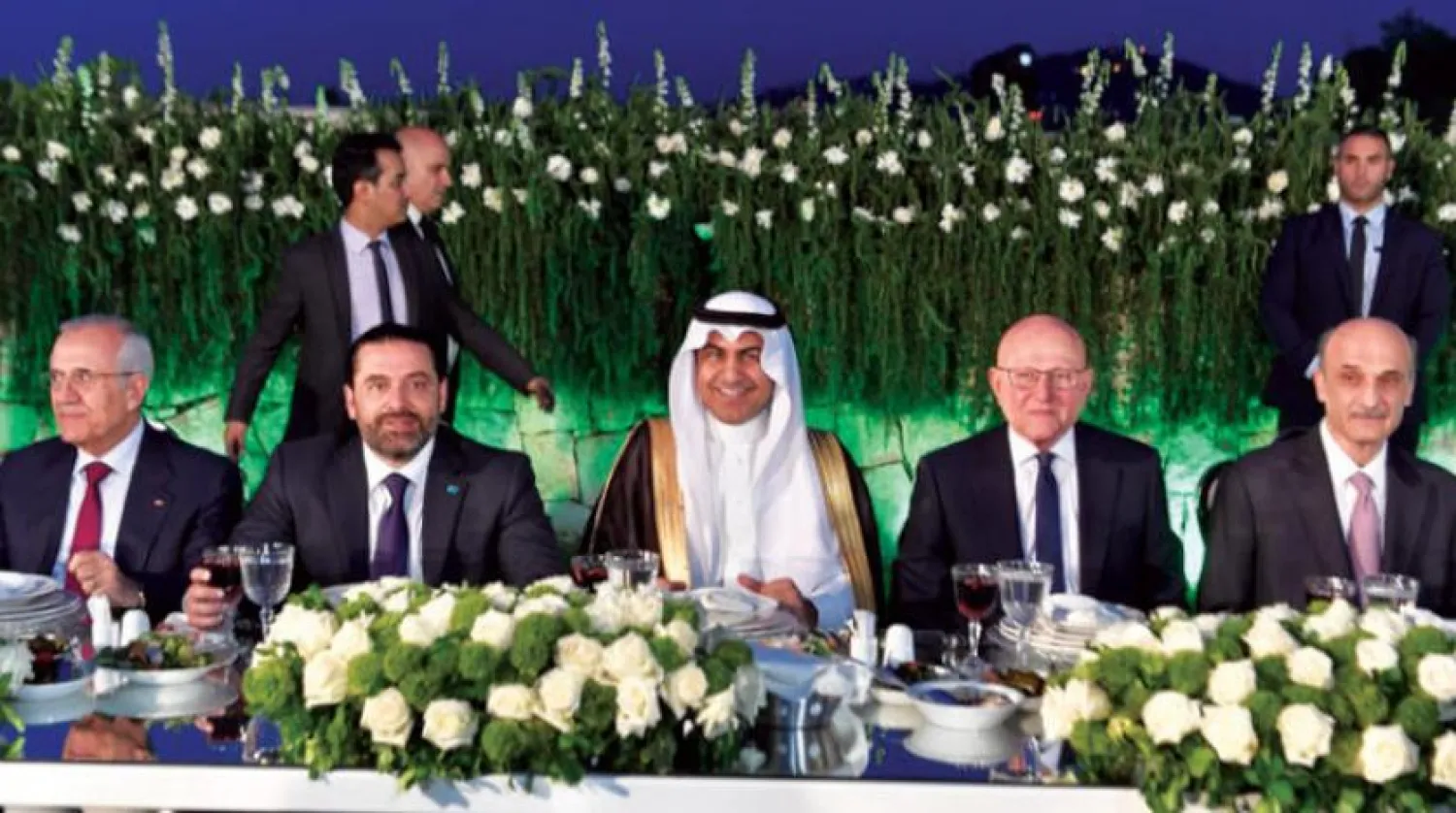
Saudi Embassy’s Iftar Brings Lebanese Leaders Together

 The advisor at the Saudi Royal Court, Nizar al-Aloula, surrounded by Lebanese officials and leaders during the Iftar banquet on Sunday (Asharq Al-Awsat)
The advisor at the Saudi Royal Court, Nizar al-Aloula, surrounded by Lebanese officials and leaders during the Iftar banquet on Sunday (Asharq Al-Awsat)
TT

Saudi Embassy’s Iftar Brings Lebanese Leaders Together

 The advisor at the Saudi Royal Court, Nizar al-Aloula, surrounded by Lebanese officials and leaders during the Iftar banquet on Sunday (Asharq Al-Awsat)
The advisor at the Saudi Royal Court, Nizar al-Aloula, surrounded by Lebanese officials and leaders during the Iftar banquet on Sunday (Asharq Al-Awsat)

The Saudi Embassy in Beirut brought together most Lebanese political forces at an Iftar banquet, held under the patronage of Lebanese Prime Minister Saad Hariri and with the participation of the advisor at the Saudi Royal Court, Nizar al-Aloula.
 
Saudi Charge d'Affaires to Lebanon Walid bin Abdullah Bukhari delivered a speech on the occasion, in which he underlined the deep rooted-relations between the Kingdom of Saudi Arabia and Lebanon, which he said would defy all challenges.
 
Hariri, for his part, said that the “Saudi house always brings all the Lebanese together and does not differentiate between them.”
 
“Gulf States have not at any time interfered in our internal affairs, and we are required in return to distance ourselves from meddling in the affairs of sister countries,” he stated.
 
The ceremony was attended by political, religious, economic and diplomatic figures. Among those present were former President Michel Sleiman, former Prime Ministers Fouad Saniora and Tamam Salam, and Lebanese Forces Party leader Samir Geagea, in addition to Kataeb Party President MP Sami Gemayel, Grand Mufti Sheikh Abdul Latif Derian and Beirut Maronite Archbishop Boulos Matar.
 
Lebanese ministers included Jamal al-Jarrah, Nohad al-Mashnouq, Pierre Bou Assi, Melhem Riachi, Ghattas Khoury and Ali Hassan Khalil.
 
Also present at the Iftar were Director General of General Security Major General Abbas Ibrahim, and Lebanese Press Syndicate Chief Aouni Al-Kaaki, in addition to the ambassadors of Kuwait, France, UAE, Egypt, Oman, Algeria, Morocco, Sudan, Yemen, Tunisia and Palestine.
 
“The Kingdom of Saudi Arabia wants Lebanon to remain united in facing the challenges and to maintain our Arabism and our commitment to the Taif Agreement,” Hariri said.
 
He also expressed his thanks and appreciation to Saudi leaders for their permanent support to Lebanon, saying: “The Kingdom has always sought stability, safety, development and peace for Lebanon.”



Miami Talks Aim to Bridge Gaps in Gaza Deal’s Second Phase

Displaced Palestinians gather to receive food rations at a charity kitchen in Khan Younis, southern Gaza (AFP)
TT

Miami Talks Aim to Bridge Gaps in Gaza Deal’s Second Phase

Displaced Palestinians gather to receive food rations at a charity kitchen in Khan Younis, southern Gaza (AFP)

Mediators are convening for fresh talks in Miami, Florida, as efforts to advance the second phase of the Gaza ceasefire agreement remain stalled, months after the truce came into effect on Oct. 10.

The meeting, which mediators say will focus on outlining a framework for the next phase, comes amid attempts to narrow gaps over key issues, including how Israel’s withdrawal would be carried out, how stabilization forces would be deployed, and the question of Hamas’ disarmament.

An analyst said the momentum could translate into concrete steps as early as next month.

Miami is hosting a meeting between US President’s Special Envoy Steve Witkoff and senior officials from the mediating countries, Qatar, Egypt and Türkiye, aimed at pushing forward the second phase of the ceasefire agreement, a White House official told AFP on Thursday.

Qatari Prime Minister Sheikh Mohammed bin Abdulrahman Al Thani said during a visit to Washington on Wednesday that preparations were under way for a mediators’ meeting on Friday to discuss a framework for advancing the second phase of the Gaza agreement.

Ahead of the Miami talks, Hamas political bureau member Bassem Naim said in remarks that Palestinians expected the talks to result in an agreement to halt all Israeli violations and breaches, and to compel Israel to comply with the provisions of the Sharm el-Sheikh agreement.

Palestinian political analyst Ayman Al-Raqab said the Miami meeting fell within efforts to bridge gaps related to the implementation of Israel’s withdrawal, the deployment of stabilization forces and Hamas’ disarmament. If the momentum continued, he said, concrete steps could be seen next month.

He told Asharq Al-Awsat that Washington’s approach at the Miami meeting should focus on implementing the agreement rather than rebuilding Rafah in a new form or dividing the Gaza Strip.

He said the gaps in the second phase were linked to Israel’s withdrawal, the deployment of stabilization forces and Hamas’ disarmament, adding that discussions should center on practical implementation solutions, not US proposals that serve Israeli ideas.

Egyptian Foreign Minister Badr Abdelatty stressed on Friday, during talks with his Russian counterpart Sergei Lavrov in Cairo, the need to implement UN Security Council Resolution 2803 on the Gaza agreement and to operate the Rafah crossing from both directions.

Lavrov said diplomatic efforts must continue to ensure the sustainability of the Gaza ceasefire.

Abdelatty also discussed the situation with Algerian Foreign Minister Ahmed Attaf in Cairo on Friday, reviewing ongoing Egyptian efforts to solidify and sustain the ceasefire and to implement the requirements of the second phase.

They stressed the need for unimpeded humanitarian aid access, preparing conditions for early recovery and reconstruction, and rejecting any measures that could undermine the unity of Palestinian territory or liquidate the Palestinian cause, according to a statement by Egypt’s Foreign Ministry.

The European Council welcomed, at the conclusion of a summit of leaders from the European Union’s 27 member states in Brussels, UN Security Council Resolution 2803, which calls for the establishment of a Board of Peace and a temporary international stabilization force as part of a plan to end the conflict in Gaza.

European leaders stressed the need to fully implement the resolution and ensure lasting security stability in Gaza, reiterating the EU’s commitment to a two-state solution and international law.

Al-Raqab said Egyptian efforts were banking on achieving a breakthrough alongside Qatar and Türkiye, reaching concrete mechanisms to implement the agreement amid European support for this path.

He added that any arrangements were awaiting a meeting between Israeli Prime Minister Benjamin Netanyahu and US President Donald Trump later this month, describing it as decisive.


Guterres Condemns Houthi Detention of Another 10 UN Staff in Yemen

 United National Secretary-General Antonio Guterres speaks during an event to mark the end of the UN political mission, in Baghdad, Iraq, Saturday, Dec. 13, 2025. (AP)
United National Secretary-General Antonio Guterres speaks during an event to mark the end of the UN political mission, in Baghdad, Iraq, Saturday, Dec. 13, 2025. (AP)
TT

Guterres Condemns Houthi Detention of Another 10 UN Staff in Yemen

 United National Secretary-General Antonio Guterres speaks during an event to mark the end of the UN political mission, in Baghdad, Iraq, Saturday, Dec. 13, 2025. (AP)
United National Secretary-General Antonio Guterres speaks during an event to mark the end of the UN political mission, in Baghdad, Iraq, Saturday, Dec. 13, 2025. (AP)

United Nations Secretary-General Antonio Guterres on Friday condemned the Houthi detention of another 10 UN personnel in Yemen, taking the total to 69, his spokesperson said.

The Iran-aligned ‌Houthis detained ‌the ‌additional ⁠UN staff on ‌Thursday, said UN spokesperson Stephane Dujarric, and Guterres calls for the immediate release of all those detained.

"These detentions render ⁠the delivery of UN ‌humanitarian assistance in Houthi-controlled ‍areas ‍untenable. This directly affects millions ‍of people in need and limits their access to life-saving assistance," Dujarric said.

The United Nations has repeatedly rejected Houthi ⁠accusations that UN staff or UN operations in Yemen were involved in spying.


Asharq Al-Awsat Publishes Outline of Lebanon’s Deposit Repayment Plan

Lebanese Prime Minister Nawaf Salam. (Reuters)
TT

Asharq Al-Awsat Publishes Outline of Lebanon’s Deposit Repayment Plan

Lebanese Prime Minister Nawaf Salam. (Reuters)

Lebanon’s Prime Minister Nawaf Salam is pushing to secure approval for a draft law aimed at resolving the fate of bank deposits frozen since the country’s financial collapse in 2019, proposing full repayment of deposits below $100,000 over four years and the conversion of larger sums into long term, asset backed debt instruments, a senior government source told Asharq Al-Awsat.

Under the proposal, depositors with balances exceeding that threshold would receive annual cash payments equal to 2% of the value of their holdings, with the remainder repaid over maturities of up to 15 years, the source said.

Lebanese government sources said Salam hopes the draft law can be approved next week, before the country enters the year end holiday period, after broad political agreement was secured on its main outlines and some objections within the government itself were addressed.

This would allow the state’s negotiating team to defend the plan in parliament and against opposition from bankers and some depositors.

While the plan is “not ideal” from the perspective of Salam and other officials, the sources said it is viewed as “the best possible option,” especially as Salam believes that every day of delay worsens the crisis.

According to the sources, he has said that had such a law been passed at the start of the crisis in 2019, the situation would be far better than it is today.

Asharq Al-Awsat reviewed the plan, formally titled the financial gap draft law, which was circulated to ministers on Friday afternoon. The government has completed the draft, which is intended to determine the scale of losses resulting from the crisis and how they would be distributed among the Lebanese state, the central bank, commercial banks and depositors.

The bill is expected to be approved and then sent to parliament for debate and ratification, as a core component of the financial reforms required by the International Monetary Fund.

The source said that “every day the law’s approval is delayed, deposits will erode further,” pledging to hold accountable those responsible for preventing Lebanese citizens from withdrawing their savings and enticing them with higher interest rates in exchange for transferring their personal funds.

“This file can no longer tolerate postponement,” the source said. “Every time we delay a decision, we are effectively widening the gap instead of narrowing it.”

Weapons and financial reform

The government is pressing ahead with financial reforms alongside the implementation of its decision to impose state monopoly over weapons.

The source said that “weapons and reforms are linked,” adding, “We have taken our decision to restrict weapons, and we are ready to provide development and security. This is what the Lebanese state will deliver.”

They also said Lebanon could not wait for regional political developments to resolve its internal problems.

“The foundation is the implementation of the constitution and the Taif Agreement,” the source said, adding that the government needs to understand Hezbollah’s vision for the post weapons phase and how it intends to integrate into the state building project.

The government views the financial gap law as “the main gateway to safeguarding people’s deposits,” stressing the need to complete it quickly while creating the best possible conditions for restoring depositors’ funds.

The source said some large depositors must bear responsibility because they “were not innocent of many violations and abuses,” while a third core principle is that the state itself will shoulder its share of responsibility.

Mechanism for repaying deposits

The approach is based on a set of fundamental principles. “Whether we agree on them immediately or the discussion takes longer, they remain the basis for implementation, and we operate within the available means,” the source said.

“These principles are not slogans, but executive rules, and any solution that does not start from them cannot be fair or sustainable.”

They also said that it was impossible to repay all deposits at once because of the size of the financial gap.

The source explained that deposits were divided into two categories, those below $100,000 and those above that threshold. Deposits would be repaid in installments over four years on the grounds that small depositors were the most harmed by the crisis.

“They are not beneficiaries of financial engineering schemes or excessive interest rates,” the source said.

“Their money is a lifetime’s savings and should not be touched.”

The source added that the standard applied would be the individual depositor, not the number of accounts.

“If a person has an account worth $40,000 at one bank and another worth $40,000 at a different bank, the two accounts are combined and treated as a single deposit of $80,000,” they explained, calling this principle essential to prevent circumvention and ensure fairness among depositors.

Asset backed bonds

For deposits exceeding $100,000, the source said they would be handled through bonds backed by real assets.

“We are not talking about fictitious bonds,” the source affirmed. “These are bonds backed by actual assets owned by the state or the central bank, including land, facilities and productive institutions.”

They said the Central Bank holds assets valued at tens of billions of dollars, ranging from the casino to land holdings and various institutions, providing a real base for such bonds.

The bonds would be long term, with maturities of between 10 and 15 years, with 2% of their value paid in cash annually.

By way of example, the source said that a depositor holding a bond worth $2 million would receive $40,000 a year in cash. Over time, the principal would decline, and by the end of the term the full original deposit would be recovered.

The importance of asset backed bonds, he said, lies in the guarantees provided by Central Bank assets and state property, allowing depositors to sell the bonds on local or international markets to other investors if they wish to recover their funds immediately.

Review of the previous period

The plan also includes an assessment of profits made in previous years. The source pointed to the period before the crisis, saying that since 2016, during what were known as financial engineering operations, abnormally high interest rates were offered, benefiting large depositors and major investors.

“Some made profits of tens of millions of dollars,” the source said, adding that they could not be treated the same as small depositors who did not benefit from any exceptional returns.

They stressed that original deposits would not be touched, but that gains generated by inflated interest rates would be corrected.

The source said that those who repaid their loans at the 1,500 Lebanese pound per dollar rate included low income borrowers who took loans to buy a home or a car, and that their cases were normal.

However, borrowers who took loans for large projects, investments or contracting would have their files reviewed based on the exchange rate at the time their debts were repaid.

Those who made profits by converting funds from Lebanese pounds to dollars would be fined, with the proceeds directed to a fund to recover depositors’ money.

The source stressed that losses could not be borne by depositors alone.

“There is a clear hierarchy,” they stressed.

“First bank shareholders, then the banks themselves, then the Central Bank, and after that the state. This is the standard applied globally, and it cannot be bypassed or reversed.”

Bank recapitalization

The source said the plan gives banks five years to recapitalize themselves, while the state would assume responsibility for increasing the capital of the central bank.

Bank restructuring is unavoidable, they clarified, adding that raising capital is first and foremost the responsibility of shareholders.

“It is not possible to maintain a banking system without holding those who benefited from profits accountable for losses,” the source said.

“This is not an attack on banks, but a basic condition for rebuilding a sound banking system.”

They acknowledged that the decision would face objections from financial and political forces, but said that failing to act would be even more difficult.

“If we do not do this now, we will not do it later,” the source said, adding that “every additional delay means greater losses.”