


Mikel John Obi: ‘If Nigeria Were Organized We’d Have Won World Cup’

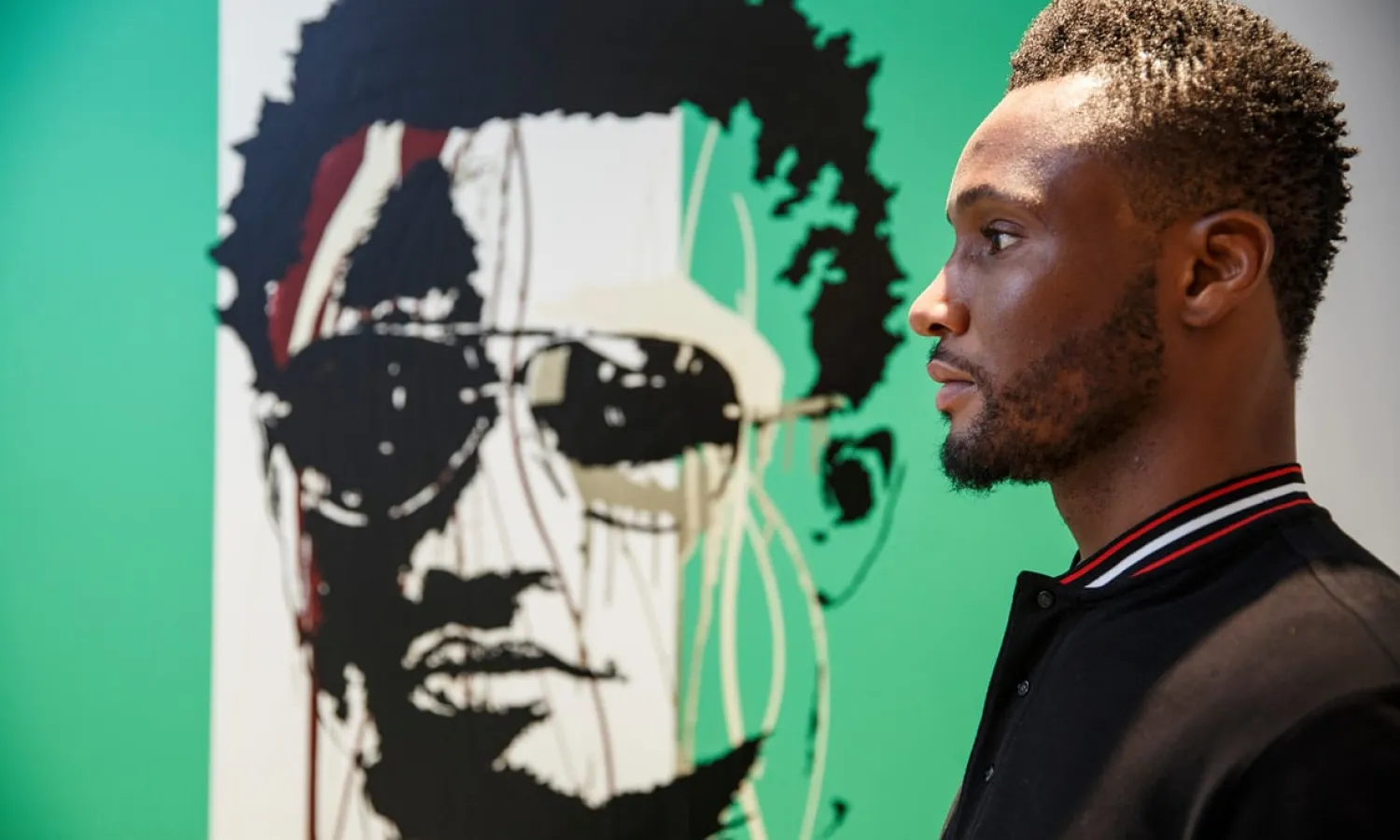
Mikel John Obi poses for a portrait next to a painting of himself in Nigeria colours at his house in Holland Park, west London. Nigeria play England at Wembley on Saturday. Photograph: Tom Jenkins/the Guardian
TT

Mikel John Obi: ‘If Nigeria Were Organized We’d Have Won World Cup’

Mikel John Obi poses for a portrait next to a painting of himself in Nigeria colours at his house in Holland Park, west London. Nigeria play England at Wembley on Saturday. Photograph: Tom Jenkins/the Guardian

For Mikel John Obi, it was the boyhood dream that soured. “It was a disaster,” the Nigeria midfielder says of the 2014 World Cup in Brazil – his first involvement at a finals.

From the outside looking in, there was a depressingly familiar undercurrent in the form of a pay dispute between the Nigeria Football Federation and the players. It led to a boycott of training from the latter days before the last-16 tie against France, which they lost 2-0. From the inside looking out, it was simply toxic.

“There were a lot of problems in the camp which a lot of people didn’t see, the media didn’t see – we kind of hid it under the table,” Mikel says. “The relationships between the players were not good and there was no discipline. There was no good feeling, no good vibe.

“It almost got to people being pinned up against dressing-room walls, although not quite. It was confrontation and arguments. Players wanted to do their own thing and they didn’t think about the team.”

Mikel is looking ahead to captaining Nigeria at the Russia World Cup and the preparations will ramp up on Saturday with the friendly against England at Wembley – the scene of some of Mikel’s most memorable triumphs from his 10 and a half seasons at Chelsea. The 31-year-old is now at Tianjin Teda in the Chinese Super League.

But the past is unavoidable for Nigeria and it has shaped what is a new era for them under the manager, Gernot Rohr – a disciplinarian German – and Mikel, whose status within the setup goes way beyond wearing the armband on match days.

The turmoil in Brazil had followed similar internal conflict at the 2010 World Cup in South Africa, when Nigeria departed at the group phase. Mikel missed the tournament through injury but he heard the stories and, afterwards, the then Nigeria president, Goodluck Jonathan, ruled that the national team should be suspended from competition for two years. The measure would be rescinded but it illustrated the depths of the despair; the sense that the squad had become ungovernable.

“There were massive problems in the camp and that’s why the president got upset,” Mikel says. “He said: ‘Until you guys fix yourselves up, that’s it. No more.’ The public were upset but they were in support of it because they also wanted whatever was going on to stop. We couldn’t keep going to tournaments and making a mockery of ourselves.”

It almost got to people being pinned against dressing-room walls, although not quite. It was confrontation and arguments
It was tempting to conclude that the shock therapy failed but, after Brazil, there remained the appetite for what Mikel describes as “radical change”. The squad has been purged and it says everything that Rohr will take only five survivors from the previous finals to Russia – Mikel, Victor Moses, Ahmed Musa, Ogenyi Onazi and Kenneth Omeruo.

The transition has been painful. Nigeria failed to qualify for the Africa Cup of Nations in 2015 and 2017 – a sentence that ought to finish with an exclamation mark. This is Nigeria – estimated population: 195 million; the largest African country, by far. They had won the 2013 Cup of Nations, in which Mikel was outstanding.

There had been trepidation when Rohr was appointed in August 2016 and Nigeria addressed a difficult World Cup qualifying group with Cameroon, Algeria and Zambia. Yet they would finish on top of it with a game to spare.

Mikel says that Rohr has driven the upturn through his attention to detail and his insistence upon certain standards, all of which come under the umbrella of putting the team first. He is forensic in his video-analysis sessions, his meetings, his work on set pieces, and that has added up to a change in the collective mentality.

Rohr’s squad is young and their inexperience is a worry. He has a group of 25 for the fixture against England; 14 of them are aged 25 or under. The young guns include Wilfred Ndidi, Alex Iwobi and Kelechi Iheanacho. But, crucially, Mikel says they are together; ready to fight for each other.

“The coach and myself, as captain, have tried to make these young players realize that we are a team, not individuals,” Mikel says. “If you don’t want to play together, you are welcome to leave. It’s amazing now to go to camp. You can feel the good feelings.

“I have been in the national team since 2005 and I haven’t seen this discipline before. It is meetings, being on time, the training. Sometimes a player has the hump because he knows he is not going to make the team and, before in the national team, he just strolls around. Now, you have to train properly. If you don’t, you are leaving the camp. The coach has changed the whole mentality.”

The warm-up game with England will stir the nostalgia in Mikel. He started in three FA Cup finals for Chelsea at Wembley and won them all, with the first – against Manchester United in 2007, at the end of his debut season – the most special. Mikel had chosen Chelsea over United when he moved from the Norwegian club Lyn Oslo in well-documented and acrimonious fashion.

“I thought I was going to get a punch from Sir Alex [Ferguson] in the tunnel,” Mikel says, with a laugh. “But that was a great game for me. Wembley is a very good ground for me.”

Mikel makes the reasonable point that he has nothing to prove to supporters in England, having won the lot at Chelsea – two Premier Leagues, four FA Cups (he got a medal in 2010, although he missed the final against Portsmouth because of injury), two League Cups, one Europa League and, most famously, one Champions League. Ever the big-game player, he starred in the final against Bayern Munich.

He is aware of the perception about top players who move to China – they are going there to retire; there is no way back into the leading European leagues. It needles him and it will give him extra edge against England.

“Look at Paulinho,” Mikel says, of the Brazil midfielder. “He went to Guangzhou Evergrande from Tottenham and then he got a move to Barcelona. You can still go back. It depends on how well you look after yourself. The players in China like Oscar, Ramires – we have offers, day in, day out, to come back to Europe.

“But if you make a decision, you need to stick by it. I have a contract [until next year] and I have to respect it. I like where I play. The culture is totally different and it’s something that I wanted to experience – and for my two little girls, as well.”

Mikel’s home remains in London. He lives in a fabulous Holland Park plot with his girlfriend, Olga Diyachenko, and their two-year-old twin daughters, Mia and Ava, although happily for him they are able to visit him in China for two- and three-month periods. The Premier League retains a pull for romantic and practical reasons. “Who knows where I am going to retire,” Mikel says. “Maybe I might come back here and retire.”

Mikel carries a lot of responsibility, not least in relation to his charity – the Mikel Obi Africa Children’s Sport Foundation. Mikel wants to set up sports academies across Africa with the goal of helping to alleviate poverty in the next generation of African children through sport.

It is the World Cup that preoccupies him and the question of how Nigeria will emerge from a group which contains Argentina, Croatia and Iceland. Mikel made his name as a holding midfielder at Chelsea but he plays as the No 10 for Nigeria, normally behind Odion Ighalo. The creative burden rests with him.

Above all Mikel – who was named as the captain by Rohr’s predecessor, Samson Siasia, in February 2016 – must embrace the role of senior statesman, diplomat and, essentially, the face of this Nigeria project. “African teams always tend to have problems inside the team,” Mikel says. “It might be bonuses, friendships, organization. If the Nigerian teams were as well organized as the Europeans, we would have won the World Cup by now. In Brazil, the financial aspect was a massive problem. Players didn’t want to train, they wanted to go on strike because they hadn’t received the bonus. This has to stop. We’ve stressed that it has to be sorted out this time.”

(The Guardian)


Sinner Sees off Popyrin to Reach Doha Quarters

 Italy's Jannik Sinner greets the fans after defeating Australia's Alexei Popyrin in their men's singles match at the Qatar Open tennis tournament in Doha on February 18, 2026. (AFP)
Italy's Jannik Sinner greets the fans after defeating Australia's Alexei Popyrin in their men's singles match at the Qatar Open tennis tournament in Doha on February 18, 2026. (AFP)
TT

Sinner Sees off Popyrin to Reach Doha Quarters

 Italy's Jannik Sinner greets the fans after defeating Australia's Alexei Popyrin in their men's singles match at the Qatar Open tennis tournament in Doha on February 18, 2026. (AFP)
Italy's Jannik Sinner greets the fans after defeating Australia's Alexei Popyrin in their men's singles match at the Qatar Open tennis tournament in Doha on February 18, 2026. (AFP)

Jannik Sinner powered past Alexei Popyrin in straight sets on Wednesday to reach the last eight of the Qatar Open and edge closer to a possible final meeting with Carlos Alcaraz.

The Italian, playing his first tournament since losing to Novak Djokovic in the Australian Open semi-finals last month, eased to a 6-3, 7-5 second-round win in Doha.

Sinner will play Jakub Mensik in Thursday's quarter-finals.

Australian world number 53 Popyrin battled gamely but failed to create a break-point opportunity against his clinical opponent.

Sinner dropped just three points on serve in an excellent first set which he took courtesy of a break in the sixth game.

Popyrin fought hard in the second but could not force a tie-break as Sinner broke to grab a 6-5 lead before confidently serving it out.

World number one Alcaraz takes on Frenchman Valentin Royer in his second-round match later.


Ukraine's Officials to Boycott Paralympics over Russian Flag Decision

Milano Cortina 2026 Winter Olympics - Skeleton - Interview with Ukraine Youth and Sports minister Matvii Bidnyi - N H Hotel, Milan, Italy - February 12, 2026 Ukraine Youth and Sports Minister Matvii Bidnyi speaks after the disqualification of Ukrainian skeleton racer Vladyslav Heraskevych from the Winter Games. REUTERS/Kevin Coombs
TT

Ukraine's Officials to Boycott Paralympics over Russian Flag Decision

Milano Cortina 2026 Winter Olympics - Skeleton - Interview with Ukraine Youth and Sports minister Matvii Bidnyi - N H Hotel, Milan, Italy - February 12, 2026 Ukraine Youth and Sports Minister Matvii Bidnyi speaks after the disqualification of Ukrainian skeleton racer Vladyslav Heraskevych from the Winter Games. REUTERS/Kevin Coombs

Ukrainian officials will boycott the Paralympic Winter Games, Kyiv said Wednesday, after the International Paralympic Committee allowed Russian athletes to compete under their national flag.

Ukraine also urged other countries to shun next month's Opening Ceremony in Verona on March 6, in part of a growing standoff between Kyiv and international sporting federations four years after Russia invaded.

Six Russians and four Belarusians will be allowed to take part under their own flags at the Milan-Cortina Paralympics rather than as neutral athletes, the Games' governing body confirmed to AFP on Tuesday.

Russia has been mostly banned from international sport since Moscow invaded Ukraine. The IPC's decision triggered fury in Ukraine.

Ukraine's sports minister Matviy Bidny called the decision "outrageous", and accused Russia and Belarus of turning "sport into a tool of war, lies, and contempt."

"Ukrainian public officials will not attend the Paralympic Games. We will not be present at the opening ceremony," he said on social media.

"We will not take part in any other official Paralympic events," he added.

Ukrainian Foreign Minister Andriy Sybiga said he had instructed Kyiv's ambassadors to urge other countries to also shun the opening ceremony.

"Allowing the flags of aggressor states to be raised at the Paralympic Games while Russia's war against Ukraine rages on is wrong -- morally and politically," Sybiga said on social media.

The EU's sports commissioner Glenn Micallef said he would also skip the opening ceremony.

- Kyiv demands apology -

The IPC's decision comes amid already heightened tensions between Ukraine and the International Olympic Committee, overseeing the Winter Olympics currently underway.

The IOC banned Ukrainian skeleton racer Vladyslav Heraskevych for refusing to ditch a helmet depicting victims of the war with Russia.

Ukraine was further angered that the woman chosen to carry the "Ukraine" name card and lead its team out during the Opening Ceremony of the Games was revealed to be Russian.

Media reports called the woman an anti-Kremlin Russian woman living in Milan for years.

"Picking a Russian person to carry the nameplate is despicable," Kyiv's foreign ministry spokesman Georgiy Tykhy said at a briefing in response to a question by AFP.

He called it a "severe violation of the Olympic Charter" and demanded an apology.

And Kyiv also riled earlier this month at FIFA boss Gianni Infantino saying he believed it was time to reinstate Russia in international football.

- 'War, lies and contempt' -

Valeriy Sushkevych, president of the Ukrainian Paralympic Committee told AFP on Tuesday that Kyiv's athletes would not boycott the Paralympics.

Ukraine traditionally performs strongly at the Winter Paralympics, coming second in the medals table four years ago in Beijing.

"If we do not go, it would mean allowing Putin to claim a victory over Ukrainian Paralympians and over Ukraine by excluding us from the Games," said the 71-year-old in an interview.

"That will not happen!"

Russia was awarded two slots in alpine skiing, two in cross-country skiing and two in snowboarding. The four Belarusian slots are all in cross-country skiing.

The International Paralympic Committee (IPC) said earlier those athletes would be "treated like (those from) any other country".

The IPC unexpectedly lifted its suspension on Russian and Belarusian athletes at the organisation's general assembly in September.


'Not Here for Medals', Nakai Says after Leading Japanese Charge at Olympics

Ami Nakai of Japan competes during the women's short program figure skating at the 2026 Winter Olympics, in Milan, Italy, Tuesday, Feb. 17, 2026. (AP Photo/Ashley Landis)
TT

'Not Here for Medals', Nakai Says after Leading Japanese Charge at Olympics

Ami Nakai of Japan competes during the women's short program figure skating at the 2026 Winter Olympics, in Milan, Italy, Tuesday, Feb. 17, 2026. (AP Photo/Ashley Landis)

Ami Nakai entered her first Olympics insisting she was not here for medals — but after the short program at the Milano Cortina Games, the 17-year-old figure skater found herself at the top, ahead of national icon Kaori Sakamoto and rising star Mone Chiba.

Japan finished first, second, and fourth on Tuesday, cementing a formidable presence heading into the free skate on Thursday. American Alysa Liu finished third.

Nakai's clean, confident skate was anchored by a soaring triple Axel. She approached the moment with an ease unusual for an Olympic debut.

"I'm not here at this Olympics with the goal of achieving a high result, I'm really looking forward to enjoying this Olympics as much as I can, till the very last moment," she said.

"Since this is my first Olympics, I had nothing to lose, and that mindset definitely translated into my results," she said.

Her carefree confidence has unexpectedly put her in medal contention, though she cannot imagine herself surpassing Sakamoto, the three-time world champion who is skating the final chapter of her competitive career. Nakai scored 78.71 points in the short program, ahead of Sakamoto's 77.23.

"There's no way I stand a chance against Kaori right now," Nakai said. "I'm just enjoying these Olympics and trying my best."

Sakamoto, 25, who has said she will retire after these Games, is chasing the one accolade missing from her resume: Olympic gold.

Having already secured a bronze in Beijing in 2022 and team silvers in both Beijing and Milan, she now aims to cap her career with an individual title.

She delivered a polished short program to "Time to Say Goodbye," earning a standing ovation.

Sakamoto later said she managed her nerves well and felt satisfied, adding that having three Japanese skaters in the top four spots "really proves that Japan is getting stronger". She did not feel unnerved about finishing behind Nakai, who also bested her at the Grand Prix de France in October.

"I expected to be surpassed after she landed a triple Axel ... but the most important thing is how much I can concentrate on my own performance, do my best, stay focused for the free skate," she said.

Chiba placed fourth and said she felt energised heading into the free skate, especially after choosing to perform to music from the soundtrack of "Romeo and Juliet" in Italy.

"The rankings are really decided in the free program, so I'll just try to stay calm and focused in the free program and perform my own style without any mistakes," said the 20-year-old, widely regarded as the rising all-rounder whose steady ascent has made her one of Japan's most promising skaters.

All three skaters mentioned how seeing Japanese pair Riku Miura and Ryuichi Kihara deliver a stunning comeback, storming from fifth place after a shaky short program to capture Japan's first Olympic figure skating pairs gold medal, inspired them.

"I was really moved by Riku and Ryuichi last night," Chiba said. "The three of us girls talked about trying to live up to that standard."
