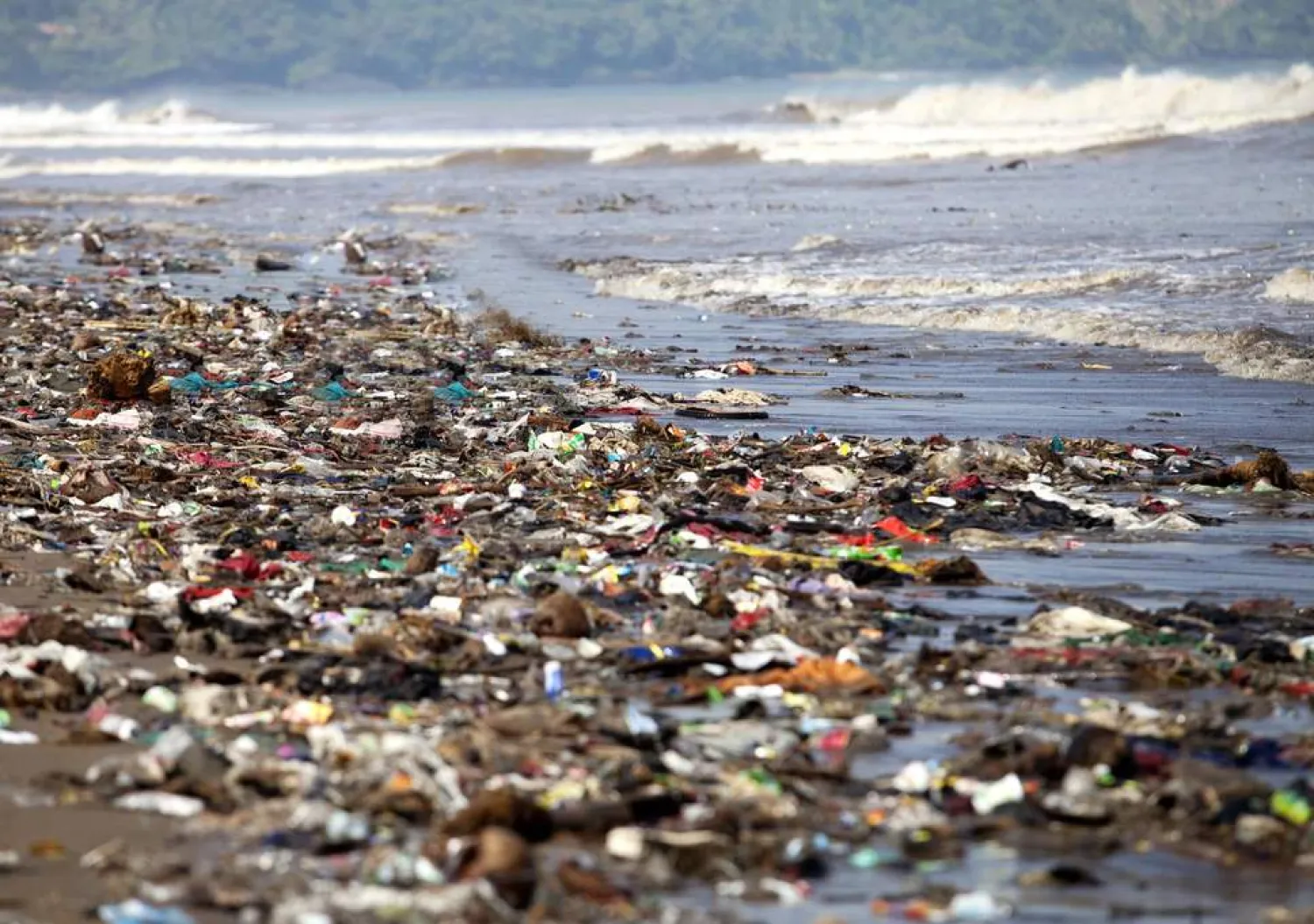
Plastic Waste Chokes Da Loc Beach in Vietnam

A seashore littered with plastic waste. (Getty Images)
TT

Plastic Waste Chokes Da Loc Beach in Vietnam

A seashore littered with plastic waste. (Getty Images)

Sands of the long tree-lined beach of Da Loc are covered with plastic waste that were belched out of an ocean that is also littered with blue plastic bags.

Just south of the capital Hanoi, the once-peaceful and clean beach of Da Loc in Vietnam’s Thanh Hoa province has been slowly suffocating under the weight of plastic waste for decades.

Pham Thi Lai, 60, a local seafood processor said: “They put everything in a plastic bag. If they’re preserving shrimp or preserving fish, they put it in a plastic bag,”

“When they finish they just throw the bags into the ocean. The trash floats to wherever the sea level rises,” she said according to Reuters.

Globally, eight million tons of plastic is dumped into the ocean every year, killing marine life and entering the human food chain, said the UN Environment Program.

The latest example was a pilot whale that died in Thailand with some 80 pieces of plastic rubbish found in its stomach.

World Environment Day on Tuesday focused on beating plastic pollution, with a call for citizens, companies and civil society groups to organize the “biggest-ever worldwide cleanup”.

On Monday, 41 embassies and international organizations in Vietnam signed a pledge to combat plastic pollution in the country.

Canadian ambassador Ping Kitnikone said in a statement: “As international partners, we have the privilege to work in Vietnam, and have a collective responsibility to reduce our plastic footprint in this beautiful country.”

Ngo Ngoc Dinh, head of Da Loc People’s Committee said: “Water rises and falls every day, how can we clean it all? We can’t escape it, we have to solve it ourselves.”


French Veterans Laid to Rest in South Korea, Decades After War

The commander of the United States Forces Korea (USFK) and of the United Nations Command (UNC) general Xavier Brunson pays his respects at the graves of two French veterans of the Korean War, Jacques Grisolet and Andre Datcharry, at the United Nations Memorial Cemetery in Korea (UNMCK) in Busan, South Korea, on May 27, 2026. (AFP)
TT

French Veterans Laid to Rest in South Korea, Decades After War

The commander of the United States Forces Korea (USFK) and of the United Nations Command (UNC) general Xavier Brunson pays his respects at the graves of two French veterans of the Korean War, Jacques Grisolet and Andre Datcharry, at the United Nations Memorial Cemetery in Korea (UNMCK) in Busan, South Korea, on May 27, 2026. (AFP)

Two French veterans of the Korean War were laid to rest on Wednesday in South Korea, their ashes buried alongside fallen soldiers who had fought with them more than seven decades ago.

Warrant Officer Jacques Grisolet and Corporal Andre Datcharry, who died recently in France, were among 37 foreign veterans of the 1950-53 war who have since chosen to be buried at the United Nations Memorial Cemetery in Busan.

The world's only UN cemetery, located in the heart of South Korea's second city, holds the remains of more than 2,300 soldiers from 14 nations.

"We are very happy that dad chose to have his ashes interred in this magnificent international cemetery. It was meaningful for him," Grisolet's daughter, Elisabeth Magrou, told AFP.

The children of both veterans -- members of the French UN battalion formed in 1950 to help counter North Korean forces -- attended the military ceremony in the vast burial ground.

Magrou said that now, her late father "will never be alone. He will rest in peace on Korean soil, in this incredible country that he loved."

Patrick Beaudouin, a French former lawmaker who heads a national association of UN veterans, told AFP that many former soldiers felt a deep connection to Korea.

The sight of war refugees "reminded them of what they had themselves lived through in their youth, when France was occupied in 1940", he said.

Many who fought and were wounded during the war -- as Datcharry was twice -- "left a part of their soul... here in Korea", Beaudouin said.

"That is why they wanted to return and rest here forever."

Since the war ended, ties between South Korea and France have remained close. Many foreign veterans have visited numerous times, watching the Asian country transform in just a few decades into a global economic power.

"When they first saw Korea 76 years ago, it was a land reduced to ashes, marred by the horrors of war and the utter misery of its people. However, when they returned decades later, they witnessed a thriving democracy and an economic powerhouse," said Stephanie Hwang, spokeswoman for the UN cemetery in Busan.

"Knowing that their sacrifices laid the very foundation for Korea's development and prosperity brings them an immeasurable sense of pride."

A total of 269 French troops died while fighting in Korea. According to Beaudouin, 17 French veterans of the war are still alive.


Think It’s Hot Now? The Next Five Years Will Smash Records, UN Says

 A woman uses a portable fan as she walks at Plaza Puerta del Sol during a spring heatwave in Madrid, Spain, May 27, 2026. (Reuters)
A woman uses a portable fan as she walks at Plaza Puerta del Sol during a spring heatwave in Madrid, Spain, May 27, 2026. (Reuters)
TT

Think It’s Hot Now? The Next Five Years Will Smash Records, UN Says

 A woman uses a portable fan as she walks at Plaza Puerta del Sol during a spring heatwave in Madrid, Spain, May 27, 2026. (Reuters)
A woman uses a portable fan as she walks at Plaza Puerta del Sol during a spring heatwave in Madrid, Spain, May 27, 2026. (Reuters)

In the next five years, the Earth is overwhelmingly likely to surge again and again past the international climate threshold set as safe and shatter its hottest-year record along the way, according to new United Nations climate projections.

The World Meteorological Organization also forecasts an overheating Arctic that warms nearly 3 degrees Fahrenheit (1.66 degrees Celsius) between now and 2030 and a dangerous drought with potential wildfires for the Amazon, a crucial part of Earth's natural defenses to lessen human-caused climate change. A hotter globe from the burning of coal, oil and gas means more extreme weather including floods, droughts and heat waves, scientists said.

The projections by the UN climate agency and the United Kingdom's Meteorological Office said there's a 75% chance that the average global temperature between 2026 and 2030 will exceed 1.5 degrees Celsius (2.7 degrees Fahrenheit) since pre-industrial times. That threshold is the agreed-upon limit of warming — averaged over 20 years — set in 2015 by the Paris climate agreement.

A UN science report a few years later detailed how exceeding that 1.5 mark means more likely death, danger and species loss. Even though it's only a few tenths of a degree, some of the planet's ecosystems, such as coral and glaciers, can't handle the strain.

Passing warming limit has consequences, but no cliff

There’s a 91% chance that at least one of the next five years will shoot past the 1.5-degree threshold and an 86% chance that one of those years will smash the record for Earth’s hottest year set in 2024, the WMO report said. The WMO projects each year between now and 2030 to be between 1.3 degrees Celsius (2.3 degrees Fahrenheit) and 1.9 degrees Celsius (3.4 degrees Fahrenheit) since the late 1800s.

“It’s important to note that (1.5) is not kind of a cliff edge that we’re going to fall off,” said report co-author Melissa Seabrook, a climate scientist at the UK Meteorological Office. “Every kind of 0.1 of a degree has more and more severe impact.”

She pointed to unprecedented May heat in Europe this week.

An entire year or more above the 1.5 degree mark “means a whole range of extreme weather events, probably many so hot/wet/dry that it exceeds anything we’ve experienced in the past and thus crucially, anything our city planning, agriculture etc. has anticipated,” Imperial College of London climate scientist Friederike Otto, who wasn’t part of the report, said in an email. “This will mean many people will lose their lives, we are in for a lot of food price shocks, and more intense wildfires.”

Nearly all the shorter-term forecasts call for a strong El Nino — a natural warming of parts of the central Pacific that alters weather worldwide and spikes global temperatures — to form soon. The WMO report said it could stretch all the way to 2028. Because of that, Seabrook said 2027 will likely break the 2024 heat record.

And if the next five years do average more than 1.5 degrees Celsius since pre-industrial times, that means Earth will have warmed a quarter of a degree Celsius (0.45 degrees Fahrenheit) in a decade, which is faster than the previous rates of warning. Those were closer to two-tenths of a degree Celsius per decade.

Climate scientists are debating whether global warming is accelerating, “which obviously is quite scary,” and if these projections come true, it would give additional evidence to those who see a speeded-up rate of change, Seabrook said.

Accelerating warmth forecast in the Arctic

The projections, based on the averaging of about 200 runs of computer simulations using 13 different climate models from various countries, show warming in the Arctic rising 3.5 times faster than the rest of the globe, because there's less ice and snow that had been reflecting solar radiation to space, Seabrook said. It becomes a vicious cycle.

“As the temperature warms, more sea ice melts, the worse this makes it,” Seabrook said.

Winters in the Arctic from 2020 to 2025 on average were 2.1 degrees Fahrenheit (1.2 degrees Celsius) warmer than the 1991-2020 average. The WMO projects the next five winters will average 5.1 degrees Fahrenheit (2.8 degrees Celsius) warmer than that recent normal, Seabrook said.

The report also forecasts Arctic sea ice to continue to shrink in the summer.

Amazon may get drier, sparking fire worries

The report calls for even warmer and unusually dry conditions in the Amazon basin, and that could be devastating for both local residents and the planet as a whole, Seabrook said.

People rely on the Amazon for water and the hotter, drier conditions should increase wildfire risk, Seabrook said, threatening to turn the Amazon, which now sucks heat-trapping carbon dioxide out of the atmosphere, into a region that worsens the problem.

Africa's Sahel area, which has been extra dry, is likely to get more than normal rain and that could lead to flooding, Seabrook said.

United Nations officials said efforts to curb climate change haven't been enough.

“Despite the progress of recent years, it’s clear that global heating is still outpacing global efforts to contain it, and the baking temperatures in Europe, India and elsewhere show yet again the brutal human and economic impacts of humanity still burning colossal amounts of coal, oil and gas,” UN climate chief Simon Stiell said about the WMO report.

“Whether it’s extreme heat, mega-storms, floods, massive wildfires or droughts hitting food supply and prices,” he said, “every nation is already paying a huge price from this global climate crisis.”



US Arrests Ex-CIA Official with $40 Mn in Gold at Home

The seal of the Central Intelligence Agency is displayed at CIA headquarters in Langley, Va., April 13, 2016. (AP)
TT

US Arrests Ex-CIA Official with $40 Mn in Gold at Home

The seal of the Central Intelligence Agency is displayed at CIA headquarters in Langley, Va., April 13, 2016. (AP)

The United States has arrested a former senior CIA official after a search found $40 million worth of gold bars at his home.

FBI officers also seized $2 million in cash and around 35 luxury watches this month from the home of David Rush in the US state of Virginia, according to court documents.

The New York Times reported on Wednesday that he was a former senior CIA official, quoting people familiar with the investigation.

An FBI probe found that Rush had provided false information about his education and military background in his job application, including lying about obtaining university degrees and serving as a pilot in the navy.

He also filled out fraudulent time sheets and obtained $77,000 in military leave pay by falsely claiming he was a member of the navy reserves, according to the affidavit.

The document describes Rush as a former senior employee at a US government agency with top secret clearance and access to classified information.

He was arrested on May 19 and charged with theft of government money.

A lawyer for Rush declined to comment to the Times.

From last November to this March, Rush made several requests to his employer for "a significant quantity of foreign currency and tens of millions of dollars in gold bars for work-related expenses."

The affidavit says that Rush received the cash and gold, without giving further information on why he needed them.

The gold and most of the cash were later found to be missing from a storage space at the official's workplace, triggering a search of his home which discovered around 303 gold bars -- worth over $40 million.