
UN Backs Libya Elections as US Strikes ISIS Positions South of Tripoli

The UN voiced support for holding elections in Libya in December. (Reuters)
TT

UN Backs Libya Elections as US Strikes ISIS Positions South of Tripoli

The UN voiced support for holding elections in Libya in December. (Reuters)

The United Nations Security Council reiterated on Wednesday its support for holding parliamentary and presidential elections in Libya in December.

Expressing its strong backing for the vote, the UN said the polls would be significant step in bringing peace to a country that has been destabilized since 2011.

The council adopted a French-drafted presidential statement that said: "The current political and security situation in Libya is not sustainable."

It notes "the resounding call of all Libyans for credible, inclusive and peaceful elections in order to achieve a united and stable Libya."

The statement welcomes "the momentum generated" by an international conference on Libya hosted by President Emmanuel Macron on May 29 where rival Libyan leaders agreed on a political roadmap leading to elections on December 10.

A presidential statement is a step below a Security Council resolution and must be approved by all 15 council members. It is usually read at an official council meeting and becomes part of the council's official record, unlike press statements.

France's UN Ambassador Francois Delattre said the presidential statement sends "a strong message to all the parties in Libya that the Security Council and the international community is fully united behind the results of the Paris conference" and full implementation of the agreement.

Libya plunged into chaos following a 2011 uprising that toppled and later ruler Moammar al-Gaddafi.

France has been trying to play peacemaker in a country where years of efforts by the United Nations and former colonial power Italy have failed to bring stability.

The Paris conference brought together Prime Minister Fayez Sarraj, head of Libya's UN-backed government in the capital of Tripoli, and General Khalifa Haftar, commander of the Libyan National Army.

In the eight-point declaration that closed the conference, the Libyan leaders committed to accepting electoral results and ensuring funds and "strong security arrangements" for the voting. They also commit to work on "phasing out parallel government and institutions" and on "the unifying of the Libyan Central Bank and other institutions."

The Security Council presidential statement welcomes the leaders' commitment "to work constructively with the UN to organize credible and peaceful parliamentary and presidential elections, and to respect the results."

It also welcomes the Libyan parties' recognition "of the importance of developing a constitutional basis for elections." And it recognizes the key role of UN envoy Ghassan Salameh "in consulting with Libyan parties to set the constitutional basis for elections and to adopt the necessary laws."

Earlier on Wednesday, the United States said it had conducted a precision air strike near the Libyan town of Bani Walid, killing four ISIS terrorists.

The strike was carried out in coordination with the Sarraj government in Tripoli, a statement from US Africa Command said.

“At this time, we assess no civilians were killed in this strike,” the statement said. It gave no information on the identity of those targeted.

Photos shared by a local source in Bani Walid showed a white all-terrain vehicle that he said had been hit in the strike. The vehicle was streaked with blood and the roof and one of the sides had been shredded.

One of those killed in the strike was Abd al-Aati Ashtaiwy, a Libyan who had travelled to Syria and had previously been based in Sirte, which ISIS controlled from 2015-2016, according to the Bani Walid source and local reports.

Bani Walid is about 150 km (93 miles) south of Tripoli


Hamas Angered by Continued Violations, Prepares Amendments to New Mediator Plan

Mourners weep beside the body of a child at a hospital in Gaza City (AFP)
TT

Hamas Angered by Continued Violations, Prepares Amendments to New Mediator Plan

Mourners weep beside the body of a child at a hospital in Gaza City (AFP)

Three Hamas sources said the movement has expressed anger to mediators over the continued Israeli violations in the Gaza Strip, most recently the assassination of Iyad al-Shanbari, a senior commander in the Qassam Brigades, the movement’s armed wing.

The three sources, speaking to Asharq Al-Awsat, said Hamas considers these violations, particularly the assassination of security leaders, a blow to mediation efforts aimed at establishing a clear agreement that obliges Israel to carry out its commitments.

It called on mediators to intervene in a “serious and firm” manner to halt these operations, which have led to the killing of about 1,000 Palestinians since the ceasefire entered into force on October 10, 2025. The sources said mediators confirmed they are continuing their efforts to put an end to the Israeli violations.

A Palestinian source in contact with the Gaza Administration Committee told Asharq Al-Awsat that Nickolay Mladenov, the highest representative for Gaza in the Peace Council, “requested on Monday that Israel halt airstrikes in the Gaza Strip for 48 hours to give the Cairo negotiations a chance to succeed, but received no response.” Hamas sources said they had no knowledge of this request.

A day after a new proposal was presented by mediators and the Peace Council regarding Gaza and advancing the implementation of the ceasefire agreement, Hamas sources said the movement is preparing a response containing remarks and requested amendments to be submitted by its negotiating delegation to Mladenov and the mediators.

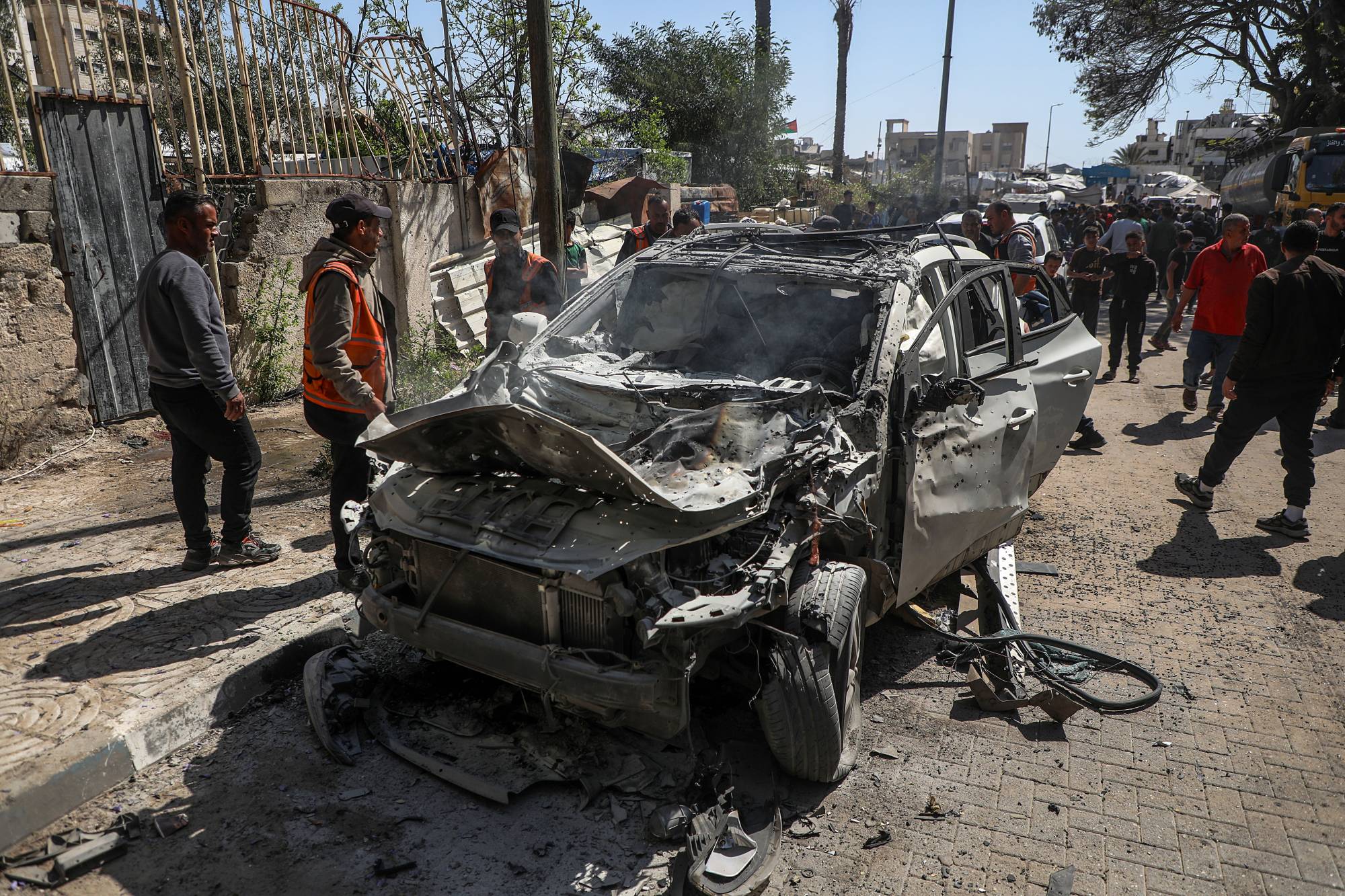
Members of the Palestinian Civil Defense and local residents inspect a damaged vehicle following an Israeli airstrike in the west of Gaza City, Gaza Strip, 28 April 2026. EPA/MOHAMMED SABER

Asharq Al-Awsat had obtained details of the proposal drafted by representatives of the Peace Council and mediators from Egypt, Qatar and Türkiye, along with the United States, concerning the Gaza Strip, particularly its disarmament.

The document, titled “Roadmap” to complete implementation of US President Donald Trump’s comprehensive Gaza peace plan, outlines 15 provisions addressing the implementation of the second phase of the ceasefire agreement between Israel and Hamas.

The response will focus, according to the sources, on demands for a clear timetable for Israeli withdrawal, the establishment of clear international mechanisms and guarantees to oblige Israel, rejecting any linkage between reconstruction and the confinement and disarmament issue, and affirming the right of factions to fully exercise their political role without restrictions.

The new paper indicates the formation of a body named the “Implementation Verification Committee,” to be established by the highest representative for Gaza, comprising guarantor states, an international stabilization force and the Peace Council, to ensure that the parties fulfill their obligations, supported by an enhanced monitoring mechanism.

In its first provisions, the document stresses the importance of full commitment by all parties to implement UN Security Council Resolution 2803 and Trump’s comprehensive plan, as an agreed international framework that will guide the implementation of this process, in a way that ensures achieving the primary objective of restoring civilian life, enabling Palestinian governance, reconstruction, security and economic recovery, and creating the conditions for a credible path toward self-determination and a Palestinian state in line with the Security Council resolution.


Lebanon President Says Israel Must 'Fully Implement Ceasefire' before Talks

 Smoke rises following an Israeli airstrike in a southern Lebanese village, as seen from the Upper Galilee 29 April 2026, amid a ceasefire between Israel and Lebanon.  EPA/ATEF SAFADI
Smoke rises following an Israeli airstrike in a southern Lebanese village, as seen from the Upper Galilee 29 April 2026, amid a ceasefire between Israel and Lebanon. EPA/ATEF SAFADI
TT

Lebanon President Says Israel Must 'Fully Implement Ceasefire' before Talks

 Smoke rises following an Israeli airstrike in a southern Lebanese village, as seen from the Upper Galilee 29 April 2026, amid a ceasefire between Israel and Lebanon.  EPA/ATEF SAFADI
Smoke rises following an Israeli airstrike in a southern Lebanese village, as seen from the Upper Galilee 29 April 2026, amid a ceasefire between Israel and Lebanon. EPA/ATEF SAFADI

Lebanese President Joseph Aoun said Wednesday that Israel must "fully implement" the ceasefire between the two countries before beginning direct negotiations, adding that Beirut was waiting for Washington to set a date for the talks, AFP reported.

Israel "must first fully implement the ceasefire in order to move on to negotiations... Israeli attacks cannot continue as they are," Aoun said in a statement shared by the presidency.

"We are now waiting for the United States to set a date to begin direct negotiations" with Israel.

Despite the ceasefire, Israel and Iran-backed Lebanese militant group Hezbollah have both engaged in fighting, trading blame over violations of the fragile truce.


Over 1.2 mn People in Lebanon to Face Acute Hunger due to War

UN forces operate in southern Lebanon, as seen from northern Israel, Wednesday, April 29, 2026. (AP Photo/Ariel Schalit)
TT

Over 1.2 mn People in Lebanon to Face Acute Hunger due to War

UN forces operate in southern Lebanon, as seen from northern Israel, Wednesday, April 29, 2026. (AP Photo/Ariel Schalit)

A UN-backed report said Wednesday that more than 1.2 million people in Lebanon were expected to face acute hunger due to the latest war between Israel and Hezbollah.

The figure was announced in a joint statement by the UN's Food and Agriculture Organization, the World Food Program and Lebanon's agriculture ministry.

Some "1.24 million people -- nearly one in four of the population analysed -- are expected to face food insecurity" at crisis levels or worse between April and August 2026, they said.

They were referring to analysis from the Integrated Food Security Phase Classification (IPC), a UN-backed group that monitors hunger and malnutrition.

This marks a "significant deterioration" from before the war erupted in March, "when an estimated 874,000 people, roughly 17 percent of the population, were experiencing acute food insecurity", the statement said.

"The deterioration is due to conflict, displacement and economic pressures," it added.

A ceasefire since April 17 has paused six weeks of war between Israel and Iran-backed militant group Hezbollah that has killed more than 2,500 people in Lebanon and displaced more than one million, according to the authorities.

Israeli forces are operating in south Lebanon near the border where residents have been warned not to return, and both sides have been trading fire despite the truce.

"Acute food insecurity is likely to deepen without sustained and timely humanitarian and livelihood support," the statement added.