




“‘An intimate moment,” he calls it. Late on a Sunday night, his last there, Andrés Iniesta sat alone in the middle of Europe’s biggest stadium, silenced now. The nets had been folded up, the lights turned out and everyone else had gone but he remained, kit on, boots and socks off to feel the grass. “It was lovely to sit there, a moment between me and the pitch where I enjoyed myself so much,” he says. “Just me saying goodbye to my home. Every corner of the Camp Nou holds a memory. It’s very powerful, brutal. It was emotional.” After 22 years, 16 in the first team, he was leaving Barcelona; leaving Spain, too.
As he sat, he thought: memories, nostalgia, back to when he arrived from Albacete in an unreliable Ford Orion. “The origins,” he says. And then, at last, he got up, collected his things and was gone. “I accepted the idea some time ago, assimilated it: I knew the end was coming.” He also says that while it “wasn’t easy to say goodbye” he “digested it well” – all the tributes, “so much affection”. Yet there was also part of him that wanted to get beyond that and back to what he knows. Because it was not the end just yet. Japan awaits, with Vissel Kobe. And before that, Russia. At 34, the man who scored the most important goal in Spanish football history, winning their only World Cup in 2010, has just days left at the highest level. Exactly how many depends on how well he and his Spain team-mates do the thing he has always done best: play football.
“This will be my last World Cup,” Iniesta says, sitting across a table at Spain’s Las Rozas HQ, hours before boarding a plane heading east. He has been coming here for 12 years but probably will not be back. “I don’t know if my Spain career will definitively close but this might be the last time. In July we’ll analyse everything. It will have been four World Cups and there won’t be another. I’m determined to enjoy every moment knowing it’s the last but I’m also going not wanting to ‘know’ it’s the last. It’s a contradiction: I don’t want to it be ‘the last World Cup’, like another homage, a testimonial – far from it. I want to compete like the first. The desire hasn’t changed; what’s changed is the moment.
“Russia will be calmer [than the last few weeks of homages] and hopefully there’s still a way to travel. It’s different now: football and tributes were mixed up, now it’s only football and just one objective.
“I’m leaving because my body’s asking me to. If not, I would have continued. When my body told me I couldn’t give more, I knew. I understood: I have to get out. It takes longer to recover physically and mentally it’s exhausting – so many years, the last three as captain. I’ve squeezed out every drop, there’s nothing left. This is the honest thing to do. It would have been easy to carry on, not worry if I was playing or performing, but I couldn’t do that. It could have been next year but it’s this. Now was the time.”
There is a determination to end at the very top, a belief that he can, and it’s tempting to see a parallel with Zinedine Zidane, who left Real Madrid in 2006 and led France – champions eight years before, unable to get out of the group four years after that – to the World Cup final. As with Iniesta, some thought he had gone too soon, while others saw him as a retiree already, but there was a sense of mission about him and he produced some of his finest football. Not that anyone is suggesting Iniesta will bow out with a Materazzi moment.
“I hope not,” he says. But there is a parallel? “Yes, in that it’s the last big occasion. And no longer being at Barcelona doesn’t mean I’m not prepared, that I’m incapable of taking on this challenge. When you make a decision, you think up to the World Cup. And then it’s over. After that, everything will be different, everything changes. I know that. But first I want to win the World Cup.”
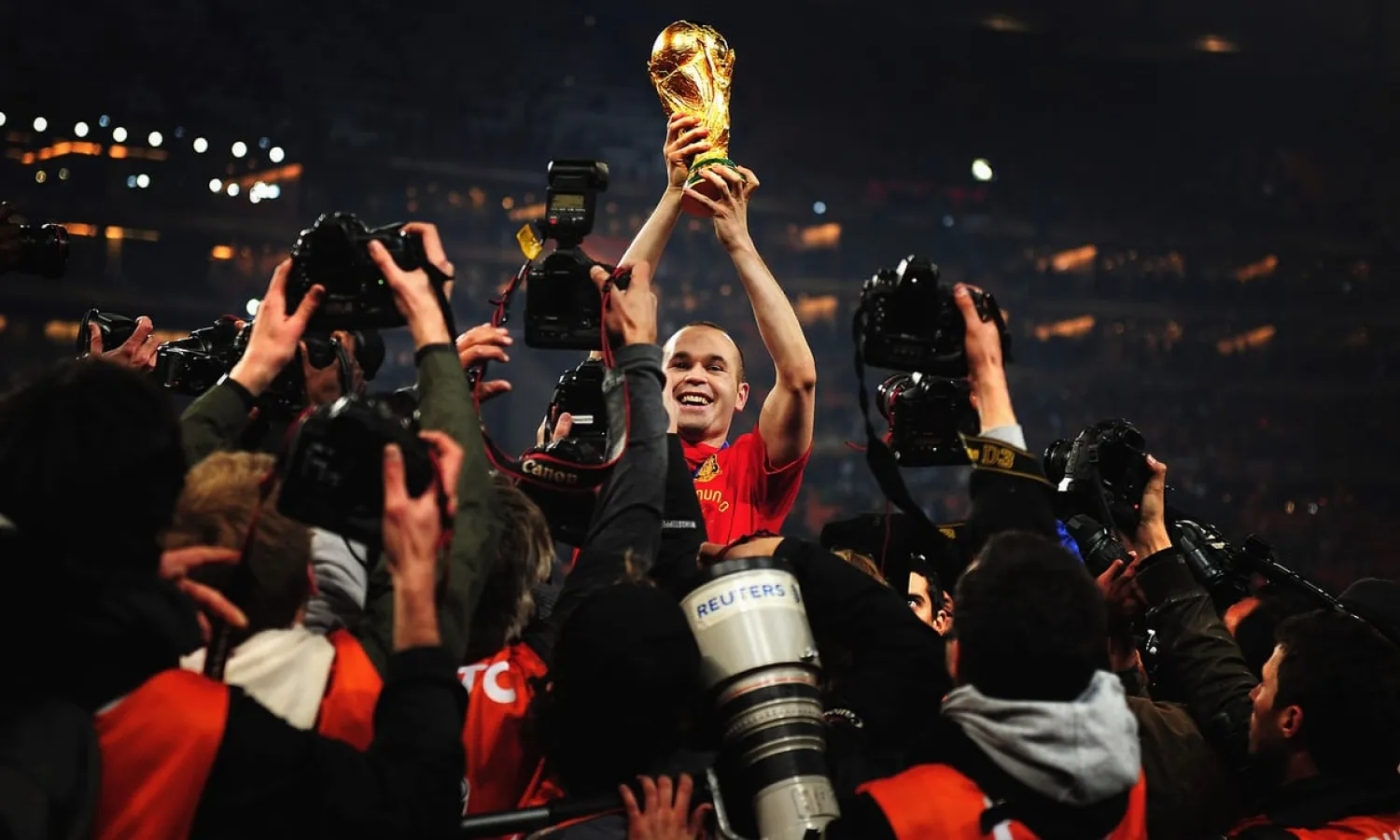
Just like in 2010. Johannesburg inevitably comes to mind, the moment when the ball sat up before him. Yet it was not just the goal, there is something deeper. Watch that final again, watch extra time, and it is extraordinary: Iniesta seems somehow to elevate above the rest, a portrait of his game distilled into 30 minutes of near-perfection. “That’s the way I felt, too. I don’t know if I’d say I felt better than everyone, but I felt a strength from somewhere. It was the same in the [Spanish] cup final: I knew it was my last final with Barcelona, we’d come from Rome, and that game was everything. In South Africa, I felt it and I think it was contagious – my team-mates felt it, too. I seemed to get an incredible amount of touches, I felt I could win every one-on-one, like there was another level.”
And then, the goal. Sitting in front of the television in Spain was Jessica, wife of Dani Jarque, the Espanyol captain who suffered a fatal heart attack a year earlier. She had not watched a game since; that night she watched Iniesta pull off his Spain shirt to reveal a vest dedicated to Jarque.
“When [my friend and biographer] Marcos explained that, we shed many tears,” Iniesta says. “There are things that make your hairs stand up and make you proud.” Iniesta had asked Hugo, the physio, to prepare the vest minutes before kick-off. “It’s the only time I’ve ever done that,” he says. “I don’t know how you explain that, what you call it: destiny or something. I’m not psychic, I can’t see the future. There has to be some word for it, why I chose that night to write the message, score, then remember and take off my shirt, because it’s easy to get swept up in everything and it doesn’t occur to you. There’s something there that made sure it all went that way.”
If there is a moment in Iniesta’s career, it is South Africa, but there is something less tangible about it, less defined by a single second – more by sensations, a joy of the game itself, the way he played.
It has not always been as easy as he made it look. He has talked eloquently about finding himself in a “dark place”. There have been injuries: he was told not to shoot in the 2009 European Cup final and almost did not make it to South Africa. And football’s surroundings can tire. “The less the actual football gets discussed, the less I like it. You hear things that aren’t true and sometimes you end up believing what you read instead of what you felt. That can influence you, which isn’t healthy.”
With Spain, there is an extra dimension: politics. Even Iniesta – cautious, neutral, rarely outspoken – has felt it; when he appealed for a solution to the Catalan crisis, it was hardly the most outlandish statement, but still some waded in. “It’s a sensitive subject, a difficult situation. People say players should give their opinion; then you give your perfectly logical and sensible opinion and you get hit from all sides. You think: ‘Is it worth opening myself up?’”
Was that ever a problem for Spain? “Inside? No, no. Everyone has their opinion: you’re not removed from it, there are personal feelings of course, but it’s lived differently. It’s a political situation to be resolved by politicians, who represent people and brought it about. It never became a big problem inside because ultimately we’re a football team and we want the same thing on the pitch.”
On the pitch, Iniesta was always different, challenging preconceptions, changing the game. He talks about Pep Guardiola and “another step forward in the evolution of football”, insisting that “years later we still see teams emulating things we started doing”, and is happy to be remembered not only for winning but the way they won. At times, that was best expressed by opponents: “You’d sometimes hear things like: ‘Bloody hell, that’s enough now, you can stop …’” Then there was Sir Alex Ferguson, a man he describes as “very special”, talking about that moment when “Xavi and Iniesta get you on that carrousel”.
Are there no regrets? How about – and, come on, indulge us here – not playing in England? “I’m sure it would have been nice, a good experience,” he says. “But I was always fine where I was; I never felt the calling, never thought I’d be better off anywhere else. Look, I’m only leaving Barcelona because my body asks me to. If not, I’d have continued.”
Iniesta was like a beacon of hope to every man, his “normality” abnormal. The day he arrived at Barcelona, one La Masia resident said: “He doesn’t look like a footballer” and that became part of his appeal. “Well,” he says, “maybe I can be an example to players with my body type, my stature, my physique, but I don’t see it like that. I don’t see football as a sport for people who are 1.80m and 75 kilos. It’s about being a team, balance, and I don’t think there’s an ideal type I don’t fit. Plenty of players have been very good without being ‘athletes’. And I never got intimidated. I always enjoyed playing against older, bigger boys. More than anything because in my village there weren’t really that many boys my age anyway. You learn to ‘survive’, you improve. Beating them drives you.”
“Beating them,” he says. Winning is something Iniesta has done rather well. He has won 35 titles. If Spain were to win the World Cup again, many would be delighted precisely because it is his 36th on his last great stage. But this is not some goodbye tour where he will be applauded everywhere and nor does he want it to be; this is the World Cup.
“Some might say it would be nice for Spain to win it, but for others it would be great for Leo to win it; others want Cristiano Ronaldo. It could be [all of] our last tournament, so it might be extra special. It’s been an incredible era. I don’t know if we’ll see something like this again. Everything, everyone, around me made me better. Everyone emerges with their own baggage, stories, titles, and there’s also a lasting respect. I’ve shared almost my entire career with some of them. The respect goes beyond the rivalry in the end.
“There’s a world of difference between saying ‘wouldn’t it be nice’ and it actually happening; 2014 was horrible, a lesson that if you’re not 100% anyone can beat you. This time, we’re in good shape. It will be hard but we know we’ve got a great team that can fight for good things. I’ve started looking at opponents. Portugal, say: maybe we had the same feeling in France [that they weren’t favourites], but they won the Euros. It’s building now and once you’re in Russia you know the time has come.”
The last time.
And then? What does he do? What do the rest of us do, come to think of it? Is there another Iniesta out there? “No, no,” he says, “but only in the same way there wasn’t another Xavi, another Puyol, Raúl, Villa, Fernando [Torres], in the sense that every player is different. Plenty of players can be more important than me, but that doesn’t matter; what matters is the journey I travelled, the memories.
“I hope I have a lot of football left. I’m happiest when I’m playing. I’ll have another life which is totally different, I’ll play differently, in a different context, but it will still be a responsibility and I hope to keep enjoying it. Then I’ll try to become a coach or something. I want to feel close to the grass. I don’t know how long I have left. I said I want to play at 40 – I don’t know if I’ll make it.”
Iniesta is laughing now. “I’d have to renew for another three years. That wouldn’t be bad.
“Football’s been my life. It has been since I was four or five, since I started kicking the ball around the village with my dad. It’s been the motor, the driving force of my life and the lives of the people around me; you become the axis around which everything turns. I’ve had an incredible experience, shared with my family. It’s been a fairytale, really – everything I lived, how I lived it. And then something new will begin that will, I’m sure, be very nice. Football’s been my life and I hope it continues to be.”
(The Guardian)


