


VAR: The Brave New World Bringing Distinct Echoes of Football’s Past

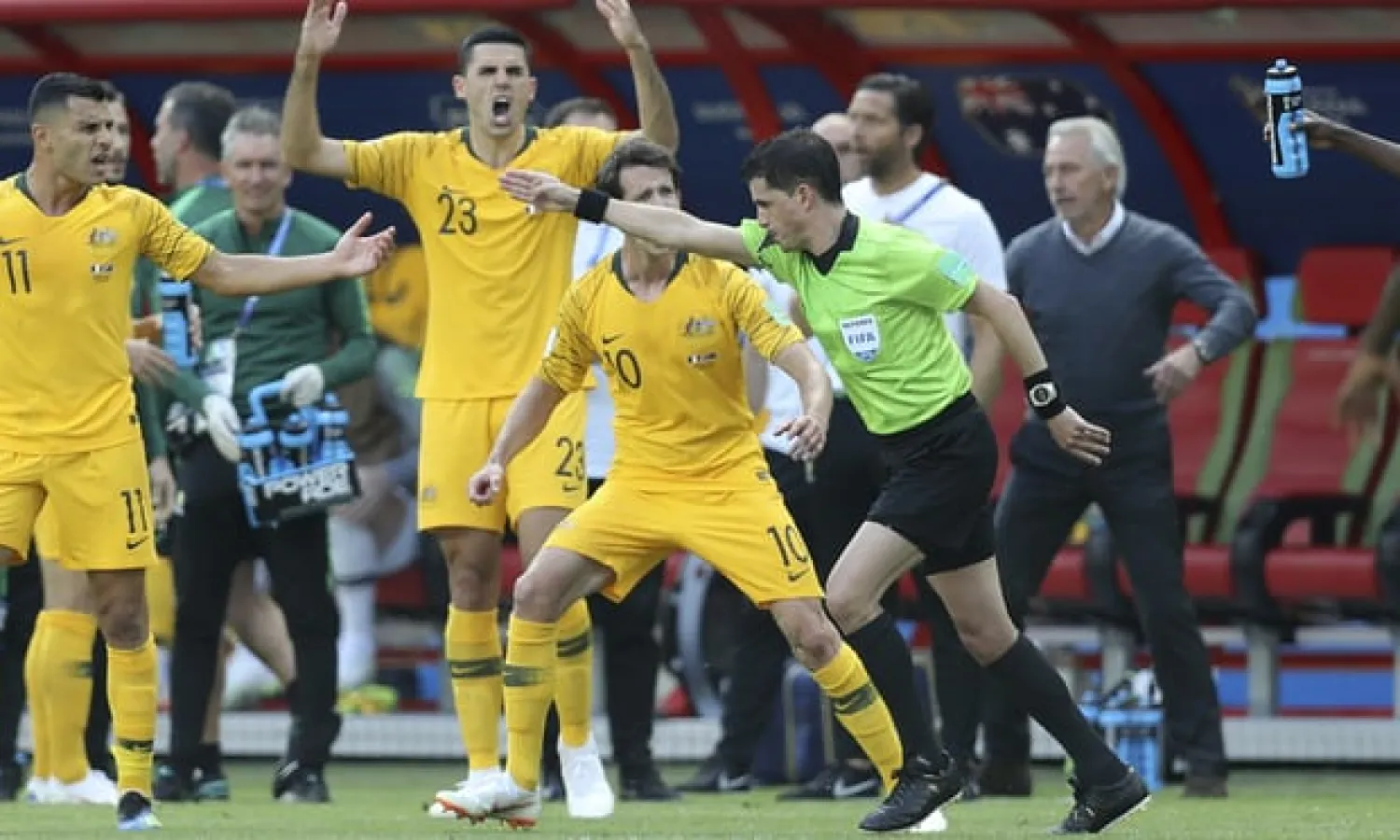
 Australian players react angrily as the Uruguayan referee, Andrés Cunha, awards France a penalty after consulting the VAR during the sides’ Group C match. Photograph: David Vincent/AP
Australian players react angrily as the Uruguayan referee, Andrés Cunha, awards France a penalty after consulting the VAR during the sides’ Group C match. Photograph: David Vincent/AP
TT

VAR: The Brave New World Bringing Distinct Echoes of Football’s Past

 Australian players react angrily as the Uruguayan referee, Andrés Cunha, awards France a penalty after consulting the VAR during the sides’ Group C match. Photograph: David Vincent/AP
Australian players react angrily as the Uruguayan referee, Andrés Cunha, awards France a penalty after consulting the VAR during the sides’ Group C match. Photograph: David Vincent/AP

Welcome, VAR, to the World Cup. Take a seat. We’ve been expecting you. On matchday three of Russia 2018, Fifa’s early-stage experiment with video technology stood briefly centre stage. This, finally, was the new world.

Although, in the event, the debate around two marginal penalty decisions for France and Argentina will be jarringly familiar to anyone with any experience of the previous 140 years or so of football refereeing. Plus ça change, plus c’est the same old story all over again: with the same argument, the same subjective calls, the same claims of injustice.

Saturday afternoon brought two games 650 miles apart. Both had similar incidents involving a trip in the area. Both saw two different applications of the process to two very similar scenarios.

In the early kick-off in Kazan, France were awarded a penalty shortly before the hour for a trip on Antoine Griezmann by the trailing leg of Josh Risdon. Initially no penalty was given by the on-field referee. Instantly the video assistant ref informed his colleague that the incident should be reviewed. A penalty was then awarded.

Three hours later in Moscow, Cristian Pavón went down in the Iceland penalty area after a challenge from Birkir Már Sævarsson. Once again play was waved on. This time there was no VAR interjection. Iceland took a goalkick and the game continued.

At which point enter, if not quite controversy, then evidence that a system designed to still the tedium of endless debate has its own potential for irresolvable differences of opinion.

The first point is that ultimately both refereeing decisions were correct, if only because neither was obviously wrong. Whatever one person with the right authority decides: that is correct. So far, so much the same.

The element of controversy comes because both incidents would seem to have the same level of claim on a video review, the second non-reviewed one arguably more so. Argentina’s fans will see a trip on Pavón. It is a matter of opinion, as ever. But replays suggest there was at least as much contact and/or reviewable grey area as in the Griezmann incident.

At the end of which VAR has offered us uncertainty and 50-50 judgment at one remove. We have simply kicked this endlessly tedious debate into some longer grass a little further off. The parameters have been narrowed. Obvious mistakes can be weeded out. But where once the subjectivity came on-field, now it comes in the VAR’s office.

Opponents of VAR will question whether it really is worth interrupting the game for this. Is it worth obsessing over the thoughts of the referees, incurring all the expense (financial and otherwise) of officials and screens, simply to introduce an incremental degree of semi-accuracy to an essentially random series of on-field collisions?

What we have learned from the first real VAR moment at this World Cup is that no two VARs are the same, that there will not be a uniform review standard. On top of this, as we always knew in a chaotic, always marginal game, that there is no objective truth to be rooted out. Papering as thickly as possible over the cracks is all that can be hoped for here.

At the end of which the VAR-flavoured universe looks not dissimilar to the previous one. Fans of both Australia and Argentina can leave their World Cup matches aggrieved over decisions made. The referees can claim to have made the correct decision simply by making one where one was required. The closest to a clear error is the decision by the VAR in Moscow not to seek a review of the Pavón trip. But even then his judgment call is simply that.

Debate. Matters of opinion. Hard luck stories. Football can’t help but provide this. No matter how finely we split the atom, its core will remain fluid and unstable. For now, with another VAR penalty awarded later in the day for Peru – correctly this time – it is simply time to buckle up and enjoy the ride with a technology that will always carry its own margins of uncertainty.

The Guardian Sport


Brazil's Botafogo Fires Carlo Ancelotti's Son from Coaching Position after Frustrating Season

FILE - Coach Davide Ancelotti of Brazil's Botafogo instructs his players during a Copa Libertadores round of sixteen second leg soccer match against Ecuador's Liga Deportiva Universitaria at Rodrigo Paz Delgado stadium in Quito, Ecuador, Aug. 21, 2025. (AP Photo/Dolores Ochoa, File)
TT

Brazil's Botafogo Fires Carlo Ancelotti's Son from Coaching Position after Frustrating Season

FILE - Coach Davide Ancelotti of Brazil's Botafogo instructs his players during a Copa Libertadores round of sixteen second leg soccer match against Ecuador's Liga Deportiva Universitaria at Rodrigo Paz Delgado stadium in Quito, Ecuador, Aug. 21, 2025. (AP Photo/Dolores Ochoa, File)

Brazilian club Botafogo fired the son of Brazil's national team coach Carlo Ancelotti on Wednesday just five months after he had signed as its manager in his first full-time coaching job.

The 36-year-old Davide Ancelotti was let go after Botafogo failed to defend its Copa Libertadores and Brazilian league titles.

The Rio de Janeiro club finished the Brazilian league in sixth place, 16 points behind champions Flamengo, and was knocked out by Ecuador's Liga de Quito in the round of 16 of the latest Copa Libertadores, The Associated Press said.

Botafogo said in a statement the decision was made after meetings earlier in the day. It did not announce any successor for the job.

Davide Ancelotti joined the club after Botafogo owner John Textor fired Renato Paiva following the team’s round-of-16 elimination at the Club World Cup in July.

The Italian has worked for more than a decade alongside his father in different roles at Bayern Munich, Napoli, Everton, and Real Madrid. He is also part of Ancelotti’s staff at Brazil.


Ecuadorian Police Say Soccer Player Mario Pineida Has Been Shot Dead in an Apparent Attack

(FILES) Ecuador's defender Mario Pineida (C) vies for the ball with Colombia's midfielder Edwin Cardona (L) during their 2018 FIFA World Cup qualifier football match in Quito, on March 28, 2017. (Photo by Juan CEVALLOS / AFP)
TT

Ecuadorian Police Say Soccer Player Mario Pineida Has Been Shot Dead in an Apparent Attack

(FILES) Ecuador's defender Mario Pineida (C) vies for the ball with Colombia's midfielder Edwin Cardona (L) during their 2018 FIFA World Cup qualifier football match in Quito, on March 28, 2017. (Photo by Juan CEVALLOS / AFP)

Ecuadorian police said on Wednesday that Mario Pineida, a 33-year-old Barcelona de Guayaquil defender and former national team player, was shot dead in an apparent attack as violence escalates in the Andean nation.

Another person who police did not identify was also killed in the incident, and a third was wounded, the Associated Press said.

Ecuador's Interior Ministry confirmed Pineida's death without providing details. Barcelona de Guayaquil said in a statement its fans are saddened by Pineida's death.

Pineida played eight games for Ecuador but was not involved in the team qualifying for the 2026 World Cup. His last game for Ecuador was at the 2021 Copa América, as a late substitute in a group-stage game against Brazil. He also went to the 2017 edition.

Pineida started his professional career at Independiente del Valle, where he played from 2010 to 2015. He then moved to the club of the coastal city of Guayaquil in 2016 and won two league titles there. The defender also had a brief spell at Brazil’s Fluminense in 2022.

Ecuadorian media reported the incident took place in the region of Samanes in the north end of Guayaquil, which lies 265 kilometers (165 miles) southwest of the capital Quito.

Ecuador is expected to have its most violent year on record with more than 9,000 homicides, according to the Ecuadorian Observatory of Organized Crime. That figure was at 7,063 violent deaths last year and a then-record 8,248 in 2023.

President Daniel Noboa has pledged to fight criminal organizations that have expanded their operations in Ecuadorian territory in connection with international drug cartels.

In November, a 16-year-old footballer of Independiente del Valle died from a stray bullet, also in Guayaquil. Two months earlier, Maicol Valencia and Leandro Yépez, both players of Exapromo Costa, and Jonathan González, of 22 de Junio died from gunshot wounds.


Saudi National Team Coach: We Aim to Conclude Our Participation in the Best Possible Manner

Renard stressed the importance of players being actively involved in domestic competitions - SPA
TT

Saudi National Team Coach: We Aim to Conclude Our Participation in the Best Possible Manner

Renard stressed the importance of players being actively involved in domestic competitions - SPA

Saudi national team head coach Hervé Renard affirmed during a pre-match press conference ahead of the team’s encounter with the UAE that the squad aims to conclude its participation in the tournament in the best possible manner. He noted that reaching this stage was not the desired objective, but focus and readiness remain essential requirements.

Renard explained that preparations for the match against Jordan were solid and that statistics reflected the Saudi team’s superiority in terms of possession and presence in the opponent’s half, as well as prior understanding of the opponent’s strategy, SPA reported.

However, he said that failure to capitalize on scoring opportunities prevented goals, while Jordan’s team succeeded in converting its chances.

He stated that exiting the semifinals is a difficult challenge for everyone, emphasizing the need to maintain professionalism and prepare well to secure victory in tomorrow’s match. He noted that the team delivered strong performances in previous matches, but effectiveness in front of goal remains a decisive factor that must be further developed in the next phase.

Renard stressed the importance of players being actively involved in domestic competitions, emphasizing that preparation for the World Cup requires higher readiness and a more competitive level to present the image expected on the global stage.

Saudi national team player Abdulrahman Al-Aboud said the ambition had been to win the title, but that was not achieved, noting the players’ readiness to compete for third place against the UAE national team.
