


US Formally Ends Decades-Long Military Presence in South Korea Capital

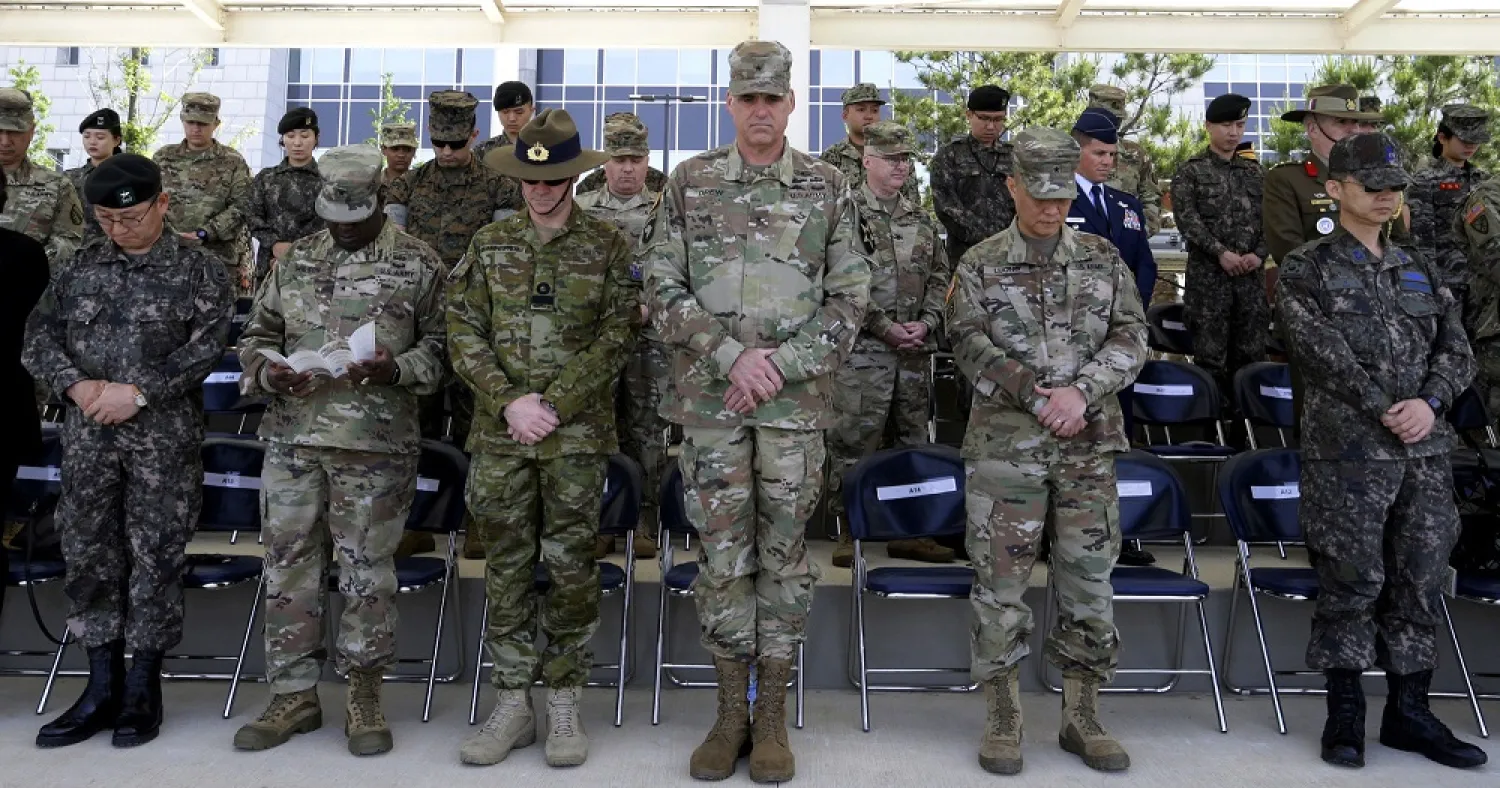
US and South Korean soldiers pray during a ceremony marking the US Memorial Day at Camp Humphreys in Pyeongtaek, South Korea in May. (AP)
TT

US Formally Ends Decades-Long Military Presence in South Korea Capital

US and South Korean soldiers pray during a ceremony marking the US Memorial Day at Camp Humphreys in Pyeongtaek, South Korea in May. (AP)

The United States formally ended on Friday its military presence in the South Korean capital Seoul ahead of relocating to a new headquarters in the western port city of Pyeongtaek.

The US military had been headquartered in Seoul's central Yongsan neighborhood since American troops first arrived at the end of World War II.

The two allies agreed as long ago as 1990 to relocate the headquarters to Camp Humphreys, an existing base in Pyeongtaek, around 60 kilometers (38 miles) south of the capital. But the project was delayed for years by resident protests, financial issues and extensive construction work.

It was not until 2013 that the first unit transferred across to Camp Humphreys, named after a pilot who died in a helicopter accident.

The command’s move comes amid a fledgling detente on the Korean Peninsula. Most troops have already transferred to the new location, and the US says the remaining ones will move by the end of this year.

Located in the western port city of Pyeongtaek and close to a US air field, the new 3,510-acre (1,420-hectare) command cost $11 billion to build and is the largest overseas US base.

A ceremony was held to mark the relocation.

A message by South Korean President Moon Jae-in said that the headquarters is the cornerstone of the US-South Korea alliance.

"In opening a new era of the US forces headquarters in Pyeongtaek, I hope that the US-South Korea alliance will develop beyond a 'military alliance' and a 'comprehensive alliance' and become a 'great alliance,'" he said in the statement.

The relocation is part of a broad US plan to realign its 28,500 troops and their bases in South Korea into two major hubs: one in Pyeongtaek and the other in the southeastern city of Daegu. US officials say they want to move out of highly populated areas and improve efficiency and military readiness.

"Modern warfare is all about concentrating and deploying forces quickly, and Pyeongtaek in these terms has many advantages because it can really function as an outlet, unlike Yongsan, which was stuck in the middle of a population center," said Yun Jiwon, a security professor at Pyeongtaek University.

It also moved US forces away from the hundreds of North Korean artillery guns targeting the Seoul metropolitan area, although Camp Humphreys is still within reach of newer weapons, such as the 300 mm guns North Korea revealed in 2015.

The land used by the Yongsan Garrison will be handed over to South Korea, which hopes to turn the site into a Seoul's "Central Park."

Camp Humphreys incorporates a total of 513 buildings including schools, shops and banks spread over 14.7 million square meters, and will accommodate 43,000 people including soldiers and their family members by the end of 2022.

The Yongsan area has been occupied by foreign forces since the late 19th century. Chinese troops used the site as their base when they came to help suppress a revolt in 1882. The Imperial Japanese Army took it over during Japan's colonization of the peninsula from 1910 to 1945.

The US military arrived to disarm Japan following its World War II defeat. Most US troops were withdrawn in 1949 but they returned the next year to fight alongside South Korea in the three-year Korean War. In 1957, the US military command in South Korea was formally launched in Yongsan.

The US has 28,500 troops stationed in the South to defend it from the nuclear-armed North, and the move comes only weeks after Trump and Pyongyang's leader Kim Jong Un had an unprecedented summit in Singapore.



After Trump’s Outburst, Senate Republicans Reverse Course on Iran

Republican Senator Bill Cassidy of Louisiana (EPA)
TT

After Trump’s Outburst, Senate Republicans Reverse Course on Iran

Republican Senator Bill Cassidy of Louisiana (EPA)

Washington: Robert Jimison and Michael Gold

The confrontation came over lunch. The cleanup began after dinner.

Hours after US President Donald Trump angrily confronted Senate Republicans for joining Democrats to approve a war powers resolution rebuking his handling of the war in Iran, Republican leaders brought another, nearly identical measure to the floor.

In a 50-to-47 vote, with one senator voting “present,” they defeated the measure in a largely symbolic move that did nothing to change the resolution the Senate had narrowly approved a day earlier. Instead, it served as an unmistakable gesture to mollify a furious president who had just berated them.

Of the Republican senators who voted to adopt a resolution on Tuesday that instructed him to end the war with Iran or seek Congress’s approval to continue, two shifted their votes: Senators Bill Cassidy of Louisiana and Rand Paul of Kentucky.

Cassidy, who hours earlier angrily confronted Trump over a lack of transparency on the status of the war, said that he changed his vote after a meeting with Vice President JD Vance and Steve Witkoff, the president’s special envoy, at the White House.

“I was going to vote yes, but I had a briefing this evening, and it was complete,” he said moments after voting against the measure, adding: “I am reassured.”

Paul, who voted “present,” said that Trump’s remarks in his lunch meeting with senators had affected his vote, though not his views on the conflict and Congress’s role in declaring war.

“I did listen to the president today, and the president feels like it reduces his leverage to find a deal, and I do think it is important that we have peace negotiations,” Paul said.

Trump celebrated Wednesday’s late-night vote, thanking Republican leaders in a social media post that falsely claimed that the Senate had “changed its vote on Iran.”

Trump said that the new vote “puts Iran on notice.”

Ultimately, the maneuver did not undo Tuesday’s vote, which was the first war powers measure approved by both chambers since the war began and remains adopted. Wednesday’s vote neither rescinded nor superseded it.

Still, Republicans sought to characterize the procedural move as a chance to “re-vote,” even though the initial action cannot simply be erased through a subsequent vote on different legislation.

“That train has left the station,” said Senator Tim Kaine, Democrat of Virginia, whose resolution was called up by Republican leaders.

He noted that because of the rules surrounding the procedural tool used to call up the vote Wednesday’s vote to defeat the so-called “motion to proceed” does not prevent him from forcing another vote on the same resolution at another point, it simply prevents the chamber from taking up a final vote to consider it.

“My bill is in exactly the same position as it was before they did this vote,” he said.

The remarkable sequence underscored the lengths Republican leaders were willing to go to contain the latest clash between Senate Republicans skeptical of the war and Trump, which unfolded during a closed-door lunch earlier in the day.

The vote was the last one senators took before leaving for a planned recess that is set to last until July 13.

It capped off a turbulent day on Capitol Hill that began after Trump abruptly called off the ceremonial signing of a bipartisan housing bill that Republicans had already started championing as a major accomplishment ahead of the midterm elections.

Dismissing that legislation as “minor,” Trump instead urged Republicans to swiftly pass an elections bill that Republicans have acknowledged does not have the votes to advance.

But at his lunch meeting, Trump made clear that he was equally furious about the Senate adopting a resolution on Tuesday that instructed him to end the war with Iran or seek Congress’s approval to continue it. In that vote, four Republican senators joined Democrats, and it succeeded because two other Republican senators were absent.

According to lawmakers who attended Wednesday’s lunch, the president berated Republicans who had voted with Democrats and singled out several senators by name. The meeting then erupted into a shouting match between Trump and Cassidy, who has become an increasingly outspoken critic of the president after losing his primary race to a challenger backed by Trump.

Among Cassidy’s complaints was that senators had yet to receive a comprehensive briefing on the Iran war. Hours later, the senator went to the White House for a briefing on the Iran war with Vance and Witkoff.

In a social media post, Cassidy said that the meeting addressed “many of my concerns” on the Iran war.

Republican leaders were also helped in their effort to defeat the resolution by the presence of Senator Dave McCormick of Pennsylvania, who missed Tuesday’s vote because he was traveling with Trump at the time.

Tensions with lawmakers over the war were likely to continue, however, as Trump asked Wednesday to approve $87.6 billion in extra spending this year for the war and several unrelated programs — a request that appeared all but dead on arrival in the Senate.

The New York Times


Vessel Hit by 'Unknown Projectile' in Hormuz Strait

Vessels at the Strait of Hormuz, as seen from Musandam,Oman, June 25, 2026. REUTERS/Stringer
TT

Vessel Hit by 'Unknown Projectile' in Hormuz Strait

Vessels at the Strait of Hormuz, as seen from Musandam,Oman, June 25, 2026. REUTERS/Stringer

A cargo ship was damaged after it was struck by an unknown projectile off the Omani coast in the Strait of Hormuz on Thursday, a British maritime agency said, reporting no casualties.

The UK Maritime Trade Operations (UKMTO) security agency reported that the incident occurred 7.5 nautical miles (14 kilometers) southeast of Dahit, in Oman's Musandam exclave.

"A cargo vessel has been hit on the starboard side by an unknown projectile, causing damage to the bridge. Master has reported no casualties and no environmental impact," AFP quoted UKMTO as saying.

British marine security firm Vanguard Tech identified that vessel as the Singapore-flagged container ship Ever Lovely.

The incident follows more than a week of relative calm in the Strait of Hormuz after Tehran and Washington lifted competing blockades as part of a memorandum of understanding to halt the Middle East war.


Supreme Court Allows Trump Administration to End Legal Protections for Haitians, Syrians

The sun sets on the US Supreme Court building after a stormy day in Washington, US, November 11, 2022. REUTERS/Leah Millis
TT

Supreme Court Allows Trump Administration to End Legal Protections for Haitians, Syrians

The sun sets on the US Supreme Court building after a stormy day in Washington, US, November 11, 2022. REUTERS/Leah Millis

The Supreme Court on Thursday allowed the Trump administration to end legal protections for migrants fleeing violence and natural disaster in Haiti and Syria, exposing hundreds of thousands more people to potential deportation.

The 6-3 decision overturns lower court orders and allows the Department of Homeland Security to swiftly end temporary protected status, a program that protects a total of 1.3 million people from 17 countries.

The Trump administration argued judges that can't second-guess immigrations officials' decisions about the protections, which were intended to be temporary.

Immigration attorneys said the countries remain unsafe to return, and the administration ended them in an unlawfully hasty process tinged by racial animus. During his 2024 presidential campaign, Trump amplified false rumors that Haitian immigrants were abducting and eating dogs and cats.

The Justice Department appealed to the Supreme Court after judges postponed the end of the program for about 350,000 Haitians and 6,000 Syrians. The high court sided with the administration before and allowed the end of the program for people from Venezuela.

Federal authorities deny that racial animus played a role. They also cited a Supreme Court decision from Trump’s first term that rejected bias claims based on his social media posts and upheld a travel ban on several Muslim-majority countries.

DHS has ended the protections people from 13 countries since Trump returned to the White House in January 2025, including some that had been in place for more than a decade, The AP news reported.

The terminations were made even though countries like Haiti and Syria remain dangerous, immigration attorneys said. Four Haitian women who were deported from the United States in February were found beheaded and dumped in a river several months later, lawyers said in court documents.

The House passed legislation with a rare bipartisan vote in April that would extend protections for Haitians, though the bill has languished in the Senate.

The US first granted protections to Haitians in 2010 after a catastrophic earthquake, and extended them multiple times amid ongoing gang violence that has displaced more than a million people, according to court documents.

Syrians, meanwhile, were first granted protected status in 2012, during a civil war that lasted for more than a decade before the fall of President Bashar Assad’s government in late 2024.

TPS was created by Congress in 1990 to prevent deportations to countries suffering from natural disasters, civil strife and other instability. It allows people already in the country to stay with work permits in increments of up to 18 months, but it doesn’t provide a path to citizenship.