

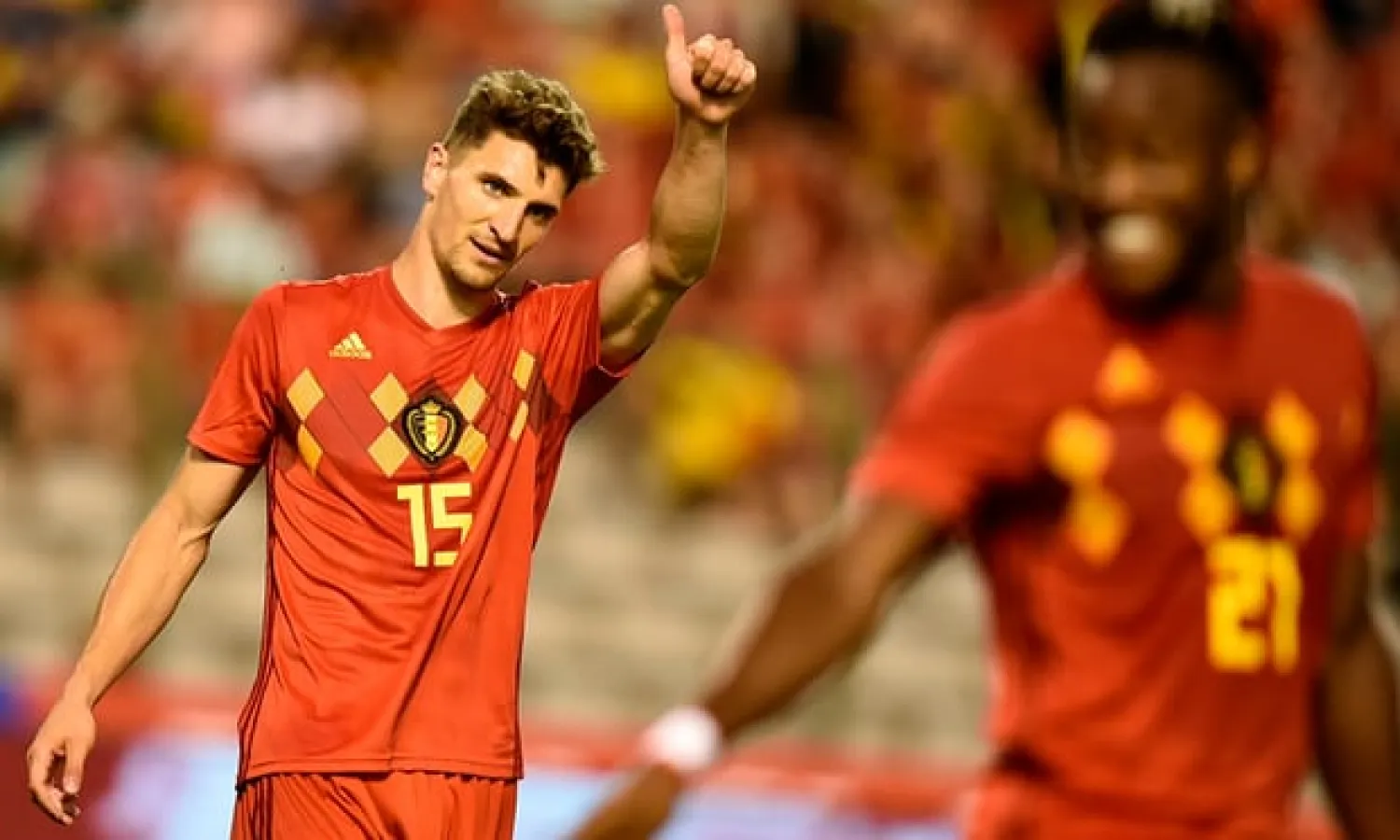

Thomas Meunier: Belgium's Wing-back as Happy in a Gallery as Playing

 Thomas Meunier idolised Brazilians like Ronaldo and Ronaldinho as a boy and grew up supporting Manchester United. Photograph: John Thys/AFP/Getty Images
Thomas Meunier idolised Brazilians like Ronaldo and Ronaldinho as a boy and grew up supporting Manchester United. Photograph: John Thys/AFP/Getty Images
TT

Thomas Meunier: Belgium's Wing-back as Happy in a Gallery as Playing

 Thomas Meunier idolised Brazilians like Ronaldo and Ronaldinho as a boy and grew up supporting Manchester United. Photograph: John Thys/AFP/Getty Images
Thomas Meunier idolised Brazilians like Ronaldo and Ronaldinho as a boy and grew up supporting Manchester United. Photograph: John Thys/AFP/Getty Images

Les Montres Molles in French; The Persistence of Memory in English. It is quite unusual to find a famous painting on the screen of a footballer’s phone, but when Thomas Meunier pushed his home button last year one of Salvador Dalí’s most recognisable works flashed up. “It’s my favourite”, he said. “It is the notion of time. It is surreal and stands out from the ordinary. Maybe that’s the reason it touches me.”

The Paris Saint-German right-back’s passion for art stretches to his youth. He grew up in Sainte-Ode, a small village in the Ardennes, where his grandmother – a teacher – schooled him in drawing and painting. “There was even a period when I said that I would become a cartoon artist,” Meunier said. “I was huge fan of Bugs Bunny.”

It could not quite sway him from another, deeper love, though. Football was the object of his affection from the age of five, when he walked into the family kitchen and asked his parents if he would join the local club. “When I had a ball at my feet, I was happy,” he remembered. At home, he practised his skills to the extent that any family member available – his grandmother if necessary – was pressed into goalkeeping duties. As a teenager, he watched YouTube videos of his heroes and spent hours trying to replicate their actions. The Brazilians were the ones he loved – Ronaldo, Rivaldo and Ronaldinho – as well as David Beckham and Paul Scholes. “A little bit of Cantona too, although I never saw him playing,” said Meunier, who supported Manchester United as a boy.

Local scouts cottoned on to his talent. He was too good for Sainte-Ode and, at 10, moved to Givry. Standard Liège were also monitoring him and, in 2004, offered him the chance to join their youth squad. He would not stay long, though; being released two years later was, he reflected later, the kind of experience that can make or break a career. “Some psychological challenges in my youth, like the divorce of my parents, have shaped my character,” he said. “If you are, just like me at that age, purely focused on football and your club tell you that you’re not good enough it can be a shock.”

He took a step backwards to Virton, a third division club closer to home. A first-team debut arrived in 2009, when he was 18, but could not support himself from football alone. He worked as a postman and, in 2010, became a warehouse worker at the car glass delivery factory Autover. At that point he earned €1,250 a month, but soon his income would skyrocket. The following year he joined Club Brugge for €200,000, and life turned upside down.

Meunier joined Brugge as a midfielder but was transformed into an attack-minded right-back. That development accelerated his journey to the top: his performances earned a place in the Belgium squad for Euro 2016 – he had previously played a few games for the under-15s and under-21s – and during the tournament he sealed a surprise move to PSG.

“When I arrived, not many team-mates knew me,” he recalled of his early days in Paris. “Thanks to the Euros there were maybe two players who remembered my name. Thiago Motta had played against Belgium with Italy. I wasn’t in the starting XI, but after the game I’d swapped shirts with him. He didn’t even remember.”

Playing in France’s capital gave him the chance to meet one of the idols he would try to copy during those years in the back garden. “Ronaldinho visited the club last season, I even have a picture with him,” he said. “Maybe that was one of the best days of my career. Sometimes I kiss my hands: that my job allows me to meet the people who made me fall in love with this game. Five years after Virton I was suddenly playing against Messi, Piqué and Iniesta – players I used to know from TV.”

Now an established figure, he has plenty to say about the negativity, aggression and violence football sometimes inspires – both in stadiums and on social media. “It’s a catastrophe”, he said last year. “The pessimism, the criticism, the hate they spout from the stands too. I can’t understand it.”

He received threats from PSG fans after “liking” a picture of a tifo from Marseille fans before they played Salzburg in the Europa League semi-final. It had been an innocent nod of approval from an art fan rather than anything ill-intended.

Nonetheless, Meunier is revelling in la vie Parisienne, particularly the museums. “It was a teacher who also opened my eyes in college,” he said. “I’m looking for emotions and sensations in a piece of art.”

And when he really likes it, the image even ends up on the screen of his phone. They might not be easy to find, but arty right-backs really do exist.

The Guardian Sport


Shakhtar Boss Pays Ukrainian Racer $200,000 After Games Disqualification

Ukrainian President Volodymyr Zelenskiy holds helmet as he meets with a Ukrainian skeleton racer Vladyslav Heraskevych , who was disqualified from the Olympic skeleton competition over his "helmet of remembrance" depicting athletes killed since Russia's invasion and his father and coach, Mykhailo Heraskevych, amid Russia's attack on Ukraine, in Munich, Germany February 13, 2026. (Ukrainian Presidential Press Service/Handout via Reuters)
TT

Shakhtar Boss Pays Ukrainian Racer $200,000 After Games Disqualification

Ukrainian President Volodymyr Zelenskiy holds helmet as he meets with a Ukrainian skeleton racer Vladyslav Heraskevych , who was disqualified from the Olympic skeleton competition over his "helmet of remembrance" depicting athletes killed since Russia's invasion and his father and coach, Mykhailo Heraskevych, amid Russia's attack on Ukraine, in Munich, Germany February 13, 2026. (Ukrainian Presidential Press Service/Handout via Reuters)

The owner of ‌Ukrainian football club Shakhtar Donetsk has donated more than $200,000 to skeleton racer Vladyslav Heraskevych after the athlete was disqualified from the Milano Cortina Winter Games before competing over the use of a helmet depicting Ukrainian athletes killed in the war with Russia, the club said on Tuesday.

The 27-year-old Heraskevych was disqualified last week when the International Bobsleigh and Skeleton Federation jury ruled that imagery on the helmet — depicting athletes killed since Russia invaded Ukraine in 2022 — breached rules on athletes' expression at ‌the Games.

He ‌then lost an appeal at the Court ‌of ⁠Arbitration for Sport hours ⁠before the final two runs of his competition, having missed the first two runs due to his disqualification.

Heraskevych had been allowed to train with the helmet that displayed the faces of 24 dead Ukrainian athletes for several days in Cortina d'Ampezzo where the sliding center is, but the International Olympic Committee then ⁠warned him a day before his competition ‌started that he could not wear ‌it there.

“Vlad Heraskevych was denied the opportunity to compete for victory ‌at the Olympic Games, yet he returns to Ukraine a ‌true winner," Shakhtar President Rinat Akhmetov said in a club statement.

"The respect and pride he has earned among Ukrainians through his actions are the highest reward. At the same time, I want him to ‌have enough energy and resources to continue his sporting career, as well as to fight ⁠for truth, freedom ⁠and the remembrance of those who gave their lives for Ukraine," he said.

The amount is equal to the prize money Ukraine pays athletes who win a gold medal at the Games.

The case dominated headlines early on at the Olympics, with IOC President Kirsty Coventry meeting Heraskevych on Thursday morning at the sliding venue in a failed last-minute attempt to broker a compromise.

The IOC suggested he wear a black armband and display the helmet before and after the race, but said using it in competition breached rules on keeping politics off fields of play. Heraskevych also earned praise from Ukraine President Volodymyr Zelenskiy.


Speed Skating-Italy Clinch Shock Men’s Team Pursuit Gold, Canada Successfully Defend Women’s Title

 Team Italy with Davide Ghiotto, Andrea Giovannini, Michele Malfatti, celebrate winning the gold medal on the podium of the men's team pursuit speed skating race at the 2026 Winter Olympics, in Milan, Italy, Tuesday, Feb. 17, 2026. (AP)
Team Italy with Davide Ghiotto, Andrea Giovannini, Michele Malfatti, celebrate winning the gold medal on the podium of the men's team pursuit speed skating race at the 2026 Winter Olympics, in Milan, Italy, Tuesday, Feb. 17, 2026. (AP)
TT

Speed Skating-Italy Clinch Shock Men’s Team Pursuit Gold, Canada Successfully Defend Women’s Title

 Team Italy with Davide Ghiotto, Andrea Giovannini, Michele Malfatti, celebrate winning the gold medal on the podium of the men's team pursuit speed skating race at the 2026 Winter Olympics, in Milan, Italy, Tuesday, Feb. 17, 2026. (AP)
Team Italy with Davide Ghiotto, Andrea Giovannini, Michele Malfatti, celebrate winning the gold medal on the podium of the men's team pursuit speed skating race at the 2026 Winter Olympics, in Milan, Italy, Tuesday, Feb. 17, 2026. (AP)

An inspired Italy delighted the home crowd with a stunning victory in the Olympic men's team pursuit final as

Canada's Ivanie Blondin, Valerie Maltais and Isabelle Weidemann delivered another seamless performance to beat the Netherlands in the women's event and retain their title ‌on Tuesday.

Italy's ‌men upset the US who ‌arrived ⁠at the Games ⁠as world champions and gold medal favorites.

Spurred on by double Olympic champion Francesca Lollobrigida, the Italian team of Davide Ghiotto, Andrea Giovannini and Michele Malfatti electrified a frenzied arena as they stormed ⁠to a time of three ‌minutes 39.20 seconds - ‌a commanding 4.51 seconds clear of the ‌Americans with China taking bronze.

The roar inside ‌the venue as Italy powered home was thunderous as the crowd rose to their feet, cheering the host nation to one ‌of their most special golds of a highly successful Games.

Canada's women ⁠crossed ⁠the line 0.96 seconds ahead of the Netherlands, stopping the clock at two minutes 55.81 seconds, and

Japan rounded out the women's podium by beating the US in the Final B.

It was only Canada's third gold medal of the Games, following Mikael Kingsbury's win in men's dual moguls and Megan Oldham's victory in women's freeski big air.


Lindsey Vonn Back in US Following Crash in Olympic Downhill 

Milano Cortina 2026 Olympics - Alpine Skiing - Women's Downhill 3rd Official Training - Tofane Alpine Skiing Centre, Belluno, Italy - February 07, 2026. Lindsey Vonn of United States in action during training. (Reuters)
TT

Lindsey Vonn Back in US Following Crash in Olympic Downhill 

Milano Cortina 2026 Olympics - Alpine Skiing - Women's Downhill 3rd Official Training - Tofane Alpine Skiing Centre, Belluno, Italy - February 07, 2026. Lindsey Vonn of United States in action during training. (Reuters)

Lindsey Vonn is back home in the US following a week of treatment at a hospital in Italy after breaking her left leg in the Olympic downhill at the Milan Cortina Games.

“Haven’t stood on my feet in over a week... been in a hospital bed immobile since my race. And although I’m not yet able to stand, being back on home soil feels amazing,” Vonn posted on X with an American flag emoji. “Huge thank you to everyone in Italy for taking good care of me.”

The 41-year-old Vonn suffered a complex tibia fracture that has already been operated on multiple times following her Feb. 8 crash. She has said she'll need more surgery in the US.

Nine days before her fall in Cortina d'Ampezzo, Italy, Vonn ruptured the ACL in her left knee in another crash in Switzerland.

Even before then, all eyes had been on her as the feel-good story heading into the Olympics for her comeback after nearly six years of retirement.
