


Houthi Celebration of Iranian Ritual Provokes Yemeni Anger

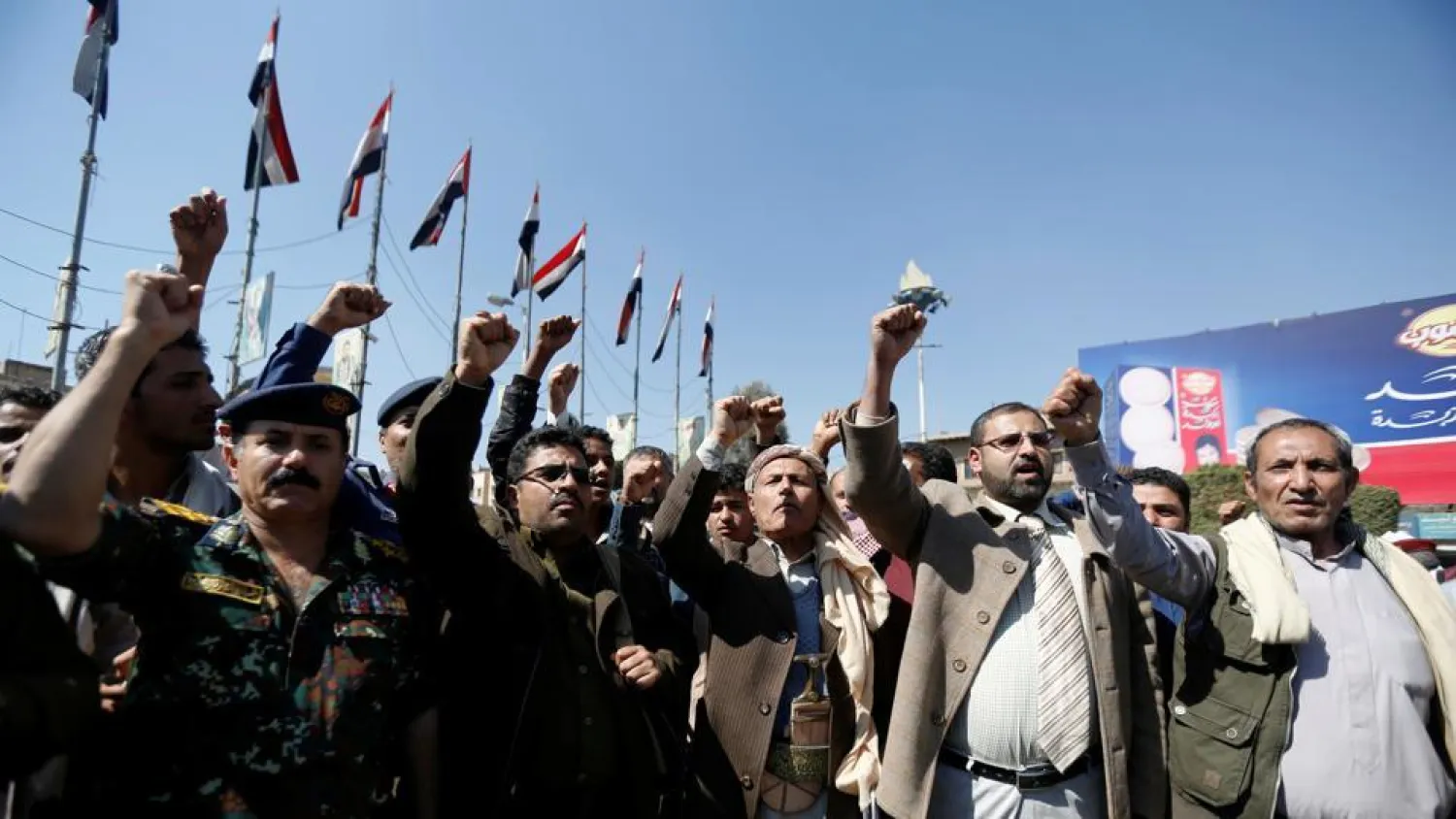
Houthi supporters in Sanaa, Yemen. (Reuters)
TT

Houthi Celebration of Iranian Ritual Provokes Yemeni Anger

Houthi supporters in Sanaa, Yemen. (Reuters)

The Iran-backed Houthi militias have intensified in recent days their sectarian activities in Sanaa and other Yemeni regions ahead of an annual Iranian ritual linked to 1979 revolution leader Khomeini.

The militias are spending massive funds to commemorate the weeklong sectarian occasion, incurring the ire of government employees at Houthi institutions who have not been paid for 20 months.

Amid the growing hatred harbored by the majority of the people against the Houthis, especially in Sanaa and major cities, the militias planted several of their spies to keep their tight grip in regions under their control.

Activists in Houthi-held Sanaa told Asharq Al-Awsat that they have spotted militia informants and spies at public spaces, such as cafes and restaurants, as well as social gatherings, such as funerals and weddings.

As a result of this Houthi activity and surveillance of telephone calls, the activists revealed that they have resorted to social media and internet messaging apps to escape the militant reprisals and prying eyes.

An activist recounted how a cafe owner in southern Sanaa had advised him to speak in a low voice when talking about the militias to avoid being overheard by Houthi spies who frequent the cafe.

Observers attributed the militias’ heightened spy efforts to their losses on the West coast battles. Residents in Sanaa, Hodeidah and Ibb have also removed and torn up Houthi posters and banners in defiance of the militias.

The Houthis appear to be concerned about the people breaking the barrier of fear, which may pave the way for armed uprisings against the militia led by former military and partisan figures.

Evidence of this concern were the Houthis’ orders to hotel and cafe owners to remove from their televisions pro-legitimacy stations. They warned that violators will be be penalized and fines. Their paranoia has gone so far as to prompt them to raid people’s homes to make sure they are not watching those stations, which they believe will expose their true sectarian and Iranian agenda and violations against Yemen.

Meanwhile, the Houthis prepared for celebrating the Khomeini commemoration by hanging hundreds of sectarian posters throughout Sanaa. They also encouraged the people to repeat Khomeini chants in what they claim “is one of the most effective ways to fortify society from being breached by the United States and Israel.”

Posters with these chants were plastered on the walls of Houthi-controlled government institutions, mosques and schools. The militants also dispatched convoys mounted with loudspeakers to broadcast recordings by Houthi founder, Hussein al-Houthi, and his brother and their current leader, Abdul Malek.

Moreover, the Houthis ordered their followers and loyalists in government departments, including universities and academic institutions, to organize seminars and events to commemorate the Iranian occasion.

The militias’ commemoration of various sectarian events throughout the year has been frustrating unpaid employees, who see their wages being spent on posters commemorating militant leaders and their dead.



Trump’s Germany Troop Cuts Show Limits of NATO Efforts to Keep US on Board

Combat aircraft from a NATO country stand in front of a hangar during a fighter plane maneuver exercise at the American military's Ramstein Air Base, near Ramstein-Miesenbach, Germany, June 6, 2024. (Reuters)
TT

Trump’s Germany Troop Cuts Show Limits of NATO Efforts to Keep US on Board

Combat aircraft from a NATO country stand in front of a hangar during a fighter plane maneuver exercise at the American military's Ramstein Air Base, near Ramstein-Miesenbach, Germany, June 6, 2024. (Reuters)

European officials have been working on ways to convince Donald Trump to keep the United States in NATO despite severe tensions over the Iran war. But his abrupt move to cut US forces in Germany is the latest sign that such efforts have their limits and are far from certain to succeed.

The substance of the decision announced on Friday to remove 5,000 troops from Germany did not come as a surprise to NATO officials. European leaders have agreed with the US president that Europeans will take over more responsibility for their own security from US forces.

Dropping a plan to deploy long-range US Tomahawk missiles to Germany was more concerning for Berlin. But even that was not a huge shock, as that deal was made by Trump’s predecessor, Joe Biden, and US Tomahawk stocks have been depleted by the US-Israeli war against Iran.

More alarming for European governments was how the move was made – with little prior notification or consultation and with US officials linking it to Trump’s displeasure at German Chancellor Friedrich Merz’s criticism of US conduct of the Iran war.

“What is worrying is not ‌the figure of ‌5,000 troops, but the political signal from Washington that longstanding, absolutely reliable partnerships no longer seem to count ‌for ⁠anything and appear to ⁠be subject to arbitrary decisions,” said Siemtje Moeller, a senior lawmaker from Germany’s Social Democrats, who are part of Merz’s governing coalition.

The move followed accusations by Trump that US allies have not been doing enough to support the US in the Iran war and suggestions by him that this meant Washington no longer needs to honor the alliance’s Article 5 mutual defense clause.

Trump also pushed the alliance to the brink by threatening to take Greenland from Denmark, a fellow NATO member. NATO Secretary General Mark Rutte helped to defuse that crisis but the underlying dispute has not been resolved.

European diplomats say they fear Trump may make further moves that could test the alliance before a summit of its 32 national leaders in Ankara in July, especially if the Iran war is not over by ⁠then and he is still venting anger at allies.

"The longer game for NATO and European allies ‌is getting through Ankara," said a European diplomat, speaking on condition of anonymity. "We need to do ‌things with the Americans if we can, and without them if we must.”

EUROPEANS PUSH BACK ON TRUMP CRITICISM

Defense experts say Europeans have little choice but to ‌try to keep the US on board, given their heavy reliance on the United States to deter any possible attack by Russia.

As part of ‌their efforts to convince Trump of the value of European allies, officials have said many European countries are honoring agreements to allow US forces to use bases on their soil and fly in their airspace during the Iran campaign - even if they are not keen to advertise the fact, given Trump and the war are deeply unpopular in much of Europe.

While Spain has banned the use of bases on its territory, Rutte said countries including Britain, Croatia, France, Germany, Greece, Italy, Montenegro, Portugal and ‌Romania were delivering on their commitments.

European officials are also working to make a broader case to Trump, other US officials, lawmakers and Republican-friendly think tanks that it is in their interests to stick with the North ⁠Atlantic Treaty Organization.

Their efforts include highlighting ⁠support for a post-war mission in the Strait of Hormuz, underlining the military and economic value of European allies and demonstrating that Europe is taking on a greater role within NATO, diplomats say.

DIFFERENCES AMONG NATO LEADERS ON IRAN WAR

While there is broad support for these efforts across the alliance, the crisis has also exposed stark differences among European NATO leaders over how to respond to the war on Iran.

Leaders of Western European countries such as Spain, France and Germany have voiced blunt criticism, reflecting domestic public opinion but risking Trump’s ire.

Rutte, by contrast, has made clear he sees anti-war rhetoric as unhelpful. Some eastern European countries, fearing any weakening of NATO will embolden Russia, have taken a similar view, diplomats say.

“When European countries are saying ‘this is not our war’, it irritated the hell out of me,” Rutte told "What the Hell is Going on", a podcast hosted by the American Enterprise Institute think tank, after meeting Trump in Washington last month.

On Monday, Rutte also said several countries were "pre-positioning essential logistical and other support" such as minehunters and minesweepers near the Gulf to be ready for a possible Strait of Hormuz mission after the war ends.

The Netherlands, Belgium and Germany have said they are sending ships that could be part of such a mission. France, which is leading planning of a potential mission with Britain, also has ships in the Middle East that could take part.

"European leaders have gotten the message, they’ve heard the message from the US loud and clear," Rutte told reporters at a summit of European leaders in Armenia.


Families Evacuated from Gaza Enjoy a Day to Decompress at Rome’s Ancient Baths

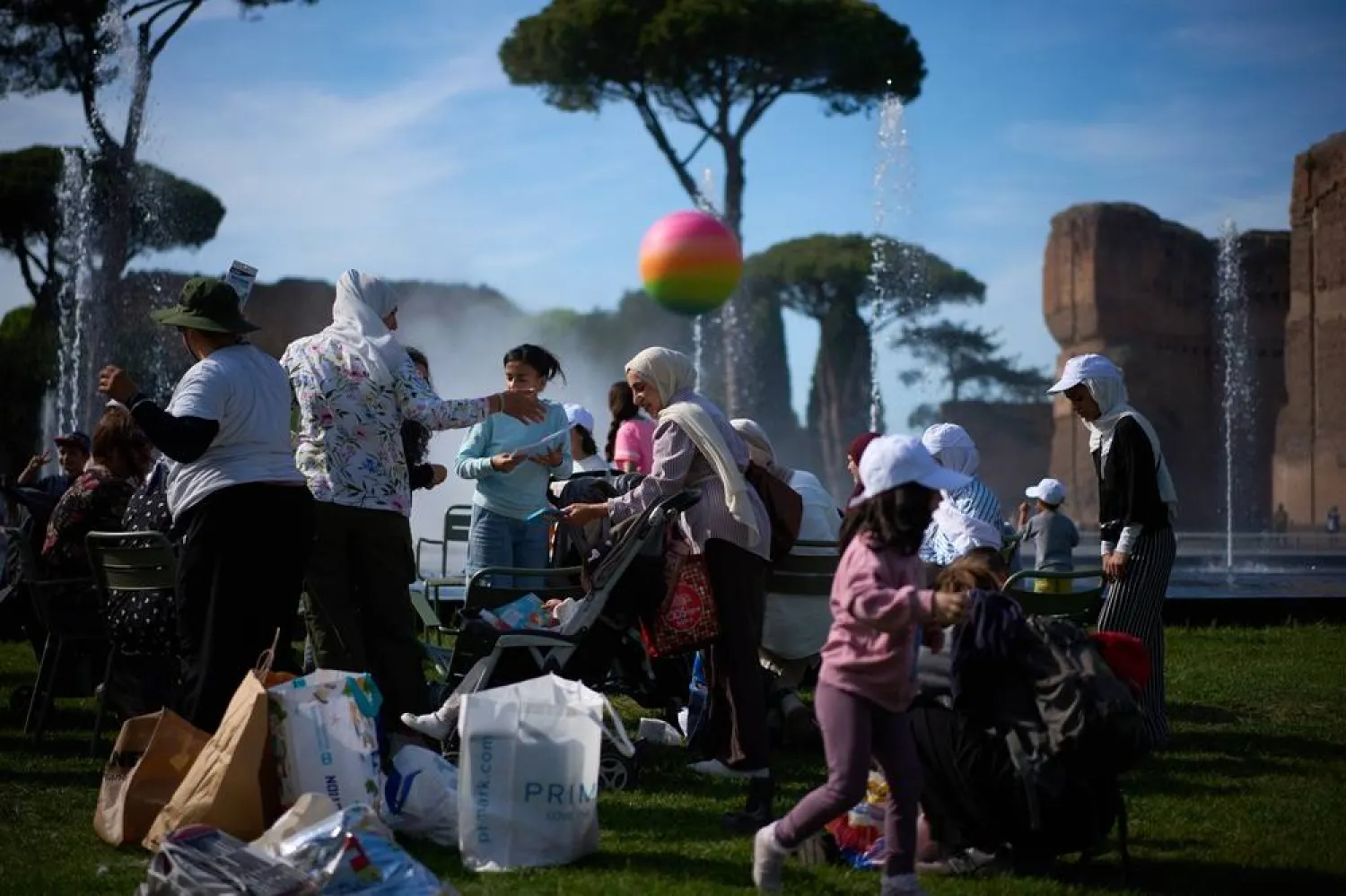
 Families of Palestinian refugees who have arrived in Italy from the Gaza Strip through humanitarian corridors due to serious medical reasons, take part in a visit to Rome's Baths of Caracalla offered by the "Guides for Gaza" association, Sunday, May 3, 2026. (AP)
Families of Palestinian refugees who have arrived in Italy from the Gaza Strip through humanitarian corridors due to serious medical reasons, take part in a visit to Rome's Baths of Caracalla offered by the "Guides for Gaza" association, Sunday, May 3, 2026. (AP)
TT

Families Evacuated from Gaza Enjoy a Day to Decompress at Rome’s Ancient Baths

 Families of Palestinian refugees who have arrived in Italy from the Gaza Strip through humanitarian corridors due to serious medical reasons, take part in a visit to Rome's Baths of Caracalla offered by the "Guides for Gaza" association, Sunday, May 3, 2026. (AP)
Families of Palestinian refugees who have arrived in Italy from the Gaza Strip through humanitarian corridors due to serious medical reasons, take part in a visit to Rome's Baths of Caracalla offered by the "Guides for Gaza" association, Sunday, May 3, 2026. (AP)

The Baths of Caracalla, the sumptuously decorated public baths complex near the Colosseum, were long a place of leisure, healthcare and relaxation for ancient Romans.

On Sunday, the place provided a different sort of decompression to a group of Palestinian children and their families who had been evacuated from Gaza for medical care, thanks to Italy’s program of “humanitarian corridors.”

“We brought families with children so they could experience visiting an ancient archaeological site," Luisa delle Fratte, a tour guide in the group Guides for Gaza, told The Associated Press. "We also offered them a snack, some games and moments of social interaction and togetherness.”

Ordinary Italian families milled about the sprawling site, some settling on the grass to enjoy the springtime sun. The Palestinian families, all of whom now reside in Rome, blended right in — following their tour guide and translator, taking selfies in front of the ruins and watching the jets of water shooting upward from the new reflecting pool. Organizers say they intended the day as a respite from medical treatments and memories of the war.

“I was injured and lost my ability to speak, as well as mobility and normal function in my hand and leg,” 13-year-old Ahmed Skena said, struggling to string together his words. He haltingly added that he also lost his father and brother in the war.

Mariam Dawwas, 25, attended with her husband and four young children, one of whom is ill. They wound up in Italy after being displaced over 10 times.

“Thank God, I am still in a better situation than in Gaza, away from the bombing. At least I am safe, I have shelter, and there is light for my children,” she said.

Some of the families at Caracalla on Sunday knew each other from Gaza, but hadn't seen one another since their evacuation, said delle Fratte of Guides for Gaza, a network founded last year in Umbria and Tuscany, and recently expanded to Naples and Rome.

"It was very beautiful to see them there embracing again and meeting one another once more,” she said.

While the Palestinian families toured the ruins, other guides offered tours to Italians in exchange for donations to support Gazzella, a nonprofit involved in child protection projects in the Gaza Strip.

The war in Gaza began with a 2023 Hamas-led attack on southern Israel, in which the fighters killed 1,200 people, most of them civilians, and abducted 251. More than 72,000 Palestinians have been killed since the start of the war, according to the Gaza Health Ministry, which does not distinguish between fighters and civilians.

The ministry, which is part of the Hamas-led government, maintains detailed casualty records that are seen as generally reliable by UN agencies and independent experts.


European Leaders See Trump’s Troop Drawdown from Germany as New Proof They Must Go it Alone

An AH-64 Apache attack helicopter stands in front of a Galaxy C-5 transport plane at the US Air Base in Ramstein, western Germany, on February 22, 2017. (dpa/AFP)
TT

European Leaders See Trump’s Troop Drawdown from Germany as New Proof They Must Go it Alone

An AH-64 Apache attack helicopter stands in front of a Galaxy C-5 transport plane at the US Air Base in Ramstein, western Germany, on February 22, 2017. (dpa/AFP)

European leaders on Monday said that US President Donald Trump’s snap decision to pull thousands of US troops out of Germany came as a surprise but is a fresh sign that Europe must take care of its own security.

The Pentagon announced last week that it would pull some 5,000 troops out of Germany, but Trump told reporters on Saturday that “we’re going to cut way down. And we’re cutting a lot further than 5,000.”

He offered no reason for the move, which blindsided NATO, but his decision came amid an escalating dispute with German Chancellor Friedrich Merz over the US-Israeli war on Iran, and Trump’s anger that European allies have been reluctant to get involved in the conflict in the Middle East.

Asked about the decision to pull out 5,000 troops from Germany, Norwegian Prime Minister Jonas Gahr Støre said: “I wouldn’t exaggerate that because I think we are expecting that Europe is taking more charge of its own security.

“I do not see those figures as dramatic, but I think they should be handled in a harmonious way inside the framework of NATO,” he told reporters in Yerevan, Armenia, where European leaders are holding a summit.

The European Union’s foreign policy chief, Kaja Kallas, said “there has been a talk about withdrawal of US troops for a long time from Europe. But of course, the timing of this announcement comes as a surprise.”

“I think it shows that we have to really strengthen the European pillar in NATO,” she said.

Asked whether she believes that Trump is trying to punish Merz, who said that the US has been humiliated by Iran in talks to end the war, Kallas said: “I don’t see into the head of President Trump, so he has to explain it himself.”

Over the weekend, NATO spokesperson Allison Hart said that officials at the 32-nation military alliance “are working with the US to understand the details of their decision on force posture in Germany.”

European allies and Canada have known since just after he came to office again last year that Trump would pull troops out of Europe — indeed some left Romania in October — but US officials had pledged to coordinate any moves with their NATO allies to avoid creating a security vacuum.

NATO Secretary-General Mark Rutte played down the move, saying that “there has been at this point disappointment on the US side” about European support for the war on Iran.

Notably France, Spain and the UK have declined to give US forces free rein to use bases on their territory to attack Iran. Spain has denied them the use of its airspace and bases there for the war.

But Rutte, who has championed Trump’s leadership at NATO despite the US president's criticism of the majority of the allies, said: “I would say the Europeans have heard a message. They are now making sure that all the bilateral basing agreements are being implemented.”

Rutte added that European nations “have decided to pre-position assets, key assets, close to the theater for the next phase.”

He provided no details, but the Europeans have insisted they would not help police the Strait of Hormuz, a key energy trade route, until the war is over.

French President Emmanuel Macron said “if the United States is ready to reopen Hormuz, that’s great. That’s what we’ve been asking for since the beginning.” But he underlined that the Europeans are not ready to get involved in any operation “that does not seem clear to us.”

In another sign of friction with Merz, Trump has accused the EU of not complying with its US trade deal and announced plans to increase tariffs next week on cars and trucks produced in the bloc to 25%, a move that would be particularly damaging to Germany, a major automobile manufacturer.

Without mentioning Trump or the United States, European Commission President Ursula von der Leyen listed recent trade deals that the bloc has sealed with Australia and India, and is now working on with Mexico.

“With like-minded friends, you have stable, reliable supply chains and Europe has the biggest network of free trade agreements,” von der Leyen, who is from Germany, told reporters.