


Cristiano Ronaldo at Madrid was More than Just Goals

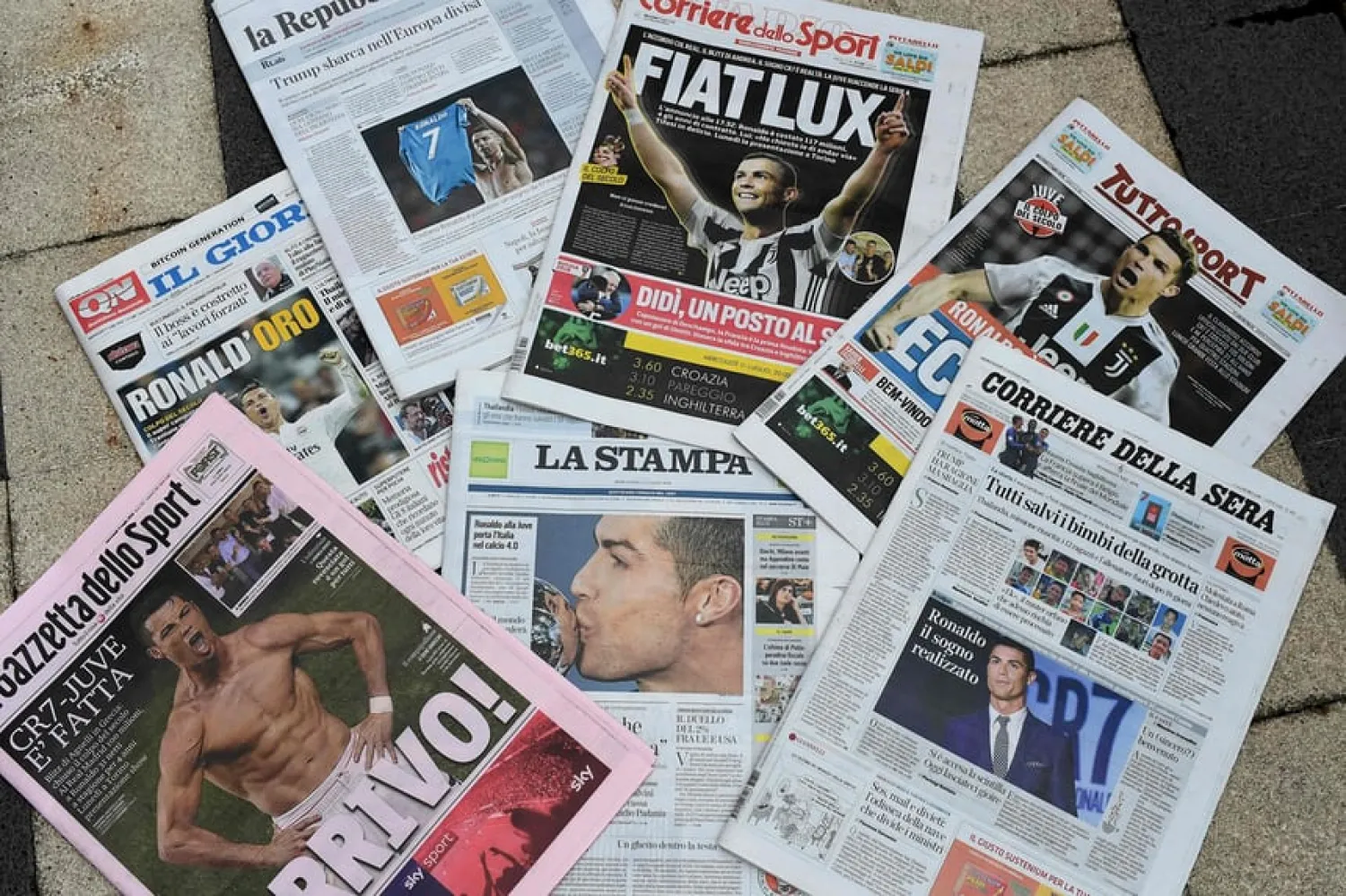
 The Italian press welcomes Ronaldo to Turin. Photograph: Miguel Medina/AFP/Getty Images
The Italian press welcomes Ronaldo to Turin. Photograph: Miguel Medina/AFP/Getty Images
TT

Cristiano Ronaldo at Madrid was More than Just Goals

 The Italian press welcomes Ronaldo to Turin. Photograph: Miguel Medina/AFP/Getty Images
The Italian press welcomes Ronaldo to Turin. Photograph: Miguel Medina/AFP/Getty Images

Your goals, your numbers and everything we’ve won together speak for themselves,” Sergio Ramos said once the news finally broke. Real Madrid’s players had doubted that it would come to this, that he would really do it and that they would really let him, but this time it was real. Barely minutes after the Champions League final, before the trophy had been handed over, Cristiano Ronaldo said that it had been – past tense – nice being at Madrid. Moments later Florentino Pérez, the president with whom there was little warmth, said he had heard before and in the end nothing ever happens. But he had not, not like this, and in the end it did.

The announcement was made at 5.34 Spanish time. After nine years at the Santiago Bernabéu Cristiano Ronaldo was joining Juventus for €100m (£88.3m), plus €5m to be paid to his former clubs. The 33-year-old has signed a four-year deal reportedly worth around €30m a year, after tax; the total cost is estimated to be €345m.

That is a lot of numbers, and there are many more. Sometimes it can feel as if that is all there is. As Real Madrid’s captain put it in his farewell to the ‘Bicho’, the Beast: your goals, your numbers speak for themselves. These are not, it appears, days for poetry, which is a pity. If a picture paints a thousand words – and the sports daily AS marked the occasion by leading on one last photo of Ronaldo topless, this time from the Greek island where the deal was closed – then it sometimes seems numbers make them obsolete. The stats say it all – especially when they are like these, so absurd.

When Ronaldo was presented at Madrid, the club’s nine European Cups were lined up at the Bernabéu. He looked at them, impressed. Nine years on, four more have been added – including three in a row, four in five years. This is their most successful era, the best any club has had in the competition since they won the first five titles, led by Alfredo Di Stéfano – the man who changed their history and made them what they are, the man who sat watching Ronaldo that night, clutching his walking stick. Ronaldo also won two league titles, two Copa del Reys and three Club World Cups.

More importantly – and there may be something telling in those two words – Ronaldo has won the Ballon d’Or five times and may well make that six this winter, and is the all-time top scorer in the Champions League, unsurpassed in each of the past six seasons. He scored 311 in the Spanish league. He scored 44 hat-tricks, for goodness sake. He scored more goals at Madrid than anyone else, ever. He overtook Emilio Butragueño, Hugo Sánchez, Carlos Santillana, Raúl and Di Stéfano. He averaged more than a goal a game (1.029); only Ferenc Puskas on 0.92 came close. Ronaldo scored 450 goals in 438 games. 451, according to the sports daily Marca (a deflected free-kick from 2010 remains disputed).

Four-hundred-and-fifty-one-flippin-goals.

Marca bade “farewell to a legend”, declaring “there won’t be another like him”, by printing the goals across a double-paged front cover: 451 little footballs, one for each strike, marked with the badge of the club that conceded them. The balls fill every space, peppered all across the page; a telling image expressing the indiscriminate nature of it, the relentlessness that defines him, the magnitude of it all. It is a useful image too: it can be exhausting just looking at the figures, a sea of digits, and it can also be easy to gloss over them. Some variation on that old line, supposedly introduced by Stalin: one goal is a triumph but 450 of them is a statistic.

And while statistics brook little argument, they also leave little room for lyricism. They can reduce everything to numbers and risk making the extraordinary routine. They normalise it – just another goal, just another hat-trick – when it is not normal. They also make it too easy to leave the analysis there, the eulogies too, failing to invite imagination or a full appreciation of an astonishing footballer who marked an era. “It was nice while it lasted,” one headline said, as if it had not lasted long when this was an entire decade of dominance at the biggest club of them all. This is part of the problem: it is as if what makes it so magnificent also makes it oddly mundane: Ronaldo? Stupid amounts of goals. And that’s it. But it is not it.

Even the one that Ronaldo said was his best, the overhead kick that he scored against the club that is now his own and the goal that sits in the middle of the sea of balls on Marca’s cover, while “framed” by picture desks and declared a work of art, ended up being quantified. Diagrams purported to show how high he had leapt, the angle of his body, like something from an engineering analysis. Man becomes machine. A beast, perhaps. An extraterrestrial, Álvaro Arbeloa called him.

It is a tempting analogy, easy enough to slip into and accurate enough. He is built, after all – a construction, self-made. He did this. His body shape, often exhibited, reinforces that and there are countless stories that relay ambition: weights on ankles, hours in the gym. Even within elite football teammates recognise he is different; there is a touch of extremism in his application that underpins an admiration which is deep. Paul Clement, assistant coach at Madrid under Carlo Ancelotti, tells the story of the team getting back in the small hours after some away trip in Europe. The rest head wearily home; Ronaldo stays at the training ground, plunging into an ice bath.

Thus the machine is made and maintained – but that, by definition, is human. He is brilliant because of who he is, and so even if the natural focus is the numbers, it is worth remembering where they come from and enjoying them for what they are. Yet cold stats do not invite warmth; counting goals leaves little room to appreciate them. That header in the Copa del Rey final, say; although, again, that was textbook in its perfection, inviting diagrams and compasses. The skill, the touch, the quality, the technique, the feeling.

The emotion is sometimes lost and the intelligence, too, is overlooked on occasion: the effort is extreme but it is also targeted, thought through. There has been self-awareness, adaptation. Zinedine Zidane, now departed, was central to that but no one was more central than Ronaldo, whose evolution has been fascinating. His game has become more focused, more limited and yet more effective than ever, and his team have been more successful. That helps explain why, at 33, Juventus believe the end is not yet nigh: his best years have come when his worst years should have done. He stepped centre stage on the biggest stages past 30. He has said he will play until he is 40; although he would not be the same, that does not seem so absurd any more.

Nothing will be the same now. “He is the best in history with Di Stéfano,” Pérez said in January. Di Stéfano departed sadly too, incidentally. It is impossible to do justice to what Di Stéfano achieved, yet there was Ronaldo being held up alongside him. Perhaps the best player in the history of the most successful club there is, one of the game’s all-time greats.

Pérez had said that a “new era” would begin the day that Ronaldo left. Now that he has, this does seem monumental, even if it was coming – like some staging post in life, something lost, a generational shift, the end. Madrid, though, have modified the message, seeking to avoid that melancholy. It has also been important to publicly lay responsibility for this break-up at Ronaldo’s door. There may be blame at some point.

For all the coldness of the conclusion to this era, the coldness too of the stats that fill endless pages today, the focal point of the farewell, this move is an emotional one primarily propelled by pride. Looking back on that overhead kick, when Juventus’ fans applauded and Ronaldo, slowly realising, brought his hand to his heart, one wonders if that was the start of something. There he felt the love, the affection he did not feel at Madrid. Signed by the outgoing Ramón Calderón, Ronaldo’s relationship was never close with Pérez and extra layers were added with time: the case brought against him by the Spanish tax man, the pursuit of other players, the refusal to countenance another renewal. And so in the end he went. Everyone does eventually, but not everyone is the same.

His figures spoke for themselves perhaps but Ronaldo wanted to be heard too. At the end of a career that became defined by the tangible values, quantifiable and counted in goals, there was something intangible he sought. There had been threats before; this time, the club decided it could not go on. Now they must confront a new era, and it won’t be easy, they know. It won’t be for anyone: this is one of those deals where it may seem that everyone wins, or perhaps that everyone loses. After the Champions League final, a European champion again, but his mind already elsewhere, Ronaldo had been asked where he would be better off than Real Madrid. “Difficult,” he said, “but life is not just about glory.”

It is not just about goals either. But, bloody hell, there were a lot of them.

The Guardian Sport


Sinner Sees off Popyrin to Reach Doha Quarters

 Italy's Jannik Sinner greets the fans after defeating Australia's Alexei Popyrin in their men's singles match at the Qatar Open tennis tournament in Doha on February 18, 2026. (AFP)
Italy's Jannik Sinner greets the fans after defeating Australia's Alexei Popyrin in their men's singles match at the Qatar Open tennis tournament in Doha on February 18, 2026. (AFP)
TT

Sinner Sees off Popyrin to Reach Doha Quarters

 Italy's Jannik Sinner greets the fans after defeating Australia's Alexei Popyrin in their men's singles match at the Qatar Open tennis tournament in Doha on February 18, 2026. (AFP)
Italy's Jannik Sinner greets the fans after defeating Australia's Alexei Popyrin in their men's singles match at the Qatar Open tennis tournament in Doha on February 18, 2026. (AFP)

Jannik Sinner powered past Alexei Popyrin in straight sets on Wednesday to reach the last eight of the Qatar Open and edge closer to a possible final meeting with Carlos Alcaraz.

The Italian, playing his first tournament since losing to Novak Djokovic in the Australian Open semi-finals last month, eased to a 6-3, 7-5 second-round win in Doha.

Sinner will play Jakub Mensik in Thursday's quarter-finals.

Australian world number 53 Popyrin battled gamely but failed to create a break-point opportunity against his clinical opponent.

Sinner dropped just three points on serve in an excellent first set which he took courtesy of a break in the sixth game.

Popyrin fought hard in the second but could not force a tie-break as Sinner broke to grab a 6-5 lead before confidently serving it out.

World number one Alcaraz takes on Frenchman Valentin Royer in his second-round match later.


Ukraine's Officials to Boycott Paralympics over Russian Flag Decision

Milano Cortina 2026 Winter Olympics - Skeleton - Interview with Ukraine Youth and Sports minister Matvii Bidnyi - N H Hotel, Milan, Italy - February 12, 2026 Ukraine Youth and Sports Minister Matvii Bidnyi speaks after the disqualification of Ukrainian skeleton racer Vladyslav Heraskevych from the Winter Games. REUTERS/Kevin Coombs
TT

Ukraine's Officials to Boycott Paralympics over Russian Flag Decision

Milano Cortina 2026 Winter Olympics - Skeleton - Interview with Ukraine Youth and Sports minister Matvii Bidnyi - N H Hotel, Milan, Italy - February 12, 2026 Ukraine Youth and Sports Minister Matvii Bidnyi speaks after the disqualification of Ukrainian skeleton racer Vladyslav Heraskevych from the Winter Games. REUTERS/Kevin Coombs

Ukrainian officials will boycott the Paralympic Winter Games, Kyiv said Wednesday, after the International Paralympic Committee allowed Russian athletes to compete under their national flag.

Ukraine also urged other countries to shun next month's Opening Ceremony in Verona on March 6, in part of a growing standoff between Kyiv and international sporting federations four years after Russia invaded.

Six Russians and four Belarusians will be allowed to take part under their own flags at the Milan-Cortina Paralympics rather than as neutral athletes, the Games' governing body confirmed to AFP on Tuesday.

Russia has been mostly banned from international sport since Moscow invaded Ukraine. The IPC's decision triggered fury in Ukraine.

Ukraine's sports minister Matviy Bidny called the decision "outrageous", and accused Russia and Belarus of turning "sport into a tool of war, lies, and contempt."

"Ukrainian public officials will not attend the Paralympic Games. We will not be present at the opening ceremony," he said on social media.

"We will not take part in any other official Paralympic events," he added.

Ukrainian Foreign Minister Andriy Sybiga said he had instructed Kyiv's ambassadors to urge other countries to also shun the opening ceremony.

"Allowing the flags of aggressor states to be raised at the Paralympic Games while Russia's war against Ukraine rages on is wrong -- morally and politically," Sybiga said on social media.

The EU's sports commissioner Glenn Micallef said he would also skip the opening ceremony.

- Kyiv demands apology -

The IPC's decision comes amid already heightened tensions between Ukraine and the International Olympic Committee, overseeing the Winter Olympics currently underway.

The IOC banned Ukrainian skeleton racer Vladyslav Heraskevych for refusing to ditch a helmet depicting victims of the war with Russia.

Ukraine was further angered that the woman chosen to carry the "Ukraine" name card and lead its team out during the Opening Ceremony of the Games was revealed to be Russian.

Media reports called the woman an anti-Kremlin Russian woman living in Milan for years.

"Picking a Russian person to carry the nameplate is despicable," Kyiv's foreign ministry spokesman Georgiy Tykhy said at a briefing in response to a question by AFP.

He called it a "severe violation of the Olympic Charter" and demanded an apology.

And Kyiv also riled earlier this month at FIFA boss Gianni Infantino saying he believed it was time to reinstate Russia in international football.

- 'War, lies and contempt' -

Valeriy Sushkevych, president of the Ukrainian Paralympic Committee told AFP on Tuesday that Kyiv's athletes would not boycott the Paralympics.

Ukraine traditionally performs strongly at the Winter Paralympics, coming second in the medals table four years ago in Beijing.

"If we do not go, it would mean allowing Putin to claim a victory over Ukrainian Paralympians and over Ukraine by excluding us from the Games," said the 71-year-old in an interview.

"That will not happen!"

Russia was awarded two slots in alpine skiing, two in cross-country skiing and two in snowboarding. The four Belarusian slots are all in cross-country skiing.

The International Paralympic Committee (IPC) said earlier those athletes would be "treated like (those from) any other country".

The IPC unexpectedly lifted its suspension on Russian and Belarusian athletes at the organisation's general assembly in September.


'Not Here for Medals', Nakai Says after Leading Japanese Charge at Olympics

Ami Nakai of Japan competes during the women's short program figure skating at the 2026 Winter Olympics, in Milan, Italy, Tuesday, Feb. 17, 2026. (AP Photo/Ashley Landis)
TT

'Not Here for Medals', Nakai Says after Leading Japanese Charge at Olympics

Ami Nakai of Japan competes during the women's short program figure skating at the 2026 Winter Olympics, in Milan, Italy, Tuesday, Feb. 17, 2026. (AP Photo/Ashley Landis)

Ami Nakai entered her first Olympics insisting she was not here for medals — but after the short program at the Milano Cortina Games, the 17-year-old figure skater found herself at the top, ahead of national icon Kaori Sakamoto and rising star Mone Chiba.

Japan finished first, second, and fourth on Tuesday, cementing a formidable presence heading into the free skate on Thursday. American Alysa Liu finished third.

Nakai's clean, confident skate was anchored by a soaring triple Axel. She approached the moment with an ease unusual for an Olympic debut.

"I'm not here at this Olympics with the goal of achieving a high result, I'm really looking forward to enjoying this Olympics as much as I can, till the very last moment," she said.

"Since this is my first Olympics, I had nothing to lose, and that mindset definitely translated into my results," she said.

Her carefree confidence has unexpectedly put her in medal contention, though she cannot imagine herself surpassing Sakamoto, the three-time world champion who is skating the final chapter of her competitive career. Nakai scored 78.71 points in the short program, ahead of Sakamoto's 77.23.

"There's no way I stand a chance against Kaori right now," Nakai said. "I'm just enjoying these Olympics and trying my best."

Sakamoto, 25, who has said she will retire after these Games, is chasing the one accolade missing from her resume: Olympic gold.

Having already secured a bronze in Beijing in 2022 and team silvers in both Beijing and Milan, she now aims to cap her career with an individual title.

She delivered a polished short program to "Time to Say Goodbye," earning a standing ovation.

Sakamoto later said she managed her nerves well and felt satisfied, adding that having three Japanese skaters in the top four spots "really proves that Japan is getting stronger". She did not feel unnerved about finishing behind Nakai, who also bested her at the Grand Prix de France in October.

"I expected to be surpassed after she landed a triple Axel ... but the most important thing is how much I can concentrate on my own performance, do my best, stay focused for the free skate," she said.

Chiba placed fourth and said she felt energised heading into the free skate, especially after choosing to perform to music from the soundtrack of "Romeo and Juliet" in Italy.

"The rankings are really decided in the free program, so I'll just try to stay calm and focused in the free program and perform my own style without any mistakes," said the 20-year-old, widely regarded as the rising all-rounder whose steady ascent has made her one of Japan's most promising skaters.

All three skaters mentioned how seeing Japanese pair Riku Miura and Ryuichi Kihara deliver a stunning comeback, storming from fifth place after a shaky short program to capture Japan's first Olympic figure skating pairs gold medal, inspired them.

"I was really moved by Riku and Ryuichi last night," Chiba said. "The three of us girls talked about trying to live up to that standard."
