


Maurizio Sarri Looks Like a Subtle Change of Direction for Chelsea

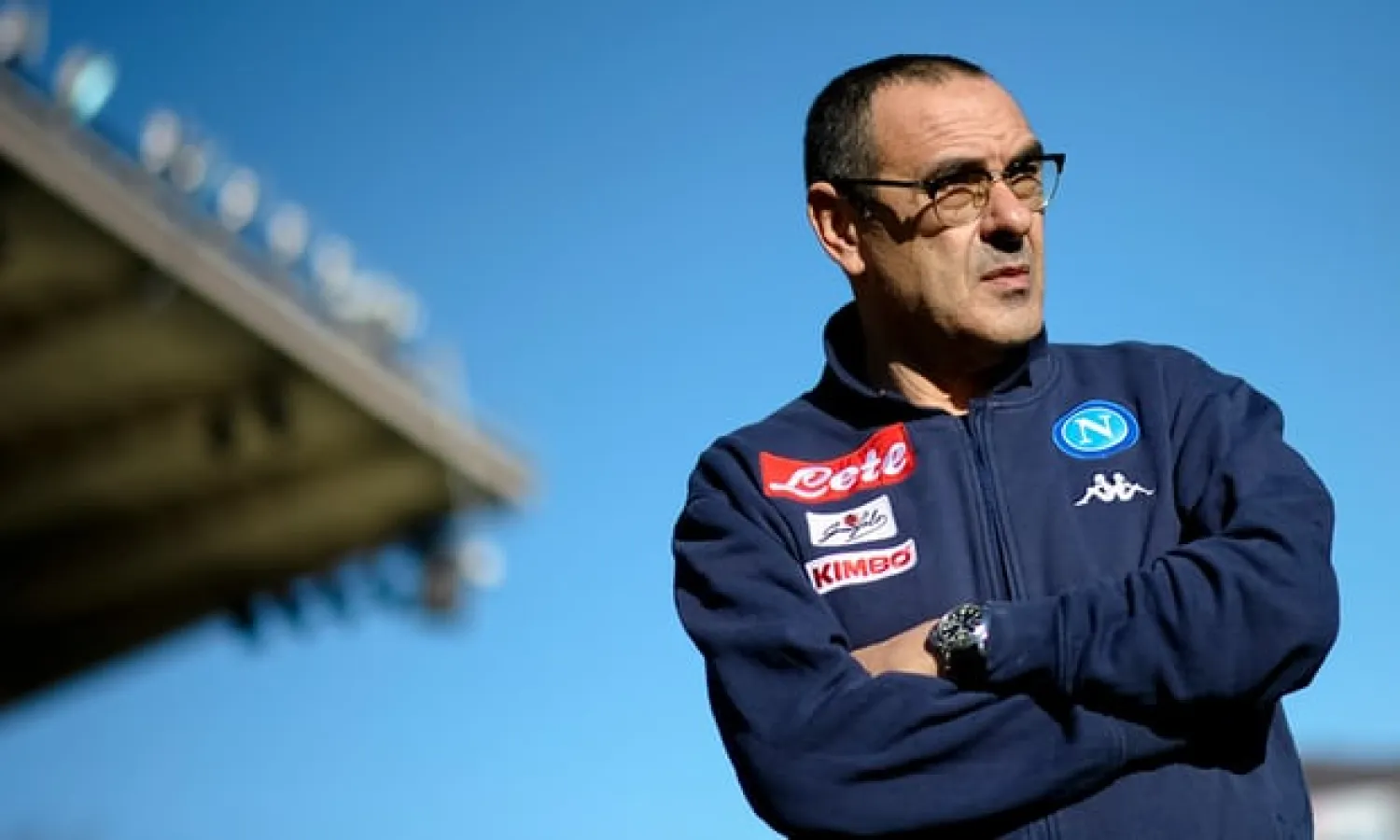
 The arrival of Maurizio Sarri as head coach marks a change of direction from Chelsea. Photograph: Nicolò Campo/LightRocket via Getty Images
The arrival of Maurizio Sarri as head coach marks a change of direction from Chelsea. Photograph: Nicolò Campo/LightRocket via Getty Images
TT

Maurizio Sarri Looks Like a Subtle Change of Direction for Chelsea

 The arrival of Maurizio Sarri as head coach marks a change of direction from Chelsea. Photograph: Nicolò Campo/LightRocket via Getty Images
The arrival of Maurizio Sarri as head coach marks a change of direction from Chelsea. Photograph: Nicolò Campo/LightRocket via Getty Images

Mauricio Pochettino has been at the club for four years and agreed a new five-year deal shortly before Antonio Conte found it necessary to pack his bags after just a couple of seasons at Stamford Bridge.

Over at Arsenal, no one expects Unai Emery to last anything like the 22 years his predecessor put in, though there is a distinct sense that the board have cast around for a manager suited to the club with a view to replicating the stability achieved under Arsène Wenger.

Chelsea do not seem to do stability. They have made 11 managerial changes in the 14 years since Claudio Ranieri’s four-season stint at the start of the millennium, and though five titles and both major European trophies have arrived in that period, no manager has succeeded in serving for longer than the Tinkerman.

Maurizio Sarri’s chances of proving any more permanent are already being questioned on account of his age – 59 – and the fact that though personable and popular he has not yet succeeded in winning anything in his managerial career. Chelsea have appointed the former Napoli manager in a departure from their normal selection process. Ever since José Mourinho arrived to speed up the process of turning Roman Abramovich’s investment into success on the pitch the club have gone for proven winners when not appointing from within or finding a short-term solution – even André Villas-Boas had the Portuguese league title and a Europa League triumph on his CV when he arrived as a relative unknown. Mourinho came fresh from winning the Champions League with Porto, Carlo Ancelotti had won it twice with Milan and would go on to win it again with Real Madrid, while Conte came direct from managing Italy following three Serie A titles in a row with Juventus.

Ancelotti has replaced Sarri at Napoli and can look forward to Champions League football next season thanks to the latter’s efforts in finishing runners-up to Juventus, though second place is not normally the sort of achievement that would recommend a manager to Chelsea. Sarri has never managed outside Italy, was in charge of obscure lower league sides such as Alessandria and Sorrento until six years ago, and in no way fits the stellar profile of the statement manager Abramovich has been accustomed to hiring. But statement managers can be hard work, as Chelsea have just discovered with Conte.

He did not lose the goodwill of his players, as seemed to happen to Mourinho in his second spell at the club, but he has gone public on numerous occasions with his dissatisfaction over funding and transfer policy. Chelsea managed only fifth place last season after winning the title the previous year. Conte’s side put up a more convincing defence than did Mourinho’s in 2015-16, though missing out on the Champions League every couple of seasons is not something that appeals to the owner and all season long Conte has sounded like someone getting his excuses in first. “After two years the club know me very well,” he said after defeating Mourinho’s Manchester United in the FA Cup final. “I can’t change.”

His departure could be seen as an acknowledgment that the club realise that, just as Sarri might be viewed as a subtle change in direction by Chelsea. Though Conte’s habitual moaning became a pain, he was merely articulating what has become increasingly apparent in the last few years: that not even Chelsea can match Manchester City for money. Or, it seems, for managerial input of the sort that brings in major trophies and attracts the very best players. That was Chelsea’s formula for instant success a decade ago, but it never brought the continuity City are starting to achieve.

Pep Guardiola has signed a two-year extension to his contract, and should he see it out – all the signs from his previous clubs suggest he will – he will have spent five years in Manchester.

The last Chelsea manager to last five years was Dave Sexton, who took over from the equally durable Tommy Docherty. Chelsea have been up and down the divisions since the 1960s, of course, becoming in the process a byword for infuriating inconsistency, but the point is that so have Manchester City. If Guardiola does stay for five years, he will be the first City manager to do so since Tony Book, and before him Joe Mercer.

The two clubs with the most eye-catching financial backing over the last few years have more in common than it might appear, but in their newly-rich incarnation City have long had a plan that they have been diligent and patient in bringing to fruition. Chelsea, admittedly not helped by friction between players and some of the managers at times, are still going through coaches at the rate they were doing when Ken Bates was in charge.

Sarri may not have led Napoli to the title but he rejuvenated his native city’s club, succeeded in playing more attacking football than Rafael Benítez and was voted Italian coach of the year last season. All those things should recommend him to Chelsea, as should the fact that though he initially signed for only a season at Napoli, he ended up with an extension to 2020.

Obviously that did not work out – this is football after all – but after the disappointments of the past few seasons, there might be worse things for Chelsea to aspire to than being Napoli to Manchester City’s Juventus. As Jürgen Klopp has proved at Liverpool, a charismatic and positive manager capable of generating love from players and supporters can take a club a long way.

The Guardian Sport


Shakhtar Boss Pays Ukrainian Racer $200,000 After Games Disqualification

Ukrainian President Volodymyr Zelenskiy holds helmet as he meets with a Ukrainian skeleton racer Vladyslav Heraskevych , who was disqualified from the Olympic skeleton competition over his "helmet of remembrance" depicting athletes killed since Russia's invasion and his father and coach, Mykhailo Heraskevych, amid Russia's attack on Ukraine, in Munich, Germany February 13, 2026. (Ukrainian Presidential Press Service/Handout via Reuters)
TT

Shakhtar Boss Pays Ukrainian Racer $200,000 After Games Disqualification

Ukrainian President Volodymyr Zelenskiy holds helmet as he meets with a Ukrainian skeleton racer Vladyslav Heraskevych , who was disqualified from the Olympic skeleton competition over his "helmet of remembrance" depicting athletes killed since Russia's invasion and his father and coach, Mykhailo Heraskevych, amid Russia's attack on Ukraine, in Munich, Germany February 13, 2026. (Ukrainian Presidential Press Service/Handout via Reuters)

The owner of ‌Ukrainian football club Shakhtar Donetsk has donated more than $200,000 to skeleton racer Vladyslav Heraskevych after the athlete was disqualified from the Milano Cortina Winter Games before competing over the use of a helmet depicting Ukrainian athletes killed in the war with Russia, the club said on Tuesday.

The 27-year-old Heraskevych was disqualified last week when the International Bobsleigh and Skeleton Federation jury ruled that imagery on the helmet — depicting athletes killed since Russia invaded Ukraine in 2022 — breached rules on athletes' expression at ‌the Games.

He ‌then lost an appeal at the Court ‌of ⁠Arbitration for Sport hours ⁠before the final two runs of his competition, having missed the first two runs due to his disqualification.

Heraskevych had been allowed to train with the helmet that displayed the faces of 24 dead Ukrainian athletes for several days in Cortina d'Ampezzo where the sliding center is, but the International Olympic Committee then ⁠warned him a day before his competition ‌started that he could not wear ‌it there.

“Vlad Heraskevych was denied the opportunity to compete for victory ‌at the Olympic Games, yet he returns to Ukraine a ‌true winner," Shakhtar President Rinat Akhmetov said in a club statement.

"The respect and pride he has earned among Ukrainians through his actions are the highest reward. At the same time, I want him to ‌have enough energy and resources to continue his sporting career, as well as to fight ⁠for truth, freedom ⁠and the remembrance of those who gave their lives for Ukraine," he said.

The amount is equal to the prize money Ukraine pays athletes who win a gold medal at the Games.

The case dominated headlines early on at the Olympics, with IOC President Kirsty Coventry meeting Heraskevych on Thursday morning at the sliding venue in a failed last-minute attempt to broker a compromise.

The IOC suggested he wear a black armband and display the helmet before and after the race, but said using it in competition breached rules on keeping politics off fields of play. Heraskevych also earned praise from Ukraine President Volodymyr Zelenskiy.


Speed Skating-Italy Clinch Shock Men’s Team Pursuit Gold, Canada Successfully Defend Women’s Title

 Team Italy with Davide Ghiotto, Andrea Giovannini, Michele Malfatti, celebrate winning the gold medal on the podium of the men's team pursuit speed skating race at the 2026 Winter Olympics, in Milan, Italy, Tuesday, Feb. 17, 2026. (AP)
Team Italy with Davide Ghiotto, Andrea Giovannini, Michele Malfatti, celebrate winning the gold medal on the podium of the men's team pursuit speed skating race at the 2026 Winter Olympics, in Milan, Italy, Tuesday, Feb. 17, 2026. (AP)
TT

Speed Skating-Italy Clinch Shock Men’s Team Pursuit Gold, Canada Successfully Defend Women’s Title

 Team Italy with Davide Ghiotto, Andrea Giovannini, Michele Malfatti, celebrate winning the gold medal on the podium of the men's team pursuit speed skating race at the 2026 Winter Olympics, in Milan, Italy, Tuesday, Feb. 17, 2026. (AP)
Team Italy with Davide Ghiotto, Andrea Giovannini, Michele Malfatti, celebrate winning the gold medal on the podium of the men's team pursuit speed skating race at the 2026 Winter Olympics, in Milan, Italy, Tuesday, Feb. 17, 2026. (AP)

An inspired Italy delighted the home crowd with a stunning victory in the Olympic men's team pursuit final as

Canada's Ivanie Blondin, Valerie Maltais and Isabelle Weidemann delivered another seamless performance to beat the Netherlands in the women's event and retain their title ‌on Tuesday.

Italy's ‌men upset the US who ‌arrived ⁠at the Games ⁠as world champions and gold medal favorites.

Spurred on by double Olympic champion Francesca Lollobrigida, the Italian team of Davide Ghiotto, Andrea Giovannini and Michele Malfatti electrified a frenzied arena as they stormed ⁠to a time of three ‌minutes 39.20 seconds - ‌a commanding 4.51 seconds clear of the ‌Americans with China taking bronze.

The roar inside ‌the venue as Italy powered home was thunderous as the crowd rose to their feet, cheering the host nation to one ‌of their most special golds of a highly successful Games.

Canada's women ⁠crossed ⁠the line 0.96 seconds ahead of the Netherlands, stopping the clock at two minutes 55.81 seconds, and

Japan rounded out the women's podium by beating the US in the Final B.

It was only Canada's third gold medal of the Games, following Mikael Kingsbury's win in men's dual moguls and Megan Oldham's victory in women's freeski big air.


Lindsey Vonn Back in US Following Crash in Olympic Downhill 

Milano Cortina 2026 Olympics - Alpine Skiing - Women's Downhill 3rd Official Training - Tofane Alpine Skiing Centre, Belluno, Italy - February 07, 2026. Lindsey Vonn of United States in action during training. (Reuters)
TT

Lindsey Vonn Back in US Following Crash in Olympic Downhill 

Milano Cortina 2026 Olympics - Alpine Skiing - Women's Downhill 3rd Official Training - Tofane Alpine Skiing Centre, Belluno, Italy - February 07, 2026. Lindsey Vonn of United States in action during training. (Reuters)

Lindsey Vonn is back home in the US following a week of treatment at a hospital in Italy after breaking her left leg in the Olympic downhill at the Milan Cortina Games.

“Haven’t stood on my feet in over a week... been in a hospital bed immobile since my race. And although I’m not yet able to stand, being back on home soil feels amazing,” Vonn posted on X with an American flag emoji. “Huge thank you to everyone in Italy for taking good care of me.”

The 41-year-old Vonn suffered a complex tibia fracture that has already been operated on multiple times following her Feb. 8 crash. She has said she'll need more surgery in the US.

Nine days before her fall in Cortina d'Ampezzo, Italy, Vonn ruptured the ACL in her left knee in another crash in Switzerland.

Even before then, all eyes had been on her as the feel-good story heading into the Olympics for her comeback after nearly six years of retirement.
