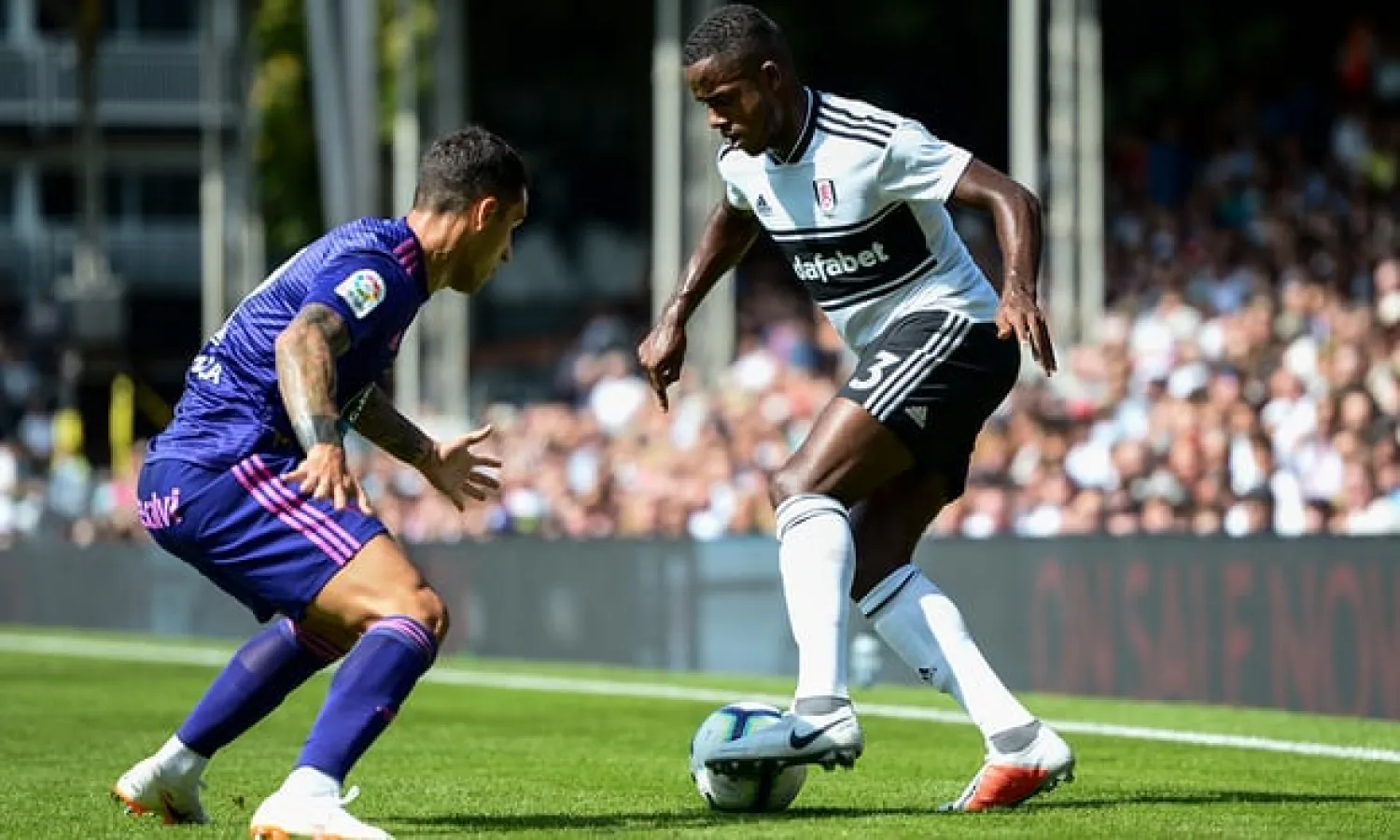

In the sweltering sunshine of Craven Cottage on Saturday afternoon, Ryan Sessegnon was going about his usual business of looking older than his years. A composed, even studious presence in a Fulham side preparing for a return to the Premier League with a friendly against Celta Vigo, he spent an hour working at establishing a relationship with André Schürrle, just arrived on loan from Borussia Dortmund, on the left flank, and then half an hour pushing up into the position vacated when the German was withdrawn. Everything he did spoke of the qualities that have made him one of the most admired teenagers in English football.
Sessegnon was the one Gareth Southgate left behind. It must have been a difficult decision – harder than, say, Jonjo Shelvey or Jack Wilshere – because he so closely fits Southgate’s unspoken template. The England manager wants players with enough upstairs to enable them to bring it to the application of their football gifts. He wants common sense as well as imagination, an ability to take responsibility without being burdened by it.
But Southgate decided that this was one tournament too early for Sessegnon, who turned 18 the day after the announcement of the squad for Russia. In any case he had Danny Rose and Ashley Young queuing up to start at left‑back, with Fabian Delph in reserve. Perhaps he also had in mind Theo Walcott, a very different type of player but one whose progress was arguably hindered by being taken to a World Cup as a teenager.
The development of young England players has been a controversial topic ever since the TV cashflow opened the gates to the finest foreign talent while enabling certain clubs to stockpile so many young players that they employ staff whose only job is to keep tabs on the ones sent out on loan. In some quarters it is claimed that the increased competition for places ensures that only the very best young Englishmen survive the test, giving the national team a core of talent hardened by the most rigorous apprenticeship. A more balanced view suggests that it can damage the development of players who would benefit from a more prolonged integration into first-team football at the highest level.
Although Sessegnon is known to be wanted by richer clubs, at the time of writing it appears that he will be starting the season in the shirt he has worn since becoming the first player born in the 2000s to score a goal in the English leagues. Not only his present club’s fans will hope he stays put for a season at least, becoming acquainted with the pace and rhythms of the top tier while under no extra pressure to retain his place. Since he has never looked uncomfortable anywhere, there is a good chance that he will make it through and become a part of Southgate’s team in time for the next World Cup – assuming, of course, that the manager lasts that long.
The previous evening, one of the many products of Chelsea’s academy stepped into the spotlight as Frank Lampard’s televised managerial debut showcased Mason Mount’s first appearance for Derby. The 19-year-old, who scored nine goals in 29 league appearances while on loan to Vitesse Arnhem last season, was a discreet presence in Lampard’s midfield, but it was a shrewd move on his part to score the sort of goal that was once his new manager’s trademark, albeit with the help of defective goalkeeping. Voted player of the tournament when England won the European Under-19 championship a year ago, Mount was invited by Southgate to train with the senior squad before they set off for Russia.
And then on Sunday, on another side of London, Pep Guardiola gave another English midfield prodigy the chance to demonstrate his gifts in front of a large audience. Phil Foden, the winner of the golden ball in last season’s Under-17 World Cup, took his chance with calm assurance, his smooth movement, Scholes-like vision and velvet-lined left foot evident as he moved the ball across the pitch before easing it into the path of Sergio Agüero for the first of Manchester City’s Community Shield goals.
Facing City at Wembley without Eden Hazard, Maurizio Sarri gave Callum Hudson‑Odoi, who had impressed the new manager in pre-season matches, a chance to fill the Belgian’s role on the left of Chelsea’s attack. There was promise in the way the 17-year-old turned Kyle Walker inside out, although an ineffectual midfield gave him little support.
These teenagers face a season of trial and scrutiny. We all remember the promise and subsequent disappearance of Ravel Morrison and Josh McEachran. As my colleague Jacob Steinberg warned on Sunday while assessing Foden’s performance, it is important to keep a sense of proportion, which is what José Mourinho failed to do four years ago when he declared that if Dominic Solanke, Izzy Brown and Lewis Baker – all teenagers on Chelsea’s books at the time – failed to win full England caps, if would be his fault.
Today, Solanke, who despaired of making it at Stamford Bridge, is fighting for a start at Liverpool, while Brown played last season for Brighton, his fourth loan club, and Baker, on his fifth loan, was a late substitute in Marcelo Bielsa’s first outing as Leeds’s manager on Sunday.
But what football fan does not yearn to see young talent prosper, cheering it on and experiencing a sense of pride as it comes to fruition? One way and another, this was a good weekend for Southgate. But come back after Christmas, when the sunshine has dimmed and the struggle is on. Then let’s see how it’s all working out.
The Guardian Sport