

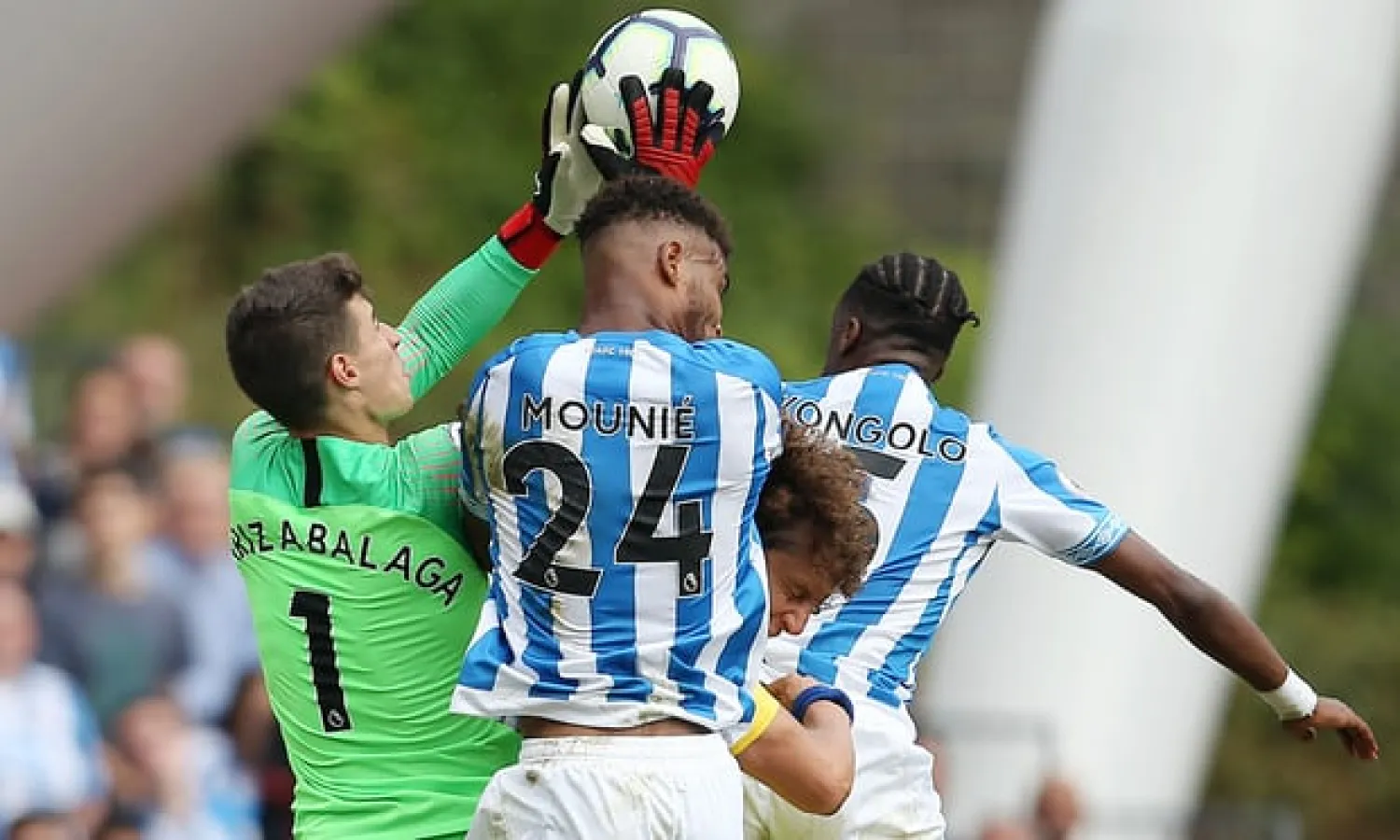

Kepa Arrizabalaga, Alisson Show Youth Beats Experience for Keepers

 Chelsea paid £70m for Kepa Arrizabalaga, who is part of a trend for young keepers in the Premier League. Photograph: Matt West/BPI/Rex/Shutterstock
Chelsea paid £70m for Kepa Arrizabalaga, who is part of a trend for young keepers in the Premier League. Photograph: Matt West/BPI/Rex/Shutterstock
TT

Kepa Arrizabalaga, Alisson Show Youth Beats Experience for Keepers

 Chelsea paid £70m for Kepa Arrizabalaga, who is part of a trend for young keepers in the Premier League. Photograph: Matt West/BPI/Rex/Shutterstock
Chelsea paid £70m for Kepa Arrizabalaga, who is part of a trend for young keepers in the Premier League. Photograph: Matt West/BPI/Rex/Shutterstock

A debate is still raging over whether the spectacular late winner Wayne Rooney created to help DC United beat Orlando City on Sunday was a highlight of the MLS season or a confirmation of limited standards across the pond, though looked at another way it could be seen as a terrific advertisement for Premier League football.

Rooney, lest it ever be forgotten, spent his last couple of English seasons chugging around for little return, frequently inviting the comment he had lost his pace and had grown old before his time. Now he finds himself rejuvenated, looking like a giant among pygmies or the seasoned professional who joins the neighbourhood kids for a kickabout in the park.

While that transformation does not necessarily flatter the American league, it is also true Rooney had more or less given up those long-distance diagonal passes in England because managers, teammates and paying spectators would complain he was simply giving the ball away. No Premier League defence would have allowed Rooney the space to send in a cross from just over halfway and then simply stood and watched as a striker arrived at the far post to claim a free header.

No Premier League goalkeeper, more importantly, would have stayed rooted to his line as the drama played out in front of him. In England, you cannot launch a hopeful ball high into the area from 50 yards out without expecting the goalkeeper to claim it or at least make an effort to punch clear. The expectation is that goalkeepers should dominate their penalty areas and that was always the case even before the present fashion for sweeper-keepers who can play with the ball at their feet took hold.

A combination of the two factors, the need to be confident in the air and capable on the ground, has pushed up the value of goalkeepers quite dramatically in the past few months. The two most expensive goalkeepers in the world are playing in the Premier League, with Chelsea’s £71m acquisition of Kepa Arrizabalaga last week topping the £67m Liverpool paid Roma for Alisson earlier in the window.

Those are serious prices, approaching the record of £75m Liverpool spent on a defender and it is beginning to appear that after decades of being regarded as a relative afterthought – an important member of the team but hardly the glamour position or starring role – the goalkeeper is coming to be seen as the first line of defence rather than the last.

This is probably nothing to do with how erratic Claudio Bravo proved in Pep Guardiola’s first season at Manchester City or the concussion-induced mistakes Loris Karius made in last season’s Champions League final. As soon as Chelsea realised they were about to lose Thibaut Courtois they immediately understood a replacement of the highest quality would be required.

The old idea that almost any experienced keeper would do as a stop-gap seems to have disappeared, at least for those clubs aiming for the Champions League positions. It is often estimated the difference between a top-notch goalkeeper and your average glovesman could be 15 points per season, the sort of margin that could make the difference between success and failure for the European elite.

How accurate that estimate might be is anyone’s guess, as is how one might go about verifying such a claim, though everyone is familiar with the idea that substandard goalkeeping can easily cost points. City set a Premier League record of 100 points in winning the title last season, something they would have been unlikely to achieve, with the best will in the world, had Bravo still been keeping goal.

Ederson not only cut out the errors and stopped a good few shots, he imbued City’s back line with extra confidence. That is something any competent goalkeeper ought to be able to do, at the very least defenders ought to be secure in the knowledge that their concentration and perspiration will not be continually undermined by calamities between the sticks, though a peculiarity of the goalkeeping position is that the main man is rarely rested, at least not for important games.

When reserve goalkeepers get outings in cup matches it is usually to keep them happy, not to give the No 1 a chance to put his feet up. If everything goes well your first-choice goalkeeper will be just that, first-choice for most of the season, so it makes sense to have someone with the complete trust of the defence ahead of him, even if half the reason is the massive transfer fee the club has just paid.

The other noticeable trend in goalkeeping is that the outstanding performers are getting younger. It used to be said a goalkeeper matured in his mid-twenties and would generally be at his best around 30, a theory that now seems wildly outdated.

David de Gea, incredibly, is beginning his eighth season at Manchester United and is 27. Liverpool’s Alisson is 25, City’s Ederson 24 and Chelsea’s Kepa 23. All those players might get better, though the likelihood is that they are at their peak right now. Certainly that is what the prices and the competition for signatures would suggest.

None of which will make great reading for Petr Cech, whose wobbles when trying to play out from the back against City on Sunday were magnified when he overreacted to a sarcastic tweet from Bayer Leverkusen. The German club have just sold Bernd Leno, their regular goalkeeper for the past seven seasons, to Arsenal, only to find Unai Emery showing a preference for Cech in the opening games of the season.

How long that situation will last is the subject of another lively debate, but it is not difficult to see the endgame. Cech is 36, Leno 10 years younger. The former Chelsea keeper has been an extremely safe pair of hands in his time but that time appears to be drawing to a close and, with it, any old-fashioned assumptions that goalkeepers can go on forever.

None of the 10 biggest signings by Premier League clubs in the summer transfer window turned out to be a centre-forward or striker. Richarlison is probably closest to a recognised goal-getter, though, like Riyad Mahrez, he operates from the wing. The two most expensive signings were goalkeepers and Kepa was almost twice the price that made Everton wince for Richarlison.

While this is a new development, it should not be expected every summer. That is the point, really. The foreseeable future ought to be fairly settled now that most of the top six have goalkeepers to keep.

The Guardian Sport


Shakhtar Boss Pays Ukrainian Racer $200,000 After Games Disqualification

Ukrainian President Volodymyr Zelenskiy holds helmet as he meets with a Ukrainian skeleton racer Vladyslav Heraskevych , who was disqualified from the Olympic skeleton competition over his "helmet of remembrance" depicting athletes killed since Russia's invasion and his father and coach, Mykhailo Heraskevych, amid Russia's attack on Ukraine, in Munich, Germany February 13, 2026. (Ukrainian Presidential Press Service/Handout via Reuters)
TT

Shakhtar Boss Pays Ukrainian Racer $200,000 After Games Disqualification

Ukrainian President Volodymyr Zelenskiy holds helmet as he meets with a Ukrainian skeleton racer Vladyslav Heraskevych , who was disqualified from the Olympic skeleton competition over his "helmet of remembrance" depicting athletes killed since Russia's invasion and his father and coach, Mykhailo Heraskevych, amid Russia's attack on Ukraine, in Munich, Germany February 13, 2026. (Ukrainian Presidential Press Service/Handout via Reuters)

The owner of ‌Ukrainian football club Shakhtar Donetsk has donated more than $200,000 to skeleton racer Vladyslav Heraskevych after the athlete was disqualified from the Milano Cortina Winter Games before competing over the use of a helmet depicting Ukrainian athletes killed in the war with Russia, the club said on Tuesday.

The 27-year-old Heraskevych was disqualified last week when the International Bobsleigh and Skeleton Federation jury ruled that imagery on the helmet — depicting athletes killed since Russia invaded Ukraine in 2022 — breached rules on athletes' expression at ‌the Games.

He ‌then lost an appeal at the Court ‌of ⁠Arbitration for Sport hours ⁠before the final two runs of his competition, having missed the first two runs due to his disqualification.

Heraskevych had been allowed to train with the helmet that displayed the faces of 24 dead Ukrainian athletes for several days in Cortina d'Ampezzo where the sliding center is, but the International Olympic Committee then ⁠warned him a day before his competition ‌started that he could not wear ‌it there.

“Vlad Heraskevych was denied the opportunity to compete for victory ‌at the Olympic Games, yet he returns to Ukraine a ‌true winner," Shakhtar President Rinat Akhmetov said in a club statement.

"The respect and pride he has earned among Ukrainians through his actions are the highest reward. At the same time, I want him to ‌have enough energy and resources to continue his sporting career, as well as to fight ⁠for truth, freedom ⁠and the remembrance of those who gave their lives for Ukraine," he said.

The amount is equal to the prize money Ukraine pays athletes who win a gold medal at the Games.

The case dominated headlines early on at the Olympics, with IOC President Kirsty Coventry meeting Heraskevych on Thursday morning at the sliding venue in a failed last-minute attempt to broker a compromise.

The IOC suggested he wear a black armband and display the helmet before and after the race, but said using it in competition breached rules on keeping politics off fields of play. Heraskevych also earned praise from Ukraine President Volodymyr Zelenskiy.


Speed Skating-Italy Clinch Shock Men’s Team Pursuit Gold, Canada Successfully Defend Women’s Title

 Team Italy with Davide Ghiotto, Andrea Giovannini, Michele Malfatti, celebrate winning the gold medal on the podium of the men's team pursuit speed skating race at the 2026 Winter Olympics, in Milan, Italy, Tuesday, Feb. 17, 2026. (AP)
Team Italy with Davide Ghiotto, Andrea Giovannini, Michele Malfatti, celebrate winning the gold medal on the podium of the men's team pursuit speed skating race at the 2026 Winter Olympics, in Milan, Italy, Tuesday, Feb. 17, 2026. (AP)
TT

Speed Skating-Italy Clinch Shock Men’s Team Pursuit Gold, Canada Successfully Defend Women’s Title

 Team Italy with Davide Ghiotto, Andrea Giovannini, Michele Malfatti, celebrate winning the gold medal on the podium of the men's team pursuit speed skating race at the 2026 Winter Olympics, in Milan, Italy, Tuesday, Feb. 17, 2026. (AP)
Team Italy with Davide Ghiotto, Andrea Giovannini, Michele Malfatti, celebrate winning the gold medal on the podium of the men's team pursuit speed skating race at the 2026 Winter Olympics, in Milan, Italy, Tuesday, Feb. 17, 2026. (AP)

An inspired Italy delighted the home crowd with a stunning victory in the Olympic men's team pursuit final as

Canada's Ivanie Blondin, Valerie Maltais and Isabelle Weidemann delivered another seamless performance to beat the Netherlands in the women's event and retain their title ‌on Tuesday.

Italy's ‌men upset the US who ‌arrived ⁠at the Games ⁠as world champions and gold medal favorites.

Spurred on by double Olympic champion Francesca Lollobrigida, the Italian team of Davide Ghiotto, Andrea Giovannini and Michele Malfatti electrified a frenzied arena as they stormed ⁠to a time of three ‌minutes 39.20 seconds - ‌a commanding 4.51 seconds clear of the ‌Americans with China taking bronze.

The roar inside ‌the venue as Italy powered home was thunderous as the crowd rose to their feet, cheering the host nation to one ‌of their most special golds of a highly successful Games.

Canada's women ⁠crossed ⁠the line 0.96 seconds ahead of the Netherlands, stopping the clock at two minutes 55.81 seconds, and

Japan rounded out the women's podium by beating the US in the Final B.

It was only Canada's third gold medal of the Games, following Mikael Kingsbury's win in men's dual moguls and Megan Oldham's victory in women's freeski big air.


Lindsey Vonn Back in US Following Crash in Olympic Downhill 

Milano Cortina 2026 Olympics - Alpine Skiing - Women's Downhill 3rd Official Training - Tofane Alpine Skiing Centre, Belluno, Italy - February 07, 2026. Lindsey Vonn of United States in action during training. (Reuters)
TT

Lindsey Vonn Back in US Following Crash in Olympic Downhill 

Milano Cortina 2026 Olympics - Alpine Skiing - Women's Downhill 3rd Official Training - Tofane Alpine Skiing Centre, Belluno, Italy - February 07, 2026. Lindsey Vonn of United States in action during training. (Reuters)

Lindsey Vonn is back home in the US following a week of treatment at a hospital in Italy after breaking her left leg in the Olympic downhill at the Milan Cortina Games.

“Haven’t stood on my feet in over a week... been in a hospital bed immobile since my race. And although I’m not yet able to stand, being back on home soil feels amazing,” Vonn posted on X with an American flag emoji. “Huge thank you to everyone in Italy for taking good care of me.”

The 41-year-old Vonn suffered a complex tibia fracture that has already been operated on multiple times following her Feb. 8 crash. She has said she'll need more surgery in the US.

Nine days before her fall in Cortina d'Ampezzo, Italy, Vonn ruptured the ACL in her left knee in another crash in Switzerland.

Even before then, all eyes had been on her as the feel-good story heading into the Olympics for her comeback after nearly six years of retirement.
