

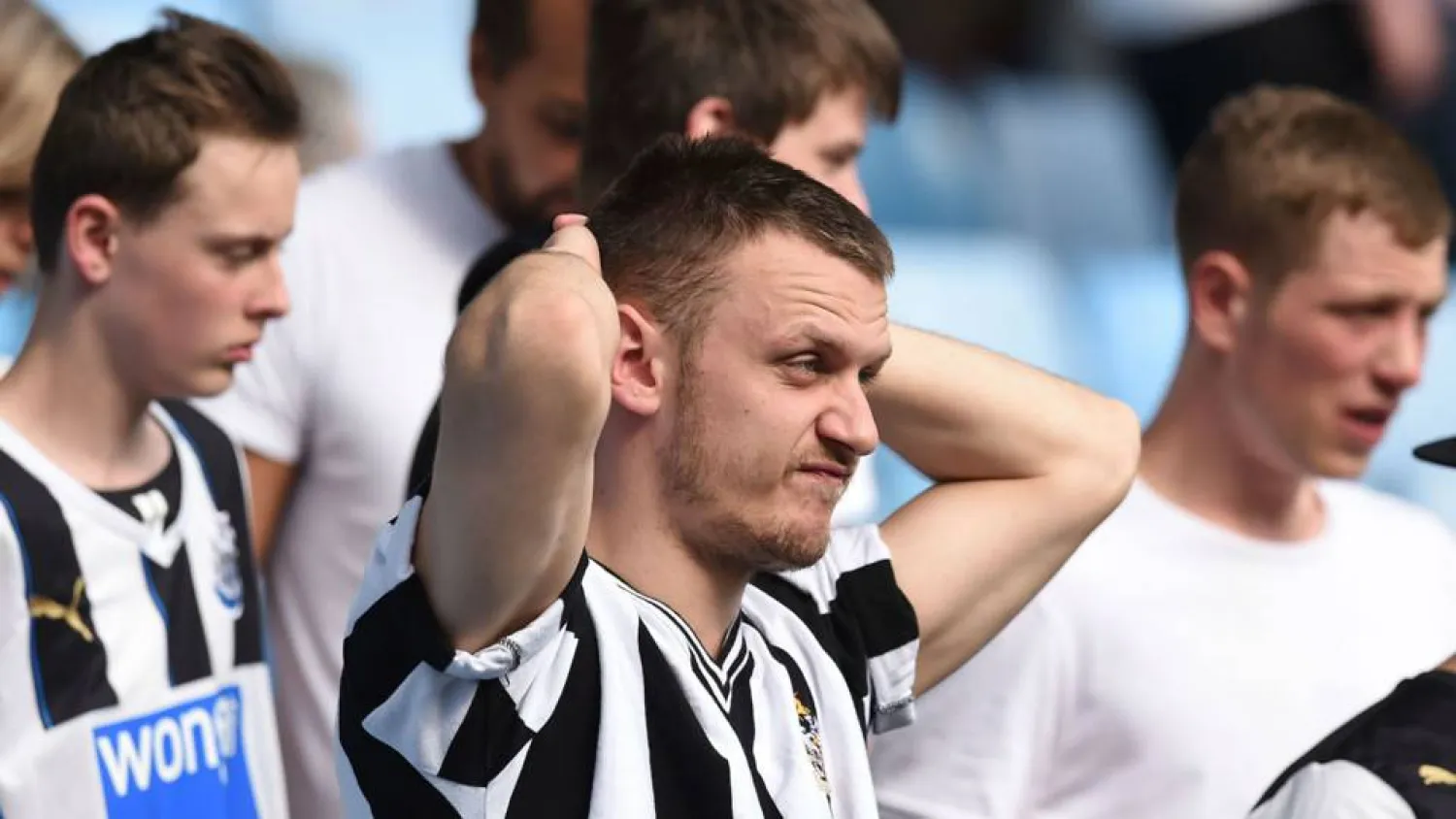

Premier League Managers Should Forget the Mythical 40-Point Mark

Newcastle fans react after their team was relegated from the Premier League in 2016. (AFP)
TT

Premier League Managers Should Forget the Mythical 40-Point Mark

Newcastle fans react after their team was relegated from the Premier League in 2016. (AFP)

Premier League managers often say they will not relax until their team has hit the magical 40-point mark. Reaching this threshold of comfort is not just the ambition of classic survivalists such as Tony Pulis and Sam Allardyce. Even Claudio Ranieri did not forget its significance during Leicester City’s remarkable run to the title in the 2015-16 season.

In early January 2016, after Leicester had drawn against Bournemouth to go joint-top of the table, the manager chose to celebrate hitting this supposed safety line rather than the fact his players had accumulated as many points as Arsenal. “Forty points, come on,” he said. “It’s fantastic.”

If Ranieri was really concerned about relegation, he should have been celebrating a few weeks earlier as the average points tally required to avoid the drop over the last 15 seasons has been just 36. In recent years, winning 40 points has been enough to guarantee a mid-table finish. Last season Swansea finished highest of the three relegated clubs on just 33 points, while Brighton won 40 points and finished 15th, well clear of danger.

In the 23 seasons since the Premier League was reduced to 20 clubs, only three sides have hit the 40-point mark and gone down – and none in the last 15 years. West Ham were relegated with 42 points in 2002-03, and Bolton and Sunderland both went down with 40 points on the board in the late 1990s.

The emergence of the top six over the last decade has helped to turn the 40-point mark into a myth. As the top clubs have become more dominant, the others have collected fewer points and, consequently, the number of points required to survive has fallen. Between 1992-93 and 2006-07 the average gap between the club that finished just above the relegation zone and the club that finished sixth was 19 points; that gap has shot up to 26 points in the last decade.

West Ham, Bolton and Sunderland were unlucky to reach the 40-point mark and still go down, but spare a thought for Crystal Palace, who hold the unenviable record of collecting the two highest points totals for a relegated club in the Premier League. In the 1994-95 campaign, when the Premier League still had 22 clubs, Palace won 45 points but were still relegated. But that pales into insignificance when compared to the anguish the club experienced in the final week of the very first Premier League season in 1992-93.

On the penultimate Saturday of the campaign, Palace beat Ipswich 3-1 at Selhurst Park to go eight points clear of Oldham Athletic, who occupied the last relegation place. Oldham would need to win all three of their remaining games to have any hope of staying up. Given they had picked up two points from their previous four games, surely Palace were safe. The players were so confident of their Premier League status they enjoyed what appeared to be a celebratory lap of the pitch in front of their relieved home fans at Selhurst Park.

Geoff Thomas, the Palace skipper at the time, says they did not necessarily think it was all over. “That was not actually a lap of honor,” he says. “The players were saying ‘thank you’ to the fans after the last home game because that was the ritual for every single club. We knew there were still games to be played but we did feel we probably had done enough.”

The faintest alarm bell rang when Oldham went to second-placed Aston Villa the next day and beat them 1–0, keeping alive their slender hopes of survival for at least one more match. On the Wednesday night, Palace ground out a goalless draw at Manchester City, which meant Oldham would have to win their last two games – against Liverpool and Southampton – to stay up on goal difference. Oldham welcomed Liverpool to Boundary Park and beat them 3-2 thanks to a brace from Ian Olney. He only scored 13 goals in his whole Oldham career but he scored two in a minute that night.

What was previously a distant hope had now turned into a distinct possibility. On the final day Oldham had to beat Southampton at home and hope Palace would lose at Highbury. Palace were in trouble and Thomas knew it. “Arsenal were a side that we had never even got close to, so we knew we had to be safe before that final game.”

Ian Wright, the departed Palace hero, opened the scoring for Arsenal in the ninth minute. This was not a time when players refused to celebrate against their old clubs, but the gusto with which Wright kissed the Arsenal badge did not go down very well with the away fans.

Oldham, meanwhile, were doing their bit at Boundary Park against Southampton. With 10 minutes to go in both matches, Palace were 1-0 down and Oldham were 4-2 up, which meant both clubs had the same number of points but Palace’s goal difference was worse by a single goal.

A goal either way would prove crucial. After 82 minutes that goal arrived at Highbury as Paul Dickov gave Arsenal a 2-0 lead. But hope re-emerged when Matt Le Tissier completed his hat-trick with five minutes to play. Once Kevin Campbell scored Arsenal’s third, Palace’s only route to salvation was a Southampton equalizer, but the Saints were not for marching in and that was that. After the elation of the previous week, Palace had been relegated with what proved a less than grand total of 49 points. Liverpool finished in sixth place with just 10 more points.

“It was probably the lowest I have ever felt on a football pitch,” says Thomas, who left the club that summer. “At the final whistle I was just devastated. It was not the way I wanted to leave in a Palace shirt.” It will provide little comfort to Palace fans, but even they will never win 49 points and go down again.

The Guardian Sport


Shakhtar Boss Pays Ukrainian Racer $200,000 After Games Disqualification

Ukrainian President Volodymyr Zelenskiy holds helmet as he meets with a Ukrainian skeleton racer Vladyslav Heraskevych , who was disqualified from the Olympic skeleton competition over his "helmet of remembrance" depicting athletes killed since Russia's invasion and his father and coach, Mykhailo Heraskevych, amid Russia's attack on Ukraine, in Munich, Germany February 13, 2026. (Ukrainian Presidential Press Service/Handout via Reuters)
TT

Shakhtar Boss Pays Ukrainian Racer $200,000 After Games Disqualification

Ukrainian President Volodymyr Zelenskiy holds helmet as he meets with a Ukrainian skeleton racer Vladyslav Heraskevych , who was disqualified from the Olympic skeleton competition over his "helmet of remembrance" depicting athletes killed since Russia's invasion and his father and coach, Mykhailo Heraskevych, amid Russia's attack on Ukraine, in Munich, Germany February 13, 2026. (Ukrainian Presidential Press Service/Handout via Reuters)

The owner of ‌Ukrainian football club Shakhtar Donetsk has donated more than $200,000 to skeleton racer Vladyslav Heraskevych after the athlete was disqualified from the Milano Cortina Winter Games before competing over the use of a helmet depicting Ukrainian athletes killed in the war with Russia, the club said on Tuesday.

The 27-year-old Heraskevych was disqualified last week when the International Bobsleigh and Skeleton Federation jury ruled that imagery on the helmet — depicting athletes killed since Russia invaded Ukraine in 2022 — breached rules on athletes' expression at ‌the Games.

He ‌then lost an appeal at the Court ‌of ⁠Arbitration for Sport hours ⁠before the final two runs of his competition, having missed the first two runs due to his disqualification.

Heraskevych had been allowed to train with the helmet that displayed the faces of 24 dead Ukrainian athletes for several days in Cortina d'Ampezzo where the sliding center is, but the International Olympic Committee then ⁠warned him a day before his competition ‌started that he could not wear ‌it there.

“Vlad Heraskevych was denied the opportunity to compete for victory ‌at the Olympic Games, yet he returns to Ukraine a ‌true winner," Shakhtar President Rinat Akhmetov said in a club statement.

"The respect and pride he has earned among Ukrainians through his actions are the highest reward. At the same time, I want him to ‌have enough energy and resources to continue his sporting career, as well as to fight ⁠for truth, freedom ⁠and the remembrance of those who gave their lives for Ukraine," he said.

The amount is equal to the prize money Ukraine pays athletes who win a gold medal at the Games.

The case dominated headlines early on at the Olympics, with IOC President Kirsty Coventry meeting Heraskevych on Thursday morning at the sliding venue in a failed last-minute attempt to broker a compromise.

The IOC suggested he wear a black armband and display the helmet before and after the race, but said using it in competition breached rules on keeping politics off fields of play. Heraskevych also earned praise from Ukraine President Volodymyr Zelenskiy.


Speed Skating-Italy Clinch Shock Men’s Team Pursuit Gold, Canada Successfully Defend Women’s Title

 Team Italy with Davide Ghiotto, Andrea Giovannini, Michele Malfatti, celebrate winning the gold medal on the podium of the men's team pursuit speed skating race at the 2026 Winter Olympics, in Milan, Italy, Tuesday, Feb. 17, 2026. (AP)
Team Italy with Davide Ghiotto, Andrea Giovannini, Michele Malfatti, celebrate winning the gold medal on the podium of the men's team pursuit speed skating race at the 2026 Winter Olympics, in Milan, Italy, Tuesday, Feb. 17, 2026. (AP)
TT

Speed Skating-Italy Clinch Shock Men’s Team Pursuit Gold, Canada Successfully Defend Women’s Title

 Team Italy with Davide Ghiotto, Andrea Giovannini, Michele Malfatti, celebrate winning the gold medal on the podium of the men's team pursuit speed skating race at the 2026 Winter Olympics, in Milan, Italy, Tuesday, Feb. 17, 2026. (AP)
Team Italy with Davide Ghiotto, Andrea Giovannini, Michele Malfatti, celebrate winning the gold medal on the podium of the men's team pursuit speed skating race at the 2026 Winter Olympics, in Milan, Italy, Tuesday, Feb. 17, 2026. (AP)

An inspired Italy delighted the home crowd with a stunning victory in the Olympic men's team pursuit final as

Canada's Ivanie Blondin, Valerie Maltais and Isabelle Weidemann delivered another seamless performance to beat the Netherlands in the women's event and retain their title ‌on Tuesday.

Italy's ‌men upset the US who ‌arrived ⁠at the Games ⁠as world champions and gold medal favorites.

Spurred on by double Olympic champion Francesca Lollobrigida, the Italian team of Davide Ghiotto, Andrea Giovannini and Michele Malfatti electrified a frenzied arena as they stormed ⁠to a time of three ‌minutes 39.20 seconds - ‌a commanding 4.51 seconds clear of the ‌Americans with China taking bronze.

The roar inside ‌the venue as Italy powered home was thunderous as the crowd rose to their feet, cheering the host nation to one ‌of their most special golds of a highly successful Games.

Canada's women ⁠crossed ⁠the line 0.96 seconds ahead of the Netherlands, stopping the clock at two minutes 55.81 seconds, and

Japan rounded out the women's podium by beating the US in the Final B.

It was only Canada's third gold medal of the Games, following Mikael Kingsbury's win in men's dual moguls and Megan Oldham's victory in women's freeski big air.


Lindsey Vonn Back in US Following Crash in Olympic Downhill 

Milano Cortina 2026 Olympics - Alpine Skiing - Women's Downhill 3rd Official Training - Tofane Alpine Skiing Centre, Belluno, Italy - February 07, 2026. Lindsey Vonn of United States in action during training. (Reuters)
TT

Lindsey Vonn Back in US Following Crash in Olympic Downhill 

Milano Cortina 2026 Olympics - Alpine Skiing - Women's Downhill 3rd Official Training - Tofane Alpine Skiing Centre, Belluno, Italy - February 07, 2026. Lindsey Vonn of United States in action during training. (Reuters)

Lindsey Vonn is back home in the US following a week of treatment at a hospital in Italy after breaking her left leg in the Olympic downhill at the Milan Cortina Games.

“Haven’t stood on my feet in over a week... been in a hospital bed immobile since my race. And although I’m not yet able to stand, being back on home soil feels amazing,” Vonn posted on X with an American flag emoji. “Huge thank you to everyone in Italy for taking good care of me.”

The 41-year-old Vonn suffered a complex tibia fracture that has already been operated on multiple times following her Feb. 8 crash. She has said she'll need more surgery in the US.

Nine days before her fall in Cortina d'Ampezzo, Italy, Vonn ruptured the ACL in her left knee in another crash in Switzerland.

Even before then, all eyes had been on her as the feel-good story heading into the Olympics for her comeback after nearly six years of retirement.
