
25 Years after Oslo, Young Palestinians See Little Hope

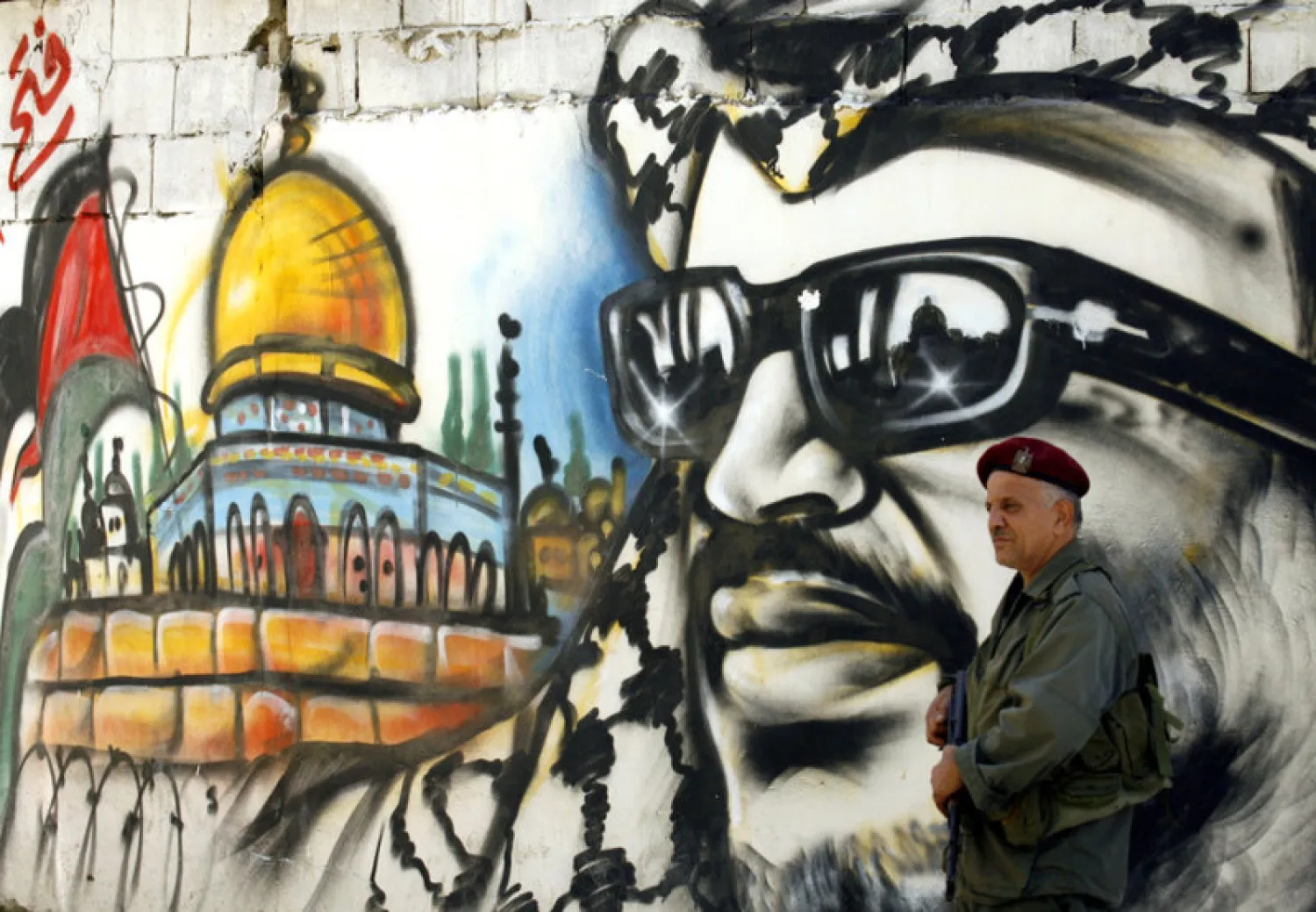
A Palestinian security officer stands by a mural of Yasser Arafat. (AFP)
TT

25 Years after Oslo, Young Palestinians See Little Hope

A Palestinian security officer stands by a mural of Yasser Arafat. (AFP)

Abed Zughayer is like many young Palestinians when he considers the legacy of the Oslo accords, the first of which was signed 25 years ago this week, said an Agence-France Presse report on Tuesday.

"The Oslo accords are wrong," Zughayer, who was five when Palestinian leader Yasser Arafat and Israeli prime minister Yitzhak Rabin famously shook hands on the White House lawn to seal the first of the agreements on September 13, 1993.

The 30-year-old, speaking at the counter of his clothing store on a busy Jerusalem street, says the accords are "preventing us from claiming our rights over this land."

Many young Palestinians who came of age after the Oslo accords see the landmark agreements which were supposed to lead to peace as a betrayal that has only consolidated Israel's occupation.

For Zughayer, Israel will never allow a Palestinian state along its borders.

What Israel wants is "all of the land," he said, referring to calls on the Israeli right to annex most of the occupied West Bank, which would end any remaining hope of a two-state solution to the conflict.

Chances of peace anytime soon are widely seen as remote.

Since 1993, Palestinians have seen persistent Israeli settlement expansion in the West Bank while both sides have endured a second Palestinian intifada, or uprising, from 2000 to 2005.

There have been three wars in the Gaza Strip, which has been under Israeli blockade for more than a decade and is run by the Hamas movement.

The Palestinian Authority, the self-rule body put in place by the Oslo accords, is confined to the West Bank where in theory it has full control of just 17 percent of the territory.

Israel, which seized it in the Six-Day War of 1967, retains complete control over most of it.

The Israeli separation wall -- a cursed symbol of the occupation for Palestinians -- cuts the West Bank off from Israel and annexed Arab east Jerusalem.

In the flashpoint West Bank city of Hebron, where several hundred Israeli settlers live under heavy military protection among some 200,000 Palestinians, "the Oslo accords have legalized the occupation," said 27-year-old Abdallah, who works in the tourism sector, according to AFP.

For him and other Palestinians, the Palestinian Authority's security coordination with Israel is an example.

Such coordination is seen as having helped prevent attacks against Israelis, but also as maintaining stability in the West Bank in favor of Palestinian President Mahmud Abbas.

Some also accuse PA officials of corruption and of using the structures put in place by Oslo to benefit themselves, said AFP.

"The peace accords have given me a government, but that government exercises another form of occupation on me," said Abdallah.

"The only difference between that occupation and Israel's is they speak Arabic!" the young man added, declining to give his name for fear of reprisals.

Some 30 percent of Palestinians in the Gaza Strip and West Bank are between 15 and 29, according to official statistics.

Born just before or after Oslo, some of them see themselves as belonging to the worst-off generation of Palestinians, with less interest in politics and weary of broken promises.

Some look back with reverence to the first Palestinian intifada, before many of them were born, as a time when Palestinians were united against Israel.

Yet there are still believers, such as Jihad Manasra, a 28-year-old activist with Abbas's Fatah party, which negotiated and signed the Oslo accords.

If Oslo has failed, it is because the accords "are violated every day by the Israelis," said Manasra, a student at Birzeit University near Ramallah, an institution known for its activism.

He continues to have faith in the two-state solution, but he is in the minority.

A recent poll in the Palestinian territories showed 43 percent support a two-state solution, while 34 percent think that armed resistance is a better option to realize Palestinian statehood.

Frustration among young Palestinian is seen as a major factor in violence when it has erupted, reported AFP.

Diplomats and relief workers -- as well as the Israeli security forces, according to Israeli media -- are concerned recent US moves to end all funding for the UN agency for Palestinian refugees and cut other aid could lead to destabilization.

"If we shut up and we negotiate, the occupation will continue," said Zughayer. "We will get nothing in the end unless we resort to weapons."

Majd, 28, who declined to give her family name, no longer believes a Palestinian state will emerge.

"The only option for me is to educate, to pass along from generation to generation, so that no one forgets that a country called Palestine exists and that these lands are ours," she said.


Report: Assad Returns to Ophthalmology, His Family Lives in Russian Luxury  

Bashar al-Assad with his wife, Asma, walk with their children in the northern Syrian city of Aleppo in 2022. (Former Syrian presidency Facebook page/AFP/Getty Images)
TT

Report: Assad Returns to Ophthalmology, His Family Lives in Russian Luxury  

Bashar al-Assad with his wife, Asma, walk with their children in the northern Syrian city of Aleppo in 2022. (Former Syrian presidency Facebook page/AFP/Getty Images)

A year after his regime was toppled in Syria, Bashar al-Assad's family is living an isolated, quiet life of luxury in Moscow.

A friend of the family, sources in Russia and Syria, as well as leaked data, helped give rare insight into the lives of the now reclusive family who once ruled over Syria with an iron fist.

Bashar now sits in the classroom, taking ophthalmology lessons, according to a well-placed source.

“He’s studying Russian and brushing up on his ophthalmology again,” a friend of the Assad family, who has kept in touch with them, told The Guardian.

“It’s a passion of his, he obviously doesn’t need the money. Even before the war in Syria began, he used to regularly practice his ophthalmology in Damascus,” they continued, suggesting the wealthy elite in Moscow could be his target clientele.

The family are likely to reside in the prestigious Rublyovka, a gated community of Moscow’s elite, according to two sources with knowledge of the situation. There they would rub shoulders with the likes of the former Ukrainian president Viktor Yanukovych, who fled Kyiv in 2014 and is believed to live in the area, according to The Guardian.

The Assads are not wanting for money. After being cut off from much of the world’s financial system by western sanctions in 2011 after Assad’s bloody crackdown on protesters, the family put much of their wealth in Moscow, where western regulators could not touch it.

Despite their cushy abode, the family are cut off from the elite Syrian and Russian circles they once enjoyed. Bashar’s 11th-hour flight from Syria left his cronies feeling abandoned and his Russian handlers prevent him from contacting senior regime officials.

Assad fled with his sons out of Damascus in the early hours of December 8, 2024, as Syrian opposition fighters approached the capital from the north and the south. They were met by a Russian military escort and were taken to the Russian Hmeimim airbase, where they were flown out of the country.

Assad did not warn his extended family or close regime allies of the impending collapse, instead leaving them to fend for themselves.

A friend of Maher al-Assad, Bashar’s brother and a top military official, who knows many former members of the palace said: “Maher had been calling Bashar for days but he wouldn’t pick up.”

“He stayed in the palace until the last second, opposition fighters found his shisha coals still warm. It was Maher, not Bashar, who helped others escape. Bashar only cared about himself.”

“It’s a very quiet life,” said the family friend. “He has very little, if any, contact with the outside world. He’s only in touch with a couple of people who were in his palace, like Mansour Azzam [former Syrian minister of presidency affairs] and Yassar Ibrahim [Assad’s top economic crony].”

‘Irrelevant’ to Putin

A source close to the Kremlin said Assad was also largely “irrelevant” to Putin and Russia’s political elite. “Putin has little patience for leaders who lose their grip on power, and Assad is no longer seen as a figure of influence or even an interesting guest to invite to dinner,” the source said.

In the first months after the Assads’ escape, his former regime allies were not on Bashar’s mind. The family gathered in Moscow to support Asma, the British-born former first lady of Syria, who had had leukemia for years and whose condition had become critical. She had been receiving treatment in Moscow before the fall of the Assad regime.

According to a source familiar with the details of Asma’s health, the former first lady has recovered after experimental therapy under the supervision of Russia’s security services

With Asma’s health stabilized, the former dictator is keen to get his side of the story out. He has lined up interviews with RT and a popular rightwing American podcaster, but is waiting for approval from Russian authorities to make a media appearance.

Russia appears to have blocked Assad from any public appearance. In a rare November interview with Iraqi media about Assad’s life in Moscow, Russia’s ambassador to Iraq, Elbrus Kutrashev, confirmed that the toppled dictator was barred from any public activity.

“Assad may live here but cannot engage in political activities ... He has no right to engage in any media or political activity. Have you heard anything from him? You haven’t, because he is not allowed to – but he is safe and alive,” Kutrashev said.

Assad children dazed

Life for the Assad children in contrast seems to continue with relatively little disruption, as they adjust to a new life as Moscow elite.

The family friend, who met some of the children a few months ago, said: “They’re kind of dazed. I think they’re still in a bit of a shock. They’re just kind of getting used to life without being the first family.”

The only time the Assad family – without Bashar – have been seen together in public since the end of their regime was at his daughter Zein al-Assad’s graduation on June 30, where she received a degree in international relations from MGIMO, the elite Moscow university attended by much of Russia’s ruling class.

A photograph on MGIMO’s official website shows the 22-year-old Zein standing with other graduates. In a blurry separate video from the event, members of the Assad family, including Asma and her two sons Hafez, 24, and Karim, 21, can be seen in the audience.

Two of Zein’s classmates who attended the ceremony confirmed that parts of the Assad family were present, but said they kept a low profile. “The family did not stay long and did not take any pictures with Zein on stage like other families,” said one of the former classmates, speaking on condition of anonymity.

Hafez, once groomed as Bashar’s potential successor, has largely withdrawn from public view since posting a Telegram video in February in which he offered his own account of the family’s flight from Damascus, denying they had abandoned their allies and claiming it was Moscow that ordered them to leave Syria.

Syrians quickly geolocated Hafez, who took the video while walking the streets of Moscow.

Hafez has closed most of his social media, instead registering accounts under a pseudonym taken from an American children’s series about a young detective with dyslexia, according to leaked data. The children and their mother spend much of their time shopping, filling their new Russian home with luxury goods, according to the source close to the family.


Rebuilding the Army: One of the Syrian Govt’s Greatest Challenges

Soldiers and police officers from the former Syrian regime handing in weapons last year to new security forces in Latakia, Syria. (Ivor Prickett for The New York Times)
TT

Rebuilding the Army: One of the Syrian Govt’s Greatest Challenges

Soldiers and police officers from the former Syrian regime handing in weapons last year to new security forces in Latakia, Syria. (Ivor Prickett for The New York Times)

When opposition factions in Syria came to power a year ago, one of their first acts was to dismiss all of the country’s military forces, which had been used as tools of repression and brutality for five decades under the rule of Bashar al-Assad and his family.

Now, one of the biggest challenges facing the nascent government is rebuilding those forces, an effort that will be critical in uniting this still-fractured country.

But to do so, Syria’s new leaders are following a playbook that is similar to the one they used to set up their government, in which President Ahmed al-Sharaa has relied on a tightknit circle of loyalists.

The military’s new command structure favors former fighters from Sharaa’s former Hayat Tahrir al-Sham group.

The Syrian Defense Ministry is instituting some of the same training methods, including religious instruction, that Sharaa’s former opposition group used to become the most powerful of all the factions that fought the Assad regime during Syria’s civil war.

The New York Times interviewed nearly two dozen soldiers, commanders and new recruits in Syria who discussed the military training and shared their concerns. Nearly all spoke on the condition of anonymity because the Defense Ministry bars soldiers from speaking to the media.

Several soldiers and commanders, as well as analysts, said that some of the government’s rules had nothing to do with military preparedness.

The new leadership was fastidious about certain points, like banning smoking for on-duty soldiers. But on other aspects, soldiers said, the training felt disconnected from the needs of a modern military force.

Last spring, when a 30-year-old former opposition fighter arrived for military training in Syria’s northern province of Aleppo, instructors informed roughly 1,400 new recruits that smoking was not permitted. The former fighter said one of the instructors searched him and confiscated several cigarette packs hidden in his jacket.

The ban pushed dozens of recruits to quit immediately, and many more were kicked out for ignoring it, according to the former fighter, a slender man who chain-smoked as he spoke in Marea, a town in Aleppo Province. After three weeks, only 600 recruits had made it through the training, he said.

He stuck with it.

He said he was taken aback by other aspects of the training. The first week was devoted entirely to Islamic instruction, he said.

Soldiers and commanders said the religious training reflected the ideology that the HTS espoused when it was in power in Idlib, a province in northwestern Syria.

A Syrian defense official, who spoke on the condition of anonymity because he was not authorized to speak publicly, said the government had not decided whether minorities would be allowed to enlist.

Syria’s leaders are relying on a small circle of trusted comrades from HTS to lead and shape the new military, several soldiers, commanders and recruits said.

The Syrian Defense Ministry did not respond to a detailed list of questions or repeated requests for comment.

After abolishing conscription, much hated under the Assad regime, the new military recruited volunteers and set qualifications like a ninth-grade education, physical fitness and the ability to read.

But soldiers who had fought with the opposition in the civil war were grandfathered into the ranks, even if they did not fulfill all the criteria, according to several soldiers and commanders.

“They are bringing in a commander of HTS who doesn’t even have a ninth-grade education and are putting him in charge of a battalion,” said Issam al-Reis, a senior military adviser with Etana, a Syrian research group, who has spoken to many former opposition fighters currently serving in the military. “And his only qualification is that he was loyal to Ahmed al-Sharaa.”

Former HTS fighters, like fighters from many other factions, have years of guerrilla-fighting experience from the war to oust the Assad dictatorship. But most have not served as officers in a formal military with different branches such as the navy, air force and infantry and with rigid command structures, knowledge that is considered beneficial when rebuilding an army.

“The strength of an army is in its discipline,” Reis added.

Most soldiers and commanders now start with three weeks of basic training — except those who previously fought alongside Sharaa’s group.

The government has signed an initial agreement with Türkiye to train and develop the military, said Qutaiba Idlbi, director of American affairs at the Syrian Foreign Ministry. But the agreement does not include deliveries of weapons or military equipment, he said, because of American sanctions remaining on Syria.

Col. Ali Abdul Baqi, staff commander of the 70th Battalion in Damascus, is among the few high-level commanders who was not a member of the HTS. Speaking from his office in Damascus, Abdul Baqi said that had he been in Sharaa’s place, he would have built the new military in the same way.

“They aren’t going to take a risk on people they don’t know,” said the colonel, who commanded another opposition group during the civil war.

Some senior commanders said the religious instruction was an attempt to build cohesion through shared faith, not a way of forcing a specific ideology on new recruits.

“In our army, there should be a division focused on political awareness and preventing crimes against humanity and war crimes,” said Omar al-Khateeb, a law graduate, former opposition fighter and current military commander in Aleppo province. “This is more important than training us in religious doctrine we already know.”

*Raja Abdulrahim for The New York Times


Winter Storm Rips through Gaza, Exposing Failure to Deliver Enough Aid to Territory

Palestinians cross a flooded street following heavy rain in Khan Younis, southern Gaza Strip, Thursday, Dec. 11, 2025. (AP Photo/Abdel Kareem Hana)
TT

Winter Storm Rips through Gaza, Exposing Failure to Deliver Enough Aid to Territory

Palestinians cross a flooded street following heavy rain in Khan Younis, southern Gaza Strip, Thursday, Dec. 11, 2025. (AP Photo/Abdel Kareem Hana)

Rains drenched Gaza’s tent camps and dropping temperatures chilled Palestinians huddling inside them Thursday as storm Byron descended on the war-battered territory, showing how two months of a ceasefire have failed to sufficiently address the spiraling humanitarian crisis there.

Children’s sandaled feet disappeared under opaque brown water that flooded the camps. Trucks moved slowly to avoid sending waves of mud toward the tents. Piles of garbage and sewage turned to waterfalls.

“We have been drowned. I don’t have clothes to wear and we have no mattresses left,” said Um Salman Abu Qenas, a mother displaced from east of Khan Younis to a tent camp in Deir al-Balah. She said her family could not sleep the night before because of the water in the tent, The AP news reported.

Aid groups say not enough shelter aid is getting into Gaza during the truce. Figures recently released by Israel's military suggest it has not met the ceasefire stipulation of allowing 600 trucks of aid into Gaza a day, though Israel disputes that finding.

“Cold, overcrowded, and unsanitary environments heighten the risk of illness and infection,” said the UN agency for Palestinian refugees, UNRWA, in a terse statement posted on X. “This suffering could be prevented by unhindered humanitarian aid, including medical support and proper shelter."

Rains falling across the region wreak havoc in Gaza Sabreen Qudeeh, also in the Deir al-Balah camp, said her family woke up to rain leaking from their tent's ceiling and water from the street soaking their mattresses. “My little daughters were screaming and got shocked when they saw water on the floor,” she said.

Ahmad Abu Taha, a Palestinian man in the camp, said there was not a tent that escaped the flooding. “Conditions are very bad, we have old people, displaced, and sick people inside this camp,” he said.

In Israel, heavy rains fell and flood warnings were in effect in several parts of the country — but no major weather-related emergencies were reported as of midday.

The contrasting scenes with Gaza made clear how profoundly the Israel-Hamas war had damaged the territory, destroying the majority of homes. Gaza’s population of around 2 million is almost entirely displaced and most people live in vast tent camps stretching for miles along the beach, exposed to the elements, without adequate flooding infrastructure and with cesspits dug near tents as toilets.

The Palestinian Civil Defense, part of the Hamas-run government, said that since the storm began they have received more than 2,500 distress calls from citizens whose tents and shelters were damaged in all parts of the Gaza Strip.

Not enough aid getting in Aid groups say that Israel is not allowing enough aid into Gaza to begin rebuilding the territory after years of war.

Under the agreement, Israel agreed to comply with aid stipulations from an earlier January 2025 truce, which specified that it allow 600 trucks of aid each day into Gaza and an agreed-upon number of temporary homes and tents. It maintains it is doing so, though AP has found that some of its own figures call that into question.

COGAT said Dec. 9, without providing evidence, that it had “lately" let 260,000 tents and tarpaulins into Gaza and over 1,500 trucks of blankets and warm clothing. The Shelter Cluster, an international coalition of aid providers led by the Norwegian Refugee Council, sets the number lower.

It says UN and international NGOs have gotten 15,590 tents into Gaza since the truce began, and other countries have sent about 48,000. Many of the tents are not properly insulated, the Cluster says.

Amjad al-Shawa, Gaza chief of the Palestinian NGO Network, told Al Jazeera Thursday that only a fraction of the 300,000 tents needed had entered Gaza. He said that Palestinians were in dire need of warmer winter clothes and accused Israel of blocking the entry of water pumps helpful to clear flooded shelters.

"All international sides should take the responsibility regarding conditions in Gaza,” he said. “There is real danger for people in Gaza at all levels.”

Senior Hamas official Khaled Mashaal said that many people’s tents have become worn out after the two-year war, and people cannot find new places to shelter. He said Gaza also needs the rehabilitation of hospitals, the entry of heavy machinery to remove rubble, and the opening of the Rafah crossing — which remains closed after Israel said last week it would open in a few days.

COGAT did not immediately respond to a request for comment on the claims that Israel was not allowing water pumps or heavy machinery into Gaza.

Ceasefire at a critical point Mashaal, the Hamas official, called for moving to the second, more complicated phase of the US-brokered ceasefire.

“The reconstruction should start in the second phase as today there is suffering in terms of shelter and stability,” Mashaal said in comments released by Hamas on social media.

Regional leaders have said time is critical for the ceasefire agreement as mediators seek to move to phase 2. But obstacles to moving forward remain.

Prime Minister Benjamin Netanyahu’s office said Wednesday that the militants needed to return the body of a final hostage first.

Hamas has said Israel must open key border crossings and cease deadly strikes on the territory.